Of Boxes and Worldviews
Humans, wily at times, straightforward at others, subject to shame and pride – the conceptual landscape within which any particular problem plays out – let alone the interlocking monster of the whole – is inevitably subject to constant change, closer to the paradoxical understanding of Heraclitus that all is flux than to Coast Guard Office of Strategic Analysis doctrine. Hey – it may well be that the Coast Guard would by its nature have understood the threat-nature of the Iranians in Millennium Challenge 2002 as well as Paul Riper, playing red team, did. From USCG to Marines is a difference of silo, but cross-fertilization is the name of the next game, and Defense Readiness (CG 3-0, Operations, 2.2.4) 1., Maritime interception/interdiction operations, is an area of USCG theoretical expertise and practical experience.
In short, the move is from blocked out and simplified complexity to a far more richly complex way of thinking, analogous to an n-dimensional concept space of shifting weights and tensions, of which this water-loaded spider’s web is a pretty good two-dimensional analog:
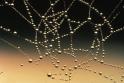
Imagine each water drop is a player, and that the entire web reconfigures as one drop shifts or is shaken, caroming into another, perhaps stretching one of the strands of the web past breaking point – and all this in an n-dimensional space beyond the capacity of most human minds to cognize, let along predict.
It is this kind of web into which our massive data inflows are directed, and the interface between the data-crunching capacity of our computers and analytic software, and the multiplex capabilities of the keenest human analytic minds – that’s where the “intel” usefully functions. Before it hits that interface is is data. Within a capable mind, or within the web-like tensions and resolutions of our keenest domain expert, analytic, and hopefully decision-making minds, is where the intelligence becomes meaningful.
Incalculable data points, multitudinous conflicting interests, and the human instinct for meaning.
As the US Coast Guard’s European colleagues have been finding out under increasing public scrutiny and with painful intensity, not only are there political and scientific issues to navigate, there can also be strictly humanitarian impacts of the sort that we find occurring in the interdiction of refugee boats making the trip between Turkey and the Greek island of Chios.
All in all, the work of the Coast Guard is a potent brew, and Computer Go pales before its complexity.
**
On a more personal note..
Do you speak any form of Inuit? Or Athanbaskan? There are in fact 16 indigenous languages with corresponding worldviews in Alaska.
What are caribou to you? Are you fluent in the magical worldview of the shamans? And what, as climate change drastically reshapes native Alaskan living, takes the place of shamanism in the leadership of native populations – in Alaska, an area of special concern to the USCG?
If you are of a scientific bent – and the USCG Academy awards Bachelor of Science degrees, so most who have passed through those gates into the Service probably are – how concerned are you by global warming – and how concerned by comparison with the preservation of Inuit or Athabaskan culture?
The truth is that both go together.
Military and law enforcement agencies are tasked with setting things right in the external world, but the world of the human psyche has its own specialists – psychiatrists no less than spiritual leaders – and while at some level the US Presidency is often considered the pinnacle of human power, there’s also a category of figures we respect for a different kind of authority, one that is earned above all by integrity and generosity of spirit: the names of Nelson Mandela, the Dalai Lama, Mahatma Gandhi and Pope Francis come to mind.
Each of these four figures embodies the practice of contemplation in action – a practice which looks within the self for a compassionate response to adversity. Among the Inuit, and across the circumpolar region more generally, this practice of looking inward for values is the particular task of the shaman – and more recently, the artist.
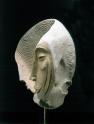
The Yupik, Inupiaq and Irish artist Susie Silook’s work, Looking Inside Myself, is a recent sculptural presentation of this theme:
Page 3 of 5 | Previous page | Next page