Thucydides Roundtable, Book I: It Would Be A Great War
[by Cheryl Rofer]
My approach to Thucydides, or any other ancient book, is almost diametrically opposite to Tanner Greer’s. It is indeed fascinating to contemplate how people thought in another time, the differences from today’s thinking, to put oneself in the mind of another. I try to do all those things from time to time, but my emphasis is often different.
After suffering through the archaic language of Julius Caesar and Macbeth in high school, I made an agreement with my English teacher: I would not read Hamlet, and he would give me a D for that report period. It seemed fair enough to me. Fighting through the language made it impossible for me to see anything else Shakespeare offered, when there were books I could read and enjoy that contained as much wisdom.
There are reasons to read the classics: to be on the same page with others who have incorporated them into their thinking, and to learn the lessons of difference that Greer describes and the lessons of similarity that I will concentrate on. I have not read Thucydides before, so my essays will be first impressions, overlaid with what I’ve read about Thucydides from more current authors. And yes, I will pluck out themes that still resonate today.
***
Greer mentions a fact that I could not shake as I read through Book One: that these were very small groups of men compared to what we think of as war in today’s world, although there may be comparisons to the ongoing war in Ukraine’s Donbas, and perhaps to some of the wars in Africa. Possibly all the factions in Syria. Another fact is that deliberations and execution of wars were by men alone, in a society that viewed women as not terribly different from slaves.
But some things remain the same. Victor Davis Hanson points to one, from Thucydides’s opening words:
…it would be a great war, and more worthy of relation than any that had preceded it.
Hanson points out that
the Peloponnesian War was a twenty-seven-year nightmare that wrecked Greece.
Great, of course, does not carry positive connotations only. It can mean more than large, enormous, as in the European name for World War I, the Great War, which is perhaps Thucydides’s meaning.
For a historian, both meanings can apply. Thucydides hit the academic jackpot, still being read almost 2500 years after he wrote. Others, too, can benefit from a war: Vendors of war materiel, those who can attach their political programs to the war, and thrill seekers.
There is also the difference between perception and reality. It is easy to consider a war great in the positive sense, engaging, bringing fame and honor, uplifting, before it starts. We will put the wrongdoers in their place. Our technological capabilities, our vigor and bravery, our strategies cannot but prevail.
From Pericles’s speech beginning at 1.141.432.1:
As to the war and the resources of either party, a detailed comparison will not show you the inferiority of Athens. Personally engaged in the cultivation of their land, without funds either private or public, the Peloponnesians are also without experience in long wars across sea, from the strict limit which poverty imposes on their attacks on each other. Powers of this description are quite incapable of often manning a fleet or often sending out an army: they cannot afford the absence from their homes, the expenditure from their own funds; and besides, they have not command of the sea.
….
Did not our fathers resist the Persians not only with resources far different from ours, but even when those resources had been abandoned; and more by wisdom than by fortune, more by daring than by strength, did not they beat off the barbarian and advance their affairs to the present height? We must not fall behind them, but must resist our enemies in any way and in every way, and attempt to hand down our power to our posterity unimpared.
This has an all too familiar ring. Analytical psychologists call it motivated reasoning: adducing the favorable evidence while leaving out the unfavorable. But war is uncertain and contains surprises. Pericles recognizes this uncertainty at the beginning of this speech and brushes it aside:
For sometimes the course of things is as arbitrary as the plans of man; indeed this is why we usually blame chance for whatever does not happen as we expected.
World War I was welcomed by many Europeans as a way to regain a lost virility and vigor. Enthusiasm for it was shared by the governments, the young men who would die, and their sweethearts.
Ernst Jünger in Storm of Steel: “We had come from lecture halls, school desks and factory workbenches, and over the brief weeks of training, we had bonded together into one large and enthusiastic group. Grown up in an age of security, we shared a yearning for danger, for the experience of the extraordinary. We were enraptured by war.”
General Friederich von Bernhardi, Prussian general and military historian, bestselling author: War is “a biological necessity,” “the natural law, upon which all the laws of Nature rest, the law of the struggle for existence.”
The reality of that war and the war after shocked people out of a public love for war, but the inclination remains.
Paul Wolfowitz anticipated an easy victory in Iraq in 2003:
There has been a good deal of comment — some of it quite outlandish — about what our postwar requirements might be in Iraq. Some of the higher end predictions we have been hearing recently, such as the notion that it will take several hundred thousand U.S. troops to provide stability in post-Saddam Iraq, are wildly off the mark. It is hard to conceive that it would take more forces to provide stability in post-Saddam Iraq than it would take to conduct the war itself and to secure the surrender of Saddam’s security forces and his army — hard to imagine. (House Budget Committee testimony on Iraq February 27, 2003)
There’s a lot of money to pay for this. It doesn’t have to be U.S. taxpayer money. We are dealing with a country that can really finance its own reconstruction, and relatively soon. (Congressional Testimony, March 27, 2003)
Similarly, Vice President Dick Cheney:
The read we get on the people of Iraq is there is no question but what they want to get rid of Saddam Hussein and they will welcome as liberators the United States when we come to do that. (Meet The Press with Tim Russert, March 16, 2003)
[In response to “We have not been greeted as liberators.”] “Well, I think we have by most Iraqis. I think the majority of Iraqis are thankful for the fact that the United States is there, that we came and we took down the Saddam Hussein government. (Meet The Press with Tim Russert, September 14, 2003)
More recently, Vladimir Putin put the Russian military into Syria for the few months he believed it would take to help Bashar al-Assad take control back. That was a year ago. The Duma just voted to keep a military presence in Syria for the indefinite future. In between, there were a couple of attempts to end that presence, both unsuccessful. One may imagine assurances from the generals in the summer of 2015 that sounded very much like Pericles’s. Or Putin’s confidence that the Russian-speakers of the Donbas would welcome the chance to associate with the mother country.
There are many more examples. The impassioned pleas that if only the United States would intervene more forcefully in Syria – specifics unknown – also represents this faith in war as the answer.
Before the fighting starts, an honest analysis may even favor one’s own side. Often both sides are willing to wage war, as Thucydides documents, which should give pause to analysts. Motivated reasoning plays its part. Ignoring the many openings for what Pericles sells short as “chance” also helps provide an optimistic analysis. War seems like a way to bring about a decisive ending to an unfortunate situation. It provides a testing ground for manhood and national pride.
It would be a great war.
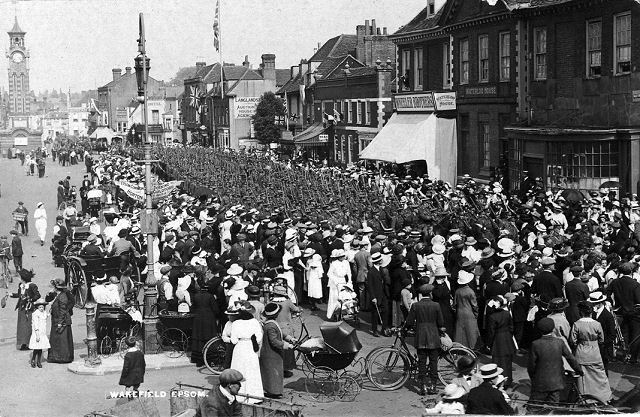
Photo: Soldiers marching through Epsom, UK, during World War I.



October 20th, 2016 at 9:12 pm
Pericles stressing Athenian naval superiority reminded me of our overconfidence with our Air Force. Projecting power and shows of force are a good deterrent. They become counter-productive if you start to put too much stock in the projection and show parts of it and leave the force to be worked out later.
October 20th, 2016 at 9:26 pm
Air forces (Russian as well) were the precise analog I thought of to the Athenian navy. Pericles seems to think about the navy in exactly the same way.
October 20th, 2016 at 10:08 pm
Hi Cheryl,
.
Great piece – I like your use of the term “motivated reasoning” and I agree with your analog with WWI. I see some of that too but in a somewhat different context ( easily foreseeable folly).
.
The Spartans thought quite a lot more of women and their capacities than did other Greeks, Gorgo of Sparta being one of the few women of a Greek polity remembered for her political views. However the Spartans did not think much of writing so we know a lot less than we should with Athenians like Thucydides doing most of the opining
October 20th, 2016 at 11:03 pm
Good point on the Spartans, Mark!
October 21st, 2016 at 1:02 pm
There’s actually not just an analogy with WW1, there’s a direct connection – albeit a bit later both in T’s book and in the war: in 1916, quotes from the Funeral Oration get used as part of the campaign to justify conscription in Britain, as well as being distributed in cheap pamphlet form in both Britain and Germany. And Juenger draws directly on Thucydides, as a German colleague of mine has studied.
October 21st, 2016 at 1:38 pm
Cheryl,
The first thing that crossed my mind while reading this piece was the quote attributed to John Hay, Sec of State in 1898 who called the Spanish American War, “a splendid little war.” In many ways this paraphrases Thucydides’s first words regarding it being a great war.
It seems that outside World War I and II, at least from the POV of the U.S., most of the wars undertaken in the late 20th and early 21st century have had that phrase silently whispering in the ear of those proposing going to war.
The last half century has proven the folly of predicting an easy war, citing Vietnam, 15+ years in Iraq and Afghanistan, and perhaps even the “war on drugs” stand as examples of hubris canceling out rationality and national interest.
October 21st, 2016 at 3:02 pm
The “splendid little war” occurred to me too. The Spanish American War was short, and that phrase managed to apply for the Americans. Sometimes wars work out that way. I think I’ve heard the phrase applied to President Ronald Reagan’s invasion of Grenada. If you outmatch the enemy and can finish it up in a week or two, the initial optimism is justified. Or seems to be. Even something that looks like it will take three months, as the Russians projected for Syria, can go much longer, and the longer it goes, the more likely that chance will factor in.
If you Google the phrase “lovely little war,” you get Grenada and a number of less successful examples.
The point about civilian wars on whatever is good: it looks like when you use that word, war, motivated reasoning kicks in no matter what the venue.
October 21st, 2016 at 5:27 pm
Yes. We are discussing WWI in my Experience of War course and it seems to be the same dynamic. I wonder why we are often convinced that war will be short and easy? Is this what we tell ourselves and others to justify it? (Proportionality of Ends, Probability of Success) Do we really believe it? Do we underestimate the enemy to that degree?
October 21st, 2016 at 6:14 pm
Short wars with lopsided victories (often naval battles but not limited to them)are rarities but they happen just often enough for strategists to chase silver bullets, surprise attacks, shock and awe. Much like a gambler looking for the next jackpot.
.
These battles happen.The 100 hour war in Gulf War I, Pearl Harbor, Salamis etc. but most often war is a long, risky, deadly slog.
October 21st, 2016 at 7:23 pm
Even that splendid Spanish-American War diverged into the Philippine Insurrection, which resulted in roughly the same number of American casualties as the Iraq War. It lasted a few years, but much longer if you count the Muslims in the South. We were fighting them on and off for decades, including just a few years ago.
November 3rd, 2016 at 9:15 am
I’ve never seen it suggested before that Thucydides meant to invest ‘great’ in 1.1 with positive connotations, and I don’t think one should examine those few words in isolation. In 1.23 Thucydides states that the Persian War was the greatest previous event, and then gives reasons why the Peloponnesian War surpassed it. The first reason he gives is that the Persian War was relatively swiftly decided, whereas the duration of the Peloponnesian War ‘went on to become great’; he then states that ‘it came about that such sufferings occurred in its course for Hellas as had never done so in an equal period of time’. In 1.1 he has previously referred to the war as the greatest ‘disturbance’ for the Greeks (and for many other peoples as well). It thus seems that, in applying the term ‘great’ to the conflict, Thucydides has in mind its duration, and the extent of the upheaval and suffering to which it gave rise.
November 3rd, 2016 at 9:39 pm
The meaning of “great” has indeed shifted over the years. I can’t go back to the Greek to argue Thucydides’s precise meaning.
.
.
Certainly adding “more worthy of relation” gives a positive cast at least to Thucydides’s role. Anticipation of a war is almost always more favorable than the reality. We’ve seen that all too much in recent decades.
.
As I said up top, I’m not doing a close reading but rather pulling out various themes and ideas.