Not Checkers, not Chess, no Go, Gen Perkins — it’s Calvinball time
Getting back to games, we have some very nice comparisons and metamorphoses already “in play” in the strategic literature. Perkins’ “Checkers to Chess” is one, “Ghess to Go” is another and more sophisticated example — Scott Boorman‘s The Protracted Game: A Wei-Ch’i Interpretation of Maoist Revolutionary Strategy is the classic here — “Chess to Star Trek’s 3-D chess” is another one worth considering, or “Chess to Mjolnir’s Game” for that matter, “Go to Buckminster Fuller‘s World Game” yet another, while “Go to the Glass Bead Game” is clearly one which would fascinate me personally..
But I’m convinced, as I’ve said before, that the game we need to understand is the one known as Calvinball:
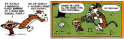
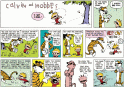
Calvinball — Calvin and Hobbes‘ favourite game to play. There is only one main rule in the game — that you can’t play it the same way twice.
Now that game idea is an audacious one, rivaling and perhaps even surpassing Peter Suber‘s awesome game, Nomic:
in which the rules of the game include mechanisms for the players to change those rules, usually beginning through a system of democratic voting. Nomic is a game in which changing the rules is a move.
When I meantion Calvinball, I not infrequently quote the philosopher Alasdair MacIntyre:
Not one game is being played, but several, and, if the game metaphor may be stretched further, the problem about real life is that moving one’s knight to QB3 may always be replied to by a lob over the net.
Now that’s talking!
And Roland Barthes:
This public knows very well the distinction between wrestling and boxing; it knows that boxing is a Jansenist sport, based on a demonstration of excellence. One can bet on the outcome of a boxing-match: with wrestling, it would make no sense. A boxing-match is a story which is constructed before the eyes of the spectator; in wrestling, on the contrary, it is each moment which is intelligible, not the passage of time… The logical conclusion of the contest does not interest the wrestling-fan, while on the contrary a boxing-match always implies a science of the future. In other words, wrestling is a sum of spectacles, of which no single one is a function: each moment imposes the total knowledge of a passion which rises erect and alone, without ever extending to the crowning moment of a result.
Switching games?
We’re blurring game-boards in real time, according to CTC Sentinel editor-in-chief Paul Cruikshank:
**
Okay, here’s another mind in the Natsec arena, that switches the playing field from “game as cricket or chess” to “game as zero-sum or non-zero sum” — President Rouhani of Iran, writing an op-ed in the Washington Post — Iran, mark you, in WaPo — who says:
The world has changed. International politics is no longer a zero-sum game but a multi-dimensional arena where cooperation and competition often occur simultaneously. Gone is the age of blood feuds. World leaders are expected to lead in turning threats into opportunities.
Rouhani is pretty conservative in Iranian terms, though we sometimes consider him a reformer — but very “other” in his thinking, compared to ours. And if we wish to game him, our Red Team must be able to think as ably and otherly as he does.
How would TRADOC suggest we adapt to a shift in games of that sort?
**
H/t The Strategy Bridge.
Page 2 of 2 | Previous page