Chuang-tzu or Zhuangzi, it’s a laughing matter [review]
“However, whenever I come to a complicated place, I size up the difficulties, tell myself to watch out and be careful, keep my eyes on what I’m doing, work very slowly, and move the knife with the greatest subtlety, until – flop! the whole thing comes apart like a clod of earth crumbling to the ground. I stand there holding the knife and look all around me, completely satisfied and reluctant to move on, and then I wipe off the knife and put it away.”
“Excellent!” said Lord Wen-hui. “I have heard the words of Cook Ting and learned how to care for life!”
**
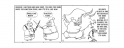
That’s a long-ish quote, but its rollicking good humor will have carried you through it, and I wanted to give you a sense of the Zhuangzi as I have known and loved it — to taste it in comparison with CC Tsai‘s vision / version of the same tale, as represented in a couple of frames from his telling:
**
So now we have Burton Watson‘s “the blade of the knife has really no thickness. If you insert what has no thickness into such spaces, then there’s plenty of room” and Brian Bruya‘s “my knife glides in and out between the bone joints, moving as it pleases: the cow suffers no pain and, in the end, doesn’t even know it’s dead.”
Pretty remarkable, either way — but that’s in English, and who knows what contortions a translator must make to move from Chinese into English? Watson‘s Chuang-tsu is closer to Lao-tsu, if you compare the statement of principle to its embodiment in an anecdote:
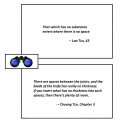
Ursula Le Guin‘s translation of the Tao Te Ching is even more succinct:
The immaterial enters the impenetrable..
No wonder cook Ting’s vorpal blade went snicker-snack, to borrow a phrase from Lewis Carroll‘s poem, Jabberwocky. And come to think of it, Lewis Carroll, aka Charles Lutwidge Dodgson, the Christ Church, Oxford logician, may indeed be the English language’s native equivalent of the Chinese Zhuangzi.
**
As I hope I have indicated, Chuang Tzu / Zhuangzi, even in translation, is a writer of enormous charm and insight, and CC Tsai‘s presentation marries the conventions of the comic book with classical Chinese artistry to provide an exemplary introduction to one of the world’s great philosopher-humorists.
Delightful. Warmly recommended.
Page 2 of 2 | Previous page