Numbers by the numbers: four
[ by Charles Cameron — importance of the ratio form (“this is to that as thus is to so”) as a bridge between domains and silos, creative leaps, the glass bead game, and finally, Chittick’s joke about camels, sex and translations from the Arabic ]
.
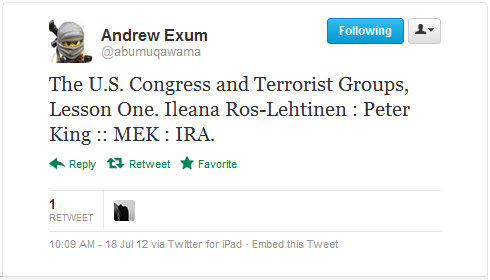
.
I retweeted this tweet of Andrew Exum‘s to my friend Paul Pilkington because I know he’s working on a project to find out what “this is to that” is to some other “this is to that” — across a wide swathe of human culture.
Note particularly that Exum is using this formal device to illuminate, to give insight, in an area of importance to analysts, strategic thinkers and decision makers.
I’m also retweeting Exum to Paul because I believe Paul’s simple experiment, based as it is on his reading of Hermann Hesse‘s Glass Bead Game, has the capacity to build an architecture of thought (a) crossing all disciplines and (b) spanning the trivial with the profound.
I’m doing something similar with Cath Styles in our Sembl games project — but this time I want to concentrate on Paul’s approach, and since there are four moving parts in an a is to be as c is to d configuration, I’m calling this post Numbers by the numbers: four — number three will just have to wait a while.
**
To get a sense of what Paul is up to, we can go to his Twitter Project page, which describes the fourth in a series of books he’s writing — and also follow him on Twitter, where he posts as Just Knecht.
Two of Paul’s recent tweets express his sense of the task pretty incisively:
The whole of language is the holding up of one unlike thing to compare, contrast and connect with another
Curating is a matter juxtaposition of work against work, artist against artist, place against place – A.Searle on Documenta 13, The Guardian
On his Twitter Project Page, he tells us:
Each tweet is an individual Glass Bead Game move, which is a comparison (metaphor, simile or analogy) across different areas, and may be either a statement or a question.
In question form, these are not unlike analogy questions from SAT tests with an additional dimension of general knowledge, cultural invention and intellectual playfulness. The basic challenge is to work out the relationship between two terms in one context, and apply it in another. Sometimes a tweet will extend an analogy further, which would be the beginning of forming a larger game from an individual move.
Some of the most interesting moves do not have right or wrong answers. Some have canonical or original answers, but they’re not necessarily right. In fact, very often I will post something I’ve picked up from elsewhere which I would love to see improved on, challenged, or at least better explained by others.
He then poses some of the sorts of questions that intrigue him:
Who is the J.H.Prynne of contemporary dance? Like Prynne in contemporary poetry they need to have been ‘out there’ right at the edge of theory and practice for some time, and also deeply steeped in tradition at the same time. Merce Cunningham? Suggestions welcome … And Heston Blumethal or Ferran Adrià might be the Prynne of cookery. But what about the Prynne of contemporary warfare?
What is the equivalent of sonata form in architecture? Goethe and Hegel both said ‘architecture is frozen music’ but neither really explained what they meant. If it is, then is there an architectural equivalent in Western architecture of the key structural form in Western art music? Suggestions welcome …
So, Zenpundit readers — who is the JH Prynne of contemporary warfare?
**
Not so long ago, in Numbers by the numbers: one, I posted a series of self-referential tweets that I’d collected over the last month or two — here I’d like to present some of Paul’s recent tweets:
Let’s start with one that’s a foreign policy insight, arguably as significant to day as it was when Vance first said it:
16 Jul @justknecht
“The Strait of Hormuz is the jugular vein of the West” (Cyrus Vance)
If these tweets can be timeless, they can also be timely:
4 Jul @justknecht
The Higgs boson is the quantum of the Higgs field, just as the photon is the quantum of the electromagnetic field
As they accumulate over time, they can build a conceptual “mesh” that engages an entire field — in this case, recent classical music — while linking it to a variety of other areas:
16 Jul @justknecht
“Boulez’ Derive 2 sounds like birthday cakes ought to” – Philip Clark, Gramophone22 Jun @justknecht
Wagner was a beautiful sunset that was mistaken for a dawn – Claude Debussy, quoted by Geoffrey Norris in Gramophone30 May @justknecht
Fauré’s Theme and Variations (no. 9) is like an evening star falling slowly from the sky – Bryce Morrison cites Alfred Cortot in Gramophone11 May @justknecht
Kraftwerk is the Warhol of pop music – The New Yorker
There’s profundity here:
9 Jun @justknecht
“Space is to place as eternity is to time.” – Joseph Joubert
This could be, as Paul says, “the beginning of forming a larger game from an individual move” — that quote in itself could plausibly be the keystone of an architecture bridging science with religion…
There are historical parallels to consider:
31 May @justknecht
Robert Burton : Oxford :: Jeremy Prynne :: Cambridge
Catty remarks by Nobel laureates:
21 May @justknecht
“Thinking is to humans as swimming is to cats” (Nobel laureate Daniel Kahneman)
Near-tautologies:
21 May @justknecht
Macon Telegraph: Recipes are to food as blueprints are to buildings.
And, ooh, exotic forms of slander!
18 May @justknecht
“[Your daughter] has lovers as numerous as the striking of tablas on Palm Sunday” – Arabic satire by Abu Nawas, 756 – 813 AD
Once again, it’s form that generates insight, not content. Get used to form, play around with it, and content will leap out at you from the page, from the screen.
**
I’m no Arabist myself, but ah! that last quote reminds me irresistibly of the difficulties faced by translators from the Arabic, as recounted by William Chittick in The Self-disclosure of God: Principles of Ibn Al-‘Arabi’s Cosmology (SUNY Press, 1998, pp. xxxv-xxvi.)
An old joke among orientalists tells us that every Arabic word has four meanings: It means what it means, then it means the opposite of what it means, then it has something to do with sex, and finally it designates something to do with a camel …. The rational mind tends to push the meaning of a word away from experience to ‘what it means’ but the imaginal mind finds the self-disclosure of the Real in the sex and the camel … it is in the world’s concrete realities that God is found, not in its abstractions.
I’d been looking for an excuse to post that quote on Zenpundit — now I’ve found it!



July 19th, 2012 at 5:47 pm
“So, Zenpundit readers — who is the JH Prynne of contemporary warfare?”
*
Can you define warfare without first defining: “‘out there’”?
*
While war is strategy, “out there” is among the process, it’s in the culture, so you first have to define the culture that you are talking about.
*
Of course defining culture is fairly simple, because it is, to a certain degree, dependent on a spatial location. In The Dalles, OR, the JH Pryne of contemporary warfare, at least everything here in the context of war, would be the person most connected to this location. Of course then one would have to learn where that person was spatially located, to take into account the leverage that person brings to The Dalles.
*
Right now, my estimation is: the JH Pryne of contemporary warfare in The Dalles, is the person in command of the building going in next to the community college. There has already been an exchange, I presume, of 8 million dollars, and another 8 million dollars in matching funds. This means that there is a huge structure being built of not only brick and mortar, but an influx of culture as well.
*
To that person, as represented by the 16 million dollars, being acted on, who is the JH Pryne of contemporary warfare in The Dalles, OR, do I have a house just for you http://artintrust.com/2012/04/29/a-virtual-tour-of-the-area/ 🙂