A Clausewitzian on “Cohesion”
Furthermore, I think Clausewitz’s speculations on cohesion were, like many of his systemic perceptions in On War, remarkably farsighted and intuitively rooted in a scientific reality that was unknown and untestable in his day. The conservative and eponymous scholar, Paul Johnson noted in his book Birth of the Modern that the 1820’s represented a time of great intellectual ferment when the arts, humanities and sciences were not yet compartmentalized, professionalized and estranged from one another. To paraphrase Johnson, it was still an era when a scientist like Faraday and an artist ( probably Harriet Jane Moore) could and did have a productive conversation about the properties of light in complete seriousness. As an intellectual, Clausewitz shared that zeitgeist.
In a military frame of reference, the concept of “cohesion” brings to mind the Greek-Macedonian Phalanx as a representative example
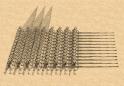
but the phenomena appears not merely in military tactics or in human social relations but throughout the animal kingdom. Howard Bloom, the popular science writer using a sociobiological perspective, used “Spartanism” and “Phalanx” as metaphors for documented behaviors of creatures as disparate as bacteria, baboons and hard shell Baptists. “Groups under threat, constrict” Bloom wrote in Global Brain and this characteristic of cohesion appears to apply even when the groups are not sentient. Network theorists and scientists can explain collective behavior in terms of “strong” and “weak” ties, nodes and hubs and resilience, including emergent behavior of systems are not even alive.
Cohesion is an aspect of the natural world.
Page 3 of 3 | Previous page
david ronfeldt:
December 31st, 2010 at 12:28 am
hmmm: clausewitz’s "cohesion" sounds quite similar to ibn khaldun’s "asabiyah"!?
Joseph Fouche:
December 31st, 2010 at 6:58 am
@david ronfeldt: And a few other things as I pointed out recently in the first item on the list in this post:. http://committeeofpublicsafety.wordpress.com/2010/12/30/the-culminating-point-of-the-offensive/. A strategic equilibrium, a sort of society wide coup d’oeil, begins with a contingent yet favorable tacit strategic orientation. This can be called a political formula (after Gaetano Mosca), asabiyah (after ibn Khaldun), aparadigm (after Thomas Kuhn), stimergy, a Zeitgeist, a national myth or creed, or cats and dogs kept widely apart.
Joseph Fouche:
December 31st, 2010 at 7:20 am
The mid-nineteenth century may have been the last point in human history where an individual could have a reasonable command of most of human knowledge. The 1930s may have been the last time when the world fit within the average cognitive limits of the human mind. Some point between then and the 1950s probably represents the culminating point of individual human cognitive enterprise, at least within the institutional social form.
seydlitz89:
December 31st, 2010 at 10:20 am
Thanks for the kind words Zen. I would only emphasize that the three ideal types of political communities cover a lot of ground, including political communities which are not states or tied to a specific territory. It opens up a whole new area of Clausewitzian theory, so we’ll see where it goes . . .
Also, I’m not "retired military", but former military, especially former military intelligence since I credit my experience in overt strategic Humint collection as providing my specific perspective of strategic theory. So, I not really that old ;-)>
All the best for 2011!
Daniel:
January 2nd, 2011 at 5:33 am
Here’s Pervez Musharraf thinking about cohesion:"The people’s destiny must be entwined with that of the state so that they develop a stake in it."Security before democracy-Pervez Musharraf-Dawn-1st Jan 2011
zen:
January 3rd, 2011 at 4:37 am
Hi seydlitz89,
.
Your status has been fixed.
.
I agree that you have opened up a fertile field for investigation, and an opportunity for Clausewitzians to develop a better framework for analyzing non-state/proto-state/substate actors, for whom questions of identity or mode of life are paramount, as military threats. I had considered going off on a historian’s tangent about the Mongol-Turkic ordas, and their deep effects on the political development of Russia and Iran but decided that would have just cluttered up the post 🙂