In Brief: Azzam illustrates Levi-Strauss on Mythologiques
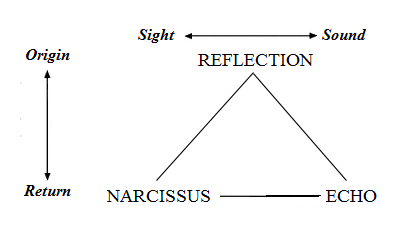
My own style of thinking leans more to the atemporal or synchronic, which in turn is closer to the logical-algebraic-geometric-graphical mode of visual expression. Thus, for me, the “myth of Narcissus” is not a story-line but a geometry, a narrative formulation of the concept of reflection, or “bouncing back”. To adapt the Levi-Strauss triangle to the Narcissus narrative, then, we have:
while the two Azzam miracle tales in my DoubleQuote at the top of this post give us:
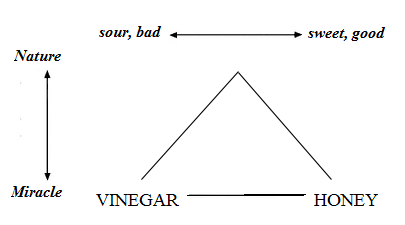
This in turn can become a square if we allow the four coordinates to be wine (intoxicant, bad), water (sobriety, good), vinegar (sour, bad) and honey (sweet, good). We notice here that water (sobriety, good) is the fourth which hovers unmentioned over the twin tales, just as Jung argued the dogma of the Assumption of the Virgin into heaven was the “fourth” which “completed” — nb, this is from a psychological perspective — the celestial Trinity of Father, Son, and Holy Spirit.
It remains for Jalaluddin Rumi to transcend the duality of the halal (sobriety) and the haram (intoxication) in his praise of his master, Shams of Tabriz:
In Shams al-Din-i Tabrizi you will discover a heart which is at once intoxicated and very sober.
**
In what sense or senses are Azzam’s two tales two, and in what sense are they one and the same?
Sources & suggested further readings include:
Page 2 of 2 | Previous page
Kurt V.:
March 7th, 2015 at 9:15 am
Charles,
Your post is a great eye-opener that goes well with my morning coffee.
.
“In what sense or senses are Azzam’s two tales two, and in what sense are they one and the same?”
In both cases, Allah brings about change; unity.
In one case, sweet, in the opposite case, sour; dualistic.
.
Clausewitz’s Trinity incorporates tensions between the three elemental forces that have both unifying, and dis-unifying tendencies as was the case observing Napoleanic France with unifying tendencies bringing about total war.
larrydunbar:
March 8th, 2015 at 6:06 pm
The same structure was used: a water bag. Also the same, water, the culture the bag was designed for, held a different position, within the society, than what was actually in the bag, wine.
In both cases, wine was changed into something that would give each man a different position within their society. A position judged to be the correct one (unity).
The difference was the will of both men. One was willing to be judged as the holder of a bag of wine, the other was not.