zenpundit.com » politics

Archive for the ‘politics’ Category

Role-playing elections, Rebekah Mercer, Cambridge Analytica, &c

Wednesday, June 27th, 2018

[ by Charles Cameron — the “politics as game” metaphor comes in towards the end of this post — I think it’s a rich one ]
.


Totally irrelevant mega-foosball game was the best illustration, understandably, Gizmodo could come up with for a sophisticated role-player with strong political implications. Photo: Hector Viva (Getty Images)

**

This is a particularly juicy topic — Bryan Alexander pointed me to it. It seems there are a couple of RPGs, and I don’t mean rocket propelled grenades, in which role-players can play out elections — 2016 and 2020 — with an added emphasis on “an influential technology accelerator.”

First, then, Jane Mayer‘s New Yorker piece, which lit things up:

A Parlor Game at Rebekah Mercer’s Has No Get Out of Jail Free Card
Members of the right-wing family that helped put Trump in the White House can relive the campaign in an elaborate dinner-party game.

I mean, how cool is that? Jane Mayer, whose book The Dark Side: The Inside Story of How the War on Terror Turned into a War on American Ideals, prompted reporter Joby Warrick to write that a CIA analyst had warned the Bush administration that “up to a third of the detainees at Guantanamo Bay may have been imprisoned by mistake,” while NYT reporter Scott Shane noted:

Mayer’s book disclosed that International Committee of the Red Cross officials had concluded in a secret report in 2007, that “the Central Intelligence Agency’s interrogation methods for high-level Qaeda prisoners constituted torture and could make the Bush administration officials who approved them guilty of war crimes.”

**

Okay, Jane Mayer is someone I geerally read with respect — and in her recent piece she delivered her goods on the megadonors and algorithms that plausibly gave Trump the 2016 election:

Robert Mercer, the New York hedge-fund magnate whose huge donations to pro-Trump groups in 2016 have been credited with putting Donald Trump in the White House, has kept a low profile since the election. But his daughter Rebekah, who runs the family’s foundation, now has a way to relive the thrill of the campaign with friends around her dinner table.

This, then, is entertainment, and good, clean fun — unless you happen to have a bias against hedge fund managers and the like.

In March, on a ski vacation at a rented house near Vail, Colorado, she brought a batch of copies of the “Rules of Play” for an elaborate parlor game called the Machine Learning President. Essentially, it is a race to the Oval Office in three fifteen-minute rounds. It’s a role-playing game, more like Assassin than like Monopoly, although players of this game do start out with an allotment of “cash” to spend on pushing their agendas, which can include “algorithmic policing” and “mass deportation.”

“Tonight, the name of the game is power,” reads the first page of the “Rules of Play.” Each player, it goes on, “will assume a new political identity.” Instead of becoming Colonel Mustard or Mrs. Peacock, as in the board game Clue, each player takes on the role of a political candidate or a “faction,” in the game’s parlance. Among the possible roles are Mike Pence, Elizabeth Warren, Black Lives Matter, Russia, Y Combinator, Tom Steyer, Wall Street, Evangelicals, the Koch Network, and Robert Mercer himself.

Colonel Mustard and Mrs. Peacock? or Rich Uncle PennyBags, the moustached logo from Monopoly? From a games perspective, Mayer’s piece is a rich trove — and of course, there’s more I could quote..

**

Now turn to Buzzfeed for a corrective, which is where Bryan landed me:

Rebekah Mercer Says She Isn’t Reliving The 2016 Election Through A Role-Playing Game
“I know nothing about that game, nothing about who created it or who plays it.”

And again, there are details aplenty:

Republican megadonor Rebekah Mercer strongly disputed on Monday a New Yorker report that she “has a way to relive the thrill” of the 2016 presidential campaign via a role-playing game that includes her father as a character.

The story, by journalist Jane Mayer, found that Mercer brought with her on a recent Colorado ski vacation the rules for “Machine Learning President,” a party game in which players assume the roles of politicians, interest groups, an influential technology accelerator, and billionaire donors involved in a hypothetical presidential election. Among the game’s characters is Robert Mercer, Rebekah’s father, a hedge fund billionaire whose donations to the Trump campaign and stakes in Breitbart News and Cambridge Analytica have brought him intense public scrutiny. Other characters include Elizabeth Warren and Mike Pence as presidential hopefuls.

In the three round game — Super Tuesday, the Primary, and the General Election — players split into factions that include the candidates themselves, Wall Street, and Russia. According to a Gizmodo story, the goal of the game “is to get players thinking about ways tech and money could be manipulated to influence the 2020 election.”

“I know nothing about that game, nothing about who created it or who plays it and, unlike Ms. Mayer, I didn’t even really read those pages and I shredded them when I got home,” Mercer wrote in an email to BuzzFeed News. Mercer did not explain why she shredded the game rules.

Ooh, shredded the game rules. And then there’s a nanny, who may have leaked the story.

**

Fast forward (by which I mean, click through) to Gizmodo‘s piece:‘Machine Learning President’ Designers Have No Idea How the Mercers Got Their Game

When a group of about 40 players first tested out a live game called the Machine Learning President at a private event in San Francisco this February, they were unaware that the game would end up memorialized in the pages of The New Yorker.

But during a ski vacation in March, the Republican mega-donor Rebekah Mercer gathered her friends together to play several rounds of the game, which pits special interest groups, political candidates, and activist organizations against each other in a simulated presidential election, aided by cash and artificial intelligence. A lawyer for Mercer told The New Yorker that she owned a copy of the Machine Learning President but had not created it and that it did not reflect her family’s views.

Indeed, the game was in fact designed by an outfit that was less than friendly to the Mercer’s position:

It’s not hard to draw comparisons between the rules of the game, with its reliance on big cash and tech capabilities, and the actions of the Mercer-backed Cambridge Analytica during the 2016 U.S. presidential election. But, as Mercer’s lawyer stated, she had nothing to do with creating the game -— in fact, it was conceptualized by one of her vocal critics.

**

Here we go:

Brett Horvath and Berit Anderson are the co-founders of Scout AI and the creators of the Machine Learning President. In 2017, the pair published a scathing critique of Cambridge Analytica, the now-shuttered political consultancy that misused the data of tens of millions of Facebook users and sat at the center of the social network’s largest scandal in years. “By leveraging automated emotional manipulation alongside swarms of bots, Facebook dark posts, A/B testing, and fake news networks, a company called Cambridge Analytica has activated an invisible machine that preys on the personalities of individual voters to create large shifts in public opinion,” the duo wrote.

Wrote, in fact, in a piece titled The Rise of the Weaponized AI Propaganda Machine — and here we’re getting into more serious, “Alert, ICYMI” waters — subtitled:

There’s a new automated propaganda machine driving global politics. How it works and what it will mean for the future of democracy.

The 20-page piece begins:

“This is a propaganda machine. It’s targeting people individually to recruit them to an idea. It’s a level of social engineering that I’ve never seen before. They’re capturing people and then keeping them on an emotional leash and never letting them go,” said professor Jonathan Albright.

Albright, an assistant professor and data scientist at Elon University, started digging into fake news sites after Donald Trump was elected president. Through extensive research and interviews with Albright and other key experts in the field, including Samuel Woolley, Head of Research at Oxford University’s Computational Propaganda Project, and Martin Moore, Director of the Centre for the Study of Media, Communication and Power at Kings College, it became clear to Scout that this phenomenon was about much more than just a few fake news stories. It was a piece of a much bigger and darker puzzle?—?a Weaponized AI Propaganda Machine being used to manipulate our opinions and behavior to advance specific political agendas.

**

So Reberkah Mercer was sent a copy of a game whose progenitors were seriously opposed to Cambridge Analytica style “weaponization” of US presidential politics, and had created a game to get others thinking along similar lines.. she then played it, or didn’t.. then, either way, shredded it.

Back to Gizmodo:

That invisible machine—and the lack of preparedness for it in the 2016 election—provided inspiration for the Machine Learning President. The goal of the game is to get players thinking about ways tech and money could be manipulated to influence the 2020 election. (It also inspired Scout AI to spin out another group, Guardians AI, that’s focused on protecting pro-democracy groups from information warfare and cyber attacks.)

“This is an experience we created to help pro-democracy groups and strengthen democracy against some of the ways technology might interfere with fair elections,” explained Randy Lubin, one of the game’s designers and the leader of a design studio called Diegetic Games. “We knew that some sort of game or simulation or exercise was a really great way to understand the incentives and systems at play.”

I think there’s plenty of eccentric and wonky games and wargames stuff in here, and would have posted this anyway — but if I need a rationale within my own “system”, I’ve been collecting game metaphors as you know, and this one has the game metaphor in those last words:

We knew that some sort of game or simulation or exercise was a really great way to understand the incentives and systems at play.

Yes, politics itself can be viewed as a game, modeled in a game, learned from in a game, wargamed — or simply “played” in a game for dinner party entertainment. The possibility of red-teaming 2020 is where this gets cutting-edge interesting.

Boom!
Puppetry cascades, or “art is theft”

Friday, June 22nd, 2018

[ by Charles Cameron — and if you experience vertigo reading any of these cascades, feel free to hang in there vertiginously — or let go ]
.

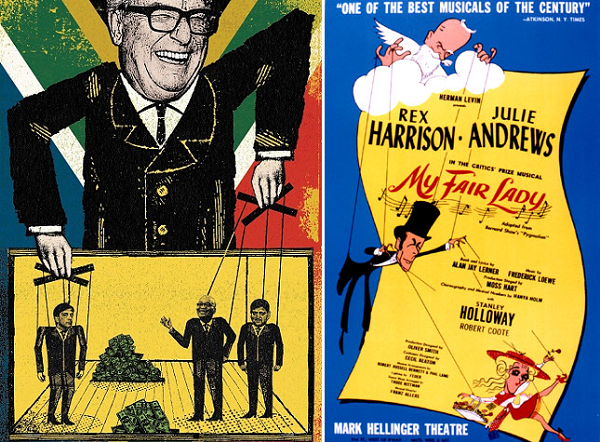
Alright, here’s a DoubleQuote in images:

I don’t believe there’s a direct borrowing (aka plagiarism, theft) here, but both images rely on a shared puppet cascades convention.

**

It’s been a bit of a yawn to say art is theft — at least since a few borrowings past Picasso, and maybe before him — what makes this pair of puppet cascades interesting is:

First, that each depicts a portion of a cascade of puppets — in the earlier, My Fair Lady version, Bernard Shaw puppeting Henry Higgins puppeting Eliza Dolittle, while the recent New Yorker graphic might as well be X (unshown) puppeting Steve Bannon puppeting Trump with Jeff Sessions and Scott Pruitt, maybe.

Second, note the X (Bernard Shaw) in the later version, and then ponder the idea that cascades may have a source, or may continue backwards ad infinitum, but Someone or Thing implicitly or explicitly needs to fill that X space. In the earlier version, Bernard Shaw does it, but that only begs the question, is Something puppeting Bernard Shaw? Deity, perhaps, or Muse?

And in the contemmporary version, where the upper puppeteer is cut off from vision, They‘s a good guess for the X Who‘s puppeting the Bannon figure, because Bannon, They, and Puppetry are all widely associated with conspiracy theory. Oh, and think, X-Files!

Hey, in reality Lerner and Lowe were making musical out of Shaw‘s theatrical Pygmalion out of Gilbert and Sullivan — and the cascade theft goes on and on, back into the mists and myths of antiquity..

The actual figures in the New Yorker cascade are X, Lord Bell (representing Bell Pottinger, the PR firm), and, below, the brothers Atul, Ajay, and Tony Gupta. The article itself, The Reputation-Laundering Firm That Ruined Its Own Reputation, is well worth a read. And look at the illustrations careful documentation of the ownership-lineages it’s pilfering from:

Illustration by Ben Jones; photographs by (clockwise from top): David M. Benett / Getty; Martin Rhodes / Gallo Images / Business Day / Getty; Foto24 / Gallo Images / Getty; David M. Benett / Bell Pottinger / Getty

**

Property is theft, now — that’s Proudhon.

Unintended consequences, the collection

Monday, June 18th, 2018

[ by Charles Cameron — what you don’t see can blindside you ]
.

Unintended consequences are the clearest indicators we have of just how much more complex the world is than we imagine it to be. They are therefore of great interest.

A short while back, WaPo had a piece that overtly referenced unintended consequences: Unintended consequences: Inside the fallout of America’s crackdown on opioids.

I’m going to take that as the starting point for another of my collections. When I find a clear case of an unintended cnsequence, I’ll add it to this post or in the comments session..

**

One major group of unintended consequences news items clusttered around the revision of redistricting rules in an attempt (at least purportedly) to curb the abuse of partisan power in gerrymandering, an ancient American political tradition practiced by both (all?) partties —

Overby & Cosgrove‘s 1996 Unintended Consequences? Racial Redistricting and the Representation of Minority Interests would appear to be a much quoted starting point, followed by Rose Institute’s 2008 Unintended Consequences of Texas Gerrymandering.

But the general principle is evident: course corrections don’t always set you back on track — or as the Taoist fellow might say, any map you can draw is liable to lead you astray — maps are fallible wrt terrain, wrt reality!

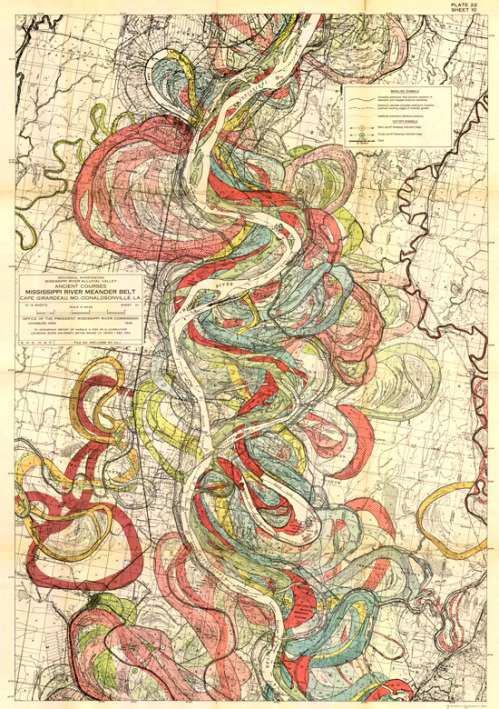
Case in point: The meandering path of the Mississippi, now here, now there — with oxbows!

Travelers, mappers and modelers, beware!

**

Oh, and BTW, I woke from the anaesthetic that accompanied my triple heart bypass to find.. Trump was president. That consequence was unintended by me at least, no matter hwat Mr Putin may have decided.

On negative space, private morality in the public square

Monday, May 7th, 2018

[ by Charles Cameron — not entirely keen about Judgment, me, but.. ]
.

Continuing on from my discussion of negative space in the painting, here’s the MSNBC clip I overheard waas on about:

**

The clip, in other words, is about private morality in the public square.

Raw Story picks up there thread in a piece titled ‘Where are the preachers of America?’:

Evangelical leaders slammed for hypocrisy of Trump support:Former New York Times White House correspondent Howell Raines, who rose to executive editor of newspaper, called out the evangelical community during a Friday appearance on MSNBC’s “The Beat with Ari Melber.”

“I want to ask you about the negative space in the painting, the thing that’s not happening — that we are always told would happen — because the Christian right and the conservative values organizations and the evangelical right cared deeply about the personal behavior of politicians and especially the president,” Melber observed.

“The president now has squarely admitted to paying this woman in direct connection to the allegations of this extramarital affair,” the host continued. “I ask you for your view of why we’re not hearing any outrage for any of those groups affiliated with Donald Trump and the Republican Party.”

“Where are the preachers of America when morality is legitimately at the center of our national life?” Raines wondered. “I think Director Comey was correct today on CBS when he said this is about values and supporting our institutions and it’s imperative that Americans who believe in the normal political process and the rule of law start speaking out.”

“That’s what’s missing in the picture to me,” he concluded.

**

That’s a significant question, to which various answers have been given — from a quick Google search:

  • The Nation, Why Evangelicals—Still!—Support Trump
  • Time, Why Evangelicals Support President Trump, Despite His Immorality
  • Atlantic, A Match Made in Heaven
  • but I’d like to leave — indeed emphasize — it as a question.

    How come the hypocrisy?

    And I think we should ask this, not as a question requiring a political answer, but as a moral question, hanging in the air, for the individual consciences of evangelicals to ponder..

    I have my own hyposcrisies to consider..

    For Jim Gant, On the Resurrection, 04

    Wednesday, April 25th, 2018

    [ by Charles Cameron — in thre “expansive” phase of this exploration ]
    .

    In her mysteriously beautiful detective procedural set in a Québécois monastery, The Beautiful Mystery: A Chief Inspector Gamache Novel, Louise Penny arrives, about midway through her tale, at this sentence:

    When Frère Mathieu brings out his bomb, the abbot brings out his pipe. One weapon is figurative, and the other isn’t.

    I’m riveted.

    **

    Because the phrase “One .. is figurative, and the other isn’t” is like a koan for me — a nut that if I could crack it would also explain such deep mysteries as:

  • “This is my body .. this is my blood” — one interpretation of “body & blood” is figurative, while the other isn’t? and:
  • “he died ..and on the third day he rose again” — one death is figurative, and the other isn’t?
  • Resurrection as myth, resurrection as history?

    **

    You might think I’m being fanciful, but just yesterday the Comey notes became accessible, and we find this exchange between the FBI Director and the President:

    The President then wrapped up our conversation by returning to the issue of finding leakers. I said something about the value of putting a head on a pike as a message. He replied by saying it may involve putting reporters in jail. “They spend a few days in jail, make a new friend, and they are ready to talk.” I laughed as I walked to the door Reince Priebus had opened.

    I trust Comey‘s “head on a pike” is figurative, and it sounds like the other — Trump‘s “putting reporters in jail” — isn’t.

    The thing about language is that it’s polyvalent, polysemous –and that inherent ambiguity is seldom more significant than when making or interpreting threats, scriptures, or poems.

    **

    So I could take this post in the direction of a discussion of the ruthless politics of Washingtom, the Kremlin, Pyongyang, Baghdad, and or Beijing..

    Or into the exegesis of the Eucharist, Resurrection, Adamic Creation stories. In matters Biblical, the question “one reading fictitious, while the other, literal, isn’t?” more or less covers the major theological division of our times..

    On this, see the Catholic Catechism (115-117) for a more Dantesque elucidation:

  • The senses of Scripture

  • According to an ancient tradition, one can distinguish between two senses of Scripture: the literal and the spiritual, the latter being subdivided into the allegorical, moral and anagogical senses. The profound concordance of the four senses guarantees all its richness to the living reading of Scripture in the Church.
  • The literal sense is the meaning conveyed by the words of Scripture and discovered by exegesis, following the rules of sound interpretation: “All other senses of Sacred Scripture are based on the literal.”
  • The spiritual sense. Thanks to the unity of God’s plan, not only the text of Scripture but also the realities and events about which it speaks can be signs.
  • The allegorical sense. We can acquire a more profound understanding of events by recognizing their significance in Christ; thus the crossing of the Red Sea is a sign or type of Christ’s victory and also of Christian Baptism.
  • The moral sense. The events reported in Scripture ought to lead us to act justly. As St. Paul says, they were written “for our instruction”.
  • The anagogical sense (Greek: anagoge, “leading”). We can view realities and events in terms of their eternal significance, leading us toward our true homeland: thus the Church on earth is a sign of the heavenly Jerusalem.
  • Two senses of Scripture: the literal and the spiritual — one is figurative, like Frère Mathieu’s bomb in Ms Penny’s novel, while the other, like the abbot’s lead pipe, isn’t?

    The Jesus of History, the Christ of Faith?

    Or all this might take another turn, with a morph into poetry..

    **

    Or history. Here’s another phrase that’s “riveting” for, I think, the same reason as that phrase “One weapon is figurative, and the other isn’t”:

    Pamphlets were both a cause and a tool of violence.

    A “cause .. of violence” — it t (a pamphlet) incites it. And “a tool of violence” — it’s (at least figuratively) a bludgeon in itself. Hm. I hope that makes sense.

    In any case, I’ve got my eye out for other examples that neatly juxtapose word and deed, as though words aren’t deeds — “speech acts” as the philosophers say. What I’m getting at, eventually, is the nature of sacrament — “an outward and visible sign of an inward and spiritual grace” — which is deeply tied up with simile, metaphor, and metamorphosis — “this is my body .. this is my blood”.

    And that quote about pamphlets? Its from a fascinating New Yorker piece, How We Solved Fake News the First Time by Stephen March, which compares fake news on the internet today with fake news in the time of the pamphleteers, and contains this remarkably “ancient and modern” observation:

    There is nothing more congruent to the nourishment of division in a State or Commonwealth, then diversity of Rumours mixt with Falsity and Scandalisme; nothing more prejudicial to a Kingdome, then to have the divisions thereof known to an enemy.

    So, -ismes were already infesting the language like kudzu grass — mixed simile? — back in 1642. And an enemy? Think Putin, ne?

    On which playful note, drawn from seven years before the martyrdom of King Charles I at the hands of the Puritans, I’ll leave you.

    For now.


    Switch to our mobile site