zenpundit.com » Afghanistan

Archive for the ‘Afghanistan’ Category

Book review: Fountainhead of Jihad

Saturday, June 22nd, 2013

[ Charles Cameron — opening of my review of Vahid Brown & Don Rassler, Fountainhead of Jihad: The Haqqani Nexus, 1973-2012 for Pragati magazine ]
.

Deep insight into the Haqqani Network

Haqqani Network is at the centre of a nexus of jehadi violence in a triangle of relations with the Pakistani Taliban, the Pakistani military and al-Qa’ida.

.

.

by Charles Cameron
.

Charlie Wilson, the gaudy US congressman from Texas whose support for arming the mujahideen during the Soviet occupation of Afghanistan gave the name Charlie’s War to George Crile’s book (and the Tom Hanks feature adaptation of the same name), drank, lusted, flirted, bribed and persuaded with cheerful abandon — and once referred to Jalaluddin Haqqani as “goodness personified.”

That same Jalaluddin Haqqani, Vahid Brown and Don Rassler argue in their book, Fountainhead of Jihad: the Haqqani Nexus, 1973-2012, was pushing the line of obligatory global jihad even before Abdullah Azzam, and was the first to recruit Arab “foreign fighters” to the jihad back in the 1980s. The network that paragon of goodness established is still, some forty years later, continuing in a tradition that began before the Durand Line was scrawled across a map, already in place when the British attempted to ‘take’ Afghanistan in the First Afghan War of 1839 — and that has arguably prevailed repeatedly in that mountainous, mutinous region against all comers since Iskandar tried his own fortune at what would later be called the Great Game.

Read the rest at Pragati

**

The book, from the admirable Hurst Publishers in London and Columbia University Press in the US is available on Amazon and elsewhere.

Pragati is the magazine of India’s Takshashila Institution.

The dervish and the gas mask

Monday, June 10th, 2013

[ by Charles Cameron — wall art, sufism and poetry in Istanbul ]
.


.

I wasn’t altogether sure, when Zeynep Tufekci tweeted a stenciled image of a whirling dervish (above, right) the other day, that the dervish was in fact wearing a gas mask. Just the fact that the dervish was showing up on a wall during the events in Turkey was interesting to me — and all the more so since Zeynep pointed out that the accompanying slogan Sen de GelCome, Come Whoever you are is from Jalaluddin Rumi, the great Sufi poet and founder of the Mevlevi order of whirling dervishes.

As the photo of a dervish whirling in the park (above, left) shows, however — and I only saw it today — the stencil is indeed the iconization — in protest art — of a dervish in gas mask in real-time Istanbul.

There’s insight to be had there.

**

The version of Rumi’s poetry that I first ran across lo these many years ago, and to which I return:

AJ Arberry, tr, Mystical Poems of Rumi 1
AJ Arberry, tr, Mystical Poems of Rumi 2

Rumi’s prose:

AJ Arberry, tr, Discourses of Rumi

Rumi’s poetry in the versions that have made this thirteenth century Afghan-born, Persian-speaking resident of Turkey “the best-selling poet in America”:

Coleman Barks, Rumi: The Big Red Book

Rumi’s life, as told within Sufi tradition:

Idries Shah, The Hundred Tales of Wisdom

Rumi’s life, teachings and poetry, in contemporary context:

Franklin D. Lewis, Rumi: Past and Present, East and West

Rumi explored with scholarship and depth:

Anne-Marie Schimmel, The Triumphant Sun
Anne-Marie Schimmel, Rumi’s World
William C Chittick, The Sufi Path of Love
Fatemeh Keshavarz, Reading Mystical Lyric

**

Come, Come Whoever you are

Manhunt: religion and the director’s eye

Saturday, June 8th, 2013

[ by Charles Cameron — with an assist from Wm Benzon, under-appreciated and brilliant film and literary critic, musician, author of Beethoven’s Anvil ]
.

Screen-time is valuable: movie directors don’t just throw it away.

Here are screen-grabs of two moments in Greg Barker‘s HBO bin Laden documentary, Manhunt, offered for your consideration:

and:

**

As you know from my review of Battle of Algiers (Pontecorvo) and Black Friday (Kashyap), I’m a film buff.

Screen time is the life-time of story: every second counts. And thus it is that if a director uses the same shot with variations at two or more points in a movie, they don’t just follow along, the way the elements in the narrative through-line follow along, one after another — they stack up. They “mean” cumulatively, synchronically…

Putting that in musical terms, they take on the function of rhythm rather than melody — and it is rhythm that can make the body dance, just as it is melody that can make the heart soar.

So, this repetition, this striking parallelism — why?

**

Here’s my friend Bill Benzon, writing about the use of parallelism in Apocalypse Now:

The Assassin and the Surfer

Now for the less obvious parallel: Willard and Lance, the only member of the boat crew to survive. One can’t miss the parallel killings nor Willard’s statement of kinship with Kurtz. This parallelism, on the other hand, is easy to miss. That is to say, it may well elude conscious notice. Unconscious notice, on the other hand … Well, what is that?

Here’s three frame-grabs that point up the parallel. The first is from the opening montage of Willard in Saigon just before he gets his orders:
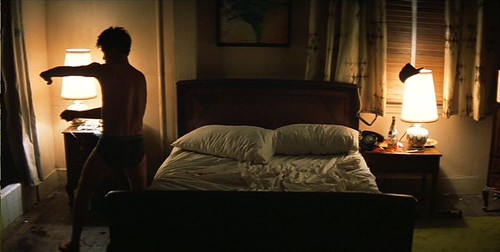

Montage AN 19 martial arts

The second shot comes much later in the film. Clean has been killed (bullet), then the Chief (spear). Lance is the one who floated the Chief’s body down the river. Now they’re heading upriver toward Kurtz again, with Lance in the bow of the boat:
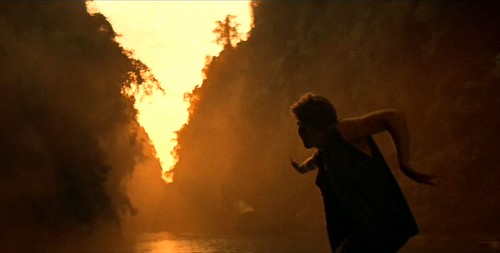

AN Lance dance1

He’s doing a martial arts dance. Not the same one as Willard did in the opening montage, but a martial arts dance. No one else in the film does such a thing. Clean does some dance moves while listening to the Rolling Stones, but they’re in an entirely different style; faster, jerkier, more angular.

Finally, we have this scene in Kurtz’s compound. Willard’s in the foreground, and Lance is in the background:
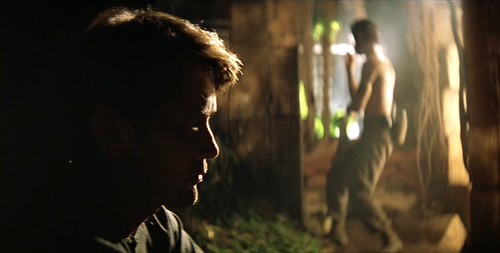

AN Lance dance2

One might suggest that this parallel is a mere accident, one might. And perhaps it is. In cases like this, however, my default assumption is that it is not an accident. It may not be there by conscious intent and deliberate plan; but it is not there by accident. The people who made this movie are too skilled to do such things inadvertently.

That final remark of Benzon’s makes exactly the point I was hoping to make here, before commenting on those two screen-grabs from Manhunt:

The people who made this movie are too skilled to do such things inadvertently.

**

There’s actually a third shot in Manhunt with a view of a dangling rear-view-mirror ornament — let’s take a look:

This one’s from the van Peter Bergen and his cameraman, Peter Jouvenal, took in the docu’s re-enactment / flashback to their CNN interview with bin Laden, back in 1997. I don’t think this one is a rosary-like thing though it might be — I think it’s just the sort of tassel decoration you’ll find on saddle-bags, or decorating a camel or a car in Afghanistan.

The other two, however, seem clearly religious, both of them are shots of the cars in which American counter-terrorist folks would have gone to work during their efforts to track down bin Laden — and I find it significant that one features a (Christian) cross while the other very likely shows (Muslim) prayer-beads.

I say “very likely” because the beads could be (secular, Greek) worry-beads — but they look more like a tasbih to me. And why would that be interesting — why would a film-maker be interested in such a parallelism?

Besides the fact that these shots allow voice over and show us the various folk involved going to work, they specifically point up the fact that those working to defeat bin Laden were not all kuffar but included Ali Soufan of the FBI and “Roger” — the fellow described by Greg Miller in this March 2012 piece in WaPo, At CIA, a convert to Islam leads the terrorism hunt.

Am In right? I don’t know. But the subliminal message, if I am, is that the manhunt for bin Laden was indeed not a “Crusaders against Islam” affair.

**
May I recommend Wm. Benzon’s Beethoven’s Anvil to all who read here who have an interest in cognition and / or music?

For more on parallelism in cinema, see David Bordwell, Julie, Julia, & the house that talked, to which Benson also pointed me.

Boston special issue promoted in Azan #2

Wednesday, June 5th, 2013

[ by Charles Cameron — for the record, there’s a Boston “special edition” of Azan, though I’ve only seen the ad! ]
.

The second issue of Azan magazine is out, and not all that exciting — but just as I did last time, I’ve scanned it for bits that interest me, and come up with a couple — but first I’d like to note is the teaser on p. 49 (below) for a “special issue” on the Boston bombings, dated 15/5 on the cover and claiming to have been published “soon after the attacks”:

I haven’t seen it, but there’s corroboration. SITE appears to have found a copy and announced it in this tweet on May 25th:

So somewhere between Azan #1 and Azan #2, there would seem to have been an out of series issue. Since it concentrates on Boston, however, and not Khorasan, there’s probably not much in it along my line of interest, so knowing it’s out there only piques my curiosity just a tad.

Love, Death, and Jihad by Pen and Sword

Wednesday, May 29th, 2013

[ by Charles Cameron — with Wagner and Abu Dujana as examples, the cognitive sting here is in the tail — the power of a double image to engage both emotion and insight ]
.

Love and death.

**

The human mind thinks in parallelisms and oppositions.

My lords, if you would hear a high tale of love and of death, here is that of Tristan and Queen Iseult; how to their full joy, but to their sorrow also, they loved each other, and how at last they died of that love together upon one day; she by him and he by her.

Thus begins Bédier‘s version of The Romance of Tristan & Iseult as Hilaire Belloc presents it in its classic English form. The parallel there, between love and death, is found also in Freud’s binary opposition of Eros and Thanatos, which he suggests in Civilization and Its Discontents:

The name libido can again be used to denote the manifestations of the power of Eros in contradistinction to the energy of the death instinct.

and in Wagner’s Liebestod — by way of returning to Tristan and Iseult:

**

Likewise, there’s a parallelism between jihad by pen (jihad bil qalam) and by sword (jihad bil saif) — shown in Abu Dujana al-Khurasani‘s move from writing on the forums to martyrdom in Khost — which al-Awlaki phrases in terms of ink and blood in eulogizing Sayyid Qutb in Constants on the Path of Jihad:

We see that in our contemporary times with people like Syed Qutb. He wrote with ink and his own blood. People like Shaykh Abdullah Azzam and Shaykh Yusuf al ‘Uyayree. They wrote amazing books, and after they died it was as if Allah made their soul enter their words to make it alive; it gives their words a new life

and which appears, contrariwise, in the hadith — considered weak by some and cherished by others:

The ink of the scholar is more sacred than the blood of a martyr

**

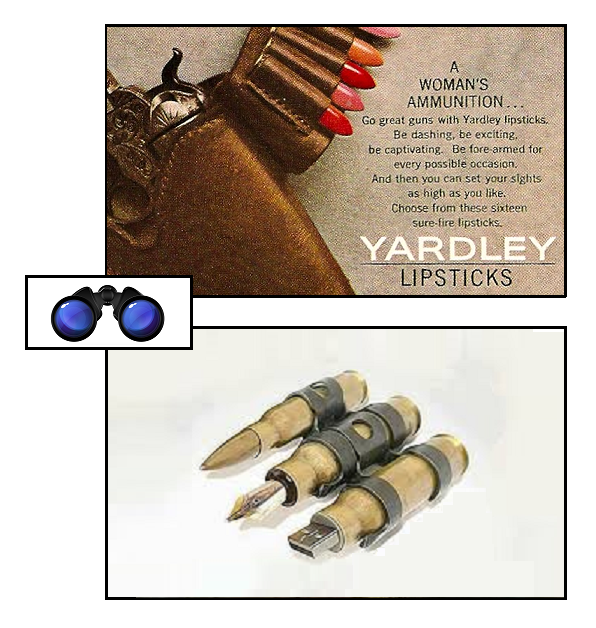
Which brings me to my own parallelism of the day — a parallelism between two uses of graphical similarities, to convey powerful messages:

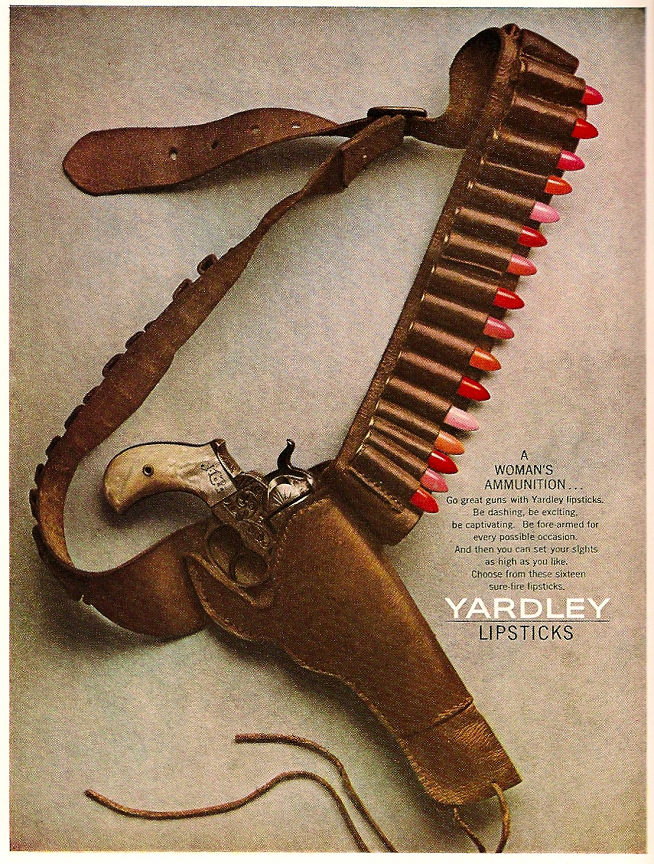
The upper panel shows a Yardley‘s lipstick ad that I must have seen forty years ago on the London Underground — it stunned me then, and it stuns me today to have rediscovered it on the net — which I have long thought of as a brilliant illustration of “rhyme” in images.

And the lower panel? It’s the parallelism between jihad bil qalam with jihad bil saif, extended into the cyber realm. Again, a powerful image, because when two items “rhyme” in some way that’a apparent to us, there’s an instinctive summoning of all that they mean to us close to the surface of consciousness, and other aspects of their relatedness can then become clear to us in a flash of insight.

**

Here’s the full Yardley’s ad, still very much as I remember it from so long ago:


Switch to our mobile site