Archive for the ‘visualization’ Category
Sacred space and the imagination
Sunday, June 19th, 2011[ by Charles Cameron — no mil/intel stuff — the sacred, architecture, nature, books, imagination ]
.
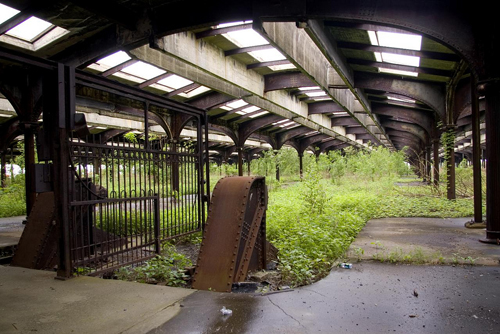
This post began with a photo my friend William Benzon took of an abandoned passenger terminal in Liberty State Park:
*
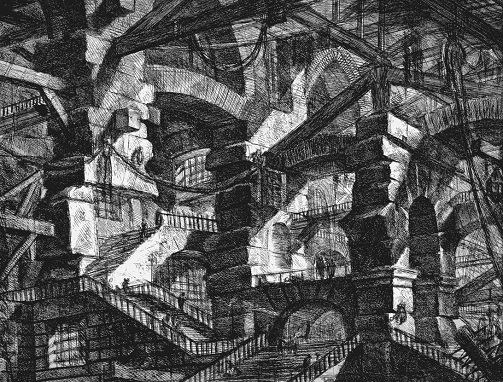
Without the greenery, I don’t think I’d feel this was “special” in quite the same way. I might see it as prison-like, akin to those magnificent Piranesi prints in his Carceri series:
… vast, haunted — the anti-cathedral.
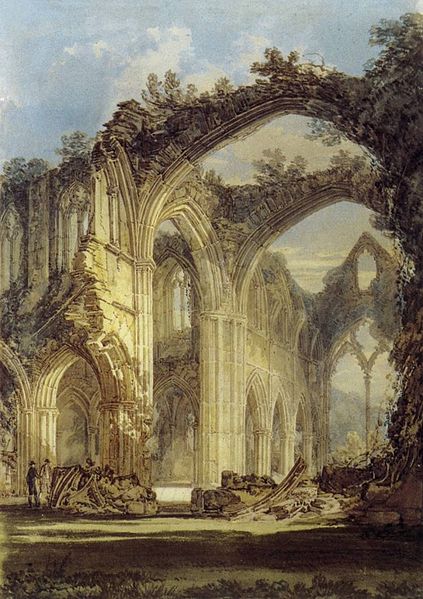
Yet the grasses and small trees are there in Benzon’s photo, green and vibrant — and in their presence, the prison becomes a cathedral… not unlike the great ruined abbeys of England, Tintern, Calder, Whitby, Walsingham, Fountains.
Here’s Tintern Abbey by JMW Turner, for a sense of how ruins were viewed in his day:
Somehow, in the workings of the human mind and heart, nature’s grasses can keep a ruined space sacred…
*
But what of books?
The effect is austere by comparison, but the hush of the library slips into the high-vaulted silence of the cloister, and when I saw Bill Benzon’s photo above, this photo of a bookstore in Holland was the first analogy to cross my mind…
The Selexyz Dominicanen bookshop is housed in an old church in the centre of Maastricht. A beautiful listed building, this former Dominican church was transformed into a bookstore by architects Merkx+Girod, resulting in an extraordinary combination of bookselling complex and church interior, preserving the unique landmark setting. It was praised by British newspaper The Guardian as ‘possibly the world’s finest bookshop’. Earlier, Selexyz Dominicanen had already received the prestigious Lensvelt Architecture Interior Award 2007 for the décor of the store.
Of course, not everyone thinks a bookstore is sacred, and a lot might depend on what books you browsed, or caught your neighbor browsing. Here’s one negative report:
When your church community gets bored of reaching out with the love of Christ and doesn’t like to meet together anymore, don’t cry over it! Build a bookstore and coffee shop out of your unwanted worship space. The chancel is great for a cappuccino… And the worship space would house a nice collection of bargain-priced books, and kitten calendars:
So next time you despair that the church has lost its way, relax and sooth your aching conscience with a steaming latte – you can even sit at the crucifix table and plug into the WiFi. There are so many uses for old churches, why bother with renewal in the Church at all?
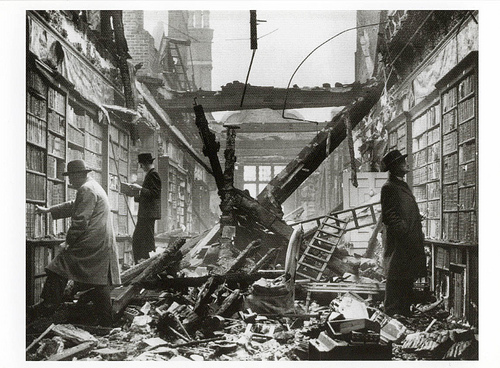
Even a ruined bookstore can have something of a sacred quality, though, as this London library photo clearly shows:
Surely, that’s the last word in books — what more could one ask for?
*
Still — look. There’s some sort of disaster, atrophy, ruin or sea-change in each of these images. What happens when an architect — as skilled as the folks from who designed that bookstore — builds a chapel in the forest?
With all the contemporary emphasis on modern sustainable architecture, sometimes we seem to forget that environmentally friendly architecture has existed for a long time. Built in 1980, Thorncrown Chapel was created with the idea of highlighting the natural setting, which was, and still is, an attractive natural setting for tourists in the area. The owner of the site, Jim Reed, hired well known architect, Frank Lloyd Wright alumni E. Fay Jones to design and build the site which used native timber to match the setting around it, and the result was a fantastic expression of architecture that was awarded the “Twenty-Five year award” by the American Institute of Architects.
It is as lovely by winter light:
as it is by light of spring and summer:
and yet I’d say there is something not ascetic but arid there: it has tried a great deal, but not died a little.
*
Nothing there is any which way ruined. And it is out of ruins that our hopes grow these days, as grass at times breaks through tarmac.
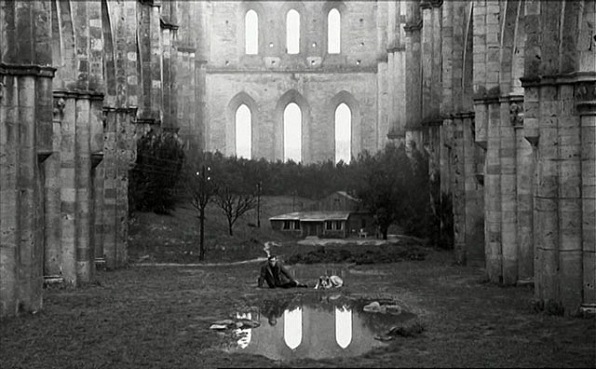
Tarkovsky’s great film Nostalghia closes with a breathtaking shot…
a sacred space in pure, delivered, imagination — a single shot which to my mind, having seen the film and left the movie theater speechless, must be accounted the greatest single work of surrealism yet…
in which the protagonist, a Russian exiled in Italy, sees finally the lonely Italian abbey that has come to symbolize his loss of hearth and home, all loss, all absence — with his home nestled inside it, the little pond, himself, his dog…
The Said Symphony: Board and Gameplay
Thursday, June 16th, 2011[ by Charles Cameron – extended analytic game on Israeli-Palestinian conflict — see Said Symphony: Intro ]
.
All the games of the HipBone family use the juxtaposition of ideas on a game-board to develop a web of associations that is larger and more complexly interwoven than the same ideas gathered in a simple list, didactic argument or sequence.
.
The Said Symphony board:
.
The simplest of these games uses the DoubleQuotes format, with which regular Zenpundit readers will already be familiar (i, ii, iii, iv). More complex games have been played on the Dart and WaterBird boards among others, some light-hearted (Movie Trivia Game), some quite serious (What Sacred Games?).
For quite a while now, I have wanted to play a solo game — something more epic in scale than a two-move DoubleQuote or even a ten-move game on the WaterBird board – that “scored” the symphony that Edward Said intuited, as mentioned in my previous post.
Not so long ago, I found the perfect board…
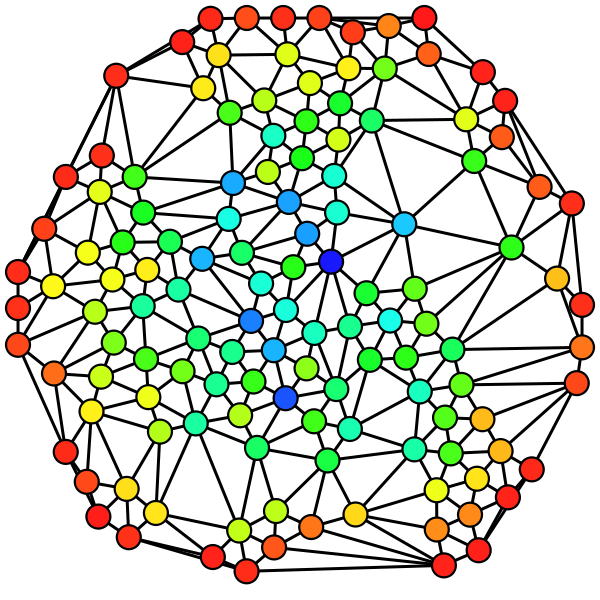
Board credit: Claudio Rocchini
.
The HipBone gameplay
.
Here’s how the gameplay works.
Slowly, I am going to “place” one quote (or image) after another on that board.
Each of these quotes or images (or equations, or sound-clips, or even blanks / silences) will be assigned a “position” (circle) on the board, a name or “move title“, some “move content” that features the quote or image and enough associated content to explain it, a series of “links claimed” in which I build bridges to directly adjacent moves already in play, and on occasion a “comment” which will allow me to weave in an overview of how the game is going, some footnotes, whatever seems helpful.
A board position, move title, move content, links claimed and comment, taken together, will comprise a single “move” on the board.
I hope to cover a wide range of issues here, political and religious, riparian and agrarian, Judaic and Christian and Muslim, secular and sacred, local, regional and international, disputed and agreed, in parallel and orthogonal and in opposition, violent and peaceable, ancient and modern and futuristic, social and individual… thesis and antithesis and synthesis, you get the drift.
Let me be clear: wherever the board shows two circles (‘board positions”) directly linked by a line, the ideas (“moves”) assigned to those two circles should have some form of linkage – associative, analogical, metaphorical, metonymic, causal, illustrative, oppositional, paradoxical, biographical, bibliographic… and so forth.
Putting that another way, I shall try to place my moves in such a way that moves joined by lines between them will indeed provoke thought and insight — about the facts on the ground, the myths in the air, the dreams and hopes and dashed hopes, the people…
So that the whole sorry, glorious story will hover behind the board, with pinpoint quotes and details shining through the moves on the board like constellations in the night sky.
Thus it is not the ideas themselves but their relationships – their duels and duets – which form the fabric of this work of architecture, the counterpoint of its music.
.
Playing and following along:
.
I shall play my moves first, one at a time, in the forums my friend Howard Rheingold, web pioneer and author of Smart Mobs, has set up for graduates of his online classes. I may at times make two or three moves there in a day — or wait a week and ponder what my next move should be.
But I don’t want to clutter up ZP every time I made a move, so I shall wait and gather them, and post here on Zenpundit when I have a suitable cluster to offer.
It was Howard‘s gracious invitation for me to introduce my games to his alumni that first nudged me off my perch and got me started playing this game that I have been thinking about for some years now –and Zenpundit is my home on the open web – so this double presentation is natural.
You are most welcome to follow along, comment and kibitz – but let me make two things clear from the outset:
The fact that I “play” a particular person, image, work of art or headline in no way means that I endorse that person or point of view – any more than a novelist or historian quoting Hitler, Churchill, or Stalin necessarily endorses the swastika, Union Jack or hammer and sickle:
Quotation does not imply endorsement or disparagement.
And the fact that I juxtapose two situations, events, anecdotes, quotes, processes or persons in no way means that I equate them – any more than a juxtaposition between the soccer game that kicked off the Football War (El Salvador and Honduras, 1969) and the Fischer-Spassky match that was a minute but focused skirmish in the Cold War (USA vs USSR, 1972) implies that soccer is or somehow equals chess — or is its exact opposite — or provides or implies a moral equivalence between America and Russia:
Linkage does not imply equivalency, moral or otherwise.
There will be symmetries, there will be asymmetries, as you’ll see — and indeed it may well prove that the discrepancies, oppositions and imbalances between two adjacent moves will be as fruitful as any parallelisms.
What I would suggest is that every move, like it or loathe it, should be heard.
.
And briefly, the HipBone Games:
.
The project builds on my previous development of the HipBone family of games, which began as an attempt to make a playable variant of the Glass Bead Game described in Hermann Hesse‘s Nobel winning novel, Magister Ludi.
I recently posted an introductory account of the games on Bryan Alexander‘s New Digital Storytelling blog; game boards are available for download at HipBoards; and the basic games rules and invitation to play are still up at my now ancient HipBone Games website.
I’m happy to take questions in the comments section.
.
Next up:
.
In my next post, I’ll play the opening moves…
The Said Symphony: Introduction
Wednesday, June 15th, 2011[ by Charles Cameron – extended analytic game on Israeli-Palestinian conflict ]
.
I have begun work on a major personal project, the Said Symphony, and I’ll be posting the work as it proceeds, privately in the Alumni forum of Howard Rheingold‘s online classes, and in public here on Zenpundit.
Here’s the deal.
The idea of the Said Symphony Game:
Edward Said, the Palestinian “public intellectual” was also an accomplished musician, and the music critic of The Nation for quite a while. One time he brought his musical and Palestinian interests together in a stunning suggestion:
When you think about it, when you think about Jew and Palestinian not separately, but as part of a symphony, there is something magnificently imposing about it…
I intend to explore that idea, in an attempt to “see” the Israeli-Palestinian question with fresh eyes, to hear it in some of the many voices – from sound-bites to scriptures – embodied in that conflict, some of the many individuals whose dreams and lives and olive trees are rooted in that sacred ground… and to present it in a way that is at once analysis and synthesis, history and work of art.
The complexity of the situation:
Let’s make this personal. Here’s a poem that expresses the way I’m thinking here:
I am Charles
My concern is the human mind in service
to an open heart, and my problem
is that the heart picks issues rich in ambiguity
and multiplicity of voices, tensions
and torsions tugging not one way but
in many directions, even dimensions, as does
a spider’s web weighed down with dew –
to clarify which a mind’s abacus is requiredequal in subtlety to subtlety itself, while
in all our thinking and talking, one
effect follows one cause from question
to conclusion down one sentence or white
paper — whereas in counterpoint,
Bach’s fugal voices contain their dissonance.
Okay?
Take a look at this spider’s web, for example:
Spiders and dewdrops do a pretty convincing job of portraying a certain level of complexity in what I think of as (virtually, metaphorically) a node-and-edge diagram of the global situation.
Mapping ideas and places:
Now, to apply that style of thinking to a serious world problem… the Palestinian-Israeli or Israeli-Palestinian conflict…
When, say, Hamas and Fatah signed their National Reconciliation Agreement on May 4, 2011, or Netanyahu won 29 standing ovations during his May 24 speech before a joint session of the US Congress, it’s like a few new drops of rain falling on that spider’s web — the droplets fall this way and that, carom into one another, the fine threads they’re on snap or stretch and swing down and around… until a new equilibrium is reached…
But try thinking the issues through before breakfast one morning if you’re the US Secretary of Defense — with the fresh winds of the Arab Spring promising a new Egypt, Iran announcing its intention to test a nuclear weapon shortly, and al-Qaida and associates training and recruiting in the background…
Pakistan… China…
And your problem isn’t a two-dimensional spider’s web with gravity pulling in just one direction – it’s more like an n-dimensional spider’s web, with multiple gravities, tugs, and tensions – and some of those tensions are in the category of known unknowns that one of your predecessors talked about, some of them unknown unknowns, and some of them literally unknowable – hidden in the hearts of more devious men than you, and known only to God.
That’s the complexity of the thing: to map the spaces where salaam might meet shalom.
That’s also the node-and-edge nature of the graphical approach I shall use.
Coming up shortly:
In my next post, I’ll explain the HipBone gameplay – the way in which moves are made on the board, and what their juxtapositions mean — and introduce the board.
If America Had the Same Political Organization of Classical Greece
Tuesday, June 14th, 2011America of City States ( Hat tip Shlok)

Would like to see this mashed up with 2008 and 2010 election result maps