Conkers (the game) and Deep Learning
Consider: they’d need more than brainpower, they’d need mobility. It wouldn’t take a rocket scientist but a robot to do the trick – locating chestnut trees, okay, with a judicious use of Google maps for targeting and drones for close observation, agility to get around the trees (climbing ‘em?) gathering and evaluating nuts, their sizes, densities, colors and weights, testing different angles of attack and types of needles for threading, the respective efficacies of polished (ooh like mahogany!) vs unpolished nuts (somewhat more in the spirit of sabi-wabi), styles of rough or silken string — and then the dexterity to swing the strung nut at its similarly strung and loosely hanging sibling-opponent!!
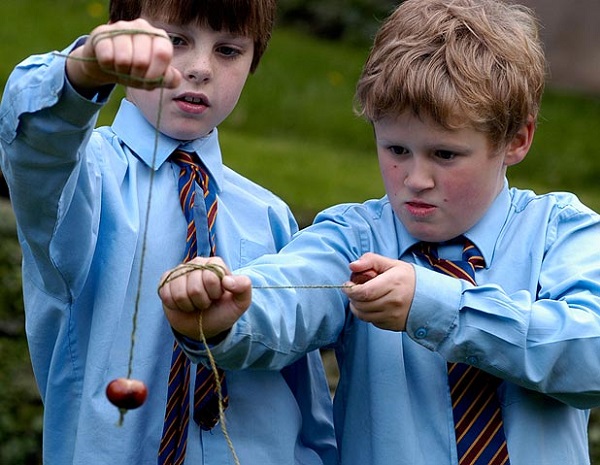
Ah, but there’s a child to find first, shy or enthusiastic, and the very approach of a disembodied brain or robot might scare or enchant said child. Your successful robot will need to avoid the uncanny valley of too close resemblance, in which a machine garners the same emotional thrill as Chucky the scary doll from Child’s Play and its endless sequels…
All this, to beat the poor kid at the kid’s own game?
Perhaps our robot overchild will have read the bit about “It matters not who won, or lost, but how you played the game” – and will have the good sense and humility to build itself an arm that’s not quite as strong as a child’s arm, and will eventually have played enough child opponents to develop a style that wins only fractionally more games than it loses – say 503 games out of a thousand.
What is man, that thou art mindful of him? and the son of man, that thou playest conkers with him?
Oh, conkers isn’t the only game I’d like to see the computers try for -– in fact it’s one of two games that has been outlawed in some British schools –- and to live outside the law you must be honest, as Dylan says. Another banned — and therefore extra-interesting — game is leap-frog. How do you win and how do you lose at that? You don’t –- you just play.
That’s when things will begin to get really interesting, I think –- when an artificial general intelligence, with or without robotic body, learns playfulness. There will need to be constraints of course, of the Do no Harm variety -– a fireproof Faraday cage playpen perhaps?
**
But play is by no means limited to infancy, it also finds an outlet in genius. So here’s my more serious, though still playful, question for the AI folks out there, and Monica Anderson with her “Intuitive AI” in particular:
When will an AI be able to play Hermann Hesse’s Glass Bead Game?
After all, it’s the only game design that has arguably won its designer a Nobel Prize. And at the moment, it’s brilliantly undefined..
Hesse conceptualized the game as a virtual music of ideas – contrapuntal, polyphonic. Its origins were found in musical games, mathematicians soon added their own quotient of arcane symbols to those of musicians, and other disciplines followed suit until as Hesse puts it:
Page 2 of 4 | Previous page | Next page