Conkers (the game) and Deep Learning
[ by Charles Cameron — offered to 3QD ]
.
This is my second submission attempting (and failing) to become a regular contributor at the fine web-aggregator known as 3QD — you can read my first here. On rereading this more recent attempt, I am not sure I would have selected it myself had I been one of the judges — it perhaps expects too mych “British” knowledge of its readers, who are as likely to come from Hoboken or Pakistan as from Oxford (hat-tip there to my two 3QD friends, Bill Benzon & Omar Ali). For those of you, therefore, who may not know what conkers is, here’s a brief video introduction, with the actual game demo starting around the 1’35” mark:
I’ll add a fantastic passage from Seamus Heaney at the end of my post, to give it the final mahogany polish a conkers post deserves.
____________________________________________________________________________________________
Three Quarks Daily submission:
Conkers is for kids. So what does it have to do with computers, AI, “deep learning” or robots?
It’s a very British game, conkers, played with the seeds of horse chestnut trees, of which Britain counts almost half a million, pierced and strung on string. I suppose you could think of it as a primitive form of rosary bashing, with each player’s rosary having only one bead, but that might give others the wrong impression since conkers (the game) is sacred the way taste is sacred before anyone has told you, “this is strawberry”, not the way sanctuaries are sacred after someone has put an altar rail round them, or screened them off with a rood screen.
Even giving the game the name Conkers with a capital C puts it on a pedestal, when all it’s about is gleefully finding a suitable conker, maybe loose on the ground or maybe encased in its prickly green shell, drilling it through with some sort of skewer or Swiss Army device, threading it (stringing it) on string, finding a gleeful or shy playmate, and whazzam! conking their conker with your own so their falls apart and yours remains triumphant. Battered perhaps, but victorious.
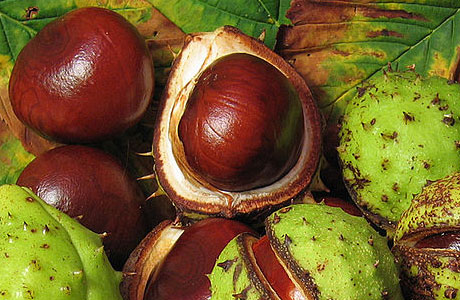
An artificial general intelligence, left to its own devices and skilled in “deep learning”, will surely figure out that play plays a significant role in learning, by reading Johan Huizinga perhaps, or figuring out “the play’s the thing” – or noting that play is how learning develops in mammalian infancy and expresses itself in human mastery. And since learning is what artificial general intelligence is good for and would like to be even better at, you can bet your best conker that artificial general intelligence will want to learn to play.
Okay, computers have played, and beaten humanity’s best, at such games as Pong, Space Invaders, Draughts, Backgammon, Chess, Jeopardy, Rock-Paper-Scissors, and Go –
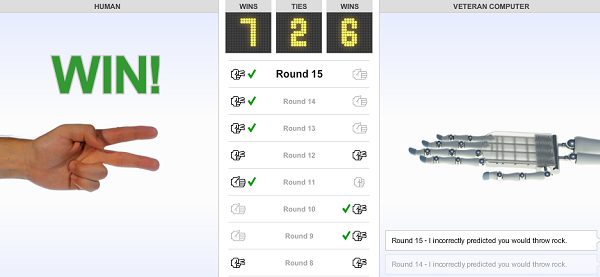
–
— and apparently one set of AI researchers is considering Texas Hold’em as a plausible next challenge. I want to see them try their hands (hands?) and minds at conkers, though.
Consider: they’d need more than brainpower, they’d need mobility. It wouldn’t take a rocket scientist but a robot to do the trick – locating chestnut trees, okay, with a judicious use of Google maps for targeting and drones for close observation, agility to get around the trees (climbing ‘em?) gathering and evaluating nuts, their sizes, densities, colors and weights, testing different angles of attack and types of needles for threading, the respective efficacies of polished (ooh like mahogany!) vs unpolished nuts (somewhat more in the spirit of sabi-wabi), styles of rough or silken string — and then the dexterity to swing the strung nut at its similarly strung and loosely hanging sibling-opponent!!
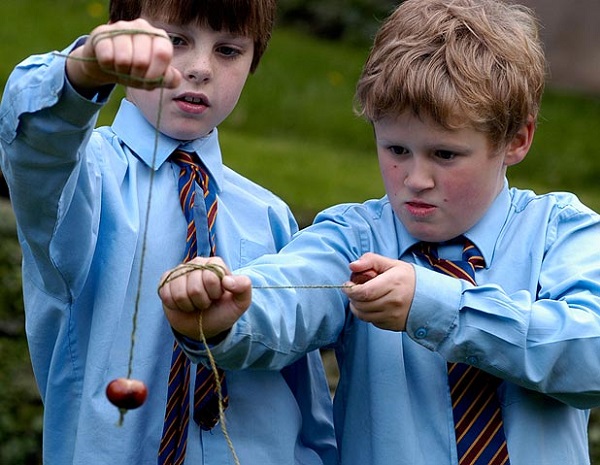
Ah, but there’s a child to find first, shy or enthusiastic, and the very approach of a disembodied brain or robot might scare or enchant said child. Your successful robot will need to avoid the uncanny valley of too close resemblance, in which a machine garners the same emotional thrill as Chucky the scary doll from Child’s Play and its endless sequels…
All this, to beat the poor kid at the kid’s own game?
Perhaps our robot overchild will have read the bit about “It matters not who won, or lost, but how you played the game” – and will have the good sense and humility to build itself an arm that’s not quite as strong as a child’s arm, and will eventually have played enough child opponents to develop a style that wins only fractionally more games than it loses – say 503 games out of a thousand.
What is man, that thou art mindful of him? and the son of man, that thou playest conkers with him?
Oh, conkers isn’t the only game I’d like to see the computers try for -– in fact it’s one of two games that has been outlawed in some British schools –- and to live outside the law you must be honest, as Dylan says. Another banned — and therefore extra-interesting — game is leap-frog. How do you win and how do you lose at that? You don’t –- you just play.
That’s when things will begin to get really interesting, I think –- when an artificial general intelligence, with or without robotic body, learns playfulness. There will need to be constraints of course, of the Do no Harm variety -– a fireproof Faraday cage playpen perhaps?
**
But play is by no means limited to infancy, it also finds an outlet in genius. So here’s my more serious, though still playful, question for the AI folks out there, and Monica Anderson with her “Intuitive AI” in particular:
When will an AI be able to play Hermann Hesse’s Glass Bead Game?
After all, it’s the only game design that has arguably won its designer a Nobel Prize. And at the moment, it’s brilliantly undefined..
Hesse conceptualized the game as a virtual music of ideas – contrapuntal, polyphonic. Its origins were found in musical games, mathematicians soon added their own quotient of arcane symbols to those of musicians, and other disciplines followed suit until as Hesse puts it:
The Glass Bead Game is thus a mode of playing with the total contents and values of our culture; it plays with them as, say, in the great age of the arts a painter might have played with the colors on his palette. All the insights, noble thoughts, and works of art that the human race has produced in its creative eras, all that subsequent periods of scholarly study have reduced to concepts and converted into intellectual values the Glass Bead Game player plays like the organist on an organ. And this organ has attained an almost unimaginable perfection; its manuals and pedals range over the entire intellectual cosmos; its stops are almost beyond number. Theoretically this instrument is capable of reproducing in the Game the entire intellectual content of the universe.
Various people, myself among them, have proposed playable variants on Hesse’s great Game, and with a little further precision, definition and development, one of us might be able to propose a specific GBG format that would challenge AI to, essentially, produce profundity, beauty, perhaps even “holiness.” For when all’s said and done, that’s where Hesse’s game inexorably leads, as his Game Master Joseph Knecht tells us:
Every transition from major to minor in a sonata, every transformation of a myth or a religious cult, every classical or artistic formulation was, I realized in that flashing moment, if seen with a truly meditative mind, nothing but a direct route into the interior of the cosmic mystery, where in the alternation between inhaling and exhaling, between heaven and earth, between Yin and Yang, holiness is forever being created.
Sample “island” of moves from Joshua Fost‘s Toward the Glass Bead Game – a rhetorical invention
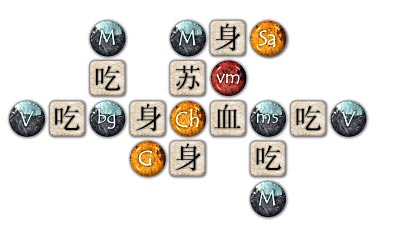
3QD is a polyphonic glass bead game of sorts, and comes far closer to Hesse’s ideal than the internet as a whole, since it curates the thoughts and insights it delivers — so maybe the challenge will be for an AI to win a place at the 3QD table by providing an essay, 1,000 to 2,500 words in length, to Abbas, by email at or before 11.59pm New York City time on some Saturday yet to be announced.
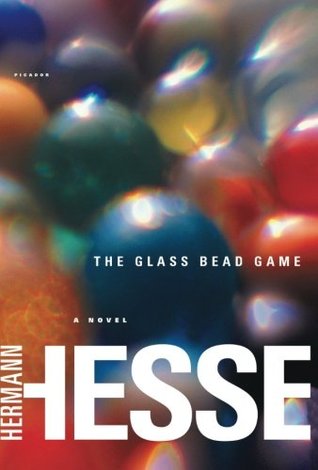
Preferably, such an AI will also have a stock of essays available, touching on a variety of subjects with passion, clarity, and at least a hint of quasi-human humor, for posting on specified Mondays. And before it writes in, it may need to think itself up a nom de plume.
____________________________________________________________________________________________
So that was my 2QD submission, with a couple of additional images thrown in. As I say, I’m not convinced I got it right — and next time. if there is a next time, I’ll likely avoid the Glass Bead Game and pick on some other topic. To give you a “rounded experience”, however, I am going to return now to conkewrs and chestnut trees, and offer you that quote I promised from Seamus Heaney, taken from his essay The Placeless Heaven: Another Look at Kavanagh:
In 1939, the year that Patrick Kavanagh arrived in Dublin, an aunt of mine planted a chestnut tree in a jam jar. When it began to sprout, she broke the jar, made a hole and transplanted the thing under a hedge in front of the house. Over the years, the seedling shot up into a young tree that rose taller and taller above the boxwood hedge. And over the years I came to identify my own life with the life of the chestnut tree.
This was because everybody remembered and constantly repeated the fact that it had been planted the year I was born; also because I was something of a favourite with that particular aunt, so her affection came to be symbolised in the tree; and also perhaps because the chestnut was the one significant thing that grew visibly bigger by the year…
When I was in my early teens, the family moved away from that house and the new owners of the place eventually cut down every tree around the yard and the lane and the garden including the chestnut tree. We all deplored that, of course, but life went on satisfactorily enough where we resettled, and for years I gave no particular thought to the place we had left or to my tree which had been felled.
Then, all of a sudden, a couple of years ago, I began to think of the space where the tree had been or would have been. In my mind’s eye I saw it as a kind of luminous emptiness, a warp and waver of light, and once again, in a way that I find hard to define, I began to identify with that space just as years before I had identified with the young tree.



April 13th, 2016 at 7:53 pm
Mark Twain, on a tree after an ice storm:
.
“The sun climbs higher, and still higher, flooding the tree from its loftiest spread of branches to its lowest, turning it to a glory of white fire; then in a moment, without warning, comes the great miracle, the supreme miracle, the miracle without its fellow in the earth; a gust of wind sets every branch and twig to swaying, and in an instant turns the whole white tree into a spouting and spraying explosion of flashing gems of every conceivable color; and there it stands and sways this way and that, flash! flash! flash! a dancing and glancing world of rubies, emeralds, diamonds, sapphires, the most radiant spectacle, the most blinding spectacle, the divinest, the most exquisite, the most intoxicating vision of fire and color and intolerable and unimaginable splendor that ever any eye has rested upon in this world, or will ever rest upon outside of the gates of heaven…”
April 13th, 2016 at 9:24 pm
Thank you.
.
Thomas Traherne, Centuries:
JG Ballard, The Illuminated Man: