[ by Charles Cameron — a brief meditation on word and image ]
.
Flags have been in the news quite a bit recently. There were the Marine Corps and Confederate flags carried by the protester outside the White House in the upper panel below:
and the flag some protesting Native American (Lakota?) grandmothers took from the white supremacists who hoped to establish a community of the like-minded in the tiny town of Leith, North Dakota — in what one account called an improv “game” of “capture the flag”.
So that’s two protests, right there. But the title of this post suggests it will concern “four flags and two tees” — and thus far I have mentioned three flags. The fourth is the flag worn as a tee-shirt decoration by one of the Grandmothers, and as shown below (upper panel) it is in fact the flag of the American Indian Movement:
while by way of contrast, the tee worn by the confederate-and-marine-flags chap is a logo rather than a flag — it’s a Southern Thread Men’s Special Deluxe Art Tee to be exact. As the ad says:
Alone or under a snap front shirt or a button down, you can show your southern roots or the vintage inspired western look.
**
My mind is a side-winder, as you know, so all this thinking about flags and logos got me thinking too about the Logos (or Word of God) and his standard.
When the Emperor Constantine, for better or worse, co-opted Christianity or converted to it or both, his battle cry in hoc signo vinces (or in this sign you will conquer in late Barbarian, in case that’s your maternal tongue) raised the chi-rho as the sign, ensign, or battle flag — the logo if you will — of the newly baptised Roman Empire. The chi-rho — ☧ — combining the first two letters of the Greek word Christos, and meaning the Anointed One.
**
Flags and mottos are consequential things. Which comes first: the image, or the word?
[ by Charles Cameron — comments on two posts by Chris Anzalone aka Ibn Siqilli ]
.
I’m bringing across two comments of mine from DoubleQuotes in the wild and making a separate post out of them — to give them more exposure, to emphasize the importance / interest of the two posts by Chris Anzalone that they are based on — and to be able to reference them in a post I’m currently working on. Both graphics are drawn from Chris Anzalone‘s Visual References post from last month, which gives essential visual support to his article, Zaynab’s Guardians: The Emergence of Shi`a Militias in Syria in the CTC Sentinel, just out.
Here’s the first, with Chris’ comment below:
.
An Internet poster showing Hizbullah’s secretary-general Hasan Nasrallah (right) and Syrian president Bashar al-Asad. The photograph of Nasrallah was taken after the 2006 Hizbullah-Israel war and has clearly been edited to show light emanating from the book (presumably the Qur’an). The same is true of the posed image of al-Asad. Both are shown by the designer as pious (thus, presumably, deserving of support).
This pair ties the piety of the politician with the piety of the cleric, making a conceptual bridge between both Lebanon & Syria on the one hand, and politics & religion on the other. Not terribly surprising, but still, cleverly done.
**
The use of “doubling” in the double cannibalism images presented below some from a little further into the same Visual References post, but serve a different function, making an association in time rather than one linking two contemporaries… They are designed to suggest that present Sunni brutalities have historical precedent — with tremendous spiritual and emotional resonance. Again, Chris’ own comment contextualizes the images:
.
Internet poster comparing Abu Sakkar, commander of a Syrian rebel group, (right), who committed a politically symbolic act of cannibalism on video with an organ (said to have been the liver or heart) from a slain Syrian government soldier in May 2013, and Hind bint ‘Utba (left), one of the Prophet Muhammad’s most virulent enemies before his conquest of Mecca in 630 C.E. In some Islamic historical sources, she is said to have taken a bite of the liver of the Prophet’s uncle, Hamza bin ‘Abd al-Muttalib, who was also one of his greatest warriors, after the Muslims’ defeat at the Battle of Uhud near the city of Madina. The text at the bottom reads: “Some stick to their habits and traditions!!,” referring to Sunni Muslims. The image of Hind and Hamza is a still from Syrian film director Moustapha Akkad’s famous 1977 film The Message about the beginnings of the prophetic career of Muhammad, the founder of Islam. Akkad was one of those killed in a bombings of hotels in ‘Amman, Jordan carried out by Al-Qa’ida in the Land of the Two Rivers/Iraq, then led by Abu Mus’ab al-Zarqawi.
Taken together, the two “doublets” linked to above can add rich spoils to our understanding of Shi’a contributions to what Chris calls “the increasing sectarianization of Syria’s civil war”.
[ by Charles Cameron — here’s today’s windfall apple from the tree of creative delight ]
.
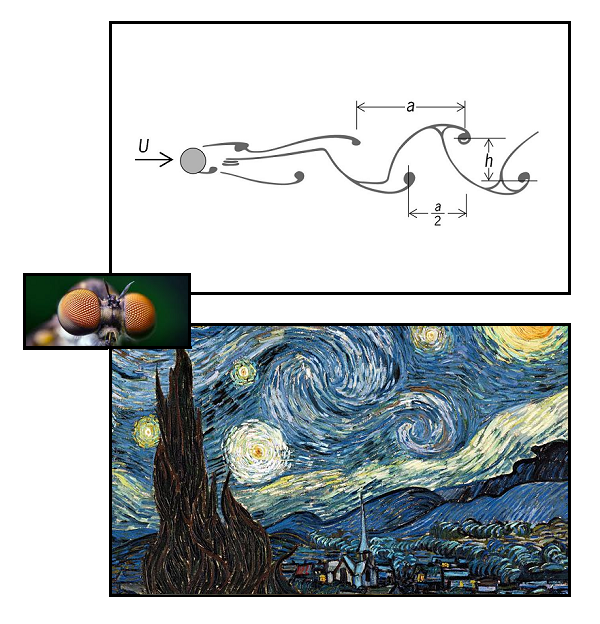
On March 31st, 2012 (or very likely the evening of the day before, because the clock this blog runs on is always way ahead of me) I posted a graphic here:
The upper image illustrates Theodore von Kármán‘s mathematics of turbulent flow, the lower image Vincent van Gogh‘s view of the night sky, and I juxtaposed them using my “DoubleQuotes” format to illustrate the underlying unity of the arts and sciences, and the breathtaking beauty and insight we can derive when we recognize a “semblance” — a rich commonality that transcends our usual division of concepts into separate and un-mutually-communicative “disciplines” and “silos”.
Apparently, this kind of cognition — the basis of every DoubleQuote, and of every move in one of the Hipbone / Sembl games — has now been termed “pattern thinking”.
**
According to Amazon, Temple Grandin and Richard Panek‘s book The Autistic Brain: Thinking Across the Spectrum was released April 30, 2013 although books are often available a couple of weeks ahead of release date, and galleys and proofs earlier still).
I’ve given a great deal of thought to the topic of different ways of thinking. In fact, my pursuit of this topic has led me to propose a new category of thinker in addition to the traditional visual and verbal: pattern thinkers.
Obviously, that’s something i’d want to find out more about, so I read on into the article, expecting good things. Imagine my surprise when I read this paragraph, though:
Vincent van Gogh’s later paintings had all sorts of swirling, churning patterns in the sky — clouds and stars that he painted as if they were whirlpools of air and light. And, it turns out, that’s what they were! In 2006, physicists compared van Gogh’s patterns of turbulence with the mathematical formula for turbulence in liquids. The paintings date to the 1880s. The mathematical formula dates to the 1930s. Yet van Gogh’s turbulence in the sky provided an almost identical match for turbulence in liquid.
Boom!
**
Okay, I just received my review copy of Hofstadter and Sander, Surfaces and Essences: Analogy as the Fuel and Fire of Thinking — I guess I’ll have to review Grandin and Panke here, too.
[ by Charles Cameron — on caterpillars, butterflies, psyche and the alephs of Georg Cantor, with a glance at the vertiginous idea it might be “boxes all the way up and down”… ]
.
Let’s get the science — which is quite fascinating — taken care of first. Here’s our best current visualization of how a caterpillar, after crafting its cocoon, prepares to become a butterfly:
**
Words can sometimes tell us some things that images can’t — or explain things to parts of us that simply cannot comprehend them visually — so here for parallel processing is an account of part of the same business from Scientific American:
How does a caterpillar rearrange itself into a butterfly? What happens inside a chrysalis or cocoon?
First, the caterpillar digests itself, releasing enzymes to dissolve all of its tissues. If you were to cut open a cocoon or chrysalis at just the right time, caterpillar soup would ooze out. But the contents of the pupa are not entirely an amorphous mess. Certain highly organized groups of cells known as imaginal discs survive the digestive process. Before hatching, when a caterpillar is still developing inside its egg, it grows an imaginal disc for each of the adult body parts it will need as a mature butterfly or moth—discs for its eyes, for its wings, its legs and so on. In some species, these imaginal discs remain dormant throughout the caterpillar’s life; in other species, the discs begin to take the shape of adult body parts even before the caterpillar forms a chrysalis or cocoon. Some caterpillars walk around with tiny rudimentary wings tucked inside their bodies, though you would never know it by looking at them.
Once a caterpillar has disintegrated all of its tissues except for the imaginal discs, those discs use the protein-rich soup all around them to fuel the rapid cell division required to form the wings, antennae, legs, eyes, genitals and all the other features of an adult butterfly or moth.
We watch the deer, and when they’re sick they know which plant is their aspirin: they eat that green medicine, and drink water. So we have deer medicine. We don’t need the mass-produced kind.
I don’t have the exact quote, but he also observed somewhat wryly that scouts from pharmaceutical companies used to watch him and see what medicines he used, in much the same way…
And if there’s any natural process that humans have watched with equivalent metaphysical interest to that which they may have shown in observing the bear’s pattern of hibernation and return, it would have been the process of metamorphosis in butterflies — whose name in Greek, psyche, is also the word for soul.
**
WB Yeats had a sense of the butterfly transcending both day-to-day human logic and death itself, when he wrote in his poem Tom O’Roughley:
‘Though logic choppers rule the town,
And every man and maid and boy
Has marked a distant object down,
An aimless joy is a pure joy,’
Or so did Tom O’Roughley say
That saw the surges running by,
‘And wisdom is a butterfly
And not a gloomy bird of prey.
adding just a few lines later:
What’s dying but a second wind?
**
What I’d like to do here is to take us from the plodding science of linear thought to which Yeats was (among other forms of linearity) objecting, towards the science — and poetry — of complexity, of nuance.
And I’d like to do it by skipping a couple of thoughts like a stone across water, inviting you to watch the ripples…
These are the leaps that connect the dots.. the creative leaps. And some leaps, it seems to me, are bigger and more demanding than others.
**
Is the leap from cocoon to butterfly in Hutching‘s quote really quite a huge leap? It certainly keeps some of our best scientists busy uncovering its hidden secrets. And the leap from butterfly to tornado, that Lorenz made? That would appear to me to be a larger leap, requiring a different mode of perception. And skipping from Hutchings to Lorenz, can we skim our stone of thought even further?
Putting two and two together is one thing: imagining “aleph null” for the first time, as Cantor did, that would be something else altogether. From two to four, I’m tempted to say, is a quantitative leap, while the imaginative leap from four, ten, or ten thousand to the alephs is qualitative.
How should we recognize and connect widely separated — yet deeply entangled — dots? What would prove to be the richest and most profound of creative leaps? Is there a move that will take us not just out of this box into the box it came in — but out of a whole matrioshka nest of boxes?
Those are the questions in my sandbox about now.
**
When we next meet, I’ll try to tie them in with this diagram that Adam Elkus recently pointed us to —
[ by Charles Cameron — the art of memory, with a sidelong glance at swans, typhoid and theodicy ]
.
Thomas Harris (and by extension Hannibal Lector) has been interested in memory palaces for a long time. We can begin to infer this this because Lector describes his hobby in Red Dragon (1981) and again in Silence of the Lambs (1988):
So — church collapses?
**
As you can tell from that last comment in the Silence of the Lambs quote — to my mind the most brilliant presentation of the problem of theodicy for our day — if there’s a God worth defending, it has to be a God who allows sparrows to fall, typhoid to accompany swans in the vast ecology of existence, churches to collapse on worshipers, and “bad things to happen to good people” from time to time.
And such things, specifically including collapses of religious buildings atop worshipers, do indeed happen in fact as well as fiction.
And they don’t only happen to Christians, either… Bon is the shamanistic religious tradition of Tibet, prior to — and later, somewhat assimilated by — Buddhism…
**
The thing is, when I read that Hannibal Lector collected church collapses, it not only made me start to take note of them myself, it also made me think of Simonides. As Frances Yates tells us in her book, The Art of Memory:
At a banquet given by a nobleman of Thessaly named Scopas, the poet Simonides of Ceos chanted a lyric poem in honour of his host but including a passage in praise of Castor and Pollux. Scopas meanly told the poet that he would only pay him halfthe sum agreed upon for the panegyric and that he must obtain the balance from the twin gods to whom he had devoted half the poem. A little later, a message was brought in to Simonides that two young men were waiting outside who wished to see him. He rose from the banquet and went out but could find no one. During his absence the roof of the banqueting hall fell in, crushing Scopas and all the guests to death beneath the ruins; the corpses were so mangled that the relatives who came to take them away for burial were unable to identify them. But Simonides remembered the places at which they had been sitting at the table and was therefore able to indicate to the relatives which were their dead. The invisible callers, Castor and Pollux, had handsomely paid for their share in the panegyric by drawing Simonides away from the banquet just before the crash. And this experience suggested to the poet the principles of the art of memory of which he is said to have been the inventor. Noting that it was through his memory of the places at which the guests had been sitting that he had been able to identify the bodies, he realised that orderly arrangement is essential for good memory.
And by way of reinforcing my Lector-Simonides conjecture, Lector certainly had a remarkable interest in memory, as we learn from his dialogue with Clarice Starling:
“Did you do the drawings on your walls, Doctor?”
“Do you think I called in a decorator?”
“The one over the sink is a European city?”
“It’s Florence. That’s the Palazzo Vecchio and the Duomo, seen from the Belvedere.”
“Did you do it from memory, all the detail?”
“Memory, Officer Starling, is what I have instead of a view.”
A belvedere, from the Italian, is “a structure (as a cupola or a summerhouse) designed to command a view” — and a beautiful view at that. Belvedere is also, ironically, the name of the town in Ohio where Buffalo Bill, Lector’s serial killer ex-patient, lives…
**
So it didn’t surprise me to discover that in Hannibal (1999), the book that follows Silence, this brilliant man who as we have seen collects church collapses and has an exquisite memory in place of a view, is revealed as a practitioner of Simonides’ art:
The memory palace was a mnemonic system well known to ancient scholars and much information was preserved in them through the Dark Ages while Vandals burned the books. Like scholars before him, Dr. Lecter stores an enormous amount of information keyed to objects in his thousand rooms, but unlike the ancients, Dr.Lecter has a second purpose for his palace; sometimes he lives there. He has passed years among its exquisite collections, while his body lay bound on a violent ward with screams buzzing the steel bars like hell’s own harp.
Hannibal Lecter’s palace is vast, even by medieval standards. Translated to the tangible world it would rival the Topkapi Palace in Istanbul for size and complexity.
We catch up to him as the swift slippers of his mind pass from the foyer into the Great Hall of the Seasons. The palace is built according to the rules discovered by Simonides of Ceos and elaborated by Cicero four hundred years later; it is airy, high-ceilinged, furnished with objects and tableaux that are vivid, striking, sometimes shocking and absurd, and often beautiful. The displays are well spaced and well lighted like those of a great museum. But the walls are not the neutral colors of museum walls. Like Giotto, Dr. Lecter has frescoed the walls of his mind.
Brilliant. And a delight, years later, to have my hunch connecting the church collapses and prison cell with only memory for a view with Simonides and the Art of Memory confirmed by the third book and film in the series…
You’ll note, btw, that the Lector (caveat lector) of the first two books has now become Lecter in alignment with the films starring Anthony Hopkins.
**
I love symmetries, so let’s move from the most monstrous criminal mind in literature, to the greatest detective…
Sherlock Holmes — in his latest television incarnation — builds memory palaces of a sort, though I’m not sure Simonides would recognize them.
I’m posting the clip from the series here to honor my son Emlyn, with whom I have been watching the series…
In 1596 Matteo Ricci taught the Chinese how to build a memory palace. He told them that the size of the palace would depend on how much they wanted to remember: the most ambitious construction would consist of several hundred buildings of all shapes and sizes, “the more there are the better it will be,” said Ricci, thought he added that one did not have to build on a gradiose scale right away. One coul create modest palaces, or one could build less dramatic structures such as a temple compound, a cluster of government offices, a public hostel, or a merchants’s meeting lodge. If one wished to begin on a still smaller scale, then one could erect a simple reception hall, a pavilion, or a studio. And if one wanted an intimate space one could use just the corner of a pavilion, or an altar in a temple, or even such a homely object as a wardrobe or a divan.
You’ll note that in this early example of virtual reality as an pedagogical technology, Ricci doesn’t start with the easy stuff, the single wardrobe or divan — he begins with “the most ambitious construction”…
Enough for now. When I want to talk about in a follow up post is detail… the crucial importance of detail.
Zenpundit is a blog dedicated to exploring the intersections of foreign policy, history, military theory, national security,strategic thinking, futurism, cognition and a number of other esoteric pursuits.