On the felicities of graph-based game-board design: thirteen
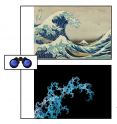
And finally, here’s an ugraded version of the other DQ of mine that seeks to bridge the arts and sciences — featuring Hokusai‘s celebrated woodblock print, The Great Wave off Kanagawa (upper panel, below) and Jakob aka nikozy92‘s fractal wave, which I’ve flipped horizontally to make its parallel with the Hokusai clearer (lower panel) — Jakob‘s is a much improved version of a fractal wave compared with the one I’d been using until today:
That brings me to the Met’s marvelous offering, to which J Scott Shipman graciously pointed me:

Here’s where you get the collection:
Rich pickings!
**
Maestro Harding and the Glass Bead Game:
Finally, I’ve been delighted today to run across a couple of vdeos of my nephew, Maestro Daniel Harding, conducting the Swedish Radio Symphony Orchestra some years back in programs exploring the interplay of mathematics and other disciplines and music:
and:
Daniel is not working the graph-based angle that my games explore, but his thinking here is pleasantly congruous with my own. His work with the SRSO has, he says in the first video here, “to do with all branches of human knowledge and curiosity, not just music — because everything is connected”.
You can’t get much closer in spirit to Hesse‘s Glass Bead Game than that!
**
Earlier in this series:
**
BTW:
I really want to believe the only American television Kim Jong Un has watched is Blues Clues and that’s just what he thinks all American mail looks like. pic.twitter.com/wL9ek5csch
— Delaney Strunk (@delaknee) June 2, 2018
NatSec, yes, and a DoubleQUote. Too good to miss. Thanks again to John Askonas..
Page 2 of 2 | Previous page