zenpundit.com » palestine

Archive for the ‘palestine’ Category

When win-win games get gamed

Monday, August 3rd, 2015

[ by Charles Cameron — a paradox I’m currently chewing on, courtesy of Richard Landes]
.

I want to take something that Richard Landes has been saying, abstract it from those conflicts to which Richard applies it, simplify it by removing one technical term that’s part of his detailed breakdown, and present it in as bare-bones a manner as I can manasge. You can see two of Richard’s own versions of the issue below.

**

The basic question, as I understand it, is this:

How does a non-zero-sum move look to a zero-sum player, and vice versa?

Let’s suppose your entire background and upbringing revolves around the idea of zero-sum, you-win-I-lose games. If you see any sign of your adversary gaining an advantage in a negotiation, that’s proof positive that you’ve been bamboozled: somehow, you must have lost. Your job is to make no concessions — to be the winner in a winner-takes-all contest.

Now suppose your background and upbringing have revolved around the idea of non-zero-sum, win-win games, in which both sides of a negotiation make some concessions so that both can emerge as winners. You offer concessions in good faith, and in return you expect similar concessions.

What happens when a zero-sum game player and a non-zero-sum game player meet in play?

It’s Landes’ suggestion that any generosity on the part of a win-win player offering his winner-take-all opponent a concession will be taken as evidence of weakness,. and the opponent, far from making a corresponding compromise, will press on and demand more — making further nmoves which will offer so little that the win-win player will be at a loss to explain why such a promising start to bnegotiations fell apart so badly.

A further supposition: so-called honor-shame societies are geared for zero-sum, winner-takes-all gameplay, while societies which rely on an innocence-guilt reading of human behavior will be no less inclined toeards playing non-zero-sum, win-win games.

That’s the idea expressed in game-theoretic terms, as simply as I can put it. To my mind, these game considerations are worth thinking through in their own right, absent the specifics to which Richard Landes brings them.

**

Here is Landes making the same point, in the context of Israeli relations with the Palestinians, the Arab and Muslim worlds, and European liberalism –all of the above broadly speaking:

And a text version, Cognitive Egocentrism, for those who find words fly home faster in print…

**

Help me think this through.
The Israeli election: in the balance

Tuesday, March 17th, 2015

[ by Charles Cameron — the election itself a one day affair, and may even be settled by the time you read this — but the impact lingers, and the complex balancing of forces in the region remains ]
.

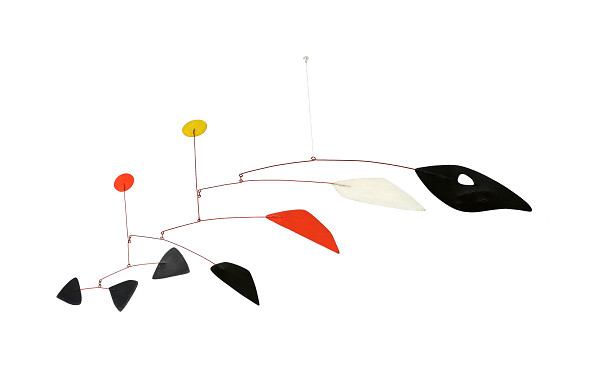
Calder

**

Nothing is ever black-and-white, it seems to me — but there are moment of exceptional clarity, and with the Israeli election (as best I can tell from afar) still in the balance as I write this, two quotes from Herzog (upper panel, below) and Netanyahu (lower panel) strike me as encapsulating the koan facing the Israeli people:

SPEC DQ Israeli elex koan

**

Still in the balance.

I was discussing the Middle East earlier in the day, an the issue of balance came up. Cheryl Rofer had said, “The big issue with KSA and Israel is balance of power” and I commented that if you throw Iran into the mix, the issue becomes one of a “balance of balances of power” — which could then be extended on out to include other interested parties.

This brought me to the idea of Alexander Calder mobiles, and the sense that they offer a kinetic equivalent to the static formalism of my own HipBone Games — their precarious balances and homeostases representing by analogy the tensions and resolutions between stakeholders and / or ideas, ideologies, approaches, in a way that features both “equilibrium and its discontents”. Fascinating.

To which Cheryl responded with gnomic accuracy:

Multibody problems are hard.

Ain’t that the truth!

**

Sources:

  • NYT, Netanyahu Says Never to a State for Palestinians
  • Fathom, We must divide the land: an interview with Isaac Herzog
  • Mobile, Alexander Calder in Gemeentemuseum Den Haag
  • A trinity of bomb

    Wednesday, December 3rd, 2014

    [ by Charles Cameron — photojournalistic fakery and a close shave for who knows who? ]
    .

    **

    To paraphrase the Athanasian Creed, which contains such phrases as:

    Such as the Father is, such is the Son, and such is the Holy Ghost.
    The Father Uncreate, the Son Uncreate, and the Holy Ghost Uncreate.
    The Father Incomprehensible, the Son Incomprehensible, and the Holy Ghost Incomprehensible.
    The Father Eternal, the Son Eternal, and the Holy Ghost Eternal and yet they are not Three Eternals but One Eternal.
    As also there are not Three Uncreated, nor Three Incomprehensibles, but One Uncreated, and One Incomprehensible.
    So likewise the Father is Almighty, the Son Almighty, and the Holy Ghost Almighty. And yet they are not Three Almighties but One Almighty.
    So the Father is God, the Son is God, and the Holy Ghost is God. And yet they are not Three Gods, but One God.
    So likewise the Father is Lord, the Son Lord, and the Holy Ghost Lord. And yet not Three Lords but One Lord.

    we might say in this case:

    The bomb is Russian, the bomb is Ukrainian, the bomb is Israeli: yet there are not three bombs, but one bomb.

    **

    I am in agreement with Libor Smolik. It is my impression that these three images are not proof of a global similarity of weaponry, but rather of sloppy journalism.

    A hat tip to FPRI’s Clint Watts for passing this tweet along. And I have to admit that “triples” such as this can beat out my DoubleQuotes on occasion. Well spotted, Libor!

    Jottings 10: The rabbi who cried Allahu Akbar

    Monday, February 17th, 2014

    [ by Charles Cameron — expect the unexpected ]
    .

    I can’t claim to understand Hebrew or Arabic, but the late Rabbi Menachem Froman, a leading Gush Emunim settler rabbi, can clearly be heard shouting “Allahu Akbar” at 5.37 and then repeatedly at 5.42 and following.

    What’s going on?

    **

    I wrote a while back:

    I am hoping to make Jottings a continuing series of brief posts, some serious and some light-hearted, that release the toxins of fascination and abhorrence from my system rapidly, ie without too much time spent in research. Jottings — hey, my degree was in Theology, Mother of the Sciences — derives from the English “jot” — and thence from the Greek iota and Hebrew yod, see Wikipedia on jots and tittles.

    Today, I hope to post four more of them. This one’s the first.

    **

    Rabbi Froman was visiting a mosque that had been desecrated the previous day by a group of his fellow settlers, who had scribbled the phrase “price tag” and some slurs against the Prophet on the walls, then set the mosque on fire.

    Harvard Professor Noah Feldman, in a Bloomberg op-ed titled Is a Jew Meshuga for Wanting to Live in Palestine? explains:

    If Israelis and Palestinians agree on one thing, it’s that more settlements in the West Bank will eventually make a two-state solution impossible. Rabbi Menachem Froman, who died on March 4 at age 68, thought differently.

    Froman was a proud and early settler, a founder of the hard-line Gush Emunim (“Bloc of the Faithful”), theologically committed to permanent Jewish settlement in what he considered historical Judea and Samaria. But Froman also fully accepted the idea of a Palestinian state there — in which he and his fellow settlers would continue to live as minority citizens.

    Crazy, you say — as did just about everyone else in Israel, to say nothing of other settlers. Froman played up the appearance of madness by appearing in Palestinian villages in his prayer shawl, tefillin (phylacteries) and long white beard and blessing the people in Arabic and Hebrew. His acting and speaking like a biblical figure further underscored the impression that he was some sort of unrealistic prophet, whether utopian or dystopian resting in the eye of the beholder.

    But why, really, is it impossible to imagine that religiously committed Jews might live under Palestinian sovereignty as citizens in the way that some Palestinian Arabs live under Jewish sovereignty in Israel proper? Looking at the standard reasons carefully, instead of just assuming their truth, can provide us with a much-needed thought experiment about the viability of the two-state solution, which looks increasingly tenuous to its supporters and critics alike.

    Food for whatever that thing is that hearts and minds do.

    **

    Related readings:

  • Yair Rosenberg, To Save the Peace Process, Get Religion
  • International Crisis Group, Leap of Faith: Israel’s National Religious and the Israeli-Palestinian Conflict
  • Adam Garfinkle, If Kerry Wants To Make Peace in the Middle East, He Should Just Put God In Charge
  • **

    Allahu Akbar — God is Great. Not such an unexpected sentiment coming from a rabbi, after all?


    Switch to our mobile site

