zenpundit.com » bias

Archive for the ‘bias’ Category

Creativity in the IC – Or the Lack of It

Sunday, March 28th, 2010

A great article in World Politics Review by Josh Kerbel, a 14-year veteran of the U.S. Intelligence Community ( Hat tip to Col. David Maxwell)

For the Intelligence Community, Creativity is the New Secret

It’s no secret that the increasing complexity of the international system — and in particular, its growing interconnectedness, integration, and interdependence — is eroding the fundamental business models of an ever-growing range of industries. Nowhere is this more evident than in the information industries, such as journalism, broadcasting, publishing, music and film, among others. More than a few entities have been swept to the brink of, or in some cases over, the precipice of irrelevance. And every information industry, it seems, is in some peril.

The U.S. intelligence community’s traditional model is similarly threatened by these transformations, but like so many cia.jpgother besieged industries, the IC is hesitant to deviate from it. In general terms, the IC’s model is a secret “collection-centric” one that:

– prizes classified data, with classification often directly correlated to value and significance;
– is driven by data availability, while analytical requirements remain secondary;
– is context-minimal, with analysis staying close to the collected data and in narrow account “lanes”;
– is current-oriented, since there are no collectable facts about the future;
– is warning-focused, emphasizing alarm-ringing;
– is product-centered, measuring success relative to the “finished intelligence” product provided to policymakers, rather than its utility or service.

This model ends up being highly “reductionist,” since secret collection leads to classification, compartmentalization and, inevitably, reduced distribution. Such a system, in which everything is constantly subdivided, was designed for the “complicated” — but not really “complex” — strategic environment of the Cold War. In that more linear environment, it was possible to know exactly where to look — namely, the USSR; access was severely restricted, making secret collection vital; the context of hostile intent and opposing alliances was well-understood; and the benefits of being forewarned, especially of imminent military action, was paramount.

Today’s complex strategic environment is vastly different. Now, there is no single focal point, as a threat or opportunity can emerge from almost anywhere; access is largely unrestricted, since the world is wide-open and information-rich; and context is much more ambiguous, because intent and relationships are fluid. In this more dynamic, non-linear strategic environment, reductionist approaches are, by themselves, a veritable recipe for systemic (i.e., strategic) surprise.

In practical terms, this means that it is no longer sufficient to just reactively collect data on how certain parts of the international system are acting in order to extrapolate discrete predictions. Rather, it’s crucial that such reductionist approaches be complemented by more “synthetic” approaches that proactively think about how the various parts of the larger system could interact, and consider how the synthesized range of possible threats and opportunities might be respectively averted or fostered. In other words, it is no longer enough to just monitor already identified issues. It is also necessary to envision potentially emergent ones. In short, it is time for the IC to use its imagination.

Read the rest here.

Comments, in no particular order of importance:
 
First, the underlying root problem is “political”. The IC is “collection-centric” primarily because the key “customers” for IC products have an implicit expectation of good intel as a higher level analytical journalism, just salted with some real-time “secrets” outside normal public purview. And some of them – George Schultz when he was SECSTATE is an example – want to be their own analyst, and are quick to complain about speculative,”edgy” analysis that clashes with their preconceptions. So IC senior managers are inclined to give the customer what they demand – current information which has a short shelf-life in terms of value. Educate the intel-consumer class of what the IC might be able to do given different tasks and they might start asking that new tasks be done.
 
Secondly, if the IC employed more programs that involved an investment in long-term “clandestinity” – it would both collect information of strategic, long-term value and offer the US opportunities to shape the responses of others through established networks of agents of influence. This is where imagination, speculation and synthesis would have greater play because of the need to create and seize opportunities rather than placing a premium on mitigating risk and avoiding failure.
 
The problem with analytical-reductionist culture in hierarchical institutions ( anywhere, not just the IC) runs deeper than a top-down, enforced, groupthink. Perceptive members of the org, even when compelled to parrot the party line “officially”, will often mock it privately and exchange more authentic critiques informally. The real problem is the extent to which this risk-averse, paralyzing, culture is psychologically  internalized by individual analysts to the point of creating lacunae. As individuals rise in the org they carry their lacunae with them and begin actively imparting them authoritatively upon their subordinates.
 
Ideally, a quality liberal education would be imparting a reflexive skepticism, a tolerance for uncertainty and a greater meta-cognitive self-awareness that would check the excessive certainty generated by an excessive reliance on the methodology of analytical-reductionism. Unfortunately, the emphasis upon academic specialization has been pushed down so hard in undergraduate and even high quality secondary public school education ( AP courses are the worst offenders) that generating good, insightful, questions is a cognitive skill that has been abandoned in favor of deriving “right answers” using “approved methods”.
 
Scenario-building
is an  effective tool for breaking  analytical-reductionist  frameworks and freeing up our ability to synthesize and construct solutions. However, to be useful, scenarios require at least an internal logic or realism even if they represent improbable “blue sky” or “black swan” outcomes and they require more cognitively diverse inputs ( from “outsiders”, “amateurs” and “heretics”) to challenge what data the received culture considers significant.

Fisking McCaffrey’s Futurism

Monday, March 24th, 2008

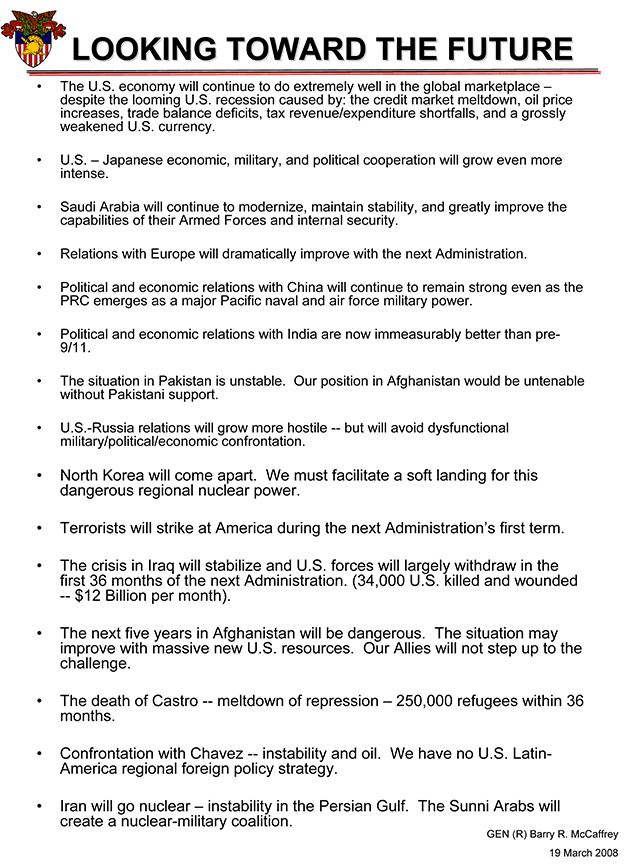
Yesterday, The SWJ Blog ( and blogfriends on Twitter, one of whom characterized it as “weak”) aleted me to a futurist slide by General Barry McCaffrey with his predictions of potential national security events faced by the United States in the near term. I’m certain this was in the context of a much larger presentation, given to a specific group with stated policy concerns; unfortunately, those particulars are unknown to me:

futurism.gif

My commentary:

First of all, one notes the number of “safe” predictions in the sense that none of these represent even the likeliest of outliers much less scenarios representing true, statistical rarity, “Gray Swans”. There’s a certain probalistic logic to doing so – the status quo more often than not in any given scenario will continue uninterrupted except by minor adjustments. On at least half of this list, given the breadth and/or vagueness, I’m certain that McCaffrey will be able in five years to say that he was more right then wrong. Unfortunately, the narrow number of domains from which he is extrapolating – nothing on cutting edge tech, applied science, the environment, macrodemographics, religious fundamentalism or interesting “intersectional” possibilities – leaves  policy makers with a vision that may be more susceptible to a Black Swan event than before by reinforcing previously held expectations.

Sidebar: I’d love to see Art Hutchinson, Tom Barnett, John Robb , Michael Tanji and the gents at Kent’s Imperative also critique the slide.

Now, in fairness, to the good General, a few of his bullet points are more interesting than others. I think McCaffrey’s called a hard landing for Cuba correctly unless Raul Castro has a secret admiration for Deng Xiaoping and the comprehension of economics to execute a Deng-like transition. It will be difficult for Cuba to really open up without the economic logic of the American market and favorable asylum policies for Cubans immediately kicking in as it did for the East Germans when the other Soviet bloc states ceased cooperating with Honecker’s repressive policies. With Chavez too, I think General McCaffrey is correct given that there is a little remarked friction between Venezuela the oil producer and America the refiner of Venezuelan oil ( refining capacity is itself a choke point along with oil production nor is all crude created equal; some is more expensive to refine than others). Finally, the temptation for al Qaida to “send a message” to the new administration and create downstream political effects may prove well-nigh overwhelming; it may even override their present policy of waiting until to pull off a catastropic level act of terror.

How do you see it ? Comments, questions, rants are all welcome.

Tuesday, August 21st, 2007

JUDGMENT DAY

An interesting confluence of information has crossed my computer screen in the last 24 hours.

Fabius Maximus was kind enough to send me a PDF, “Cognitive biases potentially affecting judgment of global risks” by Eliezer Yudkowsky, Singularity Institute for Artificial Intelligence. It’s a very interesting paper on analytical thinking – or s even though a number of the points made by Yudkowsky I have seen previously made elsewhere ( the blogosphere revels in hyperactive disconfirmation biases). Their central cognitive philosophy – “….the one whom you must watch above all is yourself”, is spot on.

Secondly, over at Kent’s Imperative, one of the Kentians, let’s call them “Most Formal Prose Kent” had a highly congruent post to the Yudkowsky paper, “The sins of analytic methodologists “:

There is an increasingly common conceit that reliance on the analyst – subject to, cognitive bias, information overload, and human fallibility – can be engineered out of the process of doing intelligence. Instead, certain methodologists would substitute organizational structures, workflow re-organization, and the introduction of supposedly superior quantitative metrics in order to create a new standard for “answers”. The underlying thrust of these efforts is to reform intelligence activities towards a more “repeatable” process, often described by industrial or scientific metaphors such “foundry” or “lab”. These typically originate from the engineering and technical intelligence disciplines, and are usually directed as criticism of typical all source efforts – particularly those grounded in social science fields or qualitative methodology.

…The fundamental flaw in many of these methodologists’ efforts is that they are essentially reductionist attempts to force the difficult and oft-times messy art of intelligence entirely into the narrow box of its scientific side. While there is a place for scientific approaches, particularly in the grounding and validation of assessment, the inherently creative, non-linear, and even non-rational elements of the profession can never be completely discarded. Most recent intelligence failures have occurred, not due to a lack of precision in judgment, but from a lack of imagination in identifying, describing, and forecasting the uncertain dynamics and emerging complexities of fast-changing accounts.”

Sagely described.

Clear thinking is difficult. Few of us begin by checking our premises or, sadly, our facts. Even in the domain of the concrete and verifiable factual information, so much rides on our implicit opinion of what exactly, in terms of data points, constitutes a ” fact” that we are usually off-base before we begin. Even if we are cognizant of these variables from the inception of forming a question, we might be horrified to discover, with some dogged investigation of the finer details, how fuzzy at the margins that even our peer-reviewed, “valid and reliable”, facts can be – much less the breezy assertions delivered by the MSM.

Then, more to the point of the KI post, there is the hasty selection of particular, reductionist analytical tools that a priori blind us to the nature of the emergent unknown that we are trying to understand. We become prisoners of our chosen perspective. One problem with human perception is that there is no guarantee, having recognized the existence of a novel dynamic phenomena, that our perception represents the most significant aspect of it. Much like conceptualizing an Elephant in motion from blind contact with it’s eyelashes. Or it’s feces.

Human nature is a perpetual rush to judgment. We must rise above that.

Thursday, February 15th, 2007

ON BIAS AND THINKING

I’d like to juxtapose a couple of interesting posts that I have read this week that have bearing on how we select information that subsequently shapes our thoughts.

At Complexity and Social Networks Blog, Maria Binz-Scharf asks “How does the way we process information relate to how we search for it?“. A key excerpt:

“Some days ago I attended a talk on human information processing by Thomas Mussweiler from the University of Cologne who spoke at the Columbia Business School. Mussweiler and colleagues conducted an impressive number of experiments on the mechanisms and influences of individual information processing. A simple example would be to ask you to determine your best athletic performance. You have two basic options: 1) You think of every single athletic moment in your life, i.e. you engage in absolute information processing, or 2) you compare what you recollect as some of your best performances to a given standard, e.g. a famous athlete’s performance (or a famous couch potato’s performance). Not surprisingly it turns out that comparison allows to process information in a more efficient manner.

Mussweiler went on to talk about various factors that influence the comparisons we make, most importantly the standards we employ for comparing information. His experiments used a technique calledpriming to activate certain standards – for example, subjects were asked to judge a trait in a person. The result shows that priming a trait concept (such as aggressiveness) will induce the subject to judge the target person according to that trait. In other words, once activated, standards are spontaneously compared to the target person.”

This is very interesting. “Priming” would be an efficiency mechanism for rapid mental screening of a large number of things. It is also a “bias mechanism” that would strongly predispose you to see some evidence of what pattern you are looking for, even if it does not exist. It would be very much like the ” Framing” of George Lakoff in its effect.

How to deal with that effect, our own unintentional biases or being targeted by zealous Lakoffian framers ? Metacognition might be a helpful technique, as suggested in the post “Strategic Learning: Metacognition and Metamemory” at The Eide Neurolearning Blog . The Drs. Edie write:

“High level strategic learning often requires constant self-regulation and error monitoring strategies, metacognition (thinking about the thought processes), sometimes specific memory techniques (metamemory or conscious thinking about memory).”

Such self-regulative monitoring provides a mental check against racing ahead with a dubious but attractive premise. It would also tend to derail the the likelihood of the amygdala becoming overly engaged in the heat of the argument and turning us into red-faced, sputtering, arm-waving, buffoons with a surge of emotionality.

Cross-posted to Chicago Boyz


Switch to our mobile site
