zenpundit.com » military

Archive for the ‘military’ Category

Variations on the Blue Screen of Death

Saturday, March 7th, 2015

[ by Charles Cameron — where would we be without our digital devices, minds & memories? ]
.

Two converging thoughts, the first from John Robb at Global Guerrillas:

Over the weekend, ISIS threatened the life of Jack Dorsey, a co-founder and Chairman of Twitter. Why? Twitter, at the urging of the US government, has been shutting down the accounts of ISIS supporters for months. So, ISIS supporters responded by making a threat with a nifty graphic:

IS warns Dorsey the Twitter CEO Robb GG

We told you from the beginning it’s not your war, but you didn’t get it and kept closing our accounts on Twitter, but we always come back. But when our lions come and take your breath, you will never come back to life

The CEO as an Objective of War

Unfortunately for the suits in Silicon Valley, ISIS isn’t as much of a pushover as al Qaeda was. They have mass and
momentum and they are smart enough to understand the role of the Internet in this struggle. Additionally, they have lots of experience coercing CEOs. They did it quite a bit of it during the war in Iraq (and it worked).

Regardless, the targeted killing of a well known tech executive in sunny California by ISIS jihadis does appear impossible to imagine. Few places are more remote from each other, and not just geographically. Silicon Valley is a hyperconnected, financially mainlined zone striving for a tech nirvana. ISIS is a disconnected autonomous zone striving to return to the 7th Century. However, that’s probably a bad assumption. Charlie Hebdo showed the world that terrorism is evolving and corporate targeting on global scale is now on the agenda. This means an attack on a tech CEO isn’t just possible, but probable. Worse, once an attack on a senior tech executive happens, future threats will be instantly credible and highly coercive..

If that occurs, we are going to find out very quickly that the corporation, and particularly tech companies, are particularly bad organizations for warfare. One reason is that they are too centralized. In particular, the institution of the CEO is a grave weakness (a systempunkt in global guerrilla lingo). The CEO’s centrality to the corporate network makes him/her a single point of failure for the entire organization. Another is that executives in most of the western world are very soft targets. Easy to find (Google and Google maps), easy to isolate, and easy to kill…

**

And the second from Marc Lindemann, When the Screens Go Dark: Rethinking Our Dependence on Digital Systems, from Small Wars Journal:

In a threat environment where even the most useful digital system may be knocked out of the fight, there needs to be a back-to-basics approach that will enable units to continue to fight effectively in the absence of their digital systems and digital guidance from higher headquarters. Every commander should be able to shut off the TOC’s power, slipping the digital leash, and have confidence that his or her unit can continue to function. Junior leaders and staff sections should be able to anticipate the problems inherent in digital-system failure and know what to do without a major disruption in TOC operations. ADRP 6-0’s non-digital solutions – “establishing trust, creating shared understanding, or providing a clear intent using mission orders” – are significant. More significant, however, and more measurable is the degree of Soldiers’ basic proficiency in their warfighting tasks.

Conclusion

Although this paper does not and cannot advocate the abandonment of the U.S. Army’s existing digital systems, the U.S Army’s dependence on digital systems is very much on its leaders’ minds today. These systems have repeatedly demonstrated the potential to make the U.S. Army a much more efficient and lethal fighting force. Before his retirement, however, GEN Robert W. Cone, then Commanding General, U.S. Army Training and Doctrine Command, gave digital systems an ultimatum: “Why do we want this piece of technology? If it does not dramatically improve training ef?ciency, we need the strength to walk away.” Right now, the military is poised to increase digital training requirements in pursuit of inter-service operations, multinational activities, and the expansion of the network to include all Soldiers and vehicles. Leaders at every level must understand their dependence on digital systems, successfully manage their units’ use of these systems, and promote decentralized initiative in support of clearly defined and mutually understood tactical goals. In the end, Soldiers must have tactical knowledge that transcends anything displayed on a computer monitor. Soldiers, not our digital systems, are what will win our future conflicts. When the screens go dark, the mission must go on.

Well, the military details are way beyond me, though they presumably make sense to other SWJ and ZP readers — but the idea that the net, or large domains within it, may suddenly go dark (or blue, as the saying goes) is one that should give each one of us, dependent as we are on digital media for our communications and memories, considerable plause.

**

It was my friend Peter Rothman — currently editor of H+ Magazine — who wrote the now celebrated digital haiku a few years back:

Windows NT crashed.
I am the Blue Screen of Death.
No one hears your screams
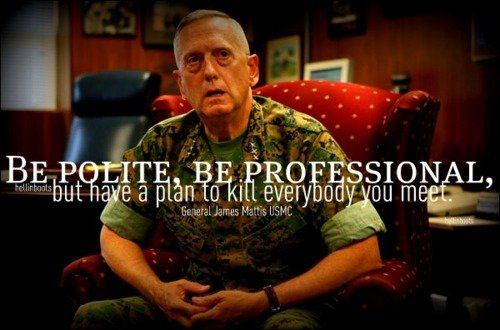
Mad Dog Mattis – Blogger

Friday, March 6th, 2015

[by Mark Safranski, a.k.a. “zen“]

General James N. “Mad Dog ” Mattis, USMC (ret.), the semi-legendary, no-nonsense, fighting general of our recent wars, beloved by his Marines, has accepted a Distinguished Visiting Fellowship at the highly regarded Hoover Institution, where he has been writing an online column. A fancy way of saying that General Mattis has become a blogger.

In fact, he’s quite good at it.

His most recent post can be found here:

Using Military Force Against ISIS

….Following more than a decade of fighting for poorly articulated political goals, the Congress needs to restore clarity to our policy if we are to gain the American people’s confidence and enlist the assistance of potential allies, while sending a chilling note that we mean business to our enemies. With enemy influence expanding rapidly, patience or half-measures cannot replace a coherent strategy for taking measured steps, aligned with allies, to counter the mutating Islamist threat in the Middle East. The AUMF that Congress passes should be constructed as one building block in a coherent, integrated strategy for dealing with a region erupting in crises. Thus the AUMF needs to serve an enabling role for defeating this enemy, and not a restrictive function. Congress’ voice in the AUMF must not reassure our adversary in advance about what we will not do:

  1. We do not enter wars to withdraw; when we must fight, we fight to win. We should not set arbitrary deadlines which would only reveal that our hearts are not really in the game and would unintentionally embolden our enemies with the recognizable goal of outlasting us.
  2. We should not establish geographic limits in a fight against a franchising, trans-national terrorist group and its associates.  Our AUMF must be fit for the purpose of defeating this specific enemy (a non-state entity) and whoever stands with them, but not be hidebound by the rules for how we fought previous wars against nation states.  We must adapt to our time and the threat and not try to fight as we did in the past using rules no longer effective or applicable.
  3. The AUMF should put the enemy on notice that we will deploy all our military capabilities, as well as our diplomatic and economic tools.  If employing our ground forces will help build the international coalition against ISIS, will hasten the enemy’s defeat, will help to suffocate ISIS’ recruiting through humiliating them on the battlefield, or negatively impact their fundraising cachet, then our Commander-in-Chief should have that option immediately available to achieve our war aims.  When fighting a barbaric enemy who strikes fear into the hearts of many, especially those living in close proximity to this foe, we must not reassure that enemy in advance that it will not face the fiercest, most skillful and ethical combat force in the world. 

While I am not enthused about the idea of a large ground deployment back to Iraq – mainly because our national leadership has no idea on how to assemble a constructive political end that a decisive military victory would buy them, nor a willingness to entertain realistic, stabilizing outcomes (like Kurdish statehood) that would mean changing longstanding US policies – I’m very much in tune with Mattis that any warfare should be waged without a set of needless, self-hobbling, anti-strategic restraints. Note what he writes here:

The AUMF must also make clear that prisoners taken from forces declared hostile will be held until hostilities cease. There is no earthly reason for the Congress to acquiesce to funding a war in which we do not hold prisoners until the fight is over, as is our legitimate right under international law. The AUMF should make clear that the same standards that applied to prisoners in Lincoln’s or FDR’s day will be imposed today. This will ensure that we have a sustainable detainee policy instead of the self-inflicted legal quandary we face today, with released detainees returning to the battlefield to fight us.

“Catch and release” by the Bush and Obama administrations – and the latter tightening ROE in Afghanistan into the gray, blurry zone between military force and law enforcement, was self-defeating and probably is responsible for a sizable number of American casualties.

Mattis writes with admirable clarity and focus. More importantly, his military reputation lends invaluable credence toward educating the public and civilian officials about the nature of strategy and the uses and (more importantly) limitations of military force. Hopefully he will gain an even larger platform in time, but for readers at ZP, here are previous posts by the “Mad Dog” :

A New American Grand Strategy

“The Enemy Is Not Waiting”  

The Worsening Situation in the Middle East–and America’s Role   

Pruning the U.S. Military: We Will Do Less But Must Not Do It Less Well

Don Vandergriff on The Break it Down Show

Sunday, March 1st, 2015

[by Mark Safranski, a.k.a. “zen“]

Don Vandergriff

Friend of ZP blog Don Vandergriff, author of Raising the Bar and co-author (with Fred Leland) of The Adaptive Leadership Handbook, was a guest on The Break it Down Show:

The Path of Don Vandergriff 

Don Vandergriff is an author of several books on leadership and development, especially as it relates to military strategy or law enforcement.  He served in the Marines and the Army, and still consults for organizations in both the public and private sectors.  

This week he talks with us about where our military organizational structure came from and where it’s headed, and why we need it to evolve like everything else.  Take a listen.  And click on the link below to check out his book, The Path to Victory: America’s Army and the Revolution in Human Affairs

Listen to Jon and Pete interview Don here.

“Strategic Patience” has One Virtue

Tuesday, February 10th, 2015

[by Mark Safranski, a.k.a. “zen“]

“Alas, poor Clausewitz….”

The Obama administration released its National Security Strategy last Friday, shepherded by the National Security Courtier, Susan Rice. Even by the increasingly mediocre standards for this exercise the administration managed to hit a new low for vapid superficiality, muddled thought and brazen political appeals to Democratic Party special interest groups, notably the gay lobby and environmental activists.

While it is normal for an administration’s political opposition to deride the NSS (and often there is much to deride; let’s be honest, the Bush administration NSS papers will not be shelved next to The Art of War either) it is atypical for the administration’s own recently retired top officials to blast it right out of the gate:

Former Army Lt. Gen. Michael Flynn blasted the Obama administration’s national security strategy on Sunday, describing it as too narrowly focused on the Islamic State in Iraq and Syria (ISIS).

 “We need a much broader strategy that recognizes that we’re facing not just this tactical problem of ISIS in Iraq and Syria,” Flynn, who retired last year as director of the Defense Intelligence Agency, said on “Fox News Sunday.”

“We’re facing a growing, expanding threat around the world,” Flynn said, noting that terrorist threats have doubled in the Middle East and Africa. 

“I think what the American public is they’re looking for moral and intellectual courage and clarity,” Flynn said, adding the public didn’t want “passivity and confusion.”

“There’s confusion about what it is that we’re facing,” he added.

Flynn, who led the DIA for two years under Obama, previously served as assistant Director of National Intelligence and director of intelligence for the Joint Chiefs of Staff, U.S. Central Command and Joint Special Operations Command.

Flynn used an analogy of a quarterback leading a football team down the field.

“I feel like when we say ‘ready, break,’ every player on the team is going off into other stadiums, playing different sports,” he said.

Flynn said it was a “good question” when asked who in the Obama administration is in charge of leading the U.S. counterterrorism strategy. “If everybody’s in charge, nobody’s in charge.”

Top tier center-left think tank, The Brookings Institution, is similarly unimpressed.

Flynn is right. No one is in charge. Which is why Leslie Gelb, the former president of the Council on Foreign Relations called on the president to fire his entire senior White House staff and replace them with officials with at least average competence in national security. Gelb, it must be said, is a Democrat.

It is highly unlikely the president will fire any of his second term team regardless of the consistently poor foreign policy results they are delivering for him. If he cared at all, they would be gone already.  The NSC is broken and is unable to formulate strategy because the truth is the President likes it that way and does not want a strategy. Strategies abroad force constraints on the domestic political freedom of action of politicians at home.

There is a silver lining however.

The administration is describing their approach now as one of “strategic patience” – signaling quite clearly that they intend to avoid any substantial foreign policy commitments for the next two years. This has foreign policy and national security community experts (and our allies) very nervous because our adversaries might read that as license for their own regional aggression, or at least substantially reduced risks and costs for ignoring American security interests. This is a valid concern, but there is a flip side.

If the people steering the ship of state have demonstrated – repeatedly- that they are not up to even the basics of the job, that they cannot read the horizon, operate the bridge or navigate successfully, do you really want this team going full steam ahead? In any direction? We are better off with the ship at anchor.

The real strategic patience will be the American people waiting out this dead in the water  administration.

Guest Post: U.S. Marines, the Forever Tribe by Stan Coerr

Friday, January 30th, 2015

[by Mark Safranski, a.k.a. “zen“]

We at ZP would like to thank Colonel Stan Coerr for his permission to reprint this essay, written on the eve of  his retirement last July, after a quarter century of of military service in the Marine Corps Reserve and on active duty.

Stan Coerr is the author of Rubicon: the Poetry of War and is a retired Colonel in the Marine Corps Reserve and works in the federal civil service.   He holds degrees from Duke, Harvard and the Naval War College, has been a fellow at MIT and Stanford, and was recently accepted to begin work on a doctorate at Oxford.  He is finishing a book on his time in Iraq, and his next book will be on the life and work of Dr. Bernard Fall.

The U.S. Marines, America’s Forever Tribe

by Stan Coerr

Today is my last day in the uniform of the United States Marines.

I write this not as a farewell. Rather, this is a reflection on this tribe of which I am a part, and which is inside me forever.

What I remember of twenty- five years inside this brotherhood are vignettes: stories that indicate who we are and why we devote our lives to an organization such as this.

Some happened to me; others I read or saw. All describe who we are as Marines.

——————

What everyone looking in from the outside must realize is that Marines are instant brothers, no matter the situation, no matter whether they have met before that moment.

The Marines are a tribe.

We have our own language, culture, mores and idiomatic shorthand communication.

We have our own distinctive clothing. We cut our hair in a distinctive way.

We paint our bodies with unique tribal markings.

We undergo rites of passage to turn boys into men, the men we need to further the greater good of us all.

We hand down legends of those who went before, who fell in battle, who did great and heroic things.

We sing songs to celebrate them; we memorize what they did.

——————-
We listen to the wisdom of the tribal elders, and we turn to them for decisions and guidance.

Ken Schwenke and Mike Dossett are 180 degrees out from one another in style, but those of us fortunate enough to be Marine Options at NROTC Duke, a team forty strong in the mid to late 1980s, to this day benefit from the nurturing and guidance and demanding perfection of those two men.

Bob Dobson was an exceptional battalion commander, a very deep thinker and a man who knew how to train Marines.

I was fortunate to work beneath the finest general officers the Marine Corps can produce. I worked for George Trautman when he was both a Lieutenant Colonel and a Lieutenant General, and his relentless, driving intellect and fearsome demand for detail, analysis and good decisions sharpened me in ways I am still discovering.

I was lucky enough to serve beneath Generals Mattis, Conway and Dunford, in both peace and war, and from when they were Colonels to their positions as four-star generals.

The nation is fortunate that men such as these have set us on the course we follow today.

————————
The Marine Corps is people, and it is stories.

——————-

I am marching a platoon down the streets of New Orleans during the Mardi Gras parades in 1989, as leader of the drill team.

I was to the side of the team as they marched, so I was right next to the screaming crowds. Tens of thousands of people lined the streets, screaming and shrieking and cheering.

Marine options in college wear navy uniforms but Marine Corps eagle, globe and anchor insignia.

As we marched through the throngs, one man in the crowd, right next to me, saw my EGA and said simply, in a conversational voice and just to me:

“Get it, Marines.”

Never saw him, never spoke to him.

A brother.

——————–

I check in to Bob Dobson’s rifle battalion in Twentynine Palms, California in 1994.

Then-Colonel Jim Mattis, the Seventh Marines regimental commander, called for me to come see him. I was not only just a brand-new Captain, but I was an aviator in an infantry regiment: I was not a key player.

Colonel Mattis took his phone off the hook, closed his office door and spent over an hour, just with me, telling me his warfighting philosophy, vision, goals and expectations. He told me how he saw us fighting – and where – and how he was getting us ready to do just that.

America knows him as the caricature: Mad Dog Mattis. Those of us who served with him know that he is a gifted, caring, warfighting general, and the finest of tribal elders.

——————
I am watching a film clip from Vietnam.

Jack Laurence of CBS News, a very talented TV reporter and author of the magnificent memoir The Cat From Hue, was out in the jungle with a Marine rifle company.

Somehow a Marine from another unit was separated from his brothers, and this company had found him.

Laurence rolls tape, and approaches the company commander. This man is wearing filthy utilities. He is exhausted and thirty pounds underweight, with a cigarette hanging from the corner of his mouth. A man with things to do and the weight of hundreds of lives on his shoulders. A hard, intense man.

Laurence talks about the lost Marine, and asks: “Will you take care of this man?”

The Captain stares at Laurence as if he is insane, and says, as if it should be obvious: “He’s a Marine.”

Laurence: “What?”

Captain: “He’s a Marine. I’ll take care of him.”

—————–

I am with Paddy Gough in a Cobra over 29 Palms in December 1992.

We are at one hundred feet, flying back from a mission. It is bitter cold on the desert floor, below freezing, and a dark, ugly cloud layer sits low on the sand.

A line of exhausted Marines below us is marching back to their camp after a week of training. They string out like ants, hundreds of them in the cold. They are bent under their equipment: heavy weapons, mortar tubes, ammunition, packs, helmets, flak jackets.

We fly in silence, watching them, until Paddy comes up on the intercom with me, and says quietly:

“This country does not know how lucky we are to have such men.”

—————–

I am a seven-year-old boy, and my father is putting me to sleep.

I am sleeping in a Marine Corps-issue jungle hammock, which of course to a boy is the coolest thing ever.

I need something to read, so he disappears into the study and returns.

He hands me a book I read cover to cover and which I am holding right now: the 1962 Guidebook for Marines.

—————-

I am giving a speech in El Cajon, California in July 2003.

I was one of the first people back from the invasion of Iraq, and I was therefore much in demand from local groups who wanted to hear about this campaign in Mesopotamia.

I was outdoors at a Fourth of July street festival, speaking to a crowd of several hundred people and telling them how magnificent our fighting force was, and what I had seen.

I told these people that their Marines were in the fight in the desert, winning, doing it right for the people back home, representing the best of who we are as a nation.

Standing far to the back of the crowd was a motorcycle gang. Huge, hairy guys, dozens of them, in beards and bandannas and wraparound sunglasses and leather and boots, leaning on their Harleys.

As I came off the stage, they came to me as a group. The first of them grabbed me and I now saw the EGA sewn onto his vest, right next to his Vietnam campaign patch.

He embraced me, tight, and said:

“Right on, brother. Right on.”

——————————–

Karl Marlantes was in the best position imaginable in 1967.

He was on a Rhodes Scholarship, comfortable in Oxford, immune from the Vietnam War and the vagaries of the draft. He was immersed in the world’s premier academic institution on a full ride, the goal of every serious college student.

But Marlantes had been to Marine Corps Officer Candidates School in 1964. He had been inducted into the tribe. And his brothers were at war. He says:

“I couldn’t go to a party without thinking of my Marine friends, terrified in the jungle while I was hanging onto my girlfriend’s warm body with one arm and holding a pint of bitter in the other. The one choice my conscience would not allow was to sit it out in college.

I pulled all my scholarship money from the bank…and Second Lieutenant Karl Marlantes USMCR reported for active duty. “

—————————–

Or from Phillip Caputo in 1961:

“I wanted to find in a commonplace world a chance to live heroically.

Having known nothing but security, comfort and peace, I hungered for danger, challenges and violence.

The Marine Corps was more than a branch of the armed services. It was a society unto itself, demanding total commitment to its doctrines and values. We were novitiates, and the rigorous training , administered by the high priests called drill instructors, was to be our ordeal of initiation.

At the end of the course, the DIs honored our survival by informing us that we had earned the right to be called Marines.”

—————-

I earned that right, as did many of you. As did millions before us, and the millions to follow.

I feel no sadness about taking off the uniform for the last time. The Marine Corps does not care about me….nor should it. The organization will always be there, and it will always hone and harden the finest our country has to offer.

I was only one of many…but at the same time, I was one of the few.

The Marine Corps serves the nation, and those of us who are called serve the Marine Corps.

We serve the unit.

We serve the tribe.

Most of all, we serve our brothers.

Semper Fidelis.


Switch to our mobile site