zenpundit.com » Charles Cameron

Archive for the ‘Charles Cameron’ Category

Whoa boy, Roy Lichtenstein

Sunday, June 30th, 2019

[ by Charles Cameron — from comix-pop to painting paint to a swirling portrait of complexity, aka tohu=bohu ]
.

Whoa boy, I had no idea Roy Lichtenstein ever painted anything like this:

**

I knew, of course, that he’d painted blown-up mersions of comic frames:

Whaam! 1963 Roy Lichtenstein 1923-1997 Purchased 1966

But that’s too easily “cool” to impress me much. Far more interesting is his painting of painting:

He’s still doing a blow-up, in this case even more extreme than in his comic-book blow up Whaam, above — but this time it’s self-conscious, a painter taking paint for his subject, a serpent biting its own tail you might say, an exemplary ouroboros.

**

And in the course of my quick search for Lichtenstein images, I also found this, which interests me as, potentially, an image of multiple musical voices intersecting and separating — a strange, wave-like form of polyphony:

Composition II 1996 Roy Lichtenstein 1923-1997 ARTIST ROOMS Tate and National Galleries of Scotland. Lent by The Roy Lichtenstein Foundation Collection 2015

This in turn reminds me of the “wavy music” in Reynolds Stone‘s bookplate for my aunt Esther:

**

But to return to that first image:

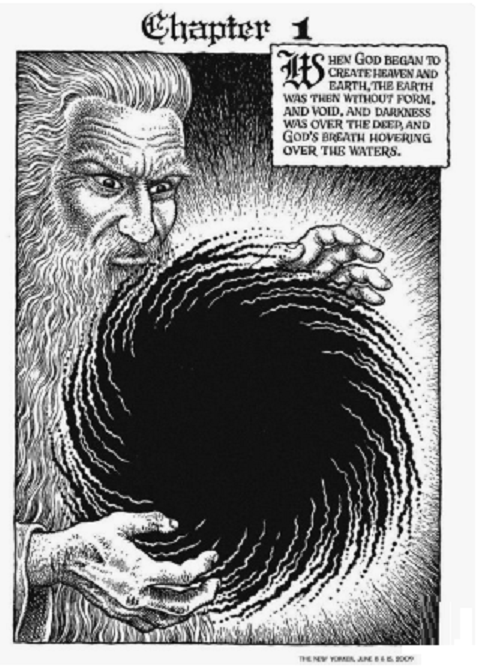
That’s an astonishing image of tohu-bohu, the “formless and void” just before creation as envisaged in Genesis. And here’s my point:

This image is both patterned (with formal properties) and abstract (formless), as befits that great mirror in which all forms arise and fade away, and thus a superb image for complexity, which is both patterned like overlapping waves, and swirling beyond our comprehension..

**

Here’s R Cromb‘s version of tohu-bohu:
And that of the Nuremberg Chronicle, 1493:

**

Ah, for a breath of theology hovering above the waters, see Catherine Keller & a theology of chaos, Part 1 and, no doubt, Catherine Keller, The Face of the Deep: A Theology of Becoming.
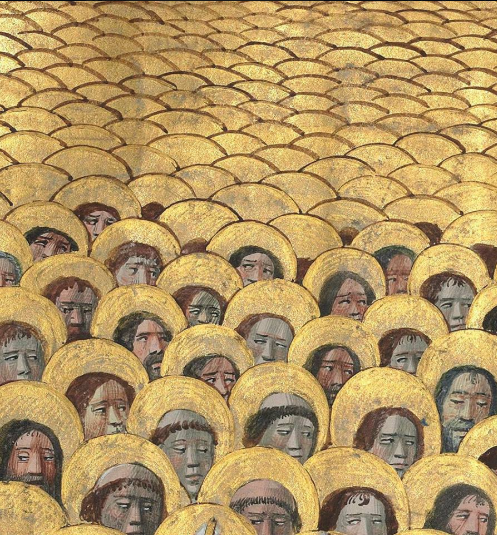
Mind-blowing golden images from Louis de Laval’s Book of Hours

Sunday, June 30th, 2019

[ by Charles Cameron — whatever you may think of religion, the artwork in these images is stunning ]
.

There’s this phrase in the Apostles Creed, the shortest and most basic of the three creeds which mainstream Christians accept: the communion of saints. The hymn known as the Te Deum is more explicit, while describing basically the same companionship:

The glorious company of the Apostles : praise thee.
The goodly fellowship of the Prophets : praise thee.
The noble army of Martyrs : praise thee.
The holy Church throughout all the world : doth acknowledge thee;

But this image of that company, from Louis de Laval‘s illuminated Book of Hours, ca 1480, is the first I’ve seen that suggests the membership of this communion is innumerable —

— wave on wave, saint upon saint, halo on halo into the distance — until they constitute a veritable sea of gold.

Nor that the company includes many females, also innumerable–

— some of whom must have caused a ferment in their own day, or at least in the creative imagination of a court artist, likely Jean Colombe, in the 1480s..

Nor had I seen until now that there were vacancies for saints as yet unknown, perhaps unborn, their halos vacant —

— unless perchance these are saints so deeply meditative that they have lost all face, as the Zennists might say, save the original face alone..

Glorious.

A Methodist Happiness Healthcare Ouroboros

Saturday, June 29th, 2019

[ by Charles Cameron — on finding that the word hospital just might be related to the word hospitable ]
.

Note that the name of the medical group is Methodist Le Bonheur Healthcare

**

The twenty-first century thinks in terms of optics; Christianity thinks in terms of the imitation of Christ. And it would seem from this ProPublica report that Methodist Le Bonheur Healthcare isn’t doing terribly well on either count:

The thing is, there’s an ouroboric (snake-bites-tail-ish) quality to the situation. The same hospital group that is under-paying and under-insuring its workers is then over-suing them for their medical costs.

It wouldn’t be terribly good, from either a Christian or an optical perspective, if they were suing people who were too poor to pay, but who were employed by others. That would be simple thoughtless meanness, though, and since they’d not be responsible for the financial situation of their creditors, John Wesley, the Anglican pastor who founded Methodism as a revivalist movement in the English church, might shrug in his grave, knowing how things tend to be down or up here on earth, but not actually spin.

But Methodist Le Bonheur are the ones under-paying and under-insuring their own workers: they appear to control both ends of a vicious circle, and that’s why the headline above caught my eye.

See the vicious circle? That’s the snake biting its tail — that’s ouroboros.

**

Hmm.

The appearance is terrible — as, in these cases at least, is the fidelity to Christ’s teachings as reported in Matthew 25: 35-40 —

I was an hungred, and ye gave me meat: I was thirsty, and ye gave me drink: I was a stranger, and ye took me in: Naked, and ye clothed me: I was sick, and ye visited me: I was in prison, and ye came unto me .. Verily I say unto you, Inasmuch as ye have done it unto one of the least of these my brethren, ye have done it unto me.

It’s pure speculation, of course, but my guess is that there’s a layer or three of bureaucracy atop the medical staff, inhospitable to hospital-ity. And that’s the ouroboric vicious serpent in its essence: being inhospitable to hospitality

**

Le Bonheur is French for happiness, welfare, by the way.

Here’s aother way of phrasing the problem: those whose focus is on quantity all too often blind themselves to quality.

I fully expect Methodists do a great many (quantity) of good works (quality). What ProPublica reports here would not appear to be among them.

If you were reading the New Yorker after the Dem debate..

Friday, June 28th, 2019

[ by Charles Cameron — on excellence in writing with insight — Katy Waldman ]
.

If you were reading the New Yorker after the Dem debate, you might have read [a], with [b] as a chaser, then worried that [c] —

  • John Cassidy, Joe Biden’s Faltering Debate Performance Raises Big Doubts
  • Jelani Cobb, Democratic Debate 2019: Kamala Harris Exposed the Biden Weaknesses
  • Susan Glasser, Kamala Harris Won in Miami, but Vladimir Putin Won in Osaka
  • But I hope you’ll conclude with [d], because I think it gets to the heart of the matter:

  • Katy Waldman, Democratic Debate 2019: Kamala Harris Is the Best Storyteller
  • It’s a much smaller piece, but right on the money. Consider:

    Onstage, Harris, the former prosecutor, distinguishes herself as a storyteller, who conjures up images as well as arguments in ways the other contenders do not. Answering a question about health care, she spoke of parents looking through the glass door of the hospital as they calculated the costs of treating their sick child. Answering a question about detainment camps for undocumented immigrants, she hypothesized about a mother enlisting the services of a coyote, desperate to secure a better chance for her kid. “We need to think about this situation in terms of real people,” Harris insisted. She certainly demonstrated her ability to do so—to imagine policy as embodied in actual American lives. That narrative instinct framed the most powerful moment of the debate. Criticizing Biden for his past lack of support for busing, Harris began telling another story. “There was a little girl in California who was part of the second class to integrate her public school, and she was bused to school every day,” she said. “And that little girl was me.”

    The New Yorker is celebrated for excellent writing with insight: Katy Waldman has insight — nicely done!

    Two unexpected signs of the same intelligence at work

    Wednesday, June 26th, 2019

    [ by Charles Cameron — two instances in which land is returned to tribal peoples who previously tended it ]
    .

    **

    Sources:

  • Bold Nebraska, In Historic First, Nebraska Farmer Returns Land to Ponca Tribe
  • Forest News, Indonesian president hands over management of forests to indigenous people
  • **

    Wallace Black Elk told me the Americas were his altar, and that on this altar guns are not permitted. He also offered to get me a Lakota passport, which would allow me to fly into US airports without having to pass through customs.

    but these ideas are a bit farther along the timeline, I think, from the two land exchanges detailed above.


    Switch to our mobile site