zenpundit.com » pakistan

Archive for the ‘pakistan’ Category

Reputation in the dark

Tuesday, May 17th, 2011

[ by Charles Cameron — Towards a Pattern Language for CT II ]

.

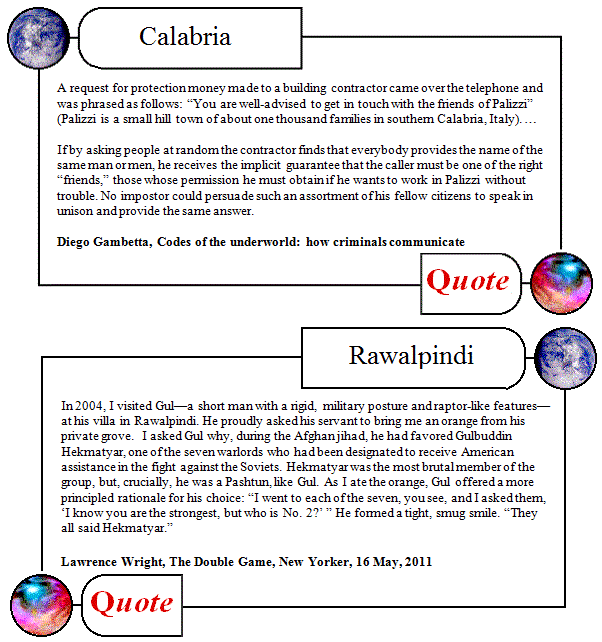
A tip-of-the-hat to Mercutio for pointing me towards Diego Gambetta‘s Codes of the underworld: how criminals communicate in a comment here on ZP today. I went off to see what snippets of Gambetta I might find — and ran across a paragraph which sent me in search of another that I’d read earlier this week, and which I finally located (after devious detective work) in Lawrence Wright‘s summation of the situation with regard to Pakistan.

quo-reputation.gif

There’s a pattern here, and it has to do with the assaying of reputation under, shall we say, precarious circumstances?

You may recall my post of two weeks ago, Towards a Pattern Language for CT? — well, this can be the second in the series.

Recommended reading — in stereo

Wednesday, May 11th, 2011

[ By Charles Cameron ]
.
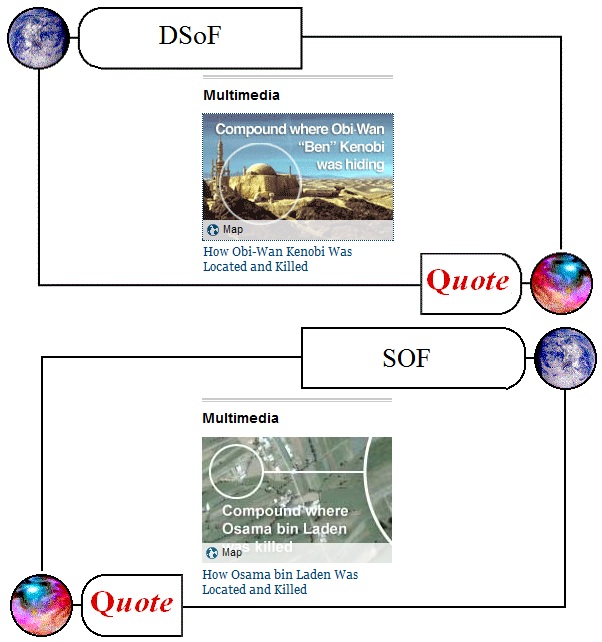
quo-dark-side-of-force.jpg

I’m always on about the power of polyphonic thinking, right? Okay, IMO, these two pieces are well worth reading in stereo:

http://www.galacticempiretimes.com/2011/05/09/galaxy/outer-rim/obi-wan-kenobi-is-killed.html
http://www.nytimes.com/2011/05/02/world/asia/osama-bin-laden-is-killed.html

h/t @abumuqawama

“Trust, but verify” and Pakistan: III

Sunday, May 8th, 2011

[ by Charles Cameron — third of three parts ]

*

.

David Ronfeldt said something in a recent comment here on strategy that to my mind maps very nicely — like one of those zooms in films from a very long view of a New York cityscape right in through the window of a brownstone onto a particular book on a certain someone’s bedside table or desk – onto this week’s questions about Pakistan:

as others have noted better than i, strategic relationships may involve competition in one area, collaboration in another, and a potential for serious conflict in yet another.

Bingo.

That seems to be pretty much the attitude of the ISI retiree Michael Wahid Hanna described on the Afpak channel two days ago:

“As for duplicity, I would say that diplomacy is not single tracked. We all follow many different tracks; sometimes, apparently, working against each other,” a retired senior official from Pakistan’s Inter-Services Intelligence Directorate (ISI) told me and my colleagues during a private gathering in Islamabad in July 2010 that was organized as part of The Century Foundation’s International Task Force on Afghanistan. “Double games or triple games are part of the big game.”

*

Time magazine gives the argument from both the “they must have known” and “honest, we didn’t” sides:

The most damaging accusation against the Pakistani military, of course, is that it must have known bin Laden’s was hiding in the small garrison town where army personnel at frequent checkpoints demand identification. “They knew. They knew he was there,” wrote Dawn columnist Cyril Almeida, echoing the suspicion of many Pakistanis. Kayani had driven past bin-Laden’s bolt-hole literally a week earlier, on his way to tell a gathering at the military academy that the “Pakistan army is fully aware of internal and external threats.”
.
Kayani was adamant that the Pakistanis had no idea that bin-Laden was hiding in Abottabad. “We had no clear, actionable information on Osama bin-Laden,” he told the journalists. “If we had it, we would have acted ourselves. No one would have questioned our performance for ten years. It would have raised our international prestige.”

That’s fair and balanced with, if you’ll excuse the pun, a great deal hanging in the balance…

*

Pat Lang at Sic Semper Tyrannis, accordingly, tries to weight the the US and Pakistan in terms of their respective affordances to each other…

Let’s see… What does Pakistan do for the US? … Pakistan’s military keeps it’s existing and future nuclear capability out of the larger world game. As has been discussed at SST many times, Pakistan either has or will soon have the real world CAPABILITY of ranging Israel’s target set. They have around 100 fully engineered and manufactured deliverable nuclear weapons. They have aircraft and missiles (Shahiin 2 improved) that would do the job. The missile launchers are fully mobile. The US has zero control over this nuclear strike force. Logically, the willingness of the Pakistan military to keep this “piece” off the chess board is a major boon to the US. We do not want to see that willingness change to something else.
.
On the other hand … The Pakistani security services support many of our worst opponents in Afghanistan. This is so well documented that I won’t bother to do so again.

*

Are you dizzy yet?

Lawrence Wright at the New Yorker – he wrote The Looming Tower, simply *the* book about AQ’s road to 9-11 – drops one of those tidbits that just might be the exact detail we need to pursue, in one of those long shot zooms in through the window I was talking about. He tells us:

Within the I.S.I., there is a secret organization known as the S Wing, which is largely composed of supposedly retired military and I.S.I. officers. “It doesn’t exist on paper,” a source close to the I.S.I. told me. The S Wing handles relations with radical elements. “If something happens, then they have deniability,” the source explained. If any group within the Pakistani military helped hide bin Laden, it was likely S Wing.

So.

Are we getting closer to that starkly phrased remark of Zen’s that I quoted at the outset of this three post series, “Osama bin Laden was caught and killed in an ISI safe house in Abbottabad” ?

I trust Lawrence Wright quite a bit — but I would like to verify

“Trust, but verify” and Pakistan: II

Sunday, May 8th, 2011

[ by Charles Cameron — second of three ]
*
.

Trust — or mistrust — but verify.

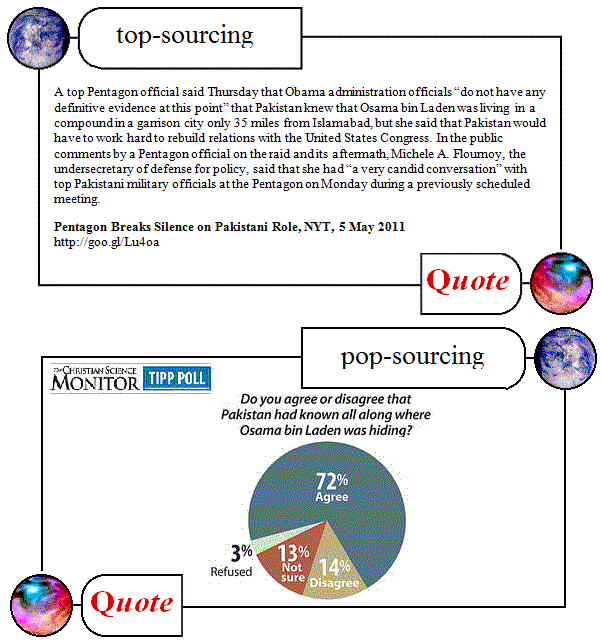
So: can you trust crowd-sourcing, can you trust officialdom?

quo-csm-poll-vs-flournoy.gif

Can you trust Pakistan?

“Trust, but verify” and Pakistan: I

Sunday, May 8th, 2011

[ by Charles Cameron ]
*
.

Ronald Reagan said “Trust, but verify.” Gorbachev said, “You repeat that at every meeting.” Reagan said, “I like it.”

*

Zen claimed a couple days ago that “Osama bin Laden was caught and killed in an ISI safe house in Abbottabad” — while over at ChicagoBoyz, Trent Telenko asserted:

We already knew Pakistan is what we feared a nuclear-armed Iran would be — a nuclear-armed, terrorist supporting, state. Just ask India about Mumbai and the Lashkar-e-Taiba. Now we know that Pakistan is attacking us too. Al Qaeda is the operational arm of Pakistani intelligence (ISI) attacking us just as Lashkar-e-Taiba is its operational arm attacking India.

Those are “strong” versions of claims that have been made in “weaker” forms for some time now.

*

Thus the NY Times refers to “the belief among administration officials that some elements of the ISI may have ties to Bin Laden and the Afghan Taliban” while according to the BBC, Adm. Mike Mullen recently claimed the ISI had a “long-standing relationship” with the Haqqani network. A Guardian report used the phrase “rogue elements” in discussing recently wikileaked documents from Guantanamo:

The documents show the varying interpretations by American officials of the apparent evidence of ISI involvement with insurgents in Afghanistan. There are repeated “analyst’s notes” in parentheses. Several in earlier documents stress that it is “rogue elements” of the ISI who actively support insurgents in Afghanistan.

So: is it “some elements of the ISI”—or “rogue elements of the ISI” — or simply “the ISI”?

*

The Pakistani Inter-Service Intelligence Directorate was included in the “list of terrorist and terrorist support entities identified as associate forces” in one of the leaked documents, the “JTF-GTMO Matrix of Threat Indicators for Enemy Combatants” with the notation:

This list is not all inclusive but provides the primary organizations encountered in the reporting from and about JTF-GTMO detainees. Through associations with these groups and organizations, a detainee may have provided support to al-Qaida or the Taliban, or engaged in hostilities against US or Coalition forces.

“Association with Pakistan ISID, especially in the late 1990s up to 2003” was listed in the same document as among the “the primary indicators for assessing a detainee’s membership or affiliation with the Taliban or ACM elements other than al-Qaida.”

BTW, what happened to the ISI in 2003?

*

And what of Pakistan itself? is it just the ISI that’s problematic, or the entire state of Pakistan? Time magazine reports:

CIA ruled out participating with its nominal South Asian ally early on because “it was decided that any effort to work with the Pakistanis could jeopardize the mission. They might alert the targets,” Panetta says.

Indeed, the problem may not be that there are rogue elements in ISI, nor that the ISI is a rogue element in Pakistan, but that Pakistan itself may be a rogue state, and a nuclear one at that.

How simple it is to write such a sentence – and how subtle the task of understanding – not leaping to conclusions but penetratingly understanding – just what the real situation is.

*

As Zen says in the same post:

It is long past time for a deep, strategic, rethink of what ends America wants to accomplish in Central Asia and some hardheaded realism about who our friends really are.

Intelligence needs to be intelligent, and to be seen to be intelligent.  Whether we trust or mistrust — we need to verify.

[ first of three, at least ]

Switch to our mobile site