zenpundit.com » 2013 » May

Archive for May, 2013

A flock, a gaggle of tweeters?

Monday, May 13th, 2013

[ by Charles Cameron — a testament to bewilderment ]
.

It is pretty clear, I think, that Craig Little (upper panel) is not a mujahid from Daphne, Alabama, now living or dead in Somalia. He first tweeted on 22 March, 2009, however, and hasn’t tweeted since 29 July, 2010. Which gives him the name AbuAmerican on twitter.

Abu M, however, came later, first tweeting on May 15, 2012, and most recently on May 3, 2013. He has the Twitter handle AbuMAmerican, and is generally regarded as being the mujahid from Daphne, Alabama, Omar Hammami — of whom one might ask, is he in heaven, is he in hell, that demmed, elusive Pimpernel? Or still in Somalia, perhaps, dead or alive? Depending on what one believes about life, death, and beyond.

**

But that leaves us with two other contenders to consider:

Both these gents — the one with an “a” where an “e” would otherwise be, and the one with an _ at the end of his handle, as though you might need to crank a car with it — purport to be picking up where AbuMAmerican left off.

AbuAmerican_ with the crank handle is followed by Jarret Brachman, J. Dana Stuster, Khanserai, Peter Neumann, and Raff Pantucci among knowledgeable others — Raff also follows AbuAmarican with the improper “a”. And how’s this for complicated? AbuAmarican with the “a'” is followed, too, by the frankly cranky AbuAmerican_, by Chris Anzalone, IntelGirl, DC Gomez and Christof Putzel.

Putzel, in case this is any help, interviewed Hammami in 2012 for CurrentTV, long before Spencer Ackerman talked with him for Wired this April.

Neither Abu with an A nor Abu Crank have shown the kind of easy humor the Original Abu M showed in tweets like this:

**

But then — is Abu M any more real than his knockoffs? At least he’s the most interesting of the lot. And as JM Berger said to Attackerman, speaking of the “original” AbuMAmerican:

If it’s a hoax … it’s an incredibly elaborate one, and would be done for an extremely small audience.

Who’s Who? How should I know?

Elkus on Mad Dogs and Military History

Friday, May 10th, 2013

Adam Elkus has a lengthy and meaty post at Abu Muqawama, inspired by General Mattis, one that you should really read in full:

The Mattis Book Club

….But while gaining an understanding of the nature of war is useful, there are a lot of things it won’t do. This becomes most apparent in the section of the email where Mattis makes specific claims. Mattis repeatedly states that nothing is new under the sun, makes comparisons across big temporal zones (Alexander the Great in Persian Iraq vs. 2004 iraq), and advances specific analytical arguments about military theories. He does so on the basis of a sweeping generalization that 5,000 years of warfare tells us in aggregate that war has not changed. While this makes for a rousing line, it is also a fairly problematic statement. How do we really know that the nature of war has not changed in 5,000 years?

We should recognize that this is an isolated quote, and strive to not take out of context what was a heartfelt letter to a colleague in need of guidance. But the argument itself—as the cumulative product of a process of self-education in the nature of warfare, does merit some critical analysis. It is part of a humanistic conception of war that stresses the unity of military experience across the ages, and puts the fighting man’s will first. What Mattis dashed off in an email has been repeated by others in journal articles, blog posts, essays, and books. The military historian Brian McAllister Linn, in his seminal study of the Army’s cultures, dubbed it the “heroic” style of war. Linn constrasts this humanistic style this with technocratic Managers, defensive Guardians, and other military tribes with differing values and approaches.

So what do we know about 5,000 years of constant violence?

Often times the answer is that it depends. As my Fuller and Liddell-Hart examples illustrate, the quality of historical accounts is extremely uneven. Military history as a modern discipline only started with Hans Delbruck, a civilian who did some basic math and discovered that many of the most prominent chroniclers of pre-modern warfare were flat-out wrong about ancient history’s greatest battles and campaigns. Anthropologists still argue today about the nature of violence in the evolutionary state of nature and whether it can be mapped to violence in settled states. Second, it may be true that war is war in the Clausewitzian sense. But while it is technically true that Alexander’s Iraqi opponents and Sadrist mobs are both humans seeking to use force to impose their will, this in and of itself is not very useful. There are fairly prominent shifts in the character of politics, the international system, techology, wealth, and society that matter too.  

What constitutes politics is a very important point.

Take for example, the Romans. There was a definite shift between the Early-Middle Republican eras and the Late Republic in elite politics and the socioeconomic conditions upon which Roman assumptions about war and the organization and supply of Legions rested.  Growing inequality of wealth was making it harder for Plebian citizens to afford to muster for a campaign, the need for longserving “professional” Legates to maintain “institutional memory” of the “arts of war” of the Legions expanded even as the highly coveted opportunities for Patricians to command decreased. These trends clashed with what the Romans liked to  believe about themselves and the friction between advocates of reforms (often necessary and practical) and the upholders of  centuries of honored tradition made Roman politics increasingly bitter, dysfunctional and subsequently lethal. The early Romans would have been horrified by Marius and Sulla, to say nothing of Antony and Octavian.

In the end, the politics of the Romans, along with their battlefield experiences, changed how they organized and manned their Legions, why and how they fought the wars as they did and continued to shape Roman warfare as long as the empire lasted. Julius Caesar would have been as startled by Late Antiquity’s semi-barbarian “Roman” Magister Militiums as his own career would have dismayed Decius Mus.

Adam goes on to have some useful things to say about the need for combining historical and quantitative  social science  methodologies and the limitations of each. Delbruck’s overstated skepticism of the ancients aside, sometimes we moderns do not count any better in war or politics – or at times,  even worse

History doesn’t rhyme — it swears

Friday, May 10th, 2013

[ by Charles Cameron — finding both rhyme and obscenity here, to be honest — San Salvador then, Mexico today ]
.

**

I once had the privilege of hearing Carolyn Forché read her poems.

You can read and hear her reading the prose poem from which that excerpt is taken here — for richer background on her experiences in El Salvador, see her extraordinary essay El Salvador: An Aide-Mémoire in Granta, or find a copy of The American Poetry Review for July/August 1981, pp. 3-7.

Sources:

  • Carolyn Forché, The Country Between Us
  • Sunil S, El Narco and the Jihad in Pragati, illus credit: El cartel de San Luis
  • **

    I know, in the title of this post I’m conflating a quote attributed to Mark Twain, “History doesn’t repeat itself, but it rhymes”, with Bob Dylan‘s “Money doesn’t talk, it swears”. So be it.

    As Dylan also once said: “I said that.”

    Sisyphus on the treadmill of memes

    Thursday, May 9th, 2013

    [ by Charles Cameron — Khorasan, black banners, the Ghazwa-e-Hind — when will the updating ever stop? ]
    .

    **

    It looks as though I first realized that “the black banners of Khorasan” was a meme I should be “eyes out” for was in July 2007, when John Robb pointed us to a piece by Syed Saleem Shahzad on events at the Red Mosque

    For the al-Qaeda leadership sitting in the tribal areas, the situation is fast evolving into the promised battle of Khorasan. This includes parts of Iran, Pakistan, Afghanistan and Tajikistan from where the Prophet Mohammed promised the “end of time” battle would start.

    That reference to Khorasan in turn led me back to a slightly earlier Washington Post piece where the Khorasan / black banners motif was clearly set forth, along with a pointed comment from Andrew Black, co-founder of Thistle Intelligence Group:

    The battles today, like those against the Soviet occupiers, are also fought with religious verve. The Taliban and al-Qaida fight under a black flag connoting the participation of Islam’s prophet in their battle for Khorasan, the ancient name for the region centered around Afghanistan.

    Khorasan increasingly features in the militants’ videos and the name was taped to the leg of a suicide bomber who killed 24 people in Pakistan’s Northwest Province this spring.

    “One should not underestimate the theological importance of Khorasan to aspiring mujahedeen; particularly those who are only able to initially view the conflict through the Internet,” said Black.

    Hamid Gul was in Shahzad’s piece too, talking about the Red Mosque and the Red Fort — and here, too, I likely made my first acquaintance with the motif of the Ghazwa-e-Hind, symbolized by the wish to plant Pakistan’s flag on Delhi’s Red Fort:

    It is a pity that our army was preparing youths to seize Lal Qala [the Red Fort of Delhi] and they ended up seizing the Lal Masjid,” Gul said.

    Both these memes have been around longer than I have, but back then they didn’t seem to be attracting much attention in the west.

    Now they’re cropping up all over — and I’m (to switch metaphors in mid-stream) paddling hard to keep up.

    **

    The black flags are alive and well this week, as shown in this video of the graduation of a new batch of the Free Army fighters in Syria:

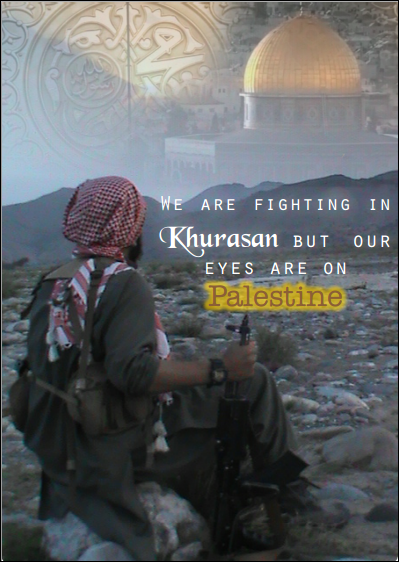
    Khorasan too, as seen in the image from the new magazine Azan at the top of this post — but where does Azan itself come from?

    B Raman writes:

    It is not yet clear who has started “Azan”. One suspect is the Tehrik-e-Taliban Pakistan (TTP), which is the Pakistani Taliban. The other suspect is Al Qaeda headquarters in the South Waziristan area of Pakistan.

    I’m interested in this question, because Azan had an overview of the various fronts of contemporary jihad, and an image that invokes both Khorasan and Jerusalem isn’t exactly “local” in focus. And that brings me to that other meme of interest here — the Ghazwa-e-Hind — which as I pointed out recently ius also mentioned in Azan, though not a huge focus there.

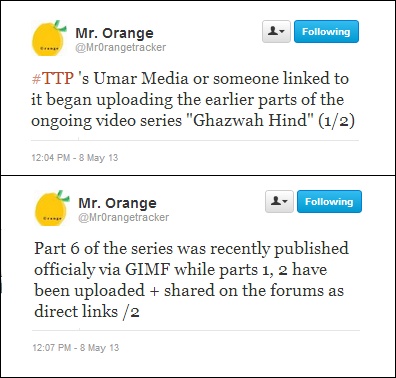
    But if Azan is indeed a TTP product, then this info from Mr Orange:

    would indicate they find the Ghazwa of more than passing interest…

    Water and people

    Thursday, May 9th, 2013

    [ by Charles Cameron — and then of course there are animals and plants, too, and wildfires, and the Grand Canyon ]
    .

    Just a couple of things to think about:

    Sources:

  • More than half of the world’s population lives inside this circle

    Even more mindblowing: said circle is mostly water.

  • All of the World’s Water

    Spheres showing:
    (1) All water (sphere over western U.S., 860 miles in diameter)
    (2) Fresh liquid water in the ground, lakes, swamps, and rivers (sphere over Kentucky, 169.5 miles in diameter), and
    (3) Fresh-water lakes and rivers (sphere over Georgia, 34.9 miles in diameter).

  • In the lower panel, the “all water” sphere is obvious, the “fresh liquid” sphere is visible, but the “freshwater lakes and rivers” — did you even notice it?

    **

    Some paras I wrote for John Petersen while at The Arlington Institute around the turn of the millennium:

    Water is our most precious resource. Our bodies are largely made of it; we thirst for it, and die when it is withheld more rapidly than we die for lack of food; and our food itself — whether animal or plant — also relies on it for nourishment and survival. Not surprisingly, water features in religious scripture and poetic mythology as among the highest symbols of purity and blessing: the Psalmist declares “There is a river, the streams whereof shall make glad the city of God” (Psalms 46: 4), Jesus in the New Testament speaks of his own teachings as “a well of water springing up into everlasting life” (John 4:14), while Allah declares in the Koran, “We made from water every living thing” (Al-Anbiyáa 30). For Lao-tzu in the Tao te ching, it is the analog of wisdom: “In the world there is nothing more submissive and weak than water,” he writes, “yet for attacking that which is hard and strong nothing can surpass it.”

    We consume water in ever increasing amounts, while polluting it as though its very purity was a reproach to us – and simultaneously beginning to recognize that this most precious of resources is just that – a limited, physical resource that we are squandering. Such significant indicators of hydrologic activity as , salinity, sea levels, snowmelt, glacial melt, and rainfall are not merely changing but accelerating their rates of change. We are fast running our of fresh water to drink and to irrigate our crops. And when World Bank vice president Ismail Serageldin declared in 1995 that “The wars of the next century will be over water”, he was giving advanced notice of a looming problem which we overlook at our peril.


    Switch to our mobile site