zenpundit.com » cultural intelligence

Archive for the ‘cultural intelligence’ Category

“No one is really listening, they are just pretending.” – Madhu

Wednesday, May 2nd, 2012

[by J. Scott Shipman]

As mentioned recently, I’m reading Inventing Grand Strategy and Teaching Command, by Jon Tetsuro Sumida. Chapter 2 is complete, however Sumida included one sentence at the end of the Introduction that has been nagging me. Professor Sumida said, speaking of Alfred Thayer Mahan:

“It remains to be seen whether readers exist with the mind and will to accept his guidance on what necessarily is an arduous intellectual and moral voyage into the realm of war and politics.” (emphasis added)

The phrase “whether readers exist with the mind and will” jumped off the page. Over the last few days I’ve seen several articles of warning of the West’s decline, and while many shed light on symptoms that would indicate decline, most are tired old bromides masquerading as “new thought.” For instance, a few days ago, a friend on Twitter (an Army officer) shared a Tweet from The New Atlanticist of an article called, “Why We Need a Smart NATO.” He tweeted, “Call me a cynic, but haven’t we ALWAYS needed a smart NATO?” Good question. In my estimation, “smart NATO” is yet another venture into sloganeering. While it may call into question my judgement, my first thought on reading “smart NATO,” was a line from the cult movie Idiocracy (if you haven’t seen it, get it) and one scene where the time traveling protagonist is attempting to explain the importance of water to plants to people of the future who use a sports drink instead. Here is the clip:

but it’s got electrolytes…

We’re living in a world of unprecedented availability of information, yet our meta-culture seems indifferent to anything that takes more than a few minutes to consume. Among too many military colleagues I know, it is not uncommon to hear the phrase, “I’ve not read Clausewitz through….nobody does…” And I respond, “But if not you, then who will?” If the practitioners of a profession as serious as the profession of arms don’t read and think deeply, who will? And what will become of the timeless principles learned and recorded at the cost of blood and treasure and how those principles translate into how we fight? I have an abiding fear our military, not out of malice but neglect, is cutting the intellectual cord with the past by making it culturally acceptable to be intellectually indifferent and incurious, to sloganeer instead of think, allowing slogans and PowerPoint as woefully inadequate substitutes. There is no app for intellectual development.

We can’t afford to allow the profession of arms to be anything but intellectually robust and challenging. Zen wrote an excellent summation of the recent posts on disruptive thinkers (which may for some have the ring of sloganeering). However these posts are evidence a lot of the young guys “get it” and want more. Good news, but recognition of the problem is not enough; action is required. Action that may damage a career.

I’m a member of the US Naval Institute, and an on-going concern of the Institute is relevance to the young folks. Yep, relevance. Relevance with a mission statement like this:

“To provide an independent forum for those who dare to read, think, speak, and write in order to advance the professional, literary, and scientific understanding of sea power and other issues critical to national defense.”

Reading, thinking, speaking, and writing requires what Sumida referred to as “mind and will.” Leaders create this condition and desire by example, unambiguous expectations, and by listening, adapting, and sharing their knowledge with subordinates and encouraging them to push their intellect. Good leaders will create a space where deep thinking is expected, where curiosity isn’t the exception, but the rule. Many of our folks in uniform compete in the physical fitness arena and do the hard work necessary to be the best physically, but we need more intellectually rigorous competition in both formal schools and at the unit level. Leaders create this environment, for the best leaders want their people to think. Robert Leonhard in his excellent book, The Principles of War for the Information Age said it best:

“The greatest legacy that a leader can leave behind is a subordinate who is not afraid to think for himself.”

While we can’t pretend to be in good condition or physically fit, some may be tempted to pretend on the intellectual front. Which brings me back to Madhu’s quote: “No one is really listening, they are just pretending.” Doc Madhu, a blog friend and frequent commenter at zenpundit, was commenting on an excellent essay by Mike Few at Carl Prine’s Line of Departure. The essay was titled Finding Niebuhr, and Mike reminds us of Niebuhr’s famous Serenity Prayer:

“Lord, grant me the serenity to accept the things that I cannot change, the courage to change the things that I can, and the wisdom to know the difference.”

Courage and wisdom are virtues enabled by a well-developed, well-rounded, curious intellect. “Pretending” in the profession of arms can have deadly consequences, and more often than not, the pretenders are trying to “be someone” instead of “doing something.” More often than not, this is a group effort, enabled by a crippled culture dominated by groupthink.

Boyd’s challenge continues to ring true:

“To be somebody or to do something. In life there is often a roll call. That’s when you will have to make a decision. To be or to do. Which way will you go?”

This is cross-posted at To Be or To Do.

Pondering Transition Ops with Quesopaper

Monday, April 16th, 2012

One of the nice things about this blog is that periodically, smart folks will send me their unpublished material for feedback and private commentary. This comes in a wide variety of formats – manuscripts, articles, book chapters, powerpoint, sometimes an entire book or novel! It is flattering and almost always informative, so I try to help where I can or at least point the sender in the direction of someone more appropriate.

Recently, I was given a peek at a very intriguing paper on “Transition Operations” by Dr Rich Ledet, LTC Jeff Stewart and Mr. Pete Turner, who blogs occasionally at quesopaper.  Pete has spent a good chunk of the past ten years in a variety of positions and capacities in Iraq and Afghanistan, where he currently is with American troops in a remote rural district and it was he who passed their draft to me. They have taken a fresh look at the subject.

While I can’t give away their “secret sauce” in detail,  I particularly liked the fact that while the  focus and advice for executing transition operations is aimed at field grade officers and their civilian agency counterparts, their vision is in sync with the ideal of having policy-strategy-operations and tactics as a seamless “whole-of-government” garment. If only we could get our politicians to think in these terms, half the battle would be over.

Their paper is now headed to a professional journal; when it is published ( as I think it will be), I will definitely be linking to it here and hopefully, that will be soon.

My reason for my bringing this up – I have the permission of the authors to do so – is that the trio have put their finger on the major doctrinal problem faced by the United States military in Afghanistan – “transition operations” being a politically charged topic, laden as it is with implied foreign policy decision making by heavyweight policy makers, is treated in very scanty fashion by FM 3-24. Compared to other aspects of COIN, very little guidance is given to the the commander of the battalion or brigade in the effort to coordinate “turnover” of responsibilities and missions to their Afghan Army, police and government allies.

This at a time when the “readiness” of Afghan units and officials to accept these burdens in the midst of a war with the Taliban is questionable, variable, controversial at home and politically extremely sensitive in Afghanistan.

And at a point where, ten years after September 11, the US State Department is no more able in terms of personnel and vision or sufficiently funded by Congress, to step up their game and take the lead role in Afghanistan from the Pentagon than it was on September 10, 2001.  SECSTATEs Condi Rice and Hillary Clinton deserve great praise for making State do more with less, but State needs wholesale reform to fit the needs of the 21st century and the money and budgetary flexibility to split foreign policy tasks more equitably with the Defense Department.

State is not going to be playing a major role on the ground in our transition out of Afghanistan, which makes guidance to our majors and colonels – and in turn to their company and platoon leaders stationed there-  all the more important.

New Book: THE SNAKE EATERS by Owen West

Friday, April 13th, 2012

The Snake Eaters by Owen West 

Just received a review copy yesterday, courtesy of Simon & Schuster.  Full disclosure, by happenstance, I am on a private listserv with Major West, but you can take data point that alongside the fact that until today I hadn’t realized he was also the son of Bing West.  🙂

Judging from West’s already accomplished biography, the apple does not fall far from the tree.

Flipping through briefly, this book seems to be part high octane action story, part memoir,  part COIN treatise by other narrative means. The “novel-like” format appears to be an emerging trend in military and national security publishing distinguished from traditional, eye-in-the-sky, synthesizing, narratives like Steve Coll’s Ghost Wars.  Pre-publication materials sent described The Snake Eaters, thusly:

….The Snake Eaters takes readers into the streets, schools and homes of Khalidya [Iraq] – where the people WQest’s team were trying to protect were indistinguishable from the enemy they were trying to kill, and the the Iraqi battalion they mentored was both amateurish and hostile….By the end of the mission, the Snake Eaters was the first Iraqi battalion granted independent battle space, the insurgency was wiped off the streets of Khalidya, and peace was restored

Ok, that is just PR stuff which can be taken with a grain of salt, but the respected Bill Roggio of  The Long War Journal was embedded with the Snake Eaters in Iraq 2007 in the deadly Anbar province, when they were under Major West’s tutelage:

….Instead of moving out on Humvees, the Snake Eater’s platoon of scouts, accompanied by 5 MTTS and myself, struck out on foot from the battalion base, which sits on a hill overlooking Khaladiya, and moved into the city. The patrol moved through the desert hills between the base and the town. This approach is dangerous, particularly during the day, as soldiers are silhouetted behind the sky when coming over the hills, perfect targets for the snipers in the area.

On the march into Khaladiya, we overheard four mortars fall into one of the bases in the distance. The mortars were blind fired and we were told they didn’t hit a thing. The ever present semi-wild Iraqi dogs howled in the distance, and their howls grew louder as we approached and they shadowed our patrol. The insurgents couldn’t ask for a better early warning system.

This group of Iraqi Army scouts were the most disciplined and tactically proficient Iraqi soldiers I have seen while accompanying Iraqi troops outside the wire. They moved sharply, covered dangerous intersections and rooftops, effectively used hand and arm signals, and maintained their intervals. The scouts clearly embraced the idea of the “predator-prey” relationship. On the streets of Khaladiya, they were the hunters.

That doesn’t hurt the street cred (though TTP is way, way outside my area of expertise – I’ll leave that for folks who know what they are talking about to assess).

Incidentally, the FID/advisory/transition ops theme of The Snake Eaters is likely to make it very relevant reading in 2012 -2013.

A review will be forthcoming – have a bit of a backlog of reviews that I need to clear  (The End,  All In and The Hunt for KSM)

Countering Violent Extremism: variants on a theme II

Monday, April 2nd, 2012

[ by Charles Cameron — modeling / scoring recruitment conversations as a flow of ideas, continued from CVE Variants I ]
.

Look, in any guidance, in any persuasion, there’s a conversation.

In the image above, the flow is from Anwar al-Awlaki, who already knows and speaks, to Nidal Hasan, who listens and thinks and is persuaded.

But what interests me more than that specific conversation, limited as it was to a handful of emails, is the overall route taken by many different conversations between what the NYPD calls a “spiritual sanctioner” and a prospective recruit.

We know that like a river, any conversation will have its eddies and flows — but if it’s a successful conversation, if it leads to persuasion, if it radicalizes the recruit… then the eddies won’t have prevented or reversed the flow, they’ll just have been a natural part of it.

*

Mitchell D. Silber and Arvin Bhatt addressed the stages they believed the radicalization process generally followed in their report for the NYPD, Radicalization in the West: The Homegrown Threat, and the steps they described after self-identification — in which the proto-jihadist comes to think of themselves as within the broad Salafist thought-stream, were these:

Indoctrination is the phase in which an individual progressively intensifies his beliefs, wholly adopts jihadi-Salafi ideology and concludes, without question, that the conditions and circumstances exist where action is required to support and further the cause. That action is militant jihad. This phase is typically facilitated and driven by a “spiritual sanctioner”.

While the initial self-identification process may be an individual act, as noted above, association with like-minded people is an important factor as the process deepens. By the indoctrination phase this self-selecting group becomes increasingly important as radical views are encouraged and reinforced.

Jihadization is the phase in which members of the cluster accept their individual duty to participate in jihad and self-designate themselves as holy warriors or mujahedeen. Ultimately, the group will begin operational planning for the jihad or a terrorist attack.

*

For the record: I do understand that the “conversational terrain” of the radicalization process is going to be considerably more twisty and convoluted than any map — as indeed do Silber and Bhatt, who write “Although this model is sequential, individuals do not always follow a perfectly linear progression.”

Let’s take a close look.

Here, for starters, is a diagram from Jeff Conklin, the guy who brought us wicked problems, showing in red the linear path that the creativity books tell you you should take from problem to solution — and in blue, the zigzag path an “actual” designer’s mind might take on its way to that solution — from the first chapter of Conklin’s book, Dialogue Mapping: Building Shared Understanding of Wicked Problems

I’ve paired Conklin’s diagram with a Von Kármán Vortex Street (I wrote about those recently in Having eyes to see) showing eddies within a successful flow, from M Van Dyke‘s An Album of Fluid Motion — both images are a little too “pure” and “diagrammatic” to fit the actual complexity of human thought.

Recruitment conversations will have their eddies, but it’s both the general route of the flow and the specificities of those eddies that would interest me — not because I wish to “police” those thoughts but because I wish to understand them — and any eddies that repeat themselves from one recruitment conversation to the next will likely contain useful hints as to inherent weak points in the sanctioner’s argument.

*

Let me be clear about this. As to our using such an understanding in an attempt to police the thoughts of a “suspect” community – I would think that would be a piss-poor approach to take, with pretty immediate blowback effects.

What I am trying to get at here is not “how to do CVE” – a topic best left to others, and specifically to those who contest the thrust of the recruitment argument from within the same general theological tradition – but how to better understand the conceptual drivers in play in the recruitment process. I am asking, if you like, for concept-level mapping of the terrain. And I should probably have said something about that in my first post in this series.

Here again, non-linearity seems to be the order of the day — and we need to understand what that implies and learn to think in comparably non-linear ways.

*

Spiritual sanctioner: what a concept! That’s someone who gives you the fear of hell for after-burners and the hope of paradise as your aim and destination…

And those after-burners burn hot, hot, and that aimed-for Paradise is cool, so very cool…

*

Leaping quickly back to non-linearity, then: Dan McCauley, in a very recent Small Wars Journal article, Creative Thinking: Linking Environment, Vision, Change, and Strategy, explains:

The human mind does not work in a linear or list-like fashion. The most common forms of communication are speech or writing, but these are limited by time and space to one word at a time. Research shows that the brain is far more multidimensional and capable of processing enormous amounts of information using images, color, relationships, associations, and other depictions in addition to speech or the written word. Defined as “seeking original ways to reach goals when the means to do so are not readily apparent,” creative thinking uses divergent and convergent thinking. Divergent thinking begins at a common point and generates a variety of thoughts, whereas convergent thinking begins from various data points or potential solutions and searches for the one that best addresses the competing requirements.

So there’s more to non-linearity than just adding some feedback loops into a model that would otherwise move smoothly from premise to conclusion. There’s a whole, rich and ambiguous broth of a world in which each problem is found, and the whole, rich and ambiguous broth of each mind with which we approach it…

*

By the time he presented his testimony before the Senate Homeland Security and Governmental Affairs Committee in November, 2009, Silber had developed his idea of the sanctioner one stage further:

In 2007, we discussed the concept of a “spiritual sanctioner”, an individual who provides religious justification for violent political extremism for individuals who are radicalizing. Within the last six months we have identified a new catalyst for radicalization – what we call the “virtual spiritual sanctioner”. Although he is not the only one, Anwar al Awlaqi, based in Yemen is exemplar of this concept.

The recognition of an online component to recruitment may have been pretty obvious even then — but the February 2011 Lieberman / Collins report, A Ticking Time Bomb: Counterterrorism Lessons From The U.S. Government’s failure To Prevent The Fort Hood Attack picks up on the notion of “virutal spiritual sanctioners” and adds a small but significant detail to the overall picture of how we currently think about (and hence model and prepare ourselves against) such threats:

These individuals provide a false sense of religious justification for an act of terrorism over the internet.

*

Which brings me to my last point. As David Martin Jones and MLR Smith say in Whose Hearts and Whose Minds? The Curious Case of Global Counter-Insurgency:

The process of radicalisation is obviously a complex one. Certainly, the passage to the act of terrorism cannot be reduced solely to religion.

That’s right: but to label the religious element in the recruitment discourse “a false sense of religious justification” comes close to dismissing it as irrelevant.

To return to my earlier statement, the after-burners of hell and the aim of Paradise alike are extremely vivid in the imagination to those whose sensibilities are attuned to them.

That’s why Hafez Abdul Qayoom of the Afghan Ulema Council could tell Rod Nordlund of the NY Times:

To Muslims, and especially to Afghans, religion is much higher a concern than civilian or human casualties … When something happens to their religion, they are much more sensitive and have much stronger reaction to it.

That’s why Robert R Fowler wrote of his al-Qaeda in the Islamic Maghreb captors:

Kidnappings of Westerners have fueled debate among securocrats as to whether our AQIM captors might simply bandits flying an Islamic flag of convenience. I know that to be the wrong answer. Our kidnappers were utterly focused religious zealots who believed absolutely in their cause.

We post-enlightenment westerners mostly have a hard time accepting, let alone intuitively feeling this.

Nancy Fouts and the heart of the matter

Thursday, March 22nd, 2012

[ by Charles Cameron — Nancy Fouts, sculpture, juxtaposition, essence of creativity, pocket universes, Arthur Koestler, Mark Turner ]
.

Nancy Fouts is an American artist based in London. I ran across her work a while ago thanks to Michael Weaver on Google+, and was immediately struck by the intensity of her images, each one of which seemed like a landmark from a larger geography, more precisely focused and dense with meaning than our own world usually appears to be.

First impression:

.
The first image I saw was of a snail on the straight edge of a razor blade (above, left) — an image out of the script of Apocalypse Now to be sure, but presented by Fouts in sharp detail and unadorned by any other context, visually, direct from eye to mind and heart.

This may be the image many people first see of her work — very, very striking, exquisite, terrifying if you allow it to be so, and yet as clear and simple, almost, as a single drop of water on a leaf.

Singer and song:

.
But it was this next image that conquered me:

The juxtaposition is impeccable: sewing machine, record on turntable – and the overlap between the two, the link, the vesica piscis between them, is the needle.

The music of Bach, Handel, and Vivaldi — particularly on harpsichord — has been disparagingly called “sewing-machine music”. If that phrase gave rise to this marvelous image, perhaps the slight can be forgiven.

The sewing-machine? It’s a Singer. And in what must surely be an ironic, gender-influenced choice coming to us from an artist so assured and exacting — the music that the needle draws from the groove of the record is, as you can tell from the record label, the music of His Master’s Voice.

Philosophical aside:

.
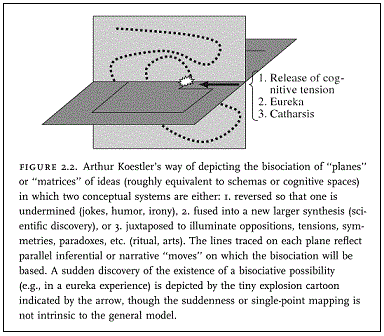
I have pointed before to this diagram from Mark Turner‘s The artful mind: cognitive science and the riddle of human creativity, based on those in Arthur Koestler‘s The Act of Creation (eg those on pp 35 and 37):

koestler-model.gif

It shows the essence of the creative act — the “release of cognitive tension” that occurs when some form of analogy, similitude, overlap allows the mind to join conceptual clusters from two fields in a “creative leap”.

Nancy Fouts’ work doesn’t merely make use of such twinned field overlaps, it makes twinned fields with overlap the defining quality of her works.

She is aiming right at the heart of the creative process. And it shows.

Moving further afield:

.
In that earlier post of mine, I talked about Ada, Countess of Lovelace, and noted that her analogy between Charles Babbage‘s Analytical Engine and Jacquard‘s mechanical loom, famously expressed by her thus:

The Analytical Engine … weaves algebraic patterns, just as the Jacquard-loom weaves flowers and leaves.

was precisely the creative leap that led to the us of punched card systems in computation from Babbage to Watson…

I could give other examples. The Taniyama-Shimura conjecture which formed the basis of Andrew Wiles‘ proof of Fermat‘s Last Theorem, bridges two previously distinct branches of mathematics precisely by showing that for every elliptic curve, there is a related modular form

And no, I don’t understand the mathematics. But I understand the concept of twinned fields, and the power of their overlap.

Some favorite tropes:

.
Back, then, to Nancy Fouts:

One thing that interests me about her work is that she has a few simple “essences” that she returns to time and again: in this case, bees, forms that resemble honeycombs, and by implication, honey.

In my own work, making similar connections between what we might paradoxically call “kindred ideas in unrelated fields” — I might set Nancy’s honeybees across from the verse from the Upanishads [Brihadaranyaka, fifth Brahmana, 14] which says:

This Self is the honey of all beings, and all beings are the honey of this Self.

Another of Nancy’s tropes connects nature and music…

The piercing:

.
And thimbles, those miniature emblems of armor and protection, are another recurring theme:

Let’s take a look at that last image, of the thimble transpierced by a needle.

I believe it has a history — again, accessible via an associative leap. Here are three images of the “wounded healer” motif, two of them specifically images of the Inuit shaman who has harpooned himself — a motif which the anthropologist and zen roshi Joan Halifax writes “captures the essence of the shaman’s submission to a higher order of knowing”:

Armor, the defenses we have in place to protect our selves, and vulnerability, the ability to to allow our selves to be wounded, so that the “self” which is “the honey of all beings” may shine through us. The paradox of Selflessness and Self.

Koan and sacrament:

.
Among wounded healers, we might count the crucified Christ, his side pierced by the spear of a Roman soldier — and here I might suggest that Fouts contrasts (image below, left) the self-sacrifice at the heart of Christianity with the pugilistic approaches of some proponents of his message:

And the image of Christ (right) balancing on a high wire?

Again I’m reminded of the language of shamanism. The anthropologist Barbara Myerhoff studied the religious beliefs and practices of the Huichol or Wixaritari of the Mexican Sierra Madre Occidental, with Ramon Medina Silva, a mara’akame or shaman of the tribe.

In her book, Peyote Hunt: The Sacred Journey of the Huichol Indians, she describes a feat of balance that Ramon performed, which appeared to serve a “sacramental” function for his people – providing them with what Cranmer‘s Book of Common Prayer calls “an outward and visible sign of an inward and spiritual grace”:

One afternoon Ramon led us to a steep barranca, cut by a rapid waterfall cascading perhaps a thousand feet over jagged, slippery rocks. At the edge of the fall Ramon removed his sandals and told us that this was a special place for shamans. We watched in astonishment as he proceeded to leap across the waterfall, from rock to rock, pausing frequently, his body bent forward, his arms spread out, his head thrown back, entirely birdlike, poised motionlessly on one foot. He disappeared, reemerged, leaped about, and finally achieved the other side. We outsiders were terrified and puzzled but none of the Huichols seemed at all worried. The wife of one of the older Huichol men indicated that her husband had started to become a mara’akame but had failed because he lacked balance.

It’s easy to read the description — but by no means as easy to keep one’s balance — something that Fouts’ image perhaps suggests more vividly than words easily can.

Richard de Mille describes the mara’akame‘s function in Huichol society as to “cross the great chasm separating the ordinary world from the otherworld beyond,” and suggests that Medina Silva’s feat of acrobatics on the barranca that day is to be understood as offering “a concrete demonstration in this world standing for spiritual balance in that world.”

Myerhoff herself was never entirely sure whether Medina Silva was “rehearsing his equilibrium,” or giving it “public ceremonial expression” that afternoon: it is clear, however, that for the Huichols, such feats of balance possess a resonance and meaning that extends beyond the “merely” physical.

Bringing the viewer into the picture

.
I may of course be projecting some of my own ideas onto Nancy Fouts’ work — and indeed, perhaps that’s the point.

She has some pretty fierce observations to make concerning matters religious — Christian, Buddhist and other — and I’ll leave those who are interested to make their own discoveries on her website. I don’t doubt there are places where her sympathies and my own overlap, and others where we differ.

Fouts speaks a direct and visceral language of images — and her juxtapositions, carefully chosen and choreographed as they are, provoke us to feel and think.

Thank you, Nancy.

No need to reach for the gun, fellas — but that’s art.

_________________________________________________________________________________________

credits for images of Harpooned Shaman: Charlie Ugyuk (left); David Ruben (right).


Switch to our mobile site