zenpundit.com » networks

Archive for the ‘networks’ Category

WikiLeaks: Critical Foreign Dependencies

Thursday, December 9th, 2010

[ by Charles Cameron ]

The most interesting part of the WikiLeaks-posted State Department Request for Information: Critical Foreign Dependencies, it seems to me, is the part that ties in with Zen’s recent post Simplification for Strategic Leverage.

Zen referenced Eric Berlow‘s recent TED talk to the effect that sometimes a complex network can be made effectively simple by reducing it to the graph of nodes and links within one, two or three degrees of the node you care about and wish to influence.

“Simplicity often lies on the other side of complexity”, Dr Berlow says, and “The more you step back, embrace complexity, the better chance you have of finding simple answers, and it’s often different than the simple answer that you started with.”

*

This resonates neatly with a few things I’ve been thinking and talking about for some time now.

1. There’s the need for visualization tools that don’t operate with as many nodes as there are data points in a database like Starlight — I’ve been wanting to reduce the conceptual “load” that analysts or journos face from thousands, sometimes tens of thousands of nodes, to the five, seven, maybe ten or twelve nodes that the human mind can comfortably work with:

What I’m aiming for is a way of presenting the conflicting human feelings and understandings present in a single individual, or regarding a given topic in a small group, in a conceptual map format, with few enough nodes that the human mind can fairly easily see the major parallelisms and disjunctions, as an alternative to the linear format, always driving to its conclusion, that the white paper represents. Not as big as a book, therefore, let alone as vast as an enormous database that requires complex software like Starlight to graphically represent it, and not solely quantitative… but something you could sketch out on a napkin, showing nodes and connections, in a way that would be easily grasped and get some of the human and contextual side of an issue across.

2. There’s the fact that the cause is typically non-obvious from the effect. In the words of Jay Forrester, the father of stocks and flows modeling:

From all normal personal experience, one learns that cause and effect are closely related in time and space. A difficulty or failure of the simple system is observed at once. The cause is obvious and immediately precedes the consequence. But in complex systems, all of these facts become fallacies. Cause and effect are not related in either time or space… the complex system is far more devious and diabolical than merely being different from the simple systems with which we have experience. Though it is truly different, it appears to be the same. In a situation where coincident symptoms appear to be causes, a person acts to dispel the symptoms. But the underlying causes remain. The treatment is either ineffective or actually detrimental. With a high degree of confidence we can say that the intuitive solutions to the problems of complex social systems will be wrong most of the time.

3. There’s the need to map the critical dependencies of the world, which became glaringly obvious to me when we were trying to figure out the likely ripple effects that a major Y2K rollover glitch – or panic – might cause.

Don Beck of the National Values Center / Spiral Dynamics Group captured the possibility nicely when he characterized Y2K as “like a lightening bolt: when it strikes and lights up the sky, we will see the contours of our social systems.” Well, the lightning struck and failed to strike, a team from the Mitre Corporation produced a voluminous report on what the material and social connectivity of the world boded in case of significant Y2K computer failures, we got our first major glimpse of the world weave, and very few of the possible cascading effects actually came to pass.

I still think there was a great deal to be gleaned there — as I’m quoted as saying here, I’m of the opinion that: “a Y2K lessons learned might be a very valuable project, and even more that we could benefit from some sort of grand map of global interdependencies” – and agree with Tom Barnett, who wrote in The Pentagon’s New Map:

Whether Y2K turned out to be nothing or a complete disaster was less important, research-wise, than the thinking we pursued as we tried to imagine – in advance – what a terrible shock to the system would do to the United States and the world in this day and age.

4. That such a mapping will necessarily criss-cross back and forth across the so-called cartesian divide between body & mind (materiel and morale, wars and rumors of wars, banks and panics):

You will find I favor quotes and anecdotes as nodes in my personal style of mapping — which lacks the benefits of quantitative modeling, the precision with which feedback loops can be tracked, but more than compensates in my view, since it includes emotion, human identification, tone of voice.

The grand map I envision skitters across the so-styled “Cartesian divide” between mind and brain. It is not and cannot be limited to the “external” world, it is not and cannot be limited to the quantifiable, it locates powerful tugs on behavior within imagination and powerful tugs on vision within hard, solid fact.

Doubts in the mind and runs on the market may correlate closely across the divide, and we ignore the impacts of hope, fear, anger and insight at our peril.

*

Getting back to the now celebrated WikiLeak, which even al-Qaida has noticed, here’s the bit — it’s really just an aside –that fascinates me:

Although they are important issues, Department is not/not seeking information at this time on second-order effects (e.g., public morale and confidence, and interdependency effects that might cascade from a disruption).

It seems to me that the complex models which Starlight provides, and Eric Berlow pillories, overshoot on one side of the problem – but avoiding all second-order effects?

One cause, one effect, no unintended consequences?

What was it that Dr Berlow just said? “if you focus only on that link, and then you black box the rest, it’s actually less predictable than if you step back, consider the entire system”…

Avoid all second-order effects?

If you ask me, that’s overshooting on the other side.

Simplification for Strategic Leverage

Sunday, December 5th, 2010

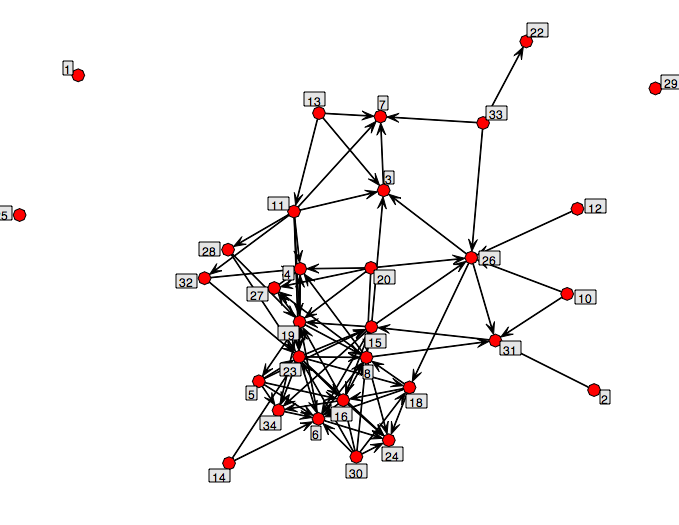
Remember this much ridiculed visual monstrosity?:

Excessively complex representations, much less the bureaucratic systems in practice, are poor vehicles for efficient communication of strategic conceptualizations to the uninformed – such as those downstream who must labor to execute such designs. Or those targeted by them for help or harm.  In addition to the difficulty in ascertaining prioritization, the unnaturally rigid complexity of the bureaucracy generally prevents an efficient focus of the system’s resources and latent power. The system gets in it’s own way while eating ever growing amounts of resources to produce less and less, leading to paralysis and collapse.

Does it have to?

Here’s an interesting, very brief take on analytical simplification from a natural scientist and network theorist Dr. Eric Berlow on how to cull simplification – and thus an advantage – out of complex systems by applying an ecological paradigm.

Cognitive simplification will be a critical strategic tool in the 21st century.

John Seely Brown: “The Power of Pull”

Monday, November 1st, 2010

John Seely Brown, who is the co-author of The Power of Pull: How Small Moves, Smartly Made, Can Set Big Things in Motion along with blogfriend John Hagel and Lang Davison, is primarily speaking about education and learning in an ecological paradigm.

Note to self: I need to read this book.

That said, “pull” is the fulcrum for all 20th century orgs that hope to adapt to the 21st, not just public education. Hierarchies, including states, can no longer completely dominate, only aspire to generally arbitrate, or concentrate their powers in an asymmetric fashion. To do this, over the long term, requires putting  attracting the allegiance of clients and allies capable of taking independent initiative in harmony with the org’s vision rather than relying primarily upon coercion to force people to mechanistically follow orders.

Not sure that too many people in our hallowed institutions “get it”.

Guest Post:A Hipbone Approach to Analysis III.

Saturday, October 30th, 2010


Charles Cameron is the regular guest-blogger at Zenpundit, and has also posted at Small Wars Journal, All Things Counterterrorism, for the Chicago Boyz Afghanistan 2050 roundtable and elsewhere.  Charles read Theology at Christ Church, Oxford, under AE Harvey, and was at one time a Principal Researcher with Boston University’s Center for Millennial Studies and the Senior Analyst with the Arlington Institute:

A Hipbone Approach to Analysis III.

by Charles Cameron

I’ve been slowly prepping this series of pieces about my analytic approach — and the mysterious business of “connecting the dots” — for a while, but.. Jeff Jonas, whose work I only recently ran across, has given me “another piece of the puzzle” and a slew of new dots to connect, so here’s a quick impression of some new (for me) terrain that connects with other areas I have long been familiar with.

1

What it comes down to in my post today is this: I would like to reconcile “connecting the dots” with “putting together the pieces of the puzzle”.

Both metaphors have to do with “seeing the big picture”, and one of them (“connecting the dots”) has to do directly with nodes and edges, i.e. with those systems we call graphs and networks, while the other suggests a far subtler set of connections.

Consider this: n+1 is the next dot in the series of integers after n, with “+1” being the only link necessary — you can represent that on a graph with two nodes and an edge. But if you had the sky of the northern hemisphere in one hand (hey, this is a thought experiment) and five square miles of landscape around Winchester Cathedral in the other, finding just where to fit the cathedral (and the surrounding, branching, leafy trees nearby) snugly into the sky would be a far trickier business, and the links between air and leaf and stone molecules would be very many — we should be grateful for the ease with which the sky accommodates itself in reality to the cathedral and the trees (and the cathedral and the trees to the sky) — and for the ease with which a painter like Turner can capture the effect…



Two puzzle pieces, I mean, may have to fit along many aspects of their intersection, while dots can be connected by a single common thread.

2

I’ve only recently “met” the mind of Jeff Jonas, but he has some remarkable things to say about puzzles — for one thing, he writes about the levels of, well, computation involved in solving a jigsaw puzzle:

The first piece you take out of the box and place on the work surface requires very little computational effort. The second and third pieces require almost equally insignificant mental effort. Then as the number of pieces on the table grows the effort to determine where the next piece goes increases as well. But there is a tipping point where the effort to determine where to place the next piece gets easier and easier … despite the fact the number of puzzle pieces on the table continues to grow.

That in itself is a fascinating thought to dwell on, in fact it’s the sort of piece of the puzzle that gives me an epiphany — Jonas talks about puzzle pieces that provoke epiphanies, too:

Some pieces produce remarkable epiphanies. You grab the next piece, which appears to be just some chunk of grass – obviously no big deal. But wait … you discover this innocuous piece connects the windmill scene to the alligator scene! This innocent little new piece turned out to be the glue.

I’m processing this as a theologian / philosopher / poet, and Jonas has just given me a new angle on the theme of the intersection of frames of reference that Arthur Koestler in The Act of Creation takes to be the fundamental element in insights ranging all the way from casual jokes about rabbis to — let me give you a more powerful example — the Taniyama-Shimura Conjecture which, if I’ve understood the layman’s version correctly, began as a hunch that the otherwise entirely distinct mathematical zones known as “elliptic curves” and “modular forms” could be mapped onto each other – and wound up once proven, successfully bridging algebra with analysis.

Now, I am no no no no mathematician — but I am a student of conceptual bridges, so if I’ve phrased myself poorly here, please bear with me. The point is to think freshly about how one idea connects with another.

Koestler’s insight at the intersection between two fields (for this is essentially a matter of multiple-frame, and thus cross-disciplinary, thinking) is, I’d suggest, Jonas’ epiphanic piece of the puzzle.

Awesome.

3

But as we are trying to figure out the puzzle pieces — and this applies to “what is the meaning of life?” as much as to “what threat should be uppermost in our concern?” — Jonas has more to throw at us:

There may be more than one puzzle in the box, some puzzles having nothing to do with others. There may be duplicate pieces, pieces that disagree with each other, and missing pieces. Some pieces may have been shredded and are now unusable. Other pieces are mislabeled and/or are exceptionally well crafted lies.

I would like to add that puzzles may not be the only thing in the (universal) box. There’s a quote that originates somewhere in Heidegger, to the effect that “A puzzle is the unknown, to be solved, while a mystery is the unknowable, to be entered into and dwelt within.” As I say, I’ve only just run into Jonas’ thoughts, but I’d like to integrate that piece of the puzzle in with the ideas he’s providing – why not have a go at the mystery too while we’re about it?

4

So what happens with ideas? How do they connect?

Hermann Hesse, the Nobel laureate in literature who gave us Siddhartha and Steppenwolf and The Journey to the East, won his Nobel for his most ambitious novel, The Glass Bead Game (Das Glasperlenspiel, also known in English as Magister Ludi). It is an amazing piece of work that inspired at least one other book by another Nobel laureate — Manfred Eigen’s Laws of the Game: How the Principles of Nature Govern Chance — gave John Holland (he of genetic algorithms) the ruling metaphor for his life’s work, was an early and profound influence on Christopher Alexander’s thinking about pattern languages, and in general serves as a catalyst for grand scale creativity among a disparate crowd of very bright minds.

It is about a game — a game on the order of the complete works of JS Bach. And the essence of the game is the juxtaposition of thoughts.

It is about “connecting the dots” and “putting together the pieces of the puzzle” on the grand scale, to create not a single link between ideas, not a small “bigger picture” deploying a half-dozen or so insights, but a vast architecture of ideas that encompasses all “deep” human thought and connects all “beautiful” cognizable patterns. Hesse uses the image of an organist playing an organ to describe the play of ideas that composes his Game, writing:

All the insights, noble thoughts, and works of art that the human race has produced in its creative eras, all that subsequent periods of scholarly study have reduced to concepts and converted into intellectual values the Glass Bead Game player plays like the organist on an organ. And this organ has attained an almost unimaginable perfection; its manuals and pedals range over the entire intellectual cosmos; its stops are almost beyond number.

And in Hesse’s central, musical metaphor, the myriad thoughts that comprise what he terms the “hundred-gated cathedral of Mind” are linked one with another by likeness — by identity, isomorphism, homology, symmetry, parallelism, opposition, analogy, metaphor…

5

I’ll have to move us deep into the territory of the arts and humanities here, because Hesse himself was supremely versed in those areas, but in doing so I would remind you that John Holland wrote of his life’s work, “If I could get at all close to producing something like the glass bead game I can’t think of anything that would delight me more.”

Here’s Hesse on the analogical / isomorphic nature of the moves that connect ideas — “only connect!” said EM Forster — in his great Game:

Throughout its history the Game was closely allied with music, and usually proceeded according to musical or mathematical rules. One theme, two themes, or three themes were stated, elaborated, varied, and underwent a development quite similar to that of the theme in a Bach fugue or a concerto movement. A Game, for example, might start from a given astronomical configuration, or from the actual theme of a Bach fugue, or from a sentence out of Leibniz or the Upanishads, and from this theme, depending on the intentions and talents of the player, it could either further explore and elaborate the initial motif or else enrich its expressiveness by allusions to kindred concepts. Beginners learned how to establish parallels, by means of the Game’s symbols, between a piece of classical music and the formula for some law of nature. Experts and Masters of the Game freely wove the initial theme into unlimited combinations. For a long time one school of players favored the technique of stating side by side, developing in counterpoint, and finally harmoniously combining two hostile themes or ideas, such as law and freedom, individual and community. In such a Game the goal was to develop both themes or theses with complete equality and impartiality, to evolve out of thesis and antithesis the purest possible synthesis.

It is Bach, it is Hegel, it is the very essence of creativity, it is the associative, metaphoric nature of mind and brain (and I won’t get more than toe-deep in the “deep problem” of consciousness here).

6

And it does involve combining the understanding of both puzzle and mystery, to return to that distinction from Heidegger:

I suddenly realized that in the language, or at any rate in the spirit of the Glass Bead Game, everything actually was all-meaningful, that every symbol and combination of symbols led not hither and yon, not to single examples, experiments, and proofs, but into the center, the mystery and innermost heart of the world, into primal knowledge. Every transition from major to minor in a sonata, every transformation of a myth or a religious cult, every classical or artistic formulation was, I realized in that flashing moment, if seen with a truly meditative mind, nothing but a direct route into the interior of the cosmic mystery, where in the alternation between inhaling and exhaling, between heaven and earth, between Yin and Yang, holiness is forever being created.

Hesse is proposing his intuition that the world of ideas is a mandala-form array of symmetries with a “vanishing point” in the center.

Well, I have leapt far from my original topic, Jeff Jonas’ comments on piecing together a puzzle, but I hope the bungee-cord I’ve been depending on has held your attention, and now as always, at the far end of the extension there’s a bouncing-back.

7

The human mind “connects the dots” and “pieces together the puzzle” by recognizing likenesses — pattern recognition, if you like.

But just how human analogical thinking functions is not exactly an easy question…

Guest Post: Of Weaponry and Flags

Sunday, October 24th, 2010

 Charles Cameron is the regular guest-blogger at Zenpundit, and has also posted at Small Wars Journal, All Things Counterterrorism, for the Chicago Boyz Afghanistan 2050 roundtable and elsewhere.  Charles read Theology at Christ Church, Oxford, under AE Harvey, and was at one time a Principal Researcher with Boston University’s Center for Millennial Studies and the Senior Analyst with the Arlington Institute:

Originally posted at Chicago Boyz.com

Of Weaponry and Flags

by Charles Cameron

Hezbollah Flag Use

A day or two ago, Abu Muqawama asked whether the Hizballah flag showed an AK-47, and in general what flags carried what weapons as emblems.

As it happens, I’d just been viewing a pro-jihadist United States of Islam video and made the following screen-capture as an illustration of my continuing concern about the “black flags of Khorasan” and the issue of whether AQ and or its franchises and or portions of the Taliban consider themselves to be fighting the apocalyptic war of the end of time.

Black Flag Support out Troops Sm

Note also that the filmmaker’s ironic borrowing of the phrase “Support Our Troops” to urge support of the troops of the Mahdi will not be lost on some viewers.

This screen-capture, from the United States of Islam video, in turn reminded reminded me of the Saudi flag, which likewise carries the shahada or Muslim profession of faith and a weapon – a sword.

Saudi flag

According to a note on an earlier version of the World Flag Database:

The script in the centre of the flag is the Islamic creed, “There is no God but Allah, and Mohammed is the Prophet of Allah”. The flag is therefore considered sacred and special protocol rules apply: the flag does not dip in salute, nor is it ever flown at half-mast. Note that the creed always reads properly from right to left, with the sword hilt to the right, so the reverse of the flag is not a mirror image of the obverse. When making the flag, the creed must be reproduced precisely, including the accent marks. The use of the flag on any commercial item (especially clothing) is not recommended as it might be considered inappropriate, or even insulting.

The Shahada is the central testament of faith of Islam, as is the Shema Yisroel of Judaism and the Credo of Christianity, and I respect it as such – and likewise the Saudi flag., on which it is displayed.

*

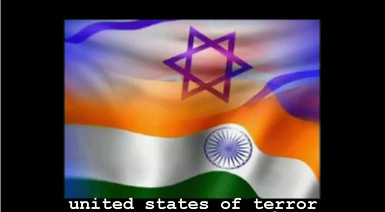
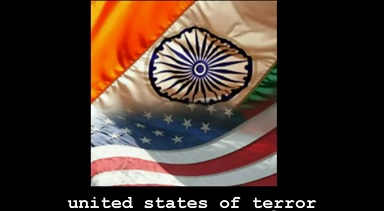
Flags, however, are potent symbols, and the graphical power of the “black flags of Khorasan” motif should not, in my view, be underestimated. The particular video that I took that screen-capture from makes use of “mix” flags of its own devising:

Flag01

– merging the American and Indian flags – or the flags of India and Israel –

Flag02

to create an imagery of the “United States of Terror” to juxtapose against their own black flags as the “United States of Islam” – giving us Huntington’s “Clash of Civilizations” in visceral graphic form.

And that conjunction of India with Israel bears thinking about, too… not only in terms of military aid between the two nations, but also of the symbolic juxtaposition of the Al-Aqsa Mosque and Jerusalem with the Babri Masjid and Ayodhya…

Indeed, the Indian flag itself also deserves consideration in our context.

indian-flag

Originally, Mahatma Gandhi had hoped that it would feature the charka or spinning wheel which he had made famous. As an informative article on the subject from The Hindu puts it:

For Gandhiji, the charka represented not a mere hand-spinning device that could provide employment and income to the poor, but much more. “The message of the spinning-wheel is much wider than its circumference. Its message is one of simplicity, service of mankind, living so as not to hurt others, creating an indissoluble bond between the rich and the poor, capital and labour, the prince and the peasant.” (Young India, September 17, 1925). “Above all, charka is a symbol of non-violence” (Collected Works of Mahatma Gandhi, Vol. 71, first edition, p.234).Gandhiji was, therefore, all the more sad when a correspondent from Hyderabad brought to his notice, on the eve of Independence, K. M. Munshi’s indictment in his broadcast speech that the wheel in the new flag represented the Sudarshana Chakra (discus of Lord Vishnu), a symbol of violence! But Gandhiji consoled himself that “under no circumstances, can the Asoka Chakra become a symbol of violence as Emperor Asoka was a Buddhist and a votary of non-violence” (Harijan Sevak, August 17, 1947).

So there’s another weapon-flag connection – albeit one where non-violence seems to triumph over violence.

*

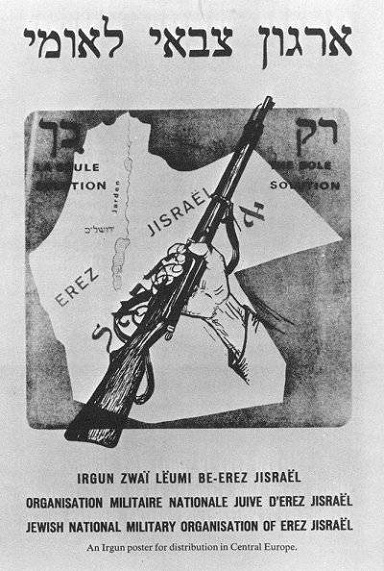
But let me get back to the yellow Hizbollah flag with which we started, and quickly note the resemblance (which I don’t claim to be the first to note, but cannot presently find my source for) between its portrayal of a rifle raised in a victorious fist, and this poster from the Irgun:

Irgun poster

And that’s enough about weaponry and flags for now, I think.

I hope to follow this post up shortly with a more detailed account of the United States of Islam video mentioned above, and its many and curious references and resonances.


Switch to our mobile site