zenpundit.com » Apocalyptic

Archive for the ‘Apocalyptic’ Category

The symmetry: Charlie Hebdo

Saturday, September 22nd, 2012

[ by Charles Cameron — my apologies for an earlier incomplete draft, quickly withdrawn — first of two, on loose cannonry and mirror imagery — second will deal with recent events in Benghazi ]
.


.

Charlie Hebdo recently published some cartoons featuring the prophet…

Okay, I’m always on about symmetry.

I posted a piece titled Messianic symmetries on ZP a while back, noting that both Ahmadinejad and Netanyahu can be viewed as exercising “leadership that makes decisions out of messianic feelings” — the quote comes from an unimpressed ex-Shin Beth director describing Bibi; Ahmadinejad makes the case for his own Mahdist leabings quite well himself.

Symmetry seems like an important analytic category to me, either because it’s there in the build of the world, or because it’s there in the build of the mind. Either way, I think we should take careful notice of symmetries.

Asymmetries I’ll talk about in my next post.

**

What about the cartoon above, right? It’s clearly based on the photo above, left, which shows Stéphane Charbonnier, the editor of Charlie Hebdo, holding his magazine with its offensive cartoons / vindication of free speech. And the suggestion is clear that he’s some kind of suicide bomber.

But who is he blowing up, exactly? Himself, and perhaps his staff and anyone else who happens to be within a few yards of his office at the time? France, Europe, the western world — the world itself? And how much irony should we read into the cartoon portrait?

They may have learned the technique from the Tamil Tigers, but these days, in the immediate wake of widespread rioting over the video clip and in the context of someone publishing cartoons that satirize the prophet, it’s clearly Islamist suicide bombers who provide the model for the cartoon of the cartoonist above.

Tit for tat? An eye for an eye? You’re just setting yourself up for a fatwa like Salman Rushdie?

**

Incendiary rhetoric on one side leads to incendiary behavior on the other, validating the incendiary rhetoric and making the escalation to incendiary behavior all the more probable.

Some of the incendiary rhetoric has its origin in holy books, which also preach peace.

There are Coptic Christians utterly blindsided by the virulence of the video, attributed to one of their number. There are Libyan Muslims utterly blindsided by the virulence of the attack on the US Embassy, attributed to some of their own.

**

I want to focus not on the specifics of the topic, but on the symmetry.

One writer, observing the partition of India and Pakistan, wrote:

The rioters brought the train to a stop. Those who belonged to the other religion were methodically picked out and slaughtered. After it was all over, those who remained were treated to a feast of milk, custard pies and fresh fruit.

Before the train moved off, the leader of the assassins made a small farewell speech: “Dear brothers and sisters, since we were not sure about the time of your train’s arrival, regretfully we were not able to offer you anything better than this most modest hospitality. We would have liked to have done more.”

Commenting on this paragraph, Ali Sethi wrote recently in the New Yorker:

That is all there is: murder—methodical and quick—followed by a feast and an ingratiating speech. Note the withholding of tags: we don’t know the location of the massacre or the religion of the killers. All we have is a spurt of base instincts.

The point here is that whenever you see a symmetry of opposites, it’s worth considering that symmetry in the abstract, as well as weighing the particular issues that drive your own side or the other.

That, I’d suggest, is one of the implications of that Paul van Riper remark I’m fond of quoting:

What we tend to do is look toward the enemy. We’re only looking one way: from us to them. But the good commanders take two other views. They mentally move forward and look back to themselves. They look from the enemy back to the friendly, and they try to imagine how the enemy might attack them. The third is to get a bird’s-eye view, a top-down view, where you take the whole scene in. The amateur looks one way; the professional looks at least three different ways.

**

I am concerned about hatred, simmering here, boiling over there. I am concerned about what sparks hatred, and what fans it. What I want to draw your attention to here, though, is the process by which one hatred fuels abother, the process of mirror imaging.

Mark Juergensmeyer, a terrific scholar of religion who has published on topics ranging from Gandhi‘s nonviolence to the violence of religionists who consider themselves sanctioned by the scriptures of various religions, makes the point in a recent Religion Dispatches post thus:

The US-based Islamophobes behind the insulting and amateurish video “The Innocence of Muslims,” and those behind the violent protests it allegedly caused around the Muslim world, are kindred hatemongers. Both are extremists with a political agenda, and both want to use this incident to discredit the legitimacy of the moderate governments in power in their respective countries. There is a symbiotic relationship between the strident protesters and the bigoted filmmakers; each needs the other.

We are in a hall of incendiary mirrors, with plenty of kindling: in my view, we should avoid playing with matches.

**

Thank God, there are also asymmetries.

In a companion post, I’ll take a look at recent, very promising events in Benghazi (h/t to Pundita for a pointer to this particular article), the not particularly unsurprising but unwelcome attitude of a Pakistani minister, and the imbalances that go along with the dangerous balances I’ve discussed in this post.

**

Oh, and let me digress…

I won the Divinity essay prize back in my schooldays at Wellington College, and received my chosen prize book, the Liber Usualis with its glorious collection of Gregorian Chants, from the then Minister of Defence, John Profumo, MP. Not long thereafter, it was discovered that he pillow talked with one Christine Keeler, a night lady of class, who also pillow talked with the Russian defence attaché. And the story was broken, week by glorious week, by the British satirical magazine, Private Eye.

Which I consequently have an affection for, after all these years. And I tell you this, because Charlie Hebdo, or Weekly Chuck as we might call it over here is, I’d suggest, a plausible latter-day French rough equivalent of Private Eye.

I don’t really like our guys posting inflammatory materials, you see, but I also have an affection for freedom of speech — and for magazines with a satirical bite, too…

So sue me, I contain multitudes.

When the rivers run red

Sunday, September 9th, 2012

[ by Charles Cameron — science and / or apocalypse, quirky, not analytic ]
.

The upper image of this par shows the Yangtze River recently, as reported by the Daily Telegraph under the delightful header, Red China:

I got it from Scence, Space & Robots, which commented:

NDTV reports that Chongqing’s Environmental Protect Bureau is blaming sand for the color change in the river. They claim flooding upstream washed sand downstream which turned the river red.

Okay, so as anyone who has stirred watercolors with their fingers knows, water can be all kinds of colors…

But what it it’s the apocalypse?

That was one possible conclusion Live Science found whehn they asked people about the red color of a lake in Texas (lower image):

The color has some apocalypse believers suggesting that OC Fisher is an early sign of the end of the world, but Texas Parks and Wildlife Inland Fisheries officials say the bloody look is the result of Chromatiaceae bacteria, which thrive in oxygen-deprived water.

So — when you see red water, do you think “aha! daub time” or “ooh, chromatiaceae” — or “OMG, it’s the end, it must be”?

**

Do you prefer to get your explanations for curious events from science, or from religion?

As Caitlin Fitz Gerald — who has an impressive acquaintance with watercolors as the artist behind the Clausewitz for Kids project — kindly tweeted:

John the Revelator puts it this way, in Revelation 16.4:

And the third angel poured out his vial upon the rivers and fountains of waters; and they became blood.

Even the Onion mentions the streets running red, though out of concern for good taste, I won’t quote…

Apocalyptic Trivia

Sunday, September 2nd, 2012

[ by Charles Cameron — the true Beast revealed, in fiction and non-fiction ].
.

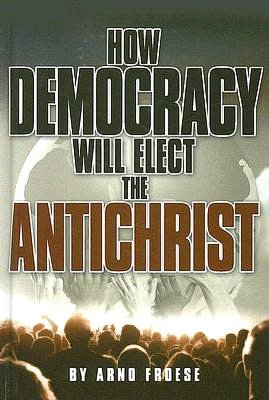
I thought this, which I came across on the web, was my apocalyptic find for the day:

Halfway through SEAL training, Cadet Jack Walker, still green but showing incredible promise, is whisked away to join four SEALs—and their dog—for a special ops mission. Walker soon finds himself in a whirlwind of otherworldly creatures and events as he finds out the true nature of this “special ops” team: SEAL Team 666. Battling demons, possessed humans, mass-murdering cults, and evil in its most dark and ancient form, SEAL Team 666 has their work cut out for them. And it’s not long before they realize that the threat isn’t just directed against the U.S.—an ancient and deadly cult has bigger plans, and Walker is at the center of a supernatural conflict with the entire world at stake.

Until, that is, I went to the thrift store, and found this:

It is ironic that democracy, the system we so love, cherish, and defend, is the only system that seems to match the endtime political scenario whereby the entire world will be united. Strangely enough, it is not through the force of communism, or some dictatorship, but the peaceful means of election “by the people, for the people,” that the prophesied one world system is being established in our day!

**

SEAL Team 666 will be available in December.

Rhetoric, intent — logistics — and who went first?

Monday, August 27th, 2012

[ by Charles Cameron — when religious leaders talk of wiping nations off the map ]
.

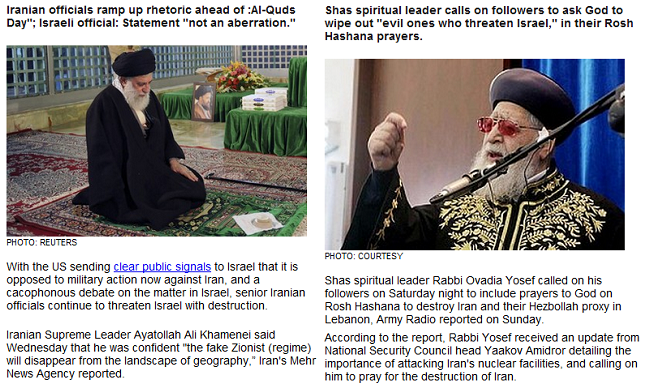
-Two bearded religious figures face of with what seems like parallel but opposite rhetoric:

______________________________________________________________________________________________

______________________________________________________________________________________________

The Ayatollah Khamenei, left, is the Supreme Jurisprudent of Iran — not merely a senior cleric but Iran’s final authority. Rabbi Ovaida Yosef, right, is the leader of the Shas movement in Israel and a cleric who swings enough power that Prime Ninister Netanyahu consults him and Foreign Minister Avigdor Lieberman, briefs him — an influence, then, something akin to an eminence grise perhaps, but by no means the final authority.

You may, loathe one of them you may loathe both of them: I doubt there are many people who admire both. But I’m not here to stir your animosities, I’m here to see what we can learn from comparing and contrasting them by catching them in similar circumstances. Perhaps it will make their differences stand out in high relief — perhaps it will reinforce their similarities.

The two men are both religious clerics, both political players, both getting on in years, both grey-bearded — and both seem to be comfortable using the same rhetoric at this point.

My aim here is to learn from this juxtaposition.

*

So I have two sorts of questions that I’d like to explore here, calmly and with appropriate documentation if you please…

One sort of question probes the differences in position and pouvoir of the two men:

Who has the higher position? Whose side has the most potent weapons? Whose side started this — or is that a moot question?

The second sort is subtler, since it has to do with motives hidden in the hearts and minds of men — and with the differences that sometimes exist between between rhetoric and intent.

Is is an entire people, or simply a regime that they would like to see an end to?

Is either one of them bluffing?

And of course my own favorite: is either one of them, the rabbi or the ayatollah, saying what he’s saying because of an “end times” (Messianic or Mahdist) expectation?

**

Hitler‘s rhetoric in Mein Kampf was pretty clear, and the actions of his Dritte Reich did not belie his rhetoric. Considerable planning was involved, there was documentation.

What, beyond rhetoric, do we know about Israeli planning to take down the Iranian nuclear program? What, beyond rhetoric, do we know about Iranian planing to respond to an Israeli strike — or to defeat and destroy Israel more generally?

Do the logistics back the rhetoric up?

What happens when the word “fire” is itself a match? What happens in an echo chamber, in a hall of mirrors?

Pew on the prevalence of Mahdism — take heed!

Sunday, August 12th, 2012

[ by Charles “told you so” Cameron — Pew figures for Mahdist expectation, also the Second Coming, Israel, and the potential influence of apocalyptic ideation on foreign policy ]
.

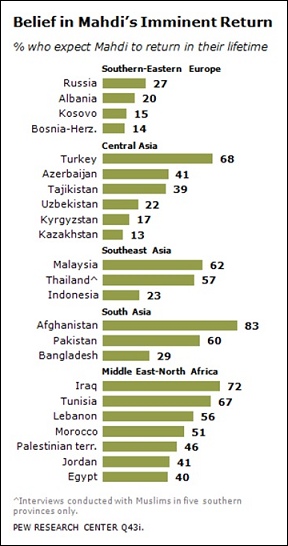
The World’s Muslims: Unity and Diversity, p. 65

.

I am Qualit, not Quant by nature, really much more interested in the workings of the imagination that in the aggregates of poll responses, so it’s a bit like pulling teeth for me to report on a Pew report — but in this case I can legitimately say “I told you so”, which massively outweighs the reluctance I might otherwise feel…

**

Recently, Pew has been including questions about the expectation of the Mahdi in some of its reports, and even Tim Furnish — who wrote the book on Mahdist movements and has long been saying we neglect them at our peril — even Tim was surprised at how widespread Mahdist expectation is, as reported in their just released The World’s Muslims: Unity and Diversity. In a post aptly titled Don’t Leave a Live (or Occulted) Mahdi Out of Your Calculations, Tim says the report contains “The most notable — indeed, strikingly important — news” in the form of “fascinating — and disturbing — data on belief in the Mahdi’s imminent (in one’s lifetime) return.”

See graphic above.

I recommend you read Tim’s analysis for the full range of his points — I won’t, for instance, be touching on what he says about Turkey — here I am going to select a couple of his key issues, and make just a point or two of my own.

**

Furnish:

Of the 23 countries whose Muslim citizens were polled, nine have majorities which expect the Mahdi in their lifetimes, with the overall average percentage at 41.8% … it is safe to extrapolate this percentage to Islam as a whole; ergo, 42% of 1.6 billion = 672 million Muslims who believe in the Mahdi’s imminent return! This is FAR greater than I had supposed.

Furnish also notes that Iran, the world’s most intensely Shi’ite nation and the one whose President has been speaking openly of Mahdist expectation, is not even included among the 23 countries Pew sampled.

Simply put, we have been blind to a very real phenomenon, and now we have a statistical alarm call to wake us up.

More subtly: there’s a difference between answering yes to the question “do you expect the Coming of X in your lifetime” and being on the edge of your seat, viewing every week as threshhold. Damian Thompson is very good on this in his book, Waiting for the Antichrist, and Stephen O’Leary in Arguing the Apocalypse suggests there’s an optimal “arousal” period — if you believe the Coming is too far away, you won’t be motivated to prepare for it quite yet, and if it’s too close it may be too late for you to do much to spread the word…

So, Pew — next time, ask a question with the opinions “in the next five to ten years” and “in my lifetime” — okay? The distinction is important, and a shift towards the shorter time-span would be highly significant.

**

Furnish again:

Despite the conventional wisdom (repeated even by Pew, in the face of their own data) that Mahdism is primarily the province of Shi`is, note that three of the four countries with the highest percentage expecting the Mahdi are majority-Sunni ones: Afghanistan (83%), Turkey (68%) and Tunisia (67%). This has ramifications, respectively, for: US policy in a country we are currently occupying; the only NATO Muslim-majority nation; and the vanguard state of the “Arab Spring.”

In his Conclusions, Furnish says:

The usual State/Defense departments’ “rational actor” approach to international relations might be quite simply irrelevant, if almost half the world’s Muslims expect the imminent return of their eschatological deliverer.

So there you have it. I discussed the “rational actor” versus Scott Atran‘s “devoted actor” in a recent post. And yes indeed, there are “ramifications for U.S. policy”…

Notably with regard to Afghanistan …

**

Here’s Furnish again:

Afghanistan is so rife with Islamic messianism because the 80% of the population that is Sunni and the 20% that is Shi`i (albeit Sevener/Isma’ili, as well as Twelver) both are in the middle of a war and occupation by a “Christian” power — which tends to ratchet up such expectations …

And again, in his Conclusions:

Afghanistan is a lost cause: over eight in ten of its people expect the Mahdi in their lifetime, and no amount of roads and clinics and girls’ schools built by the infidels will change that.

I don’t want to argue that second point in detail, although I think there’s a great deal more to life that Mahdist expectation for many who would answer “yes” to Pew’s question about expecting the Mahdi in one’s lifetime — see my comment on Damian’s book above. But how can I put it? A background Mahdist expectation can become a passionate involvement in a Mahdist movement if the right trigger comes along.

But what I find most striking here is that Afghanistan should be the country with the strongest Mahdist current out of all those Pew selected. And I’m struck not because Afghanistan has been a battlefield for so much of recent history — indeed, for so much of its history, period. I am struck because, in Al-Qaida’s recruitment narrative, supported by a number of ahadith, Afghanistan as Khorasan is the very locus from which the Mahdi’s victorious army will sweep out to conquer (finally) Jerusalem. And this too I have been posting about, eg in my discussions of Ali Soufan‘s The Black Banners and Syed Saleem Shahzad‘s Inside Al-Qaeda and the Taliban.

So the highest level of Mahdist expectation also happens to be found in an area with a potentially major role to play in an end times scenario…

**

There’s at least one earlier report in which Pew raised the question of Mahdist expectation — this time tied in with both the expectation of the Caliphate, and Christian hope of the Second Coming — their 2010 report Tolerance and Tension: Islam and Christianity in Sub-Saharan Africa.

Here, for instance, we learn:

Both Christians and Muslims believe they are living in a time that will undergo momentous religious events. For example, at least half of Christians in every country with large enough samples of Christians to analyze believe that Jesus will return to earth during their lifetime, including nearly seven-in-ten Christians in the Democratic Republic of the Congo (69%).

And at least half of Muslims in 10 of the 15 countries with large enough Muslim populations to analyze say they believe that the caliphate, the golden era of Islamic rule, will be re-established in their lifetime; this belief is most common among respondents in Mozambique (69%). And in 12 of these 15 countries, roughly six-in-ten or more Muslims believe in the return of the Mahdi, the guided one who will initiate the final period before the day of resurrection and judgment, though the survey did not ask respondents whether they expect this to occur during their lifetime.

And here is the relevant data on sub-Saharan Mahdist belief. In Q51 of this poll, Muslims were asked whether they believe “in the return of the Mahdi, the guided one who will initiate the final period before the Day of Resurrection and Judgment? Here’s the table of responses:

Given the “religious fault line” of mixed conflict and amicable coexistence between Christians and Muslims running across Africa from (so to speak) Nigeria to Somalia, with Boko Haram and Al-Shabaab among the less delightful participants, keeping an eye out for signs of Mahdist “semiotic arousal” would be important here, too.

**

And “semiotic arousal” — that reminds me. Richard Landes, who coined the term, has the definitive, encyclopedic book out about all the many forms of apocalyptic, and why they’re important: Heaven on Earth: The Varieties of the Millennial Experience Essential reading, if you ask me, on a hugely neglected and no less critically important subject.

**

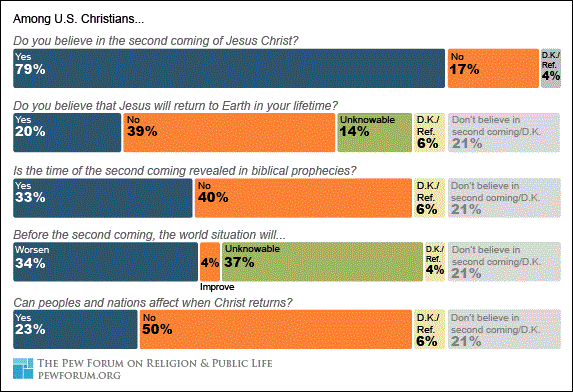
Finally, here’s yet another Pew graphic

— to be viewed in conjunction with this one, illustrating the ways in which belief in the Second Coming of Christ correlate with opinions about scriptures and the State of Israel:

**

Prophecy has impact, both on public opinion and on believing leaders. Jews with an expectation of the Messianic era, Christians expecting the soon Coming of Christ, and Muslims with Mahdist expectations each have their own apocalyptic scenarios, and in each case those scenarios exert some influence on policies relating to the Middle East and the Israeli-Palestinian situation in particular.

The bottom line?

Scriptural interpretation — and prophetic eschatology in particular — can no longer be assumed to be a quiet backwater topic for rabbinic students, seminarians and future mullahs to study, each in terms of their own tradition. It is now a series of conflicting drivers of current affairs — of war and peace.


Switch to our mobile site