My thanks to Aaron Zelin, who suggested that the “Jewish (Bible) scholar” I’d mentioned in the post to which this is an addendum (and who featured beginning around 05.32 on the video) looked like looks Simcha Jacobovici and commented, “he is not a ‘scholar’. He’s a journalist.”
**
Jacobovici is indeed the fellow in question, and after a quick search I was able to find his film, Quest for the Lost Tribes. The section excerpted in the Mahdist video can be viewed via YouTube here:
If you’d like to see the whole thing, you can begin here:
’
And Jacobovici’s opening claims are both striking and decidedly apocalyptic:
In the Bible there’s a prophecy. And that prophecy says that in the end of time, all these people that were exiled, that we call “the Lost Tribes of Israel”, will get up and come back to Israel. And it will start happening all over in the four corners of the world. And they’ll just get up and start moving back.
And what if it was actually happening? Here you have this prophecy, and people are actually getting up, they may be in your own neighborhood. And they’re packing their bags, and to you they’re just somebody else packing their bags and moving. But in actual fact they’re responding to some kind of Biblical “post-hypnotic suggestion”, I’m not talking about a thousand year, I’m talking about twenty seven hundred year old “suggestion”, that they’re responding to now.
And we can actually film these people, and match the prophecy with the events.
And the reason it should matter is that — because once they do what they have to do, they trigger the apocalypse.
**
Jacobovici’s Internet Movie Database [IMDb] page is quite a long one: he’s a journalist, yes, and specifically a documentary filmmaker — and an Emmy winner for “Outstanding Investigative Journalism”.
You may also be able to view the entire film online at his own site…
[ by Charles Cameron — the Jewish Afghans — part 2 of a series on two end times videos that Tamerlan Tsarnaev “liked” ]
.
At this point, we are about a quarter of the way into the Mahdist video I was describing in the first part of this post, and you’d be well-advised to catch up to speed there if you want to follow along here… with the fascinating story of the Afghan children of Isaac.
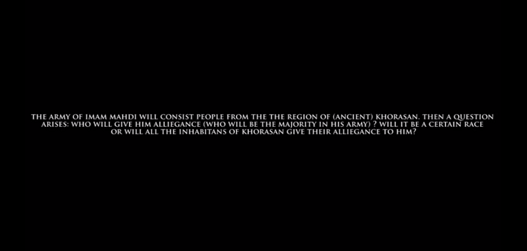
At [03.16, 03.28 and 03.37] the story begins to unfold [transcripts below]:
The first of these reads:
The army of Imam Mahdi will consist people fro the region of (ancient) Khorasan. Then a question arises: who will give hin alliegance (who will be the majority in his army)? Will it be a certain race or will all the inhabitans of Khorasan give their alliegance to him?
The second:
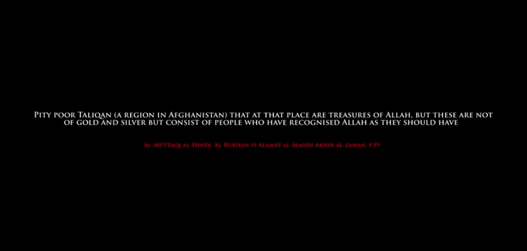
Pity poor Taliqan (a region in Afghanistan) that at that place are treasures of Allah, but these are not of gold and silver but consist of people who have recognized Allah as they should have
Al-Muttaqi al-Hindi, Al-Burhan fi Alamat al-Mahdi Akhir al-zaman, p.59
There is an indication that Afghanistan will be occupied during the Last Days. The Russian invasion of Afghanistan took place in 1979 (1400, according to the Islamic calendar).
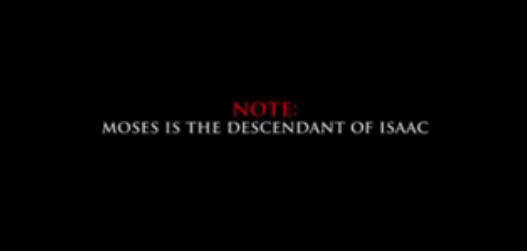
The third is headed “Note” in red, and reads:
The word Taliqan not just mentions the Taliqan region of today only but it describes the whole of the area since in older times sometimes a name of small region describes the whole of the region for example the King of whole Afghanistan and many parts of Central Asia i.e. MAHMUD OF GHAZNI was known as the KING OF ZABUL (Persian Poet Firdausi always called him as SHAH-E_ZABUL in his famous poem “Shahnama Ferdausi”). Zabul was a small province but the whole area was known as ZABUL at that time. SO the word TALIQAN means the whole of the area of Khorasan and not just TALIQAN itself.
I have tried to copy the spelling and syntax of the original, which to my ear might betray a touch of the subcontinent — but may of course have introduced errors of my own, or those of some damnable auto-correct function.
To continue. There’s something decidedly educational going on here in this video – the first, I do believe, that I’ve seen footnoted in quite this way.
The next four text slides read [04.00, 04.10, 04.15 and 04.30]:
We now know that the army of Mahdi will come out of Khorasan with their black banners and as to the question earlier (will it be a certain race or will all the inhabitants of Khorasan give their alliegance to him?
*
This answer is given to us when we read (the hadith in)
Saheeh Muslim Kitaab al-Fitan Hadith 2920
*
Abu Huraira (RA) reported that the Prophet (SAW) said, you have heard about the city of which is in the land and the other is in the sea (Constantinople). They said, Allah’s Messenger, yes. Thereupon he said, The last hour would not come unless seventy thousand persons from BANI ISHAQ would attack it.
Ishaq/Isaac: son of brahim/Abraham, father of Yaqub/Jacob
*
When they would land there, they will neither fight with weapons nor would shower arrows but would only say: “There is no god but Allah and Allah is the Greatest,” that one side of it would fall. Thaur (narrator) said: I think that he said: The part by the side of the ocean. Then they would say for the second time: “There is no god but Allah and Allah is the Greatest” that the second side would also fall, and they would say: “There is no god but Allah and Allah is the Greatest,” that the gates would be opened for them and they would enter therein and, they would be collecting spoils of war and distributing them amongst themselves that a noise would be heard and It would be said: Verily, Dajjal has come. And thus they would leave everything there and would turn to him.
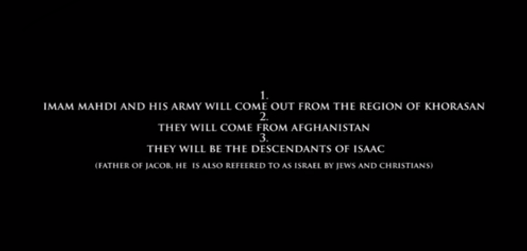
And at this point, with pedagogical precision, there’s a numbered summary of what we’ve learned thus far [05.01]:
Then an Afghan appears in video [05.06 forward] —
— while what sounds to me liker a cultured British voice translates:
When I was young, and had no beard, my grandfather’s uncle died at the age of a hundred and fifteen. He used to say that we are the children of Israel. I am of the Musahem, the People of Moses.
Got that?
**
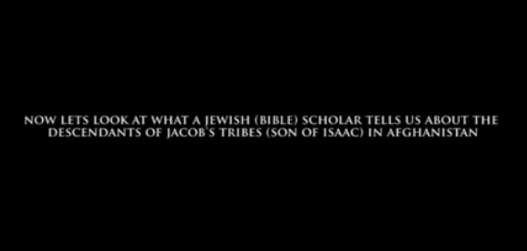
And then things take another interesting turn. Our next screen-grab offers an introduction:
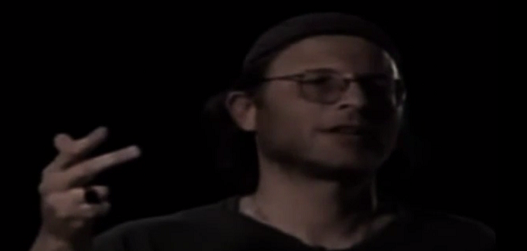
What follows is the “Jewish (Bible) scholar” — on camera —
saying [05.32]:
We are in a country that is supposedly dominated by Muslims, but not Muslims just any Muslims, Muslim fundamentalism, And yet, we come face to face with people that say, “We are Musahem – We are from the people of Moses”. Reuben, Gad, Ephraim, Shimon – four more tribes. So we’ve actually located nine of the tribes. Or, let me put it differently: we think we located nine of the tribes. If we haven’t located nine of the tribes, then it’s a very strange coincidence going on, that you have all these people, with Biblical names, with Biblical practices, with an Israelite memory, exactly where they should be according to the Biblical map.
I’m glad the next slide says, again, “And Allah knows best”. But then it segues into the Mahdi’s physical appearance, and again there’s a Jewish strand…
And Allah knows best
Now, let’s look at a hadith which explains Imam Mahdi’s appareance
Here [06.44] follows a long paragrapoh, which I’ve transcribed for easier reading:
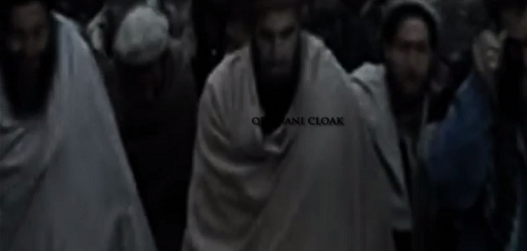
The appearance of Imam Mahdi (according to AHadith) is that he has deep wheatish complexion, light stature, medium height,beautiful broad comlexion, long straight nose, eyebrows round like bow, big natural black eyes, very white front two teeth and with a spacing between the teeth, a black mole mark on the right cheek, face glowing like a shining star, a mark on shoulder like that of Prophet Muhammad (SAW),complexion like the Arabs and body like the Childern of Israel, slight stutter in the tongue due to which he hits his right hand on left thigh sometimes because of annoyance, will appear at the agae of 40 ,while praying to Allah he will expand his hands for prayers like birds expanding their wings, will be wearing Qutwani cloaks (the clothes of the Children of Israel), will resemble in character to Prophet Muhammad (SAW) but in appearance he will be different from Prophet Muhammad (SAW)
And this section closes with an illustration — again, presumably from Afghanistan — of what is meant by a Qutwani cloak [07.26]:
**
I am going to take a break here, at the end of the section in which the people of Afghanistan, and indeed the Mahdi himself, are seen as having characteristics of the Children of Isaac.
In the third and, I hope final, section of this post, Jesus will make a stunning appearance, and attention will then turn back to Khorasan and the march of the black banners on Jerusalem… That final section of this post will, God willing, appear tomorrow.
In the meantime, I’ll also post Tamerlan Tsarnaev end times videos II: a Vinnie Paz video, which deals briefly with a second “end times” song that Tsarnaev “liked” — this one a whirl of contemporary conspiracy theories with Shaytan at the helm…
[ by Charles Cameron — possibility of Mahdist belief or sympathies on the part of one of the Boston bombers surfaces, with some details of the relevant video ]
.
I’m not alone in noticing this video [1, 2, 3], but I may have more interest in it than many others, because I believe Mahdism — and “end times” excitement in general — is a volatile conceptual additive and should be handled with considerable caution.
In particular, I would note that the “black banners of Khorasan” ahadith, cited in the video, have been widely used in AQ recruitment as reported by ex-FBI agent Ali Soufan and Syed Saleem Shahzad in their respective books [1, 2], although the ahadith are of probable Abbasid origin as suggested by David Cook [Contemporary Muslim Apocalyptic Literature, Chapter 8, Apocalyptic Predictions concerning Afghanistan and the Taliban, pp. 172 ff.] — and indeed, I’d recently asked the tweeting American mujahid Abu Mansoor Al-Amriki (Omar Hammami):
to which he’d responded:
[ I started to tweet occasional theological questions to Abu M after he instructed his followers to read Zenpundit, here and more emphatically here — I believe the post he was specifically referring to was this one ]
**
Okay.
This account of the Mahdist video would make a long post, and if you can watch the video and make out most of what it is saying in the title cards (intertitles) that form, along with the occasional voice over, the through-line of the movie, you won’t need most of the rest — I’m mostly going to offer transcriptions of those portions that aren’t too fuzzy for me to read.
Three things you might find worth noting, however, are:
the quotes from Imran Nazar Hosein, whom I’ve discussed before eg: 1, 2, 3, 4], starting in this section
the section on the supposedly Jewish origins of the Afghan people [which I discussed in some detail here], in part 2 of this post, and
the short clip from Mel Gibson‘s The Passion of the Christ which has been slipped into the video with dramatic effect, in part 3.
**
For those of you who feel like following along — and there’s plenty of detail of interest — I’ve broken the thing into parts, and my account of the video begins here…
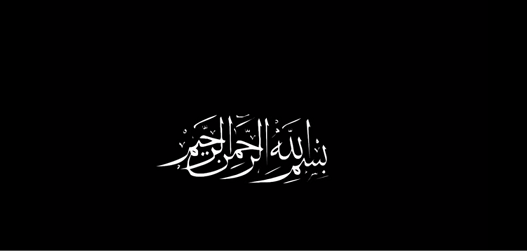
After the Bismillah:
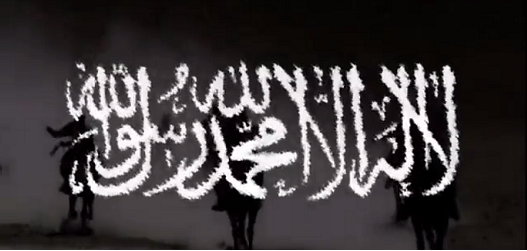
… followed by a card proclaiming it to be the work of T.R.U.E.E. Productions [00.07], the video begins with the “black banner” itself [00.21], in this form:
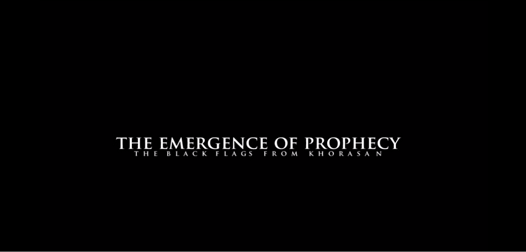
This serves as the opening title of the video, which is presented on YouTube and a minute into the video with the title “The Emergence of Prophecy: The Black Flags From Khorasan“. The banner fades slightly to show present-day horsemen, presumably from Afghanistan:
There are others — I’m thinking of Chris Anzalone and Aaron Zelin — who could tell you the origins of the various video clips and anasheed that are used throughout the video, but I’ll confine myself to the text cards and voice overs.
Over the last of the horsemen, the voice of Imran Nazar Hosein speaks [00.46]:
The prophet said, “When you see the black flags coming from the direction of Khorasan, go and join that army.” That army has already started its [march). They know it. And that’s why they demonize as a terrorist anyone, anyone who supports that army. They know it. And that’s why they demonize as a terrorist anyone, anyone who supports that army.
That’s the end of the Intro, after which the title in English appears [01.16]:
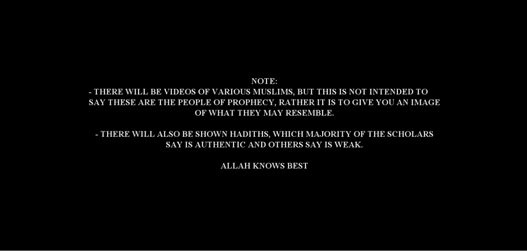
For a bit of flash and excitement, there’s a count-down [01.23 – 01.32] — we’re approaching zero hour, I’m guessing — and the first major text card shows up [01.38]. It is the first of several “notes”:
The caution exhibited here is interesting — someone doesn’t want to be caught out in an error by theologically more sophisticated viewers, hence the admission that some scholars view the black banners of Khorasan ahadith as weak… and the always welcome admission:
Allah knows best.
At [01.56] a hadith is introduced over black and white visuals of war by night:
I’ve magnified this one a little for easier reading [02.09]:
The citation in red is hard to make out, but I believe it references “Sunan Ibn Majah Hadith 971 Volume 3”.
The statement, “their weapon will be the weapon of Emaan (Faith)” is of interest, compare in the New Testament Ephesians 6.13-17 —
Wherefore take unto you the whole armour of God, that ye may be able to withstand in the evil day, and having done all, to stand. Stand therefore, having your loins girt about with truth, and having on the breastplate of righteousness; And your feet shod with the preparation of the gospel of peace; Above all, taking the shield of faith, wherewith ye shall be able to quench all the fiery darts of the wicked. And take the helmet of salvation, and the sword of the Spirit, which is the word of God.
as is the reference to the conquest of Constantinople “without materialistic weapons”. But all that’s fodder for another post on another day.
At [02.36] we get:
The text in red here — compare with the use of white and red print against a black background in the screen-grab by JM Berger from an As-Sahab Media video at the top of this post — reads fairly clearly:
Saheeh Muslim Book Hadith 2896, page 1904, volume 3
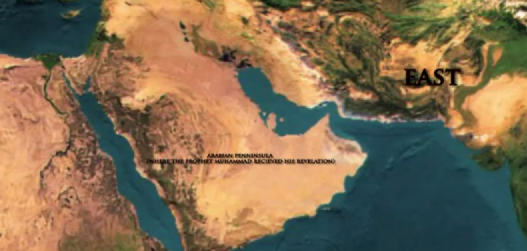
There’s a brief flash of the world map, then this map with its central text in small print and the word EAST quite large by comparison [02.54]:
That central text reads:
Arabian Penninsula
(Where the Prophet Muhammad received his Revelation)
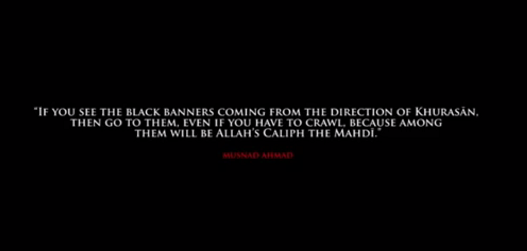
Next coes another hadith [02.59]:
Here the only reference is “Musnad Ahmad”.
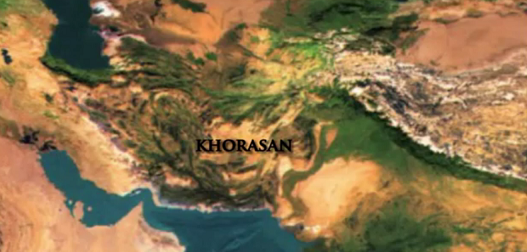
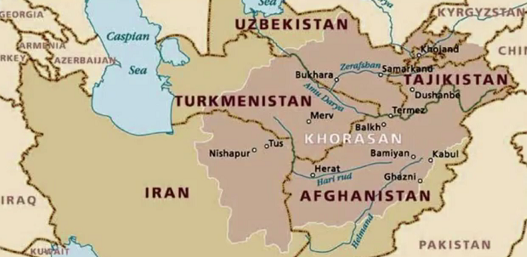
Then two maps identifying Khorasan [03.04 and 03.07]:
So that’s the set-up.
Things get pretty intriguing around here, as a question is posed as to the race or races of those who will follow the black banners, and the comments on Afghanistan and the Lost Tribes of Israel begin…
[ by Charles Cameron — at times the missing pieces of a puzzle are right there in plain sight — might it be a good idea to notice them? — oh, and Carthage! ]
.
Carthage Ports Puniques, 1958, personal collection of Bertrand Bouret, via Wikimedia
I recently wrote about the failure of many translators of jihadist texts to include the specific Qur’anic citations on which they were based — something I noticed because I’m keenly interested in theologies, but which doesn’t seem to concern those who are trying to understand jihad. A week ago I saw a neat parallel from the world of political propaganda, as noted by Patrician Kushlis at Whirledview:
one of the experts at the conference in describing the unique characteristics of the North Korean propaganda barrage pointed out that the country’s threats always concluded with the phrase: “if the Americans attack.” But the speaker added that these four final words are not reported in the media or government statements we see in the West.
What is it with these people, that they keep on uttering phrases that can safely be ignored at the beginnings and endings of statements?
I mean, would anyone in Carthage have bothered to translate into Punic — the language the Carthaginians spoke — an utterance like the Elder Cato‘s repetitive and obviously phatic Carthago delenda est ?
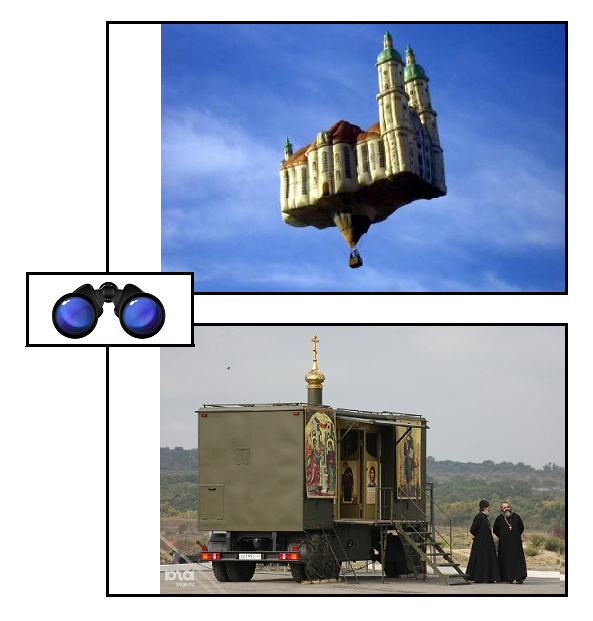
I suppose you could think of this double image as representing “the ideal” (above) and “the real” (below). In actuality, the upper image is of “Cathedral Balloon @ Balloon Fiesta ’08” — while the lower image is of an actual Russian army chapel, of which the Guardian notes:
The latest addition to the Russian military arsenal takes the form of an airborne church complete with parachuting priests.
**
Fr John Peck over at The Orthodox Church of Tomorrow gleefully tosses us this image from the Russian Airborne Force Press-Service:
**
Not until that rather boxy parachuting chapel equals and indeed surpasses the great mediaeval cathedrals in splendor will we begin to be on our way to Revelation 21.21:
And I John saw the holy city, new Jerusalem, coming down from God out of heaven, prepared as a bride adorned for her husband.
**
Hat-tip to Michael Robinson, my “go to” source (what an abysmal phrase, but language is never static. eh?) for all things antiquarian, aesthetic and ecclesial…
Zenpundit is a blog dedicated to exploring the intersections of foreign policy, history, military theory, national security,strategic thinking, futurism, cognition and a number of other esoteric pursuits.