zenpundit.com » 2005 » September

Archive for September, 2005

Friday, September 23rd, 2005

THE ECONOMICS OF HORIZONTAL THINKING [ UPDATED]

Some time ago, I did a three-part series on cognition that dealt with vertical and horizontal thinking and their relationship to the generation of insight. I haven’t touched the subject much since then until today when I accidentally stumbled across a reference to the Nobel-prize winning economist Robert Lucas and his paper ” The Mechanics of Economic Development” ( not available online as far as I can determine -sorry. Here’s someone else applying his ideas).

Dr. Lucas argues that a high density of creative people, broadly defined as to include conceptualizers, executors and venture capital financiers, tend to form clusters with high productivity and knowledge spillovers. Ideas flow faster and translate into action and tangible goods or services more effciently as a result.

What is happening in the “cluster” ? You have networks facilitating horizontal thinking that would tend to become, in a probalistic sense, more productive as they grow more complex over time with the nodes forming ever more numerous links. Presumably, this process would be subject to the law of diminishing returns; human attention is finite. Concentration of talent in one location eventually will bid up its value elsewhere with smaller, competing, geographic clusters. Population density imposes a cost of living/lifestyle threshold that varies in terms of individual psychology. On the margins, some talent will always be deciding to leave as conditions change for the cluster.

The blogosphere is itself a ” virtual cluster” with blogs tending to form “ koinon” – a phenomena which often is obscured rather than revealed by blogrolls. Koinonia combined with the ubquitous use of search tools like Technorati , Google Blog Search and others would tend to distribute some of the benefits Lucas proposes, at least potentially when people begin trying harvest the blogosphere.

We’re just starting to scratch the surface of what we can do – and of understanding what we’re doing.

UPDATE:

Must be the day of the Dismal Science. Dr. Von is posting on the cutting edge today –
Econophysics“:

Further evidence of deep links between physical systems and economic models have also been discovered. In the September issue of Physics Today, an article entitled “Is Economics the Next Physical Science?” is featured. Yale professor Martin Shubik and Santa Fe Institute researchers Doyne Farmer and Eric Smith have been working on econophysics, where well-established mathematical methods used by physicists over many years have been used to establish better dynamical economic models. For example, the study of chaotic systems in physical systems as economic analogs in the sense that an economic market can follow very different paths if there are relatively minor changes in the initial conditions of the market. The mathematics used in this type of analysis follows techniques used in physics. The observation of numerous power laws in physical systems and networks (i.e. scale-free networks) over a number of years has led to more refined analysis tools, which are now being used to understand newly discovered power laws in economic theory. These power laws include analysis of price movement in stocks over short periods of time as well as income distributions in capitalistic economies. Production and distribution networks of large corporations have been shown to follow characteristic power laws associated with scale-free networks. What may seem like random trading patterns in the stock market that lead to market swings and patterns may be analogous to random motions of many-body systems that show emergent behavior. Statistical mechanics relationships are being used to study various types of economic models (since probability distribution functions rule).

And Dan coincidentally, has a very intriguing real-life example of unanticipated emergent behavior in a virtual reality platform.

Damn, that worked out well ! My Koinon is on fire today ;o)

Thursday, September 22nd, 2005

SHORTER RECOMMENDED READING

Younghusband at Coming Anarchy posts his review of Colonel Thomas X. Hammes, The Sling and The Stone while Curzon defiantly crossbreeds sociobiology and geopolitics.

William Arkin of Early Warning on “CONPLAN 0400” – a WMD location exercise. Of course, if there really was a WMD to locate without causing a public panic, they’d bill it as an exercise. ( Hat tip to Noah)

Dr. Dan Nexon of Duck of Minerva explains realist balance of power in terms of IR theory with the aid of tiny circles and Machiavelli.

Jeremiah at Organic Warfare on The Eastern Way of War

Wednesday, September 21st, 2005

SOLDIER-STATESMEN FOR GLOBALIZED ” SMALL WARS”
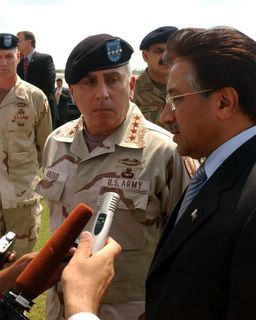

General John Abizaid and Pakistani President Musharraf. Picture courtesy of SPC. Claude Flowers, Public Affairs Office, CENTCOM Posted by Picasa


Whether you view the War on Terror through the prism of William Lind’s 4GW theory, Dr. Barnett’s PNM taxonomies, John Robb’s ” open-source” warfare or more orthodox perspectives, globalization is making demands upon American military officers more reminiscient of the late 19th century than the 20th. A commander today must be more than a specialist in the military arts and an inspirational leader in the field; increasingly they are dealing with questions of politics and diplomacy once reserved for high civilian appointees. They are required to be adept in economic administration for humanitarian and reconstruction purposes and possess both a media presence and a communications strategy. “Small wars” have gone global and the requirements of fighting them in an interconnected world under the glare of a 24/7 broadband media is producing a new corps of soldier-statesmen from the theater commander right down to the ” strategic corporal“.

The slow evolution of the American soldier-statesman can be seen from the early 20th century. While the comic-opera Spanish-American War saw celebrity soldiers like Teddy Roosevelt cast in a heroic light and wide authority granted to Admiral Dewey and General Wood, that trend was reversed by Woodrow Wilson in WWI. From the outset of the war, the president jealously guarded his prerogatives as Commander-in-Chief from both the Congress and the uniformed services. Wilson dominated the scene to the extent that today only specialists can recall the name of Wilson’s Army Chief of Staff (it was Peyton C. March) and General John ” Blackjack” Pershing, while a revered figure, operated on a narrow delegation of authority designed to help him block Allied desires to feed American doughboys directly into the French and British armies bleeding to death on the Western Front.

The real ” heroes” of the Great War, as historian Jordan Schwarz wrote, were the civilian administrators like William McAdoo and Herbert Hoover – both of whom became leading contenders for appointive office and party nominations for the presidency in the 1920’s. Few soldiers other than Douglas MacArthur gained that kind of public acclaim. The Army and Navy faced genuine public hostility and drastic budget cuts in the aftermath of the spectacular ( and essentially fraudulent) Nye Committee hearings that formented isolationist and pacifist sentiment. Never was the military more a lonely caste apart from American society than during the interwar years.

WWII was the great planetary clash of mass production, mass-man, Second-Wave great powers all of which fielded forces on a scale never seen in history and unlikely to ever be seen again. The military was likened to a great and complex machine in which every officer, soldier, sailor and pilot played their small cog-like part. Ironically, as this Newtonian model of warfare reached it’s apex the very complexity of running the military machine encouraged the rebirth of military-statesmanship at the uppermost levels. If Chuchill, Stalin and FDR were ” The Big Three” then General George C. Marshall was the fourth and his handpicked supreme commander, Dwight Eisenhower, was the fifth.

Not only did their political superiors increasingly defer to their professional judgment on operational matters but both Eisenhower and Marshall had real input into shaping the grand strategic outcome of the Second World War. This acceptance into the realm of statemanship and national policy making by their wartime civilian leaders was confirmed by the brilliant postwar political careers both men enjoyed; Marshall as Secretary of State and Secretary of Defense and Eisenhower as NATO supreme commander and President of the United States. MacArthur too, as SCAP during Japan’s occupation, was given the broadest latitude imaginable to exercise statesmanship where he can be credited with reconstructing modern Japan as an integral part of the West. MacArthur’s firing, the retirement of the five and senior four star flag officers of WWII and Ike’s election soon resubordinated the military to strict civilian control and were given input only into very limited areas of professional competence.

The Vietnam War effort suffered from a general officer corps wedded to this narrow technical perspective when statesmanship and a broader vision would have served better. General William Westmoreland methodically built up the conventional military machine with which his experience as a WWII staff officer had made him intimately familiar. Greater political insight might have made Westmoreland and the Pentagon brass willing to listen to those voices – John Paul Vann, the CIA, David Hackworth, David Halberstam, George Ball – who pointed out how ill-suited the structure of the American war effort was to winning a political and unconventional war in the Vietnamese jungle.

Younger officers in field command such as Colin Powell, used the bitter lessons of Vietnam to rebuild a battered mass-conscription Army into a world-class force of professional soldiers. Paradigmatically, Powell’s generation of officers also became exceptionally risk-averse to expeditionary missions that smacked of nation-building or counterinsurgency, preferring to be prepared to fight only ” Big wars” against Warsaw Pact opponents. Where the previous generation of general officers had presented a can-do face to presidential requests from JFK and LBJ, the new rising corps of generals and admirals struck the pose of Cassandra, warning of impending doom and searching to find the magic number of troops to request to kill any desire of the White House or Congress to intervene anywhere. A mantra initially spelled out by Caspar Weinberger and later known as “ The Powell Doctrine” became the automatic reference point in any debate over using the military overseas.

Powell’s post-Vietnam cohort which also includes figures like Wesley Clark, Tommy Franks, H. Norman Schwarzkopf, Charles Krulak and John Abizaid were well-suited for the role of soldier-statesman being among the best educated and trained American officers since the Civil War generation. Abizaid is an Arabist, Franks has an advanced degree in public administration, Clark was a Rhodes Scholar; and similar if not more impressive credentials are held by majors and colonels currently serving in Iraq who, within a few years, will be brigadiers.

While the officer corps in the uniformed services have the talent to act the part of statesman and although the chaotic conditions of Gap states and terrorist warfare require it, whether generals much less corporals will be permitted to become ” strategic” actors in the field is an open question. In an era where nimble netwar where organizations move fast and break all known rule-sets, the very top-heavy U.S. military finds it hard to part with long-held customs of vertical hierarchy and uniformity to adopt flatter, faster, more autonomous, military formations.

Beyond the brass where the critical decisions are made by men whose formative experiences on the battlefield were almost two generations earlier are the civilian appointees at the DoD, in the White House and on Congressional staffs. Quick to micromanage but loathe to accept responsibility for the actions of field commanders following instructions from Washington, civilians need to accept their role of providing leadership by making( and standing behind) the tough political decisions, setting broad strategic goals and granting sufficient discretion to carry out the policy objectives.

Finally, most of all, civilian leadership must accept the responsibility when things sometimes go wrong, as they inevitably do in battle, instead of leaving low-ranking soldiers and officers twisting in the wind. Properly directed and supported, given realistic and specific objectives, the U.S. military will move heaven and earth to accomplish their mission.

Tuesday, September 20th, 2005

NORTH KOREAN NUCLEAR DEAL: PARSING THE PUZZLE OF PYONGYANG (UPDATED)

I’ll begin this post by wishing I had some better information, though the report today that the DPRK is already trying to hedge on the recently announced breakthrough indicates that the U.S. may have received at least as good as it gave. My second comment is that all the bloggers who are running around trying to figure out if this deal is good or bad for George W. Bush ought to be considering if it is good or bad for the United States.

Why the sudden deal ? I can only offer speculation:

First, after juggling two rogue proliferators while still engaged in Iraq, the Bush administration decided to cut a deal with whichever party was willing to” pull a Libya” so as to focus hardline attention on the remaining holdout. The essence of strategic thinking is making choices. We cannot deal with Iraq, Iran and North Korea all at once and expect the situation to improve in our favored direction. That’s simply a fact and neither wishing nor bluster is going to change it.

The DPRK is a ghoulish regime and morally it is far worse than Iran. It’s capacity for making mischief for American interests though is less by virtue of geography, ideology and culture. Iran on the other hand, is actively making mischief in Iraq ( though not as much as they could) and is well-placed by geography, population, religion, ideology and oil to cause far more. Added to that is Iran’s intransigence in the face of EU entreaties, armed with carrots to cut a reasonable deal on nuclear tech with the IAEA followed by what is probably one of the most diplomatically inept speeches given at the UN since Khrushchev banged his shoe.

Iran’s newly elected hardline Islamist president Mahmoud Ahmadinejad probably intended this move both to solidify Iran’s limited support in the Muslim world and to force the Bush administration to engage Iran as a diplomatic high priority. Well, I think he succeeded – just not in a way he intended while underscoring how little Teheran’s rulers understand the United States and still less the Bush administration. Kim Jong-Il was wiser; he did not read the recent changes in American nuclear doctrine as either coincidence or bluff or that a lack of any capacity to definitively resolve the outcome of major military attack would prevent the United States from launching one.

People were taken aback by the Six Party talks announcement because diplomacy was working – quietly, behind he scenes – as it should. Negotiations in public through loud statements indicate that no real negotiations are taking place in private. Something was offered in seriousness to bring the DPRK back to the table and China – whose President Hu held high-level talks with President Bush – is neither prepared to pay the freight on North Korea’s impending famine or back them if Pyongyang provokes a war or full-scale Japanese rearmament by testing a nuclear weapon. A deal was sealed most likely at this time between Beijing and Washington.

You don’t merely play against the other player, you play against the scenario as well. And Iran may have just lost.

UPDATE:

Nadezhda of Chez Nadezhda/LAT has excellent counterarguments in the comment section, plus a post here. Other bloggers that have intelligently posted on the North Korean nuclear deal can be found below:

CKR of Whirledview
Thomas P.M. Barnett
Caerdroia
Arms Control Wonk also here.
Simon World – strong on Chinese angle.
Coming Anarchy
NKZone
Asiapundit
Conjectures& Refutations – Iranian nuke program
Kevin Drum
The Useless Tree

Monday, September 19th, 2005

AN ECHO OF CONQUEST

The hyper-prolific Robert Conquest began speculating five years ago in his Reflections on a Ravaged Century that shifting global conditions would stir a revival of interest in the Anglosphere as a cultural, economic and strategic entity. John O’Sullivan, former adviser to Margaret Thatcher, writes in the current issue of The New Criterion:

“If the British were now to reorient their policies towards the Anglosphere, as India is doing, that in itself would signify at least the beginnings of cultural self-confidence. As they were developed, moreover, Anglospherist policies would restore some of the openness and opportunities of the former empire in a wider non-imperial setting. National narratives of different English-speaking countries, now rendered meaningless or unspeakable by multicultural attack, would be given a fresh and forward-looking aspect. The Britishness shaped by this new national orientation would be one that incorporated “minorities” not in separate cultural en-claves but as equal contributors to our common island story and culture. It would be a Britishness to which British Muslims could assimilate with pride and a genuine sense of common ownership rather than with the shameful feelings of someone entering a multicultural brothel. Would such a Britishness safeguard us against domestic religion-based terrorism. Not entirely perhaps, but it would reduce support for it among the uncertain and give the majority of all faiths greater fortitude in resisting it. “

Perhaps Conquest was once again ahead of the curve ? If so, he’s still quite far ahead but this is a stirring.


Switch to our mobile site
