zenpundit.com » 2013 » April

Archive for April, 2013

Margaret Thatcher

Wednesday, April 17th, 2013

[ by Charles Cameron — on Margaret Thatcher’s funeral, with a brief note on her theological stance ]
.

Many of my friends in the UK detested her, many of my friends here at Zenpundit think highly of her: my interest here is to note on the day of her funeral in St Paul’s Cathedral the grace and closure which high ceremonial brings to a nation — the other side of the coin, if you will, to the vigorous and at times raucous debate which marked her time as Prime Minister in London’s House of Commons:

The Church of England understands the power of ceremonial, and the English choral tradition is among its greatest treasures. Both are on display in the video above, which makes a fine addition to those of the recent Papal and Canterbury enthronements and the Coronation of Elizabeth II, which I presented in my recent post, A tale of two cities: Rome and Canterbury.

For your convenience, today’s Order of Service can be found here.

**

As to Thatcher’s theology, I found these paragraphs from the blogger Cranmer illuminating:

Baroness Thatcher’s Christianity was grounded in the Protestant nonconformity of devout and evangelical Methodism: her conservatism was Tory in its Burkean deference to the great institutions of state but thoroughly Whiggish and libertarian after Mill in its iconoclastic challenge to the big agencies of state; in her emphasis on the ‘work ethic’ kind of Protestantism, and her patriotic belief in the national British Christian spirit and her notion of morality as the opportunity for free choice. She had what some identified as a ‘puritan streak’, espousing the values of the English suburban and provincial middle-class and aspiring skilled working-class. These contrasted with the values of the establishment élite of the Church of England, landowners, university academics, the Foreign Office and the professions.

Her writings and speeches are unequivocal in the provenance of her theo-political worldview. In Statecraft, she wrote: ‘I believe in what are often referred to as “Judaeo-Christian” values: indeed my whole political philosophy is based on them’. In the second volume The Path to Power she went further: ‘Although I have always resisted the argument that a Christian has to be a Conservative, I have never lost my conviction that there is a deep and providential harmony between the kind of political economy I favour and the insights of Christianity’.

Also useful — and also via Cranmer — come these remarks from Antonio E. Weiss, The Religious Mind of Margaret Thatcher:

Of all British Prime Ministers from Harold Macmillan to Tony Blair, Margaret Thatcher was by far the most vocal about her faith whilst in office, and the only one to draw direct and explicit parallels between her personal beliefs and her political ones. Macmillan believed that ‘a nation can[not] live without religion’, and, more personally in his official biography, he claimed that ‘I go to Communion as long as I can…I reach for the Bible whenever I can…I still find religion a great help’. For Douglas-Home, ‘Christianity was of the heart, not of the pew, a matter of private witness and personal conduct’. Wilson was brought up very much in the Nonconformist manner as a Baptist, joined the evangelical Oxford Group at university and told an interviewer in 1963 that ‘I have religious beliefs and they very much affected my political views’. Heath’s attitude to religion was more similar to Home’s, in that he did not speak openly about it – as he told James Margach in 1965: ‘It’s not a thing one talks about very much but it has a secure hold’, but when reminiscing in his memoirs, he did also claim that: ‘My Christian faith also provided foundations for my political beliefs … I was influenced by the teaching of William Temple (former Archbishop of Canterbury)’. Callaghan’s mother was ‘deeply religious and fundamentalist’. He became a Sunday school teacher in the late 1920s and although he claimed to turn away from his Baptist upbringing when his activities in the Labour Party increasingly had the ‘first charge on my energies’, he also stated in his memoirs that he owed an ‘immense debt’ to his Christian upbringing and that he had never ‘escaped its influence’. Major, on the other hand, whilst professing belief in God – ‘I do believe. I don’t pretend to understand all the complex parts of Christian theology, but I simply accept it…[I pray] in all circumstances’ – seemed to be uncomfortable with the whole issue: ‘I was mortally embarrassed to be interviewed about my religious faith on Radio 4’s Sunday programme’. And of course Tony Blair famously admitted to praying to God for guidance when preparing for the Iraq war of 2003.

**

Some further reading, including the sources quoted above:

Cranmer, Margaret Thatcher has died and passed into Glory
Cranmer, Margaret Thatcher renewed the relationship between Christianity and Conservatism
The Economist, High office, low church
Damian Thompson, Margaret Thatcher’s Christianity: if only the Churches had reached out to her
Telegraph, Margaret Thatcher: her unswerving faith shaped by her father
Catholic Herald, Some think it ironic that pugnacious Mrs Thatcher should pray for harmony. But she was closer to St Francis than you may think

Margaret Thatcher: Christianity and Wealth, Speech to the Church of Scotland General Assembly, May 21,1988

Of related interest:

Slavoj Zizek, The simple courage of decision: a leftist tribute to Thatcher

**

It would be interesting to see a similar set of quotations and readings for recent US Presidents…

North Korea: the missing words

Wednesday, April 17th, 2013

[ by Charles Cameron — at times the missing pieces of a puzzle are right there in plain sight — might it be a good idea to notice them? — oh, and Carthage! ]
.

Carthage Ports Puniques, 1958, personal collection of Bertrand Bouret, via Wikimedia


I recently wrote about the failure of many translators of jihadist texts to include the specific Qur’anic citations on which they were based — something I noticed because I’m keenly interested in theologies, but which doesn’t seem to concern those who are trying to understand jihad. A week ago I saw a neat parallel from the world of political propaganda, as noted by Patrician Kushlis at Whirledview:

one of the experts at the conference in describing the unique characteristics of the North Korean propaganda barrage pointed out that the country’s threats always concluded with the phrase: “if the Americans attack.” But the speaker added that these four final words are not reported in the media or government statements we see in the West.

What is it with these people, that they keep on uttering phrases that can safely be ignored at the beginnings and endings of statements?

I mean, would anyone in Carthage have bothered to translate into Punic — the language the Carthaginians spoke — an utterance like the Elder Cato‘s repetitive and obviously phatic Carthago delenda est ?

Please Welcome our New Co-Blogger, Lynn C. Rees

Wednesday, April 17th, 2013

On behalf of Charles Cameron and J. Scott Shipman, I would like to warmly welcome the newest co-blogger to zenpundit.com, Lynn C. Rees.

Rees’ blogging and insightful comments have long been enjoyed by many in this corner of the blogosphere, though some were written  pseudo-anonymously and then later circulated by third parties on private listservs.  Some samples of his writing:

….If I were to draw a rough analogy between the Old Testament and De re militari in Chinese history, the Old Testament would be a compilation of all the major Spring and Autumn and Warring States‘ literature of one of the smaller seven warring states (Judah) redacted by a Legalist-leaning Confucian (the Deuteronomists of Josiah’s reign) right before Chin (Neo-Babylonian Empire) completed its conquest of China (Fertile Crescent) and then re-redacted by Szma Chyan (Ezra) in the early days of the Han (Achaemenid) Dynasty. The theme of the Deuteronomists (“In those days there was no king in Israel: every man did that which was right in his own eyes.” Judges 21:25) is similar to a strong theme emphasized by editors of the Seven Military Classics that China had to be unified under one authority (“all under Heaven” (TyanSya) to eliminate the disorder of warring states during the Warring States era. This theme was recently expertly propagandized by the Beibing Regime in the interesting Jet Li film Hero on Jau Jeng.

De re militari would be a compilation of stray bits of the six existing Seven Military Classics studiously assembled by a public-spirited provincial Confucian scholar with no military experience and submitted as a memorial to the Late Han court in the hopes that its ancient virtues would rouse the court to reverse the collapse of the dynasty.

The Western strategic tradition after 1500 drew heavily on works synthesizing De re military and more recent recovered works from antiquity like Polybius and especially Livy.

and, from another post, in a different place:

….A network requires asabiya, that almost mystical force of network cohesion and harmony that makes the members of a group unite to fight the far enemy instead of dividing to fight the near enemy. While asabiya is sometimes personified by a particular individual and their qualities, true asabiya transcends the one and distributes itself across the many. But individual humans remain asabiya’s greatest ally and most dangerous enemy. It’s appropriate to view the network immediately around particularly potent individuals as webs rather than networks. Like its namesake spider web, an individual’s web places them in the center of a network. Like the spider, the web allows a supernode to detect fluctuations in asabiya density before it directly encounters the source of the disturbance. The web also amplifies a supernode’s reach, radiating its localized asabiya through its web into the greater network, disrupting or strengthening broader network asabiya as it might.

Asabiya separates an army from a mob. Ardant duPicq observed that most of the casualties inflicted in battle up to his time happened when one side’s cohesion was smashed. The enemy could then run down the disorganized stragglers as they fled the battlefield. The loss ofasabiya proves fatal.  Asabiya is the force that allows a Headless Chicken to run around without its head. The Romans, for example, lacked the magical spark of the Macedonian armies of Alexander and Pyrrhus. Parmenio suggested to Alexander after the Battle of Issus that he should accept Darius III’s offer of an alliance, the hand of his daughter in marriage, and all Asia Minor, reputedly saying “If I were Alexander, I would accept the terms.” “So would I, if I were Parmenio.”, Alexander replied. If Alexander had been killed at Granicus, Parmenio would have retreated back into Europe. It took that special insanity of Alexander to take the arms of Macedon all the way to the Hyphasis. In contrast, the Roman armies of the Old Republic relied on asabiya. They could be commanded by a mediocrity and yet pull out a victory. They could suffer a catastrophic defeat like Cannae and still bounce back. They were robust against failure. In fact, the Magic Bullet was anathema to the Roman. The occasional genius who popped up, burning brightly in the firmament, the Scipio, the Marius, was pulled down by an Elder Cato or some other old senatorial blood.

But exactly who is Mr. Rees?

Lynn C. Rees is a software engineer specializing in workflow optimization and genealogy. He is a long-time student of how human systems discover and cope with truth through (or despite) culture and politics. Lynn group blogs at Chicago Boyz (joining the Clausewitz, Xenophon, Afghanistan 2050, and Reagan Centenary roundtables along the way) and the third Committee of Public Safety. He also contributed to The Handbook of 5GW, edited by Dr. Dan Abbott.

Welcome aboard Lynn!

Boston: of motives and munitions

Tuesday, April 16th, 2013

[ by Charles Cameron — the prayer response at least is wordless and direct ]
.

**

The most deeply felt post about the Boston Marathon massacre I’ve seen was Caitlin Fitz Gerald‘s Boston’s best Day:

If you’ve never been to Boston on Patriots’ Day, you might not know this, but it’s the best day of the year in Boston. It’s a state holiday, spring is hitting, the Red Sox play a morning game, and thousands of runners and hundreds of thousands of people come from all over the world for the Boston Marathon. The marathon is a 26-mile party. Every runner hears cheers from every person the whole way down the route. It is a gorgeously international event, with runners and spectators coming from all corners of the earth, filling the city and lining the marathon route. In the ultimate Patriots’ Day experience, you can go to Fenway to see the Sox, then walk out to Kenmore Square to watch the runners come through. They are tired then, they are in their last mile, but people line the route 10 and 15 deep hooting and cheering and clapping to help them through to the end. It’s amazing to watch the elite runners fly through the toughest course in the world, and just as amazing to watch the regular runners, most of them raising money for charity, people who have trained months and years to do this superhuman thing.

This didn’t just hit close to home, it hit my home.

Caitlin is also responsible for the elegant Clausewitz for Kids.

**

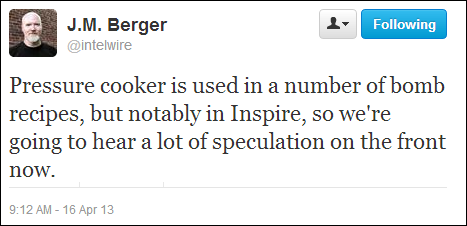
The most sensible response to the various premature speculations as to who’s to blame is JM Berger‘s tweet:

The speculations themselves ranged from dangerous incitement (Muslims or North Koreans, kill em all) to dangerous incitement (d’oh, it’s the Mossad)

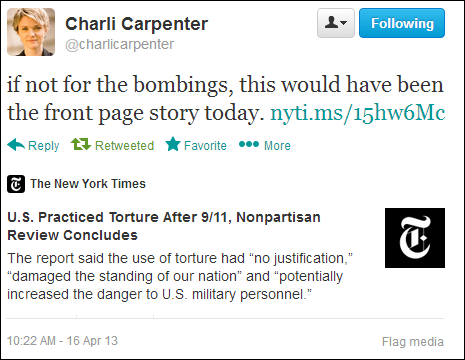
The least expected insight came from Charli Carpenter:

**

Pressure cookers:

For background, here’s a DHS release on pressure cookers from 2010.

It’s beginning to seem likely that the bomb or bombs were made with a pressure cooker or pressure cookers — normally unsuspicious items that can be found in many homes, or easily purchased online.

JM Berger would be my resource for ongoing analysis of the Boston event, but Betsy Ross sees to be the one to follow for information about pressure cookers as weaponry. Their history goes back at least as far as the Croatian nationalist hijacking of TWA flight 355 in September 1976, although the “pressure cooker bomb” in that case was a threatening fake rather than the real thing. Max Fisher tells us their use in bomb-making is mentioned in the Anarchist’s Cookbook — I’m not about to spend money on something that would only tell me how to maim people in any case — but Berger pointed out (first in my feed) that AQAP’s Inspire magazine featured them:

The Inspire mention appears in their first issue, in a piece by “AQ Chef” titled Make a bomb in the kitchen of your mom.

**

But you know what most interested me in that article?

It’s not the recipe, no sireee, I have no interest in how to blow things — much less, people — up. It’s the warning that the writer attached. Explosive devices can easily — all too often and all too literally — blow up in the faces of those who are trying to make or set them.

Bomb making is a hazardous occupation — and that’s why the order and emphasis with which the AQ Chef [promotes his three dafety precautions interests me so much:

The following are a few safety precautions:

1. Put you trust in Allah and pray for the success of your operation. This is the most important rule.
2. Wear gloves throughout the preparation of the explosive to avoid leaving behind fingerprints.
3. This is an explosive device so take care during preparation and handling.

Did you get that? The most important advice is to trust in God and pray for success — taking care during preparation and handling comes a distant third.

That’s piety, people — piety before practicality.

And — as if to prove the point — three Palestinian would-be suicide bombers were killed by their own devices back in 1999, because they refused to comply when Israel announced a “premature switch from daylight savings time to accommodate a week of pre-sunrise prayers“.

So much irony, so much stupidity, so much sorrow.

**

A few other pages to note:

Bruce Schneier, The Boston Marathon Bombing: Keep Calm and Carry On
Jeff Stein, How They Will Investigate the Boston Bombing

Andy Kroll, Question Everything You Hear About the Boston Marathon Bombing
Dana Liebelson and Tim Murphy, 6 False Things You Heard About the Boston Bombing
Adam Serwer, Terror Attacks on Sporting Events, Especially Marathons, Are Surprisingly Rare

Mike Adams via Alex Jones, Boston marathon bombing happened on same day as ‘controlled explosion’ drill by Boston bomb squad — conspiracist, reminiscent of Ruppert on 9/11

XKCD, Pressure cooker: the worst thing? — see graphic above

Zoketsu Norman Fischer, In Times of Trouble — a Zen view from just post 9/11.

Boston 4/15/13

Tuesday, April 16th, 2013

The Boston Marathon was bombed today near the finish line with allegations of multiple other unexploded devices:

CBS Boston station WBZ-TV reports one of the three who died from the attack was an 8-year-old boy.

 Two bombs exploded near the crowded finish line of the Boston Marathon on Monday, killing three people and injuring more than 125 others in a terrifying scene of broken glass, smoke and severed limbs, authorities said.

Police reportedly set off at least one other explosive device with a water cannon. On Monday night, a federal law enforcement source told CBS News correspondent Bob Orr that an earlier report was incorrect that authorities had found one other device that was intact and had not been detonated. Orr reports that authorities are not in possession of such a device.

 CBS News senior correspondent John Miller reports that a Saudi national is being questioned by authorities. He was seen “acting suspiciously” running from the explosion, and a civilian chased him down and tackled him. He was turned over to Boston police and is being questioned by the FBI. He is being cooperative and denies any involvement.

 “This could mean a lot, or this could mean very little,” Miller said. “It’s too soon to call him a suspect.”

 Miller reported earlier that authorities are also reviewing surveillance video that shows a man from behind carrying two backpacks near the site of the explosions. Authorities are not sure whether the subject in the video is linked to the blasts.

Boston police say no suspect has been taken into custody. 

There is much speculation and misinformation at the present time and a rush to analytic judgement is premature when crucial physical evidence is in the early stages of being found, identified and tested by expert investigators. White House officials have classified the attack – which featured a second blast to harm first responders and bystanders – “terrorism”.

Terrorism would appear to be accurate. Whether this is by a group or a “lone wolf” is not yet determined. The presence of multiple, coordinated bombs would be very difficult for one person acting alone to plant without detection but not impossible, a small cell is more likely. A high failure rate of bombs may indicate a determined amateur rather than a professional bomb-builder from a group like the IRA, Hezbollah or Lashkar-e- Taiba, all of which are noted for their skill with explosives. Nor can a foreign state security agency be definitively ruled out at this time, though that is much less likely a possibility ( Pointlessly bomb the Boston Marathon and get yourself a 2 carrier group aerial “regime decapitation” campaign).

Before jumping to conclusions about the possible identity of the Boston Bomber, recall first guesses are frequently wrong and as with the “Anthrax Letters”, we may never know for certain. Or the FBI may run down the culprits in the next 48 hours. People using this attack to score cheap partisan political points right now in the media or on social network sites  are supreme asshats


Switch to our mobile site