SOLDIERS OF THE CORE VS. THE 4GWARRIORS OF THE GAP 
John Robb at Global Guerillas had an excellent post up last week on ” The New Warrior Class” a 1994 article in the military journal Parameters by Ralph Peters that dealt with the differences in worldview between modern professional soldiers and the various irregular, unconventional and sometimes pre-modern warriors. Below is the Peters graphic that summarizes the battlefield dichotomy.
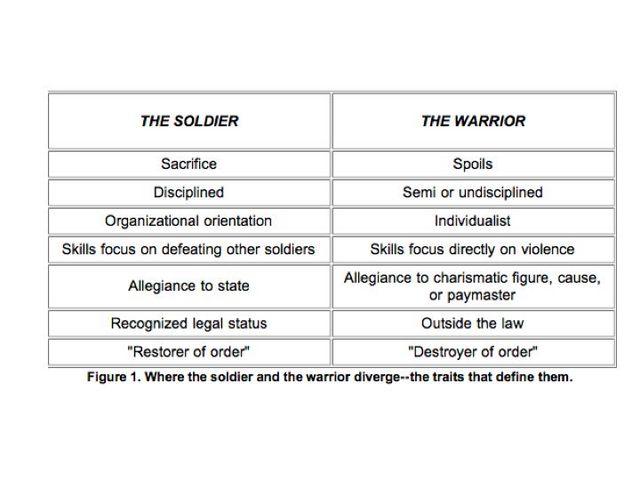
Peters and Robb are both concerned about the intersection of modernity in the form of advanced, martial skill-sets with barbaric pre-modern ( and post-modern) mentalities. Peters writes:
“Dispossessed, cashiered, or otherwise failed military men form the fourth and most dangerous pool of warriors. Officers, NCOs, or just charismatic privates who could not function in a traditional military environment, these men bring other warriors the rudiments of the military art–just enough to inspire faith and encourage folly in many cases, although the fittest of these men become the warrior chieftains or warlords with whom we must finally cope. The greatest, although not the only, contemporary source of military men who have degenerated into warriors is the former Soviet Union. Whether veterans of Afghanistan or simply officers who lost their positions in post-collapse cutbacks, Russian and other former-Soviet military men currently serve as mercenaries or volunteers (often one and the same thing) in the moral wasteland of Yugoslavia and on multiple sides in conflicts throughout the former Soviet Union. These warriors are especially dangerous not only because their skills heighten the level of bloodshed, but also because they provide a nucleus of internationally available mercenaries for future conflicts. Given that most civil wars begin with the actions of a small fraction of the population (as little as one percent might actively participate in or support the initial violence),[5] any rabid assembly of militants with cash will be able to recruit mercenary forces with ease and spark “tribal” strife that will make the brutality of Africa in the 1960s seem like some sort of Quaker peaceable kingdom. “
This is essentially what Islamist radicals have managed with the Arab Afghans and second generation Jihadis schooled at the knees of their Arab Afghan seniors. Interestingly enough, the Pentagon has also ” recruited mercenary forces with ease” through the contracting of highly adept ” Corporate warriors” – many of whom are experienced special forces vets – for work in Iraq and Afghanistan. These corporate warriors are unshackled from many of the legal and command and control restrictions of U.S. military personnel and can act accordingly.
John Robb, expounds further in his post on why this may be the most dangerous pool of potential warriors:
“Peters’ formulation works well as a starting point in our analysis. Warriors, as he describes them, are difficult to defeat because of the asymmetrical methods by which they fight war. It’s classic fourth generation warfare — dirty, nasty, and ultimately won or lost in the moral sphere.
However, as tough as the the 4GW warrior is, it fails to account for the extreme resilience and innovation we see today in global terrorism and guerrilla warfare. We are also fighting on many more levels that merely the moral one. This implies that something has been left out of this analysis. My conclusion is that it fails to appreciate how globalization has layered new skill sets on ancient mindsets. Warriors, in our current context, are not merely lazy and monosyllabic primitives as Peters implies. They are wired, educated, and globally mobile. They build complex supply chains, benefit from global money flows, and they invest shrewdly. In a nutshell, they are modern.”
Much of Iraq’s insurgency is a part-time, unskilled, bunch of rabble paid a modest sum to lob grenades or shoot wildly with their AK-47’s but there are two far more dangerous clusters of insurgents. Iraqi veterans of the Republican Guard, Special Republican Guard, Special Security Organization, the Mukhabarat and its Army parallel who possess varying degrees of Soviet Spetsnaz training. A highly disciplined and skilled group that is also backed into a corner – they have nowhere to go and some are too notorious to hide by blending in with the local population. The other dangerous element are the al Qaida affiliated foreign jihadis. They are highly motivated and often suicidal in their willingness to take losses. Some are experienced in combat from Bosnia to Afghanistan.
What are seeing In Iraq and earlier in Somalia is the paradigm for conflicts where the Core attempts to ” export security” and connectivity to the Gap in failed states and defeated rogue regimes. The warriors will run away from the scary, American ” Leviathan” force that will steamroll over them but they will come out of the woodwork, 4GW style, to degrade, demoralize and disrupt attempts at System Administration by the more constabulary-type, nation-builders envisioned by Dr. Barnett. They are Ghazis with laptops.
System Administration forces may have to either be constructed with more ” small wars” expert trigger-pullers to go in and disrupt potential 4GW warrior groupings before they can get started or System Administration and Leviathan will have to work in tandem as a synergistic network.



June 26th, 2005 at 10:54 pm
Mark,
To go through your points:
Sacrifice / Spoils: IIRC, the all-volunteer army has a higher pay-scale than the draft army. This would imply the professionalized military is more “warrior” and the conscripted military was more “soldier.”
Disciplined / Undisciplined: We would agree that Britain’s very SysAdmin troops are Soldiers, while the Mongol Horde’s cavalry were Warriors. But unless I’m mistaking your definition of “disciplined,” the Hordesmen suffered through much more than Her Majesty’s soldiery would.
Organization / Individualist: Granted. 4GW requires warriors, while NCW requires soldiers.
Effects-Based / Violence-Based: Granted. Effects-based war is non-obvious, and seems to require soldiers.
State-Based / Non-State-Based: Granted, if only because of the organizational / individualist divide.
Legal / Ultralegal: Is this meaningful? North Vietnam definitely extended more legal protection to insurgent warriors than ARVN than enemy soldiers (who they often accused of being war criminals).
Restorer of Order / Destroyer of Order: Both fighting soldiers and warrirs seek isolate the enemy and subdue or subvert his networks. That’s destructive. While SysAdmin soldiers are concerned about reorientation/reharmonization, that doesn’t mean all soldiers are.
-Dan tdaxp
June 27th, 2005 at 3:35 am
Hey Dan
Re: “Sacrifice / Spoils: IIRC, the all-volunteer army has a higher pay-scale than the draft army. This would imply the professionalized military is more “warrior” and the conscripted military was more “soldier”
Ralph Peters would disagree with you but John Keegan would agree ( which ain’t bad).
This gets down to definitions of behavior. I would place the Samurai in the same ethos category as an Army Ranger or Navy SEAL. So too the Hordes of Ghengis Khan and his immediate successors as Khagan – they were highly disciplined and bound by the Yasaq.
Vikings, Ghazis, the Celts, Vandals, Pawnee, Huns, Mobiles, the Freikorps, Somali Technicals – these have another ethos altogether. They’re raiders, opportunists, guerillas – they hit and run not stand and fight.
Re: ” Legal/Ultralegal -Is this meaningful” It is if we wish it to be since the USG is in the position to establish standards or to refuse to do so.