Of films, riots and hatred III: Scorsese and Verhoeven
[ by Charles Cameron — The Last Temptation of Christ troubles, an early warning re the upcoming Jesus of Nazareth movie — the blood libel and more ]
.
American and European Christians, too, can react violently to films they perceive as blasphemous, and this too we should remember as we weigh our own responses to the rioting in Cairo and elsewhere.
Martin Scorsese‘s Last Temptation of Christ gives us a sense of how modern American and European Christians can react to perceived blasphemy, while the forthcoming Paul Verhoeven movie of his own book Jesus of Nazareth will test the degree to which we’ve learned the lessons of a quarter century ago — and of this last week.

.
**
Martin Scorsese’s The Last Temptation of Christ: stirred strong feelings when it opened. I was in LA at the time, and was following the controversy fairly closely having attended an early screening, and having both literary and theological interests.
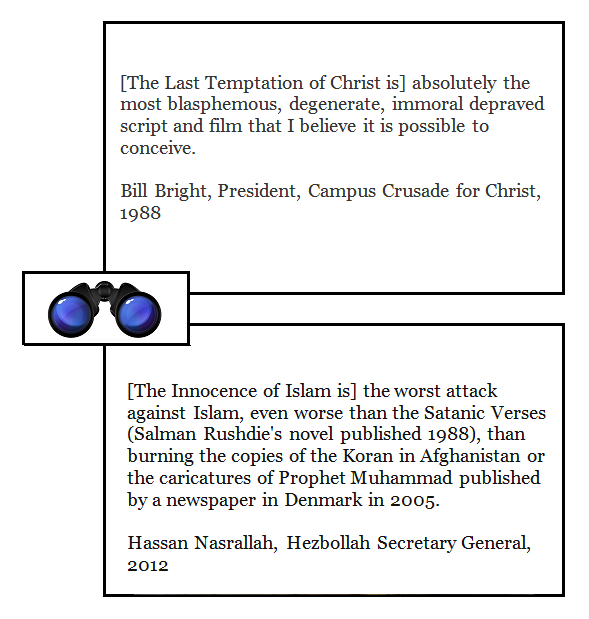
The short video clip below is a little choppy, it doesn’t make it particularly clear that the clips you see are from the film Martin Scorsese made of a novel — written by the Nobel laureate Nikos Kazantzakis — which makes no attempt nor pretense to be a historical or religiously orthodox portrayal of Christ. IMO, it is worth watching for the glimpse it gives of just how strong the undercurrents of emotion aroused by Scorsese’s film were at the time:
**
I’m bringing this subject up and attending to it in some detail because NBC World News mentioned Martin Scorsese’s movie on the 13th of this month, in an explanation as to Why films and cartoons of Muhammad spark violence, but without gwetting the picture quite right:
Director Martin Scorsese’s adaptation of a book by the same name showed Jesus struggling with lust, depression and doubt, and engaging in sex — in his imaginings — before snapping back to reality and dying on the cross. That movie was seen as blasphemy by some Christians, who — though not violent — were vocal enough to prevent the film from being shown in many parts of the United States.
There may have been no violence done to humans in the US — but there as certainly damage to property, and some vicious threats made, as The Encyclopedia of Religion and Film records:
At the Cineplex Odeon Showcase Theater in New York City, vandals slashed seats and spray-painted threats aimed at the chairman of MCA: “Lew Wasserman: If you release ‘The Last Temptation of Christ,’ we will wait years and decimate all Universal property. This message is for your insurance company.”
In parts of Europe, the violence was more intense:
Overseas, at the September 28 opening in Paris, demonstrators who had gathered for a prayer vigil threw tear gas canisters at the theater’s entrance. Catholic clergy led rock-throwing and fire-bombing assaults on theaters in many French municipalities. A thousand rioters in Athens trashed the Opera cinema, ripping apart the screen and destroying the projection equipment.
In Paris, specifically, the violence severely injured some human targets. From Wikipedia (with their footnotes removed — you can track the various quotes from the original page):
On October 22, 1988, a French Christian fundamentalist group launched Molotov cocktails inside the Parisian Saint Michel movie theater while it was showing the film. This attack injured thirteen people, four of whom were severely burned. The Saint Michel theater was heavily damaged, and reopened 3 years later after restoration. Following the attack, a representative of the film’s distributor, United International Pictures, said, “The opponents of the film have largely won. They have massacred the film’s success, and they have scared the public.” Jack Lang, France’s Minister of Culture, went to the St.-Michel theater after the fire, and said, “Freedom of speech is threatened, and we must not be intimidated by such acts.”
The Catholic response — from the Cardinal Archbishop of Paris among others — reproved both the blasphemy and the rioting:
The Archbishop of Paris, Jean-Marie Cardinal Lustiger, said “One doesn’t have the right to shock the sensibilities of millions of people for whom Jesus is more important than their father or mother.” After the fire he condemned the attack, saying, “You don’t behave as Christians but as enemies of Christ. From the Christian point of view, one doesn’t defend Christ with arms. Christ himself forbade it.” The leader of Christian Solidarity, a Roman Catholic group that had promised to stop the film from being shown, said, “We will not hesitate to go to prison if it is necessary.”
There was apparently a connection with French far-right politics, too:
The attack was subsequently blamed on a Christian fundamentalist group linked to Bernard Antony, a representative of the far-right National Front to the European Parliament in Strasbourg, and the excommunicated followers of Archbishop Marcel Lefebvre. Lefebvre had been excommunicated from the Catholic Church on July 2, 1988. Similar attacks against theatres included graffiti, setting off tear-gas canisters and stink bombs, and assaulting filmgoers.
There were legal proceedings following the Saint Michel incident, and it’s notable that Fr. Gérard Calvet OSB, founder and Prior of the Benedictine Abbaye Sainte-Madeleine du Barroux, testified at the tribunal on behalf of the convicted youths, describing their motives if not their mode of expression as “noble”. Would that term be equally applicable to protesters of blasphemies against other faiths? We now live in a dense-packed world where such comparisons are easily made.
Let’s pause for a minute over the twinned remarks of the late (and widely respected) Cardinal Lustiger concerning Last Temptation —
Jean-Marie Cardinal Lustiger, said “One doesn’t have the right to shock the sensibilities of millions of people for whom Jesus is more important than their father or mother.” After the fire he condemned the attack, saying, “You don’t behave as Christians but as enemies of Christ. From the Christian point of view, one doesn’t defend Christ with arms. Christ himself forbade it.”
and compare the remarks of a similarly authoritative religious figure in Libya to the Innocence of Muslims video:
Libya’s Grand Mufti, Sheikh Sadeq Al-Ghariani, has issued a fatwa condemning Tuesday’s killing of US Ambassador Chris Stevens along with three other American diplomatic staff and a number of Libya security guards. He said those involved were criminals who were damned by their action.
He also condemned the production of any film, picture or article insulting the Prophet Mohammad or any of the prophets by “extreme fanatics” in the US or elsewhere. The Prophet Muhammad, Ghariani said, had specifically forbidden the killing of ambassadors and envoys.
**
Almost a quarter century has passed since Scorsese’s movie opened, but as I said above, we will soon have an opportunity to show what we have learned from those lamentable events in Paris and the more recent tragedies in Benghazi, Cairo and elsewhere.
Paul Verhoeven — the director of such blockbusters as RoboCop, the original Total Recall, and Basic Instinct — has raised the financing for his upcoming movie Jesus of Nazareth, based on his book of the same name, and scripted by Roger Avary, who shared an Oscar with Quentin Tarrentino for their Pulp Fiction screenplay.
Verhoeven, be it noted, is not only a writer and movie director, but also a member of the Jesus Seminar — a group of scholars which, as Wikipedia nicely puts it, “treats the canonical gospels as historical sources that represent Jesus’ actual words and deeds as well as elaborations of the early Christian community and of the gospel authors” and prepares color-coded editions of the gospels suggesting which sayings of Jesus should be considered original, and which are better understood as later additions.
Here, to give you an idea of what may be on the horizon, is an excerpt from a quick and informal take on the upcoming movie by an admirer of Verhoeven:
Deadline reports that the legendary Paul Verhoeven — a guy who, amazingly, only directed three movies in the past fifteen years — has received financing to adapt his own book, Jesus of Nazareth, which discounts every mythical story surrounding Christ and, instead, opts to present him as a simple human figure with a message powerful enough to radiate throughout time. Roger Avary (Tarantino‘s story partner on Pulp Fiction) will write the film, while Muse Productions are doing the proper backing.
Almost any work going against the long-held Biblical grain will get groups up in arms — no, I don’t even need to provide examples — but the claims of Nazareth are, even in this context, still mighty contentious. Most notable is the idea that Jesus is not the son of God, but was actually the product of Mary being raped by a Roman soldier; so, right off the bat, you’re discounting the entire foundation of his story.
I am pointing this out because right now would be a good time for the various churches to begin a general conversation about the film-maker’s right to hold an opinion, write a book and make a movie, the hurt that may be felt by believers, and the importance of responding without hatred or violence when offended.
**
In our concern with matters of Christian and Muslim issues, let us not lose sight of the fact that Jews too have movies made about them that may not only hurt feelings but also represent real threats against them, reminiscent of Nazi and earlier Russian antisemitic propaganda fabrications.
From the copious “blood libel” entry in Wikipedia:
In 2003 a private Syrian film company created a 29-part television series Ash-Shatat (“The Diaspora”). This series originally aired in Lebanon in late 2003 and was broadcast by Al-Manar, a satellite television network owned by Hezbollah. This TV series, based on the antisemitic forgery The Protocols of the Learned Elders of Zion, shows the Jewish people as engaging in a conspiracy to rule the world, and presents Jews as people who murder Christian children, drain their blood and use this blood to bake matzah.
MEMRI has a report with further details, and a MEMRI clip of the scene in which a Christian child is killed by Jews has been posted on YouTube, with the comment:
Al-Shatat: Jews Murder A Christian Child and Use His Blood for Passover Matzos. anti Semite Arab propaganda against Jews, Judaism and Israel.
The following is a scene from the Syrian-produced TV series Al-Shatat. Al-Shatat was first aired on Hizbullah’s Al-Manar TV during the month of Ramadan 2003, and then on two Iranian channels during Ramadan 2004. Al-Mamnou’ TV, a new Jordanian channel, is airing Al-Shatat during Ramadan 2005.
It is worth recalling, too, that Mel Gibson‘s film, The Passion of the Christ, was perceived by many Jews, Christians and others as anti-Semitic — and that nonetheless the Orthodox Jew and conservative movie critic Michael Medved wrote:
The possibility of anti-Jewish violence in response to the film has been irresponsibly emphasized and has become, self-fulfilling prophecy. In parts of Europe and the Islamic world, anti-Semitic vandalism and violence occur daily, and hardly need a film by a Hollywood superstar to encourage them. In this context, Jewish denunciations of the movie only increase the likelihood that those who hate us will seize on the movie as an excuse for more of hatred.
**
I trust it is not too late to wish our Jewish readers l’shana tova: may your apples be dipped in honey and all our days bathed in peace.



September 17th, 2012 at 11:57 pm
I read this with mixed feelings. Christians rarely if ever assassinate people when they’re upset by blasphemy – considering today’s culture, we’d have to be doing it all the time. Whereas the Qúran specifically calls for people to kill blasphemers. That’s a huge difference and I can’t see how we can even begin to equate the two religions. I am willing to predict that there will not be one attempt on Verhoeven’s life, and no one will be killed in the United States over the movie. Whereas, if he were to make a movie about Muhammad, their would be a fatwa issued. Just ask Salman Rushdie – I think he’d give the same point of view.
September 18th, 2012 at 3:14 am
Hi Scott:
.
I’m working my way towards some sort of conclusions about the situation, but thus far I’m mostly clearing away some of the brush. From my POV, we’re still in the preliminaries: we’ll do best if we ground whatever we think in peace (post #1 re Benedict XVI); we’d do well to remember that other people that Muslims riot against other embassies than ours (post #2 re the Chinese / Japanese dispute); we’d do well to recognize that when a movie came out that many Christians considered blasphemous, cinemas were trashed in people seriously injured (post #3, this one, re Last Temptation & the Verhoeven movie); and I imagine there will be more…
.
What I’m trying to do, essentially, at this point is to reduce our own blind spots — mote and beam stuff, Matt 5 — like the piece I quoted where someone from NBC News said Christian responses to TLTJC had been “non-violent” when in fact four people were seriously burned in a fire-bombed cinema and someone else died of a heart attack fleeing a cinema that someone tossed some tear gas into. That’s not non-violence, but we’re largely blind to it. So as I said on Twitter, this was a grueling post for me to make, because it’s “my own kind” that I’m mostly looking at here.
.
But I also want to make sure we don’t forget the terrible anti-Semitism that encourages TV stations in the Middle East to put out programs that perpetuate the blood libel, which is why I closed this particular piece with a reminder of the Al-Shatat series. That, to me, is one of the biggest blind-spots of all.
.
But there’s a lot more to be said, even from my very limited and idiosyncratic perspective .. coming up soon, I hope.
September 18th, 2012 at 11:50 am
Charles, in due respect, I support Scott’s view.
September 18th, 2012 at 3:23 pm
Charles,
.
This is a bit too relativist. Scott is right, rhetoric and physical violence are two different thing. Modern Western Christian cultures, if anything, is discounted and marginalized—lacking conviction. Islamic culture appears to celebrate death and death sentences on anyone who disagrees—both in word and deed. I don’t see a blind spot here—-pun intended. Savagery writ large in the name of Islam—right or wrong, is what is happening…
September 18th, 2012 at 8:18 pm
Hi Scott, Morgan, J Scott:
.
I want to explore these issues here more fully in an upcoming post, and so will keep this response fairly brief (okay, by my standards).
.
The first thing I’d like to do is to ask whether anyone is questioning any of the facts or quotations I have presented, and if so, which facts or quotations.
.
There’s one I’ll withdraw myself, incidentally — from my comment #2 above: the person who died from a heart attack did so after tear gas was thrown into a movie where Claude Chabrol’s film about an abortionist in occupied France, Une affaire de femmes, was showing. Whether this incident too was religiously motivated I don’t know.
.
Once we’ve agreed on or discussed the facts and quotations I’m offering, I hope we can turn to the questions of comparisons and evaluations, which is where I expect any major disagreements among us will lie.
.
***
.
The second thing I want to say is that I have tried to show that there was more than rhetoric in Christian responses to the Last Temptation movie —
I am not, however, arguing in any way that this corresponds in intensity to the events in response to the video of Mohammed — which at least in the Benghazi case appears to me to have been a pre-planned commando raid using the video as cover.
.
That kind of situation, it seems to me, is another of the complexities at work here — the use of religious cover for political or military ends. But that, too, is a complex business, and one that I hope to deal with at some point — either in this series of posts, or further down the road.
.
For now, let me just say that I see many complexities at work, and am trying to address them one a a time.
September 18th, 2012 at 8:35 pm
Charles:
Just as a quick note, I said no one would be killed in the United States. I made no prediction about other countries. I will also note that the Bible specifically states that we should turn our cheek and that we are blessed when we are persecuted, and that again, the Q’uran states to kill infidels for blasphemy. Therefore Christians are “in the wrong” when they react that way, but Muslims are “in the right” according to their Holy Book.
September 18th, 2012 at 9:02 pm
Hi Charles,
.
Wow, when I read: “—the use of religious cover for political or military ends” I was reminded of those who subscribe to the “utopia of democracies”—an article of faith among many who advocate the exportation of “democracy” at the tip of a bayonet. For many of these folks, “democracy” is their religion, if not in deed, but in rhetoric and policy.
.
The modern Western Christian communities are too busy attempting to explain their relevance than to do harm, as the modern meta-Church in the US attempts to be all things to all people, and churches in Europe sit empty.
.
Scott, your last comment (#6) reminded me of the hymn Onward Christian Soldiers—which truly speaks to the theme you expressed using marching/martial style music. Also, our Battle Hymn of the Republic—the line which as been changed in the modern era from:
.
In the beauty of the lilies Christ was born across the sea,
With a glory in His bosom that transfigures you and me:
As He died to make men holy, let us die to make men free,
While God is marching on.
.
to
.
In the beauty of the lilies Christ was born across the sea,
With a glory in His bosom that transfigures you and me:
As He died to make men holy, let us live to make men free,
While God is marching on.
.
Which doubles back to my comment to Charles on utopian democrats (not the party).
September 18th, 2012 at 11:12 pm
Hi Scott:
.
I don’t want to get into detailed discussions of later legal practices regarding blasphemy in Islam, which i hold no brief for, but I don’t think you’ll find blasphemy as such discussed in the Qur’an itself.
.
There are various stories told as to how the Prophet dealt with those who insulted him: this one interests me particularly because the fellow concerned is sometimes described as a poet — he was clealy a skilled wordsmith in any case, described thus by one source:
Note here that he repeatedly insulted the propeht. Another telling relates his capture:
There are other such stories, generally suggesting that the Prophet was lenient with those who had abused him, verbally or physically — also generally indicating that the results of his patience were beneficial to the young religion.
.
What happens after his death is another matter.
September 19th, 2012 at 12:37 am
Charles:
From the Q’uran:
O Prophet! Make war on the unbelievers and the hypocrites. Be harsh with them. Their ultimate abode is hell, a hapless journey’s end. – Sura 9:73
Fight unbelievers who are near to you. Sura 9:123 (different translation:
Believers! Make war on the infidels who dwell around you. Let them find harshness in you. (another source: ) Ye who believe! Murder those of the disbelievers….
When you meet the unbelievers, smite their necks, then when you have made wide slaughter among them, tie fast the bonds, then set them free, either by grace or ransom, until the war lays down its burdens. – Sura 47:4
More here: http://www.wvinter.net/~haught/Koran.html
September 19th, 2012 at 12:44 am
Scott,
.
Seems our current cast of characters are operating off this selection, and not the ones Charles used.
.
In Christianity, the difference was Christ. If one reads the OT, the LORD God directed wholesale slaughter. I re-read Joshua the other night, and was taken aback at the violence.
.
There is no mediating influence on Islam; hence the continued bloodshed.
September 19th, 2012 at 3:23 am
the crucial difference is consensus (or enforced consensus, as the case may be). Particular Christians are upset at blasphemy. Particular Christians (or groups of Christians) can even take violent action against perceived blasphemy (though examples are relatively rare by world standards). But Western societies do not have a general official consensus on the necessity of punishing blasphemy (they used to have such a consensus, though details varied even then). Because of that shattering of official consensus (driven in large part by the slow long term effects of the fundamentalist Protestant revolution and the subsequent rise of bands of believers determined to hold to their individual faith and conscience, even in the face of horrendous persecution..and multiple sectarian conflicts that proved irreconcilable by violence) these acts of violence usually lack official sanction. Instead the notion of rule of law protects the life and property of heretics, however reluctantly and imperfectly…sometimes TOO imperfectly, but even then an attempt is made to maintain appearances of rule of law.
This is not the case in the “core Islamicate world”. Whether Sunni or Shia, all major groups agree that blasphemy and apostasy are crimes. More to the point, they can be enforced by free-lance enforcers (“citizens arrest’, more usually, “citizens beating to death”). The resulting climate is COMPLETELY different from what prevails in Western society.
These riots and attacks are attempts to defend that official consensus, not just attempts by one or the other group of true-believers to respond to theological boundary-crossing. The feeling is that if this sort of thing is not nipped in the bud, then the official consensus will fall apart. People will become like the infidels. Some believers, some not, some switching as and when they see fit. That picture is itself unacceptable to most of the rulers as well as the ruled. That is why neither defends the right of blasphemers to their individual conscience, much less the right to gratuitously insult…
See for background: http://www.3quarksdaily.com/3quarksdaily/2010/11/blasphemy-law-the-shape-of-things-to-come.html
September 19th, 2012 at 3:25 am
btw, I should add, its not a fight the islamicate world can win. Technology has made victory impossible. The rest is details.
September 19th, 2012 at 3:33 am
The Thirty Year’s War also put a serious dent in even the otherwise impressively bloodthirsty Europeans’ collective desire to fight over religious supremacy within Christendom. It was the WWII of the emergent modern era and 1/3 of all central Europeans dead (mostly Germans, but a fair # of Danes, Swedes, Poles, Magyars, Bohemians, French and Turks) helped at least as much as the spread of protestant individualism to remove sectarian differences as a just cause for war
September 19th, 2012 at 3:41 am
Omar wrote:
.
” This is not the case in the “core Islamicate world”. Whether Sunni or Shia, all major groups agree that blasphemy and apostasy are crimes. More to the point, they can be enforced by free-lance enforcers (“citizens arrest’, more usually, “citizens beating to death”). The resulting climate is COMPLETELY different from what prevails in Western society.
These riots and attacks are attempts to defend that official consensus, not just attempts by one or the other group of true-believers to respond to theological boundary-crossing. The feeling is that if this sort of thing is not nipped in the bud, then the official consensus will fall apart”
.
The closest American analog to that practice is the use of mob violence to support Jim Crow racial segregation in the postbellum South, which is not an analogy that will win much sympathy for the cause of Muslims aggrieved over the film and demanding the US adopt censorship. And likely, as with racial segregation, once the recourse to mob violence is delegitimized, it will be suppressed and Islamic states will undergo a grassroots secularization
September 19th, 2012 at 3:59 am
Greetings all:
.
JScott writes:
I was quoting an example of the prophet’s reported behavior when insulted, ie a case parallel to that of the video clip.
.
It is also relevant to note that it was an example of the prophet’s behavior during his lifetime — as I understand it, there is Islamic jurisprudence that suggests that during his lifetime he was able to forgive, but that after his death he could no longer do so, and thus his followers inherit an obligation to avenge him, vengeance being what we might call “the default option”.
.
Scott:
.
The verses you quote don’t mention blasphemy — they concern people who are in conflict with the Muslim community. None of them justify the killing of those who speak ill of the prophet, or of God. As far as I know, blasphemy simply isn’t mentioned in the Qur’an.
.
By way of comparison, Leviticus 24.16 says:
As JScott points out, the New Testament has a different overall tone, and Christ’s basic teaching on those who “persecute you, and shall say all manner of evil against you falsely, for my sake” is to rejoice at one’s good fortune!
.
All the same, thee quotes you mention do exist, they have both a context in time and a history of interpretation and its consequences.
.
Just how they should be interpreted, whether they abrogate other verses, whether they apply to specific situations in which the young faith was militantly oppressed, and what uses have been made of them since are all complex questions, and important in the context of discussions of the varied currents in contemporary Islam.
.
I’m beginning to think this series of posts will need to be a book if it is to cover all the relevant issues… the topic of blasphemy probably deserves its own post, it seems. Thomas Aquinas has some interesting observations to make:
Theologies, given a little time to develop, are full of nuances…
September 19th, 2012 at 12:20 pm
Charles:
Do note that the Leviticus selection applies to the people of Israel, and not to people that didn’t believe in Yahweh. (Sorry, my seminary training coming through there!).
September 19th, 2012 at 12:54 pm
Zen:
In regards to religion and war, from here – http://www.foreignpolicy.com/articles/2012/08/06/god_and_the_ivory_tower?page=0,2:
“Moreover, the chief complaint against religion — that it is history’s prime instigator of intergroup conflict — does not withstand scrutiny. Religious issues motivate only a small minority of recorded wars. The Encyclopedia of Wars surveyed 1,763 violent conflicts across history; only 123 (7 percent) were religious. A BBC-sponsored “God and War” audit, which evaluated major conflicts over 3,500 years and rated them on a 0-to-5 scale for religious motivation (Punic Wars = 0, Crusades = 5), found that more than 60 percent had no religious motivation. Less than 7 percent earned a rating greater than 3. There was little religious motivation for the internecine Russian and Chinese conflicts or the world wars responsible for history’s most lethal century of international bloodshed.”
September 19th, 2012 at 5:24 pm
Hi Charles,
.
While the prophet may have been more indulgent of those who spoke poorly of him, and the Qur’ran remains silent on blasphemy, Islamic religious hierarchies have created Sharia law and fatwas to deal with these offenders (Rushdie being perhaps the most famous).
.
Wikipedia has pretty good run-down on blasphemy.
.
Perhaps part of the distinction is a our guilt culture vs honor/shame underpinnings of the Islamic world? I found a post at Dicentra’s Garden that summarizes quite well.
September 19th, 2012 at 5:55 pm
I remember being somewhat puzzled about the furor over The Last Temptation of Christ. I had read the book and loved it, as I had most of Kazantzakis’s novels. I thought of it as a reflection on or imagining of the crucifixion and didn’t find it at all blasphemous. I thought the movie was a pale, pale reflection of the novel but not outrageous.
Maybe I have a high tolerance for blasphemy. Or maybe somebody who’s itching to be outraged will find more to be outraged with than I would.
September 19th, 2012 at 5:56 pm
BTW, there is a very ancient tradition of meditations on the sufferings of Christ. Are they all blasphemous?
September 19th, 2012 at 8:08 pm
Charles, j.Scott, Scott & Zen: Don’t Muslims believe that the Prophet was the last messenger of god/Allah and he was to write down–in the Koran–what god/Allah told him? That, to me implies they believe what god/Allah told them was the last word on the subject. Based on that assumption, which may be wrong I admit: how can Islam secularize without changing some wording in the Koran? Doesn’t changing some of the wording imply that the Koran isn’t the last word of god/Allah ? Wouldn’t thot process of changing ungermine Islam itself? Enlighten this poor, perhaps confused, individual. I can anticipate a possible answer: change interpretation not wording; but then we are at a Clinton moment; depends upon what is is.
September 19th, 2012 at 8:13 pm
Heh, greetings all!
.
Responding to Scott at #16 above:
.
Hi Scott:
Hey, I approve of seminary training!
.
As I understand it, blasphemy is forbidden to gentiles under the Noahide law, but this might involve blasphemy against their own gods rather than the god of Israel. Here’s part of CD Ginsburg’s commentary on vv 15-16, informed both by his Jewish upbringing and Christian belief:
Ginsburg was writing a century or more ago, and I don’t have access to much in the way of contemporary scholarship, but the Soncino Pentateuch and Haftorahs comments on v. 16:
Nuances such as these matter, in all scriptural traditions.
.
But here’s the thing — you need to be a rabbinic scholar, presumably fluent in Hebrew and Aramaic, and a seminarian, hopefully fluent in Greek and perhaps Coptic too, and a scholar of Islam, with Arabic, Farsi and perhaps other languages under your belt, to know what the equivalent subtleties and nuances are in all three Abarahamic faiths.
.
I’m doing my best as a generalist, but hey, that’s a tall order – it really requires a team of people. Rabbi Reuven Firestone is one of the few scholars I know with an excellent command of these matters, and I recommend his books on Jihad: The Origin of Holy War in Islam and on Holy War in Judaism. But that’s one man, and one perspective.
September 19th, 2012 at 9:26 pm
Charles –
It would be interesting to see what the Talmud and other rabbinical commentaries have to say on the subject!
Morgan:
That is a critical question, and one with no easy answers. I look forward to Charles’ answer – and I’ll certainly have to ponder it myself!
September 19th, 2012 at 10:19 pm
Scott:
.
Indeed. The Jewish Encyclopedia throws some interesting light on the matter, noting for instance that “To revile the king, who was God’s representative, was apparently considered a species of blasphemy (Ex. xxii. 27; Isa. viii. 21)”…
.
See also the Babylonian Talmud tractate Sanhedrin 56. Here I am way out of my depth.
September 19th, 2012 at 10:24 pm
Scott & Charles,
.
Here is Matthew Henry’s take on Leviticus 24.
.
He does a good job of establishing the context, frame, and circumstance of the judgement. Note that in the Hebrew, editors added “the LORD.”
September 19th, 2012 at 10:38 pm
JScott:
Heh, the article linked and quoted there is by Richard Landes, my old mentor and friend from Center for Millennial Studies days, and the author of a book I’ve mentioned here before and should really take the time to review (if time were mine to take), Heaven on Earth: the Varieties of the Millennial Experience.
.
Let me just say that concepts of honor are indeed important factors in a rich and nuanced understanding of human behavior, but also quite an intellectual minefield. Mary Habeck, for instance, doesn’t mention the concept (if her index can be believed) in her well-regarded book Knowing the Enemy: Jihadist Ideology and the War on Terror. Neither does the anthropologist Scott Atran, in his Talking to the Enemy.
.
Again, this conversation is pushing me up against my personal limits — by no means a bad thing — and some of what we’re discussing is in areas I’ll be attending to (hopefully) in later posts.
September 19th, 2012 at 10:57 pm
Hi Dave:
.
I’m one of those who didn’t find anything particularly objectionable in The Last Temptation, but was also moved by Gibson’s Passion of the Christ. There are people who found each of those films unpalatable, but I suspect a smaller number who appreciated both. FWIW, I viewed Gibson’s Passion as a “stations of the cross” suited to private, devotional use, but not at all helpful as a vehicle for interesting or convincing non-believers.
.
On another tack…
.
One of the things i learned in a brief immersion in film studies is that the impact a film has on a viewer depends to quite a large extent on exactly where in the cinema the viewer is sitting. As I understand it, the sixth to eight row is where directors prefer to sit to view films, to get a sense that’s both engaged and with some measure of distance. I think a figurative version of that insight may be applicable here…
.
Editing to add:
.
But see Roger Ebert, Sittin’ in the front row.
September 20th, 2012 at 12:10 am
I actually read Last Temptation and yes, the outrage was odd considering at the end He wakes up on the cross and it was all a dream. I suspect most people didn’t know that, they just heard about Jesus having sex and stuff like that. Also, Charles, David Landes Wealth and Poverty of Nations was one of the first books I read that sent me down the path of reading about international affairs.
I am curious to see how you would answer Morgan’s question about secularizing the Q’uran in comment 21.
Also, is this one of the longest comment threads in Zen’s history?
September 20th, 2012 at 12:42 am
Hi Charles,
.
Good point on honor. I have The Oxford History of Islam, The Legacy of Jihad, War, Terror & Peace (which I’ve spent some time with off and on), A History of the Arab People, The Middle East, and Soldiers of God in my personal library—to name a few, and none have honor or shame in the index.
.
I get what you’re saying about the intellectual minefield, but our culture is so far removed from a sense of honor (at least in our meta-culture), that the concept is relegated to gangs and the subcultures. That said, honor is something to be defended—as the Matthew Henry excerpt showed—and in his opinion even at the level of the Almighty. Perhaps that is one of the common thread of the Abrahamic faiths? I don’t know.
.
As for morgan’s comment 21; FWIW, one of the constraints of Islam is the body of law that has been erected around the Koran—no doubt intended to protect, but instead has made the Islamic world-view intractable and unsympathetic to a “reformation.” It is truly in-the-box thinking; so either they prevail, or the provoke the world to eventually destroy them. They are at war with us, but we’ve not had the stones to truly acknowledge and respond appropriately. An Iranian nuclear device might just wake us from the slumber—I don’t know. BTW, I’m not part of the “attack Iran” group on the right—we’ve done a pretty good job of screwing up that relationship for lots of reasons, across administrations—just hope we can avoid a war.
.
This thread has driven me to book indexes, commentaries, and broad swaths of time thinking about your ideas—and I like it. As an autodidact, I spent a good portion of the 80’s studying the Bible and Christianity—in fact, at one point I thought it was my vocation.
September 20th, 2012 at 1:18 am
Scott,
.
One last thing; J.M. Powis Smith’s book The Origin and History of the Hebrew Law says the “blasphemer, whether foreign or native born, must be stoned to death by the community as a whole.” (page 86) (I’ve an old copy in my library and it is pretty good.)
September 20th, 2012 at 2:48 pm
Thanks Scott. Yet even MORE books for my anti-library…
September 23rd, 2012 at 4:04 am
Scott: “I will also note that the Bible specifically states that we should turn our cheek…”
That’s noble advice, but it’s not helpful if the other guy is going to rip it off your face. Otherwise, your conclusion (#6) appears correct.
Another aspect: Muslims always declare Allah “the compassionate, the merciful”. That means that his adherents do not have to be.
More on Suhail bin ‘Amr: ” This polytheist who was always against Islam changed into an obedientbeliever. His eyes never stopped crying out of fear of Allah. ”
I don’t know whether that’s in one of the surahs, or just in the commentaries.
That’s an interesting point about Verhoven being one of the Jesus Seminar. That group has been pretty well skewered by Timothy Luke Johnson in “The Real Jesus: The Misguided Quest…..”
Let’s assume that there’s some ideal form of Islam, defined by the Koran. That it has been so twisted and perverted by its followers (who, admittedly, are not really big into exegesis) has to mean that the message isn’t all that solid.
There was a time when the Bible was twisted that way – but that was a few hundred years ago.
And as you say, Leviticus was for a particular people, at a particular time. If you want to accept some of it, you have to take it all or nothing. Otherwise, it’s “delicatessen religion”.
September 23rd, 2012 at 9:15 pm
Hi, ZZMike:
Christians likewise frequently declare that “God is love”, quoting I John 4.8. Does that mean his adherents do not have to be loving? In the same verse, the immediately preceding words say “He that loveth not knoweth not God.”
.
Furthermore, Exodus 15.3 tells us “The LORD is a man of war: the LORD is his name” while Romans 15:33 declares “Now the God of peace be with you all. Amen.” If we think some skill is required to know what to make of these verses in our own set of scriptures, it’s worth considering that the scriptures others quote may need similar exegetical skills, no?
.
There’s more I could say, but that will do for one comment.
September 23rd, 2012 at 9:30 pm
Hi Morgan:
.
You said a mouthful…
As I understand it, Muhammad is indeed regarded as the Seal of the Prophets and the Qur’an the final and definitive verbal revelation of God — Qur’an 46.12:
You go on to write:
Obviously, there are many in the Muslim fold who feel that way, as there are many within the Christian fold distressed by attempts to “secularize” “demythologize” or otherwise “update” Christianity.
I would just note here that the Torah is similarly considered as definitive by Jews and the New Testament by Chrstians — but that in each case, as with the Qur’an, interpretation has been required to explain the text and expound its meaning in the varying contexts of different times and places, and that these interpretations have changed to a greater or lesser extent over time.
.
St Paul considered slavery acceptable as part of the existing social system —
— at the same time that he stresses the essential equality of slave and master in the eyes of God —
William Wilberforce, obviously, changed Christian practice in this regard without going to the lengths of Thomas Jefferson, who took scissors to the text…