Book Review: Turning Pro by Steven Pressfield

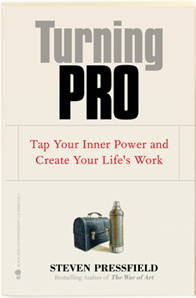
Turning Pro by Steven Pressfield
Steven Pressfield has a new nonfiction book and a new publishing company and both are vehicles for the same message.
[Full disclosure: I consider Steve a friend and this early review was made possible by his sending me a review copy and the “lunch pail manifesto” Black Irish lunchbox pictured above. OTOH, I get many review copies from publishers and PR folks and if the book they send is terrible, or just not well suited for ZP readers, I won’t review it]
First, Turning Pro is the latest sequence of a series of books that explore the mindset of the authentic creator or artist, following The War of Art and Do the Work and their struggle with what Steve terms “Resistance”, the internal psychological force that insidiously undermines our will to complete creative works (or…start them) and fulfill our life’s dreams. In the War of Art, one turned “pro” when one acquired for the first time, the mindset required to successfully battle resistance instead of supinely giving in. Turning Pro naturally expands on that aspect of Pressfield’s creative philosophy.
I say “philosophy” because that is what it is. Many of Steve’s novels are set in the ancient world of classical civilization and I know that he has done a great deal of reading in ancient history, philosophy and literature. Before the moderns and post-moderns, philosophy asked fundamental questions and students of most schools of philosophy were seeking how to live a good life, with “good” usually meaning “virtuous” in the sense of a life that is authentic, noble or honorable. We see this in particular with Socrates, the Stoics and those influenced by them such as Xenophon, Epictetus, Cicero and Marcus Aurelius, all of whom were concerned with philosophy as a practical way of life and not as an abstract exercise. My impression is that this has left a mark on Pressfield’s view of life. This is not to say that Steve is writing advice from the perspective of book-learning – far from it; he makes clear his long education in the school of hard knocks, but I think the books and the knocks have been mutually reinforcing.
For example, here is Epictetus from the The Enchiridion:
….Aiming therefore at such great things, remember that you must not allow yourself to be carried, even with a slight tendency, towards the attainment of lesser things. Instead, you must entirely quit some things and for the present postpone the rest. But if you would both have these great things, along with power and riches, then you will not gain even the latter, because you aim at the former too: but you will absolutely fail of the former, by which alone happiness and freedom are achieved.
And here is Steve from Turning Pro:
My shadow career (I’ve had more than one) was driving tractor-trailers.
In my late twenties and early thirties, I drove trucks for a living….What I was really doing was running away from writing. Driving trucks was for me a shadow version of writing, because being a truck driver was, in my imagination, powerful and manly (just as I imagined being a writer would be). It was interesting: it was never boring. It was a career I could take pride in, an occupation that felt right to me….
….Of course this was all self-delusion.
The road was taking me nowhere.
I wasn’t writing books. I wasn’t facing my demons. I was spectating at life through the movie screen of a cab-over windshield, while every mile I traveled only carried me farther away from where I needed to go and from who I needed to become.
This is one of the major themes of Steve’s nonfiction work – the need to conquer resistance, ignore distractions, eschew indirect approaches and confront head-on what you need to do and fear to try. To take the risk and dive into the deep end of the pool without rationalizing procrastination. Easy to say, but difficult for all of us to do and Steve breaks his advice in Turning Pro into digestible vignettes that separate the world of the aspiring amateur from the polished professional, the apprentice from the master. Turning Pro can be read in one sitting or read again and again until you gain the habit of “the Professional Mindset”.
A second theme, maybe a meta-theme in Turning Pro is also present in Black Irish Books, which Steve has launched in partnership with Shawn Coyne, Steve’s co-blogger and the publisher of The War of Art, has to do with what might be called “craftsmanship as an identity”. This is probably not quite the right description, but there is an essence of nostalgia for America’s boom years of WWI to the early sixties when a man’s job was substantially his identity and his hard work provided not only a rising standard of living for his family, but a psychological anchor and sense of pride. Something generally considered worthy of admiration. An era I recall dimly from my earliest years of childhood in a bungalow neighborhood in Chicago where this way of life was still the norm.
Black Irish Books has a “lunch pail manifesto” authored by Coyne:
The retro lunch pail and towering thermos on the cover of Steven Pressfield’s Turning Pro are in honor of some legendary Pros.
Back in the analog days when the economy relied on blue collar muscle to build the modern world, Steelworkers gave everything they had to get that work done. In three shifts, twenty four hours a day, three hundred and sixty five days a year, hard-hatted men with lunch pails swinging from their gnarled hands passed through mill gates in Aliquippa, Baltimore, Bethlehem, Braddock, Buffalo, Chicago, Clairton, Cleveland, Gary, Homestead, Lehigh, McKeesport, Pittsburgh, Pueblo, Tuscaloosa, Steubenville, Weirton, and Youngstown among many other cities.
Without those fully stocked lunch pails, these men would never have made it through a single shift. Let alone a double.
They couldn’t duck out and drive to a fast food joint for lunch. Their Chevy Impalas were in the rank and file parking lot, five football fields away from the shop floor. Sweat-soaked and exhausted after four hours in 100+ degree heat, they had to shed twenty pounds of flame retardant asbestos clothing just to take their twenty-minute break.
What kept them going for the second half of their shifts were the two or three chipped ham sandwiches, the couple chunks of cheese, the extra donuts from breakfast and the quarter piece slab of peach pie jammed inside their pails. And, of course, a huge thermos of coffee.
Wives spent the tail end of their evenings packing their guys’ pails. The best cold cuts and treats always went to dad. It was a sacred thing for a kid to see a scarred hard hat and a full lunch pail on the kitchen counter. That helmet and pail represented the indispensable tools of her father’s work—the armor to enter his chosen profession and the fuel to get him back home….
This is a theme that strikes a jarring contrast with America’s melancholy zeitgeist – an economy that is stagnant and in danger of cratering, elites who look out for a quick buck and an upcoming generation of cheerful smartphone experts with helicopter parents who expect huge rewards for just showing up. The stark, black, industrial lunch box is an artifact of the world of Nelson Algren or Studs Terkel but it is also a symbol of skilled labor, hard work, excellence and productivity, of a simpler but more muscularly dynamic time while the boxing glove denotes a pugnacious stance toward adversity or resistance.
Are you ready for Turning Pro?



June 13th, 2012 at 8:42 pm
My copy arrived at lunch today, I almost finished the first pass. Good stuff, and good for you!
June 14th, 2012 at 4:00 am
Thx! Steve’s nonfiction work I read straight through – novels take longer 🙂
June 18th, 2012 at 2:30 pm
This is a theme that strikes a jarring contrast with America’s melancholy zeitgeist – an economy that is stagnant and in danger of cratering, elites who look out for a quick buck and an upcoming generation of cheerful smartphone experts with helicopter parents who expect huge rewards for just showing up.
.
You sure can write, Zen. And those parents haven’t helped their kids one bit, at least from my vantage point of having taught medical students and medical residents at various points in my career. Stories of students telling professors they “don’t know anything” are legion, but maybe they are exagerrated. Dysfunction reigns in some parts of the “academy”.
.
Breaking through resistence is wonderful. Unfortunately, it also means some of us who kind of have done that don’t have time for commenting on such lovely blogs anymore 🙁 Prioritizing is one way I will have to break through this resistence. Bummer. Days should have 48 hours in them, yeah?
June 18th, 2012 at 2:39 pm
Hi Doc Madhu,
.
Thank you very much. There is an alternate explanation for your students – smart kids who have been academic “stars” without much effort or work in school due to where they are on the Bell Curve relative to the mean suddenly collide with the expectations of medical school and they are smart enough analytically to get perspective for the first time on how much they don’t know. It’s a positive epiphany if they embrace the realization but dangerous if they reject it for ego reasons. I imagine the former go on to be very good doctors and the latter compose the kind who other doctors wish would leave the profession.
.
I hear you on time – every year seems I have less and less 🙁
June 18th, 2012 at 2:44 pm
Yes, I think you are exactly correct. I was one such student because high school was so easy for me that when I went to college I didn’t have any good study skills or work habits. And then college was rocky, but I still managed to get into medical school by transferring colleges and buckling down for a few years after an initial shock of getting C’s. Still, it took years even after that to develop good work habits because of my essential intellectual arrogance developed during high school.
.
A different time, though. I remember getting a B or B minus in a chem class at college and it was maybe the second highest score in the class. No one earned an A and I was still proud of my effort because I figured the prof just didn’t give A’s much and I kind of liked that.