zenpundit.com

Boston: of motives and munitions

April 16th, 2013

[ by Charles Cameron — the prayer response at least is wordless and direct ]
.

**

The most deeply felt post about the Boston Marathon massacre I’ve seen was Caitlin Fitz Gerald‘s Boston’s best Day:

If you’ve never been to Boston on Patriots’ Day, you might not know this, but it’s the best day of the year in Boston. It’s a state holiday, spring is hitting, the Red Sox play a morning game, and thousands of runners and hundreds of thousands of people come from all over the world for the Boston Marathon. The marathon is a 26-mile party. Every runner hears cheers from every person the whole way down the route. It is a gorgeously international event, with runners and spectators coming from all corners of the earth, filling the city and lining the marathon route. In the ultimate Patriots’ Day experience, you can go to Fenway to see the Sox, then walk out to Kenmore Square to watch the runners come through. They are tired then, they are in their last mile, but people line the route 10 and 15 deep hooting and cheering and clapping to help them through to the end. It’s amazing to watch the elite runners fly through the toughest course in the world, and just as amazing to watch the regular runners, most of them raising money for charity, people who have trained months and years to do this superhuman thing.

This didn’t just hit close to home, it hit my home.

Caitlin is also responsible for the elegant Clausewitz for Kids.

**

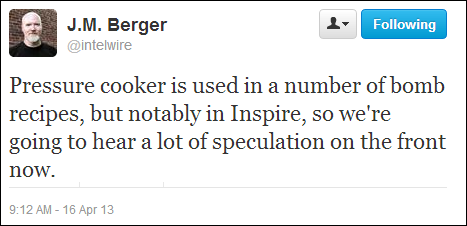
The most sensible response to the various premature speculations as to who’s to blame is JM Berger‘s tweet:

The speculations themselves ranged from dangerous incitement (Muslims or North Koreans, kill em all) to dangerous incitement (d’oh, it’s the Mossad)

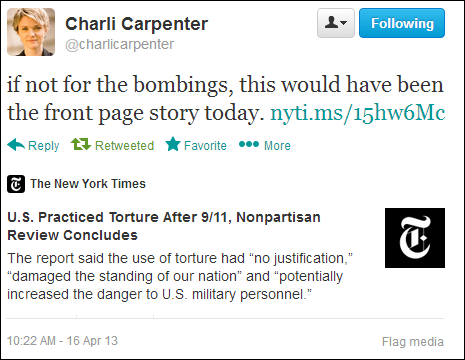
The least expected insight came from Charli Carpenter:
**

Pressure cookers:

For background, here’s a DHS release on pressure cookers from 2010.

It’s beginning to seem likely that the bomb or bombs were made with a pressure cooker or pressure cookers — normally unsuspicious items that can be found in many homes, or easily purchased online.

JM Berger would be my resource for ongoing analysis of the Boston event, but Betsy Ross sees to be the one to follow for information about pressure cookers as weaponry. Their history goes back at least as far as the Croatian nationalist hijacking of TWA flight 355 in September 1976, although the “pressure cooker bomb” in that case was a threatening fake rather than the real thing. Max Fisher tells us their use in bomb-making is mentioned in the Anarchist’s Cookbook — I’m not about to spend money on something that would only tell me how to maim people in any case — but Berger pointed out (first in my feed) that AQAP’s Inspire magazine featured them:
The Inspire mention appears in their first issue, in a piece by “AQ Chef” titled Make a bomb in the kitchen of your mom.

**

But you know what most interested me in that article?

It’s not the recipe, no sireee, I have no interest in how to blow things — much less, people — up. It’s the warning that the writer attached. Explosive devices can easily — all too often and all too literally — blow up in the faces of those who are trying to make or set them.

Bomb making is a hazardous occupation — and that’s why the order and emphasis with which the AQ Chef [promotes his three dafety precautions interests me so much:

The following are a few safety precautions:

1. Put you trust in Allah and pray for the success of your operation. This is the most important rule.
2. Wear gloves throughout the preparation of the explosive to avoid leaving behind fingerprints.
3. This is an explosive device so take care during preparation and handling.

Did you get that? The most important advice is to trust in God and pray for success — taking care during preparation and handling comes a distant third.

That’s piety, people — piety before practicality.

And — as if to prove the point — three Palestinian would-be suicide bombers were killed by their own devices back in 1999, because they refused to comply when Israel announced a “premature switch from daylight savings time to accommodate a week of pre-sunrise prayers“.

So much irony, so much stupidity, so much sorrow.

**

A few other pages to note:

Bruce Schneier, The Boston Marathon Bombing: Keep Calm and Carry On
Jeff Stein, How They Will Investigate the Boston Bombing

Andy Kroll, Question Everything You Hear About the Boston Marathon Bombing
Dana Liebelson and Tim Murphy, 6 False Things You Heard About the Boston Bombing
Adam Serwer, Terror Attacks on Sporting Events, Especially Marathons, Are Surprisingly Rare

Mike Adams via Alex Jones, Boston marathon bombing happened on same day as ‘controlled explosion’ drill by Boston bomb squad — conspiracist, reminiscent of Ruppert on 9/11

XKCD, Pressure cooker: the worst thing? — see graphic above

Zoketsu Norman Fischer, In Times of Trouble — a Zen view from just post 9/11.

Boston 4/15/13

April 16th, 2013

The Boston Marathon was bombed today near the finish line with allegations of multiple other unexploded devices:

CBS Boston station WBZ-TV reports one of the three who died from the attack was an 8-year-old boy.

 Two bombs exploded near the crowded finish line of the Boston Marathon on Monday, killing three people and injuring more than 125 others in a terrifying scene of broken glass, smoke and severed limbs, authorities said.

Police reportedly set off at least one other explosive device with a water cannon. On Monday night, a federal law enforcement source told CBS News correspondent Bob Orr that an earlier report was incorrect that authorities had found one other device that was intact and had not been detonated. Orr reports that authorities are not in possession of such a device.

 CBS News senior correspondent John Miller reports that a Saudi national is being questioned by authorities. He was seen “acting suspiciously” running from the explosion, and a civilian chased him down and tackled him. He was turned over to Boston police and is being questioned by the FBI. He is being cooperative and denies any involvement.

 “This could mean a lot, or this could mean very little,” Miller said. “It’s too soon to call him a suspect.”

 Miller reported earlier that authorities are also reviewing surveillance video that shows a man from behind carrying two backpacks near the site of the explosions. Authorities are not sure whether the subject in the video is linked to the blasts.

Boston police say no suspect has been taken into custody. 

There is much speculation and misinformation at the present time and a rush to analytic judgement is premature when crucial physical evidence is in the early stages of being found, identified and tested by expert investigators. White House officials have classified the attack – which featured a second blast to harm first responders and bystanders – “terrorism”.

Terrorism would appear to be accurate. Whether this is by a group or a “lone wolf” is not yet determined. The presence of multiple, coordinated bombs would be very difficult for one person acting alone to plant without detection but not impossible, a small cell is more likely. A high failure rate of bombs may indicate a determined amateur rather than a professional bomb-builder from a group like the IRA, Hezbollah or Lashkar-e- Taiba, all of which are noted for their skill with explosives. Nor can a foreign state security agency be definitively ruled out at this time, though that is much less likely a possibility ( Pointlessly bomb the Boston Marathon and get yourself a 2 carrier group aerial “regime decapitation” campaign).

Before jumping to conclusions about the possible identity of the Boston Bomber, recall first guesses are frequently wrong and as with the “Anthrax Letters”, we may never know for certain. Or the FBI may run down the culprits in the next 48 hours. People using this attack to score cheap partisan political points right now in the media or on social network sites  are supreme asshats

Thomas P.M. Barnett Goes Dark

April 15th, 2013

Tom goes sine die

You can still catch Dr. Thomas P.M. Barnett’s geopolitical thinking at TIME magazine’s Battleland blog and, of course, if you subscribe to Wikistrat 


Recommended Reading & Viewing

April 14th, 2013

Top Billing! T. Greer –Far Right and Far Left – Two Peas in a Pod?

….There are two groups who consistently oppose this plutocratic “pragmatic” consensus: the far left and the far right. These two groups, seemingly divided, are united by their “radical” opposition to many otherwise unquestioned aspects of America’s standing political regime. To name but a few:

  • The belief that the United States federal government should play a strong role in holding up the U.S. economy – particularly sectors deemed “Too Big To Fail.” 
  • Strong support for subsidies or other forms of ‘corporate welfare’ for influential or strategic industries (“The Farm Lobby,” “Big Pharma,” and the energy sector – both the “Big Oil” and green energy varieties – are prominent examples).
  • A commitment to America’s global hegemony and globalization writ large. The chosen instruments for this are transnational economic agreements, financial interventions (as pioneered by the IMF), or offers of substantial military assistance. 
  • The use of drone strikes, special forces and other ‘limited war‘ operations as the most effective response to international terrorist movements.
  • A disdain for the rule of law and governmental transparency. 
  • Prioritizing national security over privacy and individual rights.
  • Eclipse of the legislative branch in favor of an increasingly large, complex, and powerful executive. Outsourcing legislative policy making to congressional, think tanks, or industry wonks.  

Tea-party and Occupy members are opposed to most, if not all, of these things. However, identfying the real problem does not ensure the two sides will agree on solutions. What party program could unify the two sides? Mr. Parameswaran outlines one possible solution. He labels it “radical centrism: [….] 

An outstanding post . Hat tip to L.C. Rees 

The League of Ordinary Gentlemen – (Blaisep)Under a Field of Flowers: Captain Emil Kapaun 

….As Chinese Communist forces encircled the battalion, Kapaun moved fearlessly from foxhole to foxhole under direct enemy fire in order to provide comfort and reassurance to the outnumbered Soldiers. He repeatedly exposed himself to enemy fire to recover wounded men, dragging them to safety. When he couldn’t drag them, he dug shallow trenches to shield them from enemy fire. As Chinese forces closed in, Kapaun rejected several chances to escape, instead volunteering to stay behind and care for the wounded. He was taken as a prisoner of war by Chinese forces on Nov. 2, 1950.

After he was captured, Kapaun and other prisoners were marched for several days northward toward prisoner-of-war camps. During the march Kapaun led by example in caring for injured Soldiers, refusing to take a break from carrying the stretchers of the wounded while encouraging others to do their part.

Once inside the dismal prison camps, Kapaun risked his life by sneaking around the camp after dark, foraging for food, caring for the sick, and encouraging his fellow Soldiers to sustain their faith and their humanity. On at least one occasion, he was brutally punished for his disobedience, being forced to sit outside in subzero weather without any garments. When the Chinese instituted a mandatory re-education program, Kapaun patiently and politely rejected every theory put forth by the instructors. Later, Kapaun openly flouted his captors by conducting a sunrise service on Easter morning, 1951. 

Emil Kapaun, US Army captain, Catholic priest, Congressional Medal of Honor recipient and a martyr for religious freedom, is the American Maximilian Kolbe

SWJ – Understanding Groupthink and Aligning FM 3-24 Counterinsurgency with Reality 

….To illustrate the nuanced challenges of groupthink, we informally surveyed a small group of Intermediate Level students at one of the Defense Department’s educational institutions.  The students were junior field grade officers from joint and international services, nearing the end of their year-long education.  Our survey asked two questions:  1) Whether their education had formally addressed groupthink as a subject; and 2) What were groupthink’s causes?  A little more than half of the group responded that while groupthink had been discussed early in their education year, albeit briefly as part of a broader class topic, groupthink was not a central focus of the class.  In response to the causes of groupthink, about half of the group cited dominant personalities within a group who ignored dissenting opinions, and the inclination of group members to remain within the group’s good graces by avoiding dissention.  Less than one-fourth of the responses cited direct pressure on any member who objected to group opinions.[2]  What strikes us is not what the students said, but what they did not say.

Two excellent and – I might suggest, related – articles.

Lexington Green – Margaret Thatcher: Revolutionary, Leader

….There is always a “them” who are the current ruling group. They are the ones dealt into the existing game, its apologists and advocates. To take them on, to organize and lead an opposition movement, the leader must have extremely strong character. Such a leader must be self-assured, know how things really work, and have a very thick skin. The leader must have no regard for conventional wisdom and no respect for the often unstated limits of what can be done or, even more, what is “simply not done” or “simply not said.”

As a practical matter, such a leader must have the capacity to speak plainly and clearly to a majority of ordinary people who are quietly victimized in the existing game, to show them how certain changes will be good for them, and good generally. They do not lead by force or lies, they lead by telling hard truths and gaining assent to the hard path to better things.

Mrs. Thatcher was such a leader.  

Strategic Studies Institute – (Manwaring) Venezuela as an Exporter of 4th Generation Warfare Instability and (Bunker) Op-Ed: The Need For A “Half-Pivot to the Americas” 

Kings of War – (Betz) Kim Jong Un, We’re all gonna be like three little Fonzies here, OK? and (Egnell) Rethink, but don’t dismiss – on U.S. training of foreign troops 

The Glittering Eye – Personal Computers Aren’t Too Good 

ForbesNanotechnology’s Revolutionary Next Phase 

Taking Note –Michelle Rhee’s Reign of Error 

It’s easy to see how not trying to find out who had done the erasing–burying the problem–was better for Michelle Rhee personally, at least in the short term. She had just handed out over $1.5 million in bonuses in a well-publicized celebration of the test increases[9]. She had been praised by presidential candidates Obama and McCain[10] in their October debate, and she must have known that she was soon to be on the cover of Time Magazine[11]. The public spectacle of an investigation of nearly half of her schools would have tarnished her glowing reputation, especially if the investigators proved that adults cheated–which seems likely given that their jobs depended on raising test scores.

Moreover, a cheating scandal might well have implicated her own “Produce or Else” approach to reform. Early in her first year she met one-on-one with each principal and demanded a written, signed guarantee[12] of precisely how many points their DC-CAS scores would increase.

Relying on the DC-CAS[13] was not smart policy because it was designed to assess students’ strengths and weaknesses. It did not determine whether students passed or were promoted to the next grade, which meant that many students blew it off. 

Recommended Viewing:

New Book and New Monograph

April 10th, 2013

The Strategy Bridge by Colin S. Gray

I have been eager to read this book by the eminent Anglo-American strategist Colin Gray ever since Adam Elkus sang it’s praises and now I have a hardcover copy thanks entirely to an enterprising amigo. A description from Oxford Scholarship:

The Strategy Bridge: Theory for Practice is an original contribution to the general theory of strategy. While heavily indebted to the writings of Carl von Clausewitz, Sun Tzu, and the very few other classic authors, this book presents the theory, rather than merely comments on the theory, as developed by others. Bridge explains that the purpose of strategy is to connect purposefully politics and policy with the instruments they must use. The primary focus of attention is on military strategy, but this subject is well nested in discussion of grand strategy, for which military strategy is only one strand. Bridge presents the general theory of strategy comprehensively and explains the utility of this general theory for the particular strategies that strategists need to develop in order to meet their historically unique challenges. The book argues that strategy’s general theory provides essential education for practicing strategists at all times and in all circumstances. As general theory, Bridge is as relevant to understanding strategic behaviour in the Peloponnesian War as it is for the conflicts of the twenty?first century. The book proceeds from exposition of general strategic theory to address three basic issue areas that are not at all well explained in the extant literature, let alone understood, with a view to advancing better practice. Specifically, Bridge tackles the problems that harass and imperil strategic performance; it probes deeply into the hugely under?examined subject of just what it is that the strategist produces—strategic effect; and it ‘joins up the dots’ from theory through practice to consequences, by means of a close examination of command performance. Bridge takes a holistic view of strategy, and it is rigorously attentive to the significance of the contexts within which and for which strategies are developed and applied. The book regards the strategist as a hero, charged with the feasible, but awesomely difficult, task of converting the threat and use of force (for military strategy) into desired political consequences. He seeks some control over the rival or enemy via strategic effect, the product of his instrumental labours. In order to maximize his prospects for success, the practicing strategist requires all the educational assistance that strategic theory can provide.

I am unfortunately in the midst of a large project for work, but The Strategy Bridge is now at the very top of my bookpile and I will review it when I am finished.

And as long as we are on the subject of Professor Gray, he ventured into the murky domain of cyber war recently, publishing a monograph on the subject for The Strategic Studies Institute:

Making Strategic Sense of Cyber Power: Why the Sky is not Falling

Obviously, Dr. Gray is not in the “Cyber Pearl Harbor” camp:

The revolution in military affairs (RMA) theory of the 1990s (and the transformation theory that succeeded it) was always strategy- and politics-light. It is not exactly surprising thatthe next major intellectual challenge, that of cyber, similarly should attract analysis and assessment almost entirely naked of political and strategic meaning. Presumably, many people believed that “doing it” was more important than thinking about why one should be doing it. Anyone who seeks to think strategically is obliged to ask, “So what?” of his or her subject of current concern. But the cyber revolution did not arrive with three bangs, in a manner closely analogous to the atomic fact of the summer of 1945; instead it ambled, then galloped forward over a 25-year period, with most of us adapting to it in detail. When historians in the future seek to identify a classic book or two on cyber power written in the 1990s and 2000s, they will be hard pressed to locate even the shortest of short-listable items. There are three or four books that appear to have unusual merit, but they are not conceptually impressive. Certainly they are nowhere near deserving (oxymoronic) instant classic status. It is important that cyber should be understood as just another RMA, because it is possible to make helpful sense of it in that context. Above all else, perhaps, RMA identification enables us to place cyber where it belongs, in the grand narrative of strategic history….

Read the rest here.


Switch to our mobile site