zenpundit.com » recommended reading

Archive for the ‘recommended reading’ Category

Recommended Reading

Sunday, May 23rd, 2010

Top Billing! BBC‘Artificial life’ breakthrough announced by scientists

Scientists in the US have succeeded in developing the first living cell to be controlled entirely by synthetic DNA. The researchers constructed a bacterium’s “genetic software” and transplanted it into a host cell. The resulting microbe then looked and behaved like the species “dictated” by the synthetic DNA. The advance, published in Science, has been hailed as a scientific landmark, but critics say there are dangers posed by synthetic organisms.

This is a seminal scientific breakthrough with staggering downstream implications. John Robb commented on a few of them:

Now that we have a self-replicating biological platform (yeast — likely one of many different platforms that will be floated over the next couple of years) that can accommodate a completely synthetic genome, the race in on:   towards an abundance in nearly every material or process that can be enabled via biological means.

Nagl vs. Galbraith at The Economist….. 

Coming Anarchy (Curzon) – Education will not save us, Part 2

….To all of this, I can only repeat my Robert D. Kaplan-esque conclusion from my previous post-education will not save us. The long-term battle against Islamist terror is actually fueled by the promotion of education. Whether it be 19th century France, 20th century Russia and China, or 21st century Islamic World, education is not the cure for political extremism but often the catalyst to violence. Pursuing the mass education of the poor as policy to counter the spread of extremism, is misguided.

SWJ BlogOn the DNI

An excellent media round-up on the resignation of Admiral Dennis C. Blair  as DNI

Eide Neurolearning BlogThe Creative Advantage: How Vivid Memories of the Past Help Predictions for the Future

When researchers looked at the brain regions involved in looking at the past, they found many of the same regions activated in response to prompts to imagine events in the future.

….But because personal memory is so closely linked to future prediction pathways, shouldn’t we think about the implications for education? There’s a lot concern these days about American students not being prepared for the new millennial global workplace. Perhaps we spend too little time cultivating rich personal experiences, the development of spatial intelligence, and future thinking.

The Atlantic (Marc Ambinder)The Secret Pentagon Spy Ring

The CIA doesn’t think STRATCOM should play in this lane. But neither does Robert Gates, the Defense Secretary, or the State Department, or the National Security Staff. Information Operations involves five fields: deception, psychological operations, computer network operations, electronic warfare and operations security. When you hear these terms, you think military, war, penetration of secret bunkers and the like. The State Department and the others want to make sure that Information Operations don’t conflict with what they call Strategic Communications — getting the message out that the US isn’t fighting against Islam, that the Afghan military is a credible institution. State sees IO from the perspective of an ad agency: what does the customer need? STRATCOM sees IO from the perspective of a military targeter: what’s the target, and how to we use all resources to manipulate it.

The problem is that the main thrust of the current administration’s strategy for combating terrorism involves strategic communication, State Department-style. There is room for both approaches, of course, but there isn’t room for an entity like STRATCOM to make unilateral decisions about how to influence the adversary. 

Schmedlap – Why do Good Citizens Suddenly Become Terrorists?

I am not proposing a cause for their shift in behavior. But I am asserting that nobody should be shocked or befuddled. Affluence, integration, and apparent moderate viewpoints do not provide any kind of moral or spiritual guidance. They are not a foundation upon which happiness is built. They are only indicators of past performance, not indicators of future performance. The real head-scratcher is that anyone would measure someone’s success in life by these worldly, materialistic standards.

The League of Ordinary Gentlemen (Rufus F.)Plato, “Crito”, and should we obey bad laws?

There was Socrates and then there was Plato’s Socrates.

RECOMMENDED VIEWING:

Authors @Google – Dr. David Kilcullen ( Hat tip NYRKinDC)
Recommended Reading

Monday, May 10th, 2010

Top Billing! Andrew ExumCNAS Report:Leverage: Designing a Political Campaign for Afghanistan

Exum has a judicious and deftly played piece of analysis and policy advocacy here that takes as a starting point that the US has few options but to work with the regime of Hamid Karzai, whatever its flaws and previous American mistakes, and then offers his prescriptions for rebuilding that relationship. Exum advocates a strengthened and reorganized civilian agency presence via a “political campaign design”, a template borrowed from military planning and modified to suit the civilian components of the DIME spectrum.

“In the end, by having so vocally and materially committed to the Karzai regime, the United States and its allies are tied to its successes and failures. The goal, then, should be to maximize the former and minimize the latter through focused application of U.S. leverage,” writes CNAS Fellow and author Andrew Exum.  “Designing a political campaign minimizes the role luck plays in whether the United States and its allies are successful.”

By drawing on research conducted through hundreds of interviews with U.S. and NATO military officers and diplomats, policymakers and NGOs in Afghanistan, Exum offers recommendations to design an effective political campaign:1. Convene another strategic review to assess the civilian strategy, not the U.S. and allied military strategy, in Afghanistan. President Obama should ask the tough questions to his secretaries and envoys that he asked his military commander – General Stanley McChrystal – to answer in his fall 2009 review.

2. Build a functioning relationship with Hamid Karzai and demonstrate to the Afghan president that he has an enduring partner in the United States and its allies.

3. Use U.S. and allied leverage to press the government of Afghanistan to either hold elections for district governors or appoint competent governors from Kabul. Effective local governance is a prerequisite for U.S. and allied forces to institute aid and development projects that are essential to addressing the factors driving conflict and violence at the local level

Hat tip to Steve Pampinella. 

I disagree with continuing to hitch our war to Karzai for a number of reasons, but as the USG is going to continue down this path regardless, they might as well look at Exum’s recs to see how they might do so with greater returns on the dollars spent and blood shed.

The New Republic (Nicholas Schmidle)In a Ditch

Crazies 2.0 in Pushtunistan are here. This is not your Father’s Islamist radicalism.

It’s important to consider what Khawaja might have been doing in North Waziristan. The Pakistani army is apparently gearing up for an offensive there against the Taliban, akin to the ones conducted in Swat and South Waziristan last year. In his confession from captivity, Khawaja claimed that he was sent by two former ISI chiefs to broker a deal with the militants, telling them that they’ll be spared if they simply aim their weapons towards Afghanistan, rather than on targets in Pakistan. It’s also been reported that Khawaja had arranged for the kidnapped British journalist to meet with Hakimullah Mehsud, the Pakistani Taliban leader rumored dead who has recently surfaced. That Khawaja, on either mission, would be kidnapped and murdered illustrates a profound evolution that’s occurred in Pakistan over recent years concerning the dynamic between the ISI and their one-time jihadi clients.

Bill Roggio  US pressures Pakistan to target North Waziristan

The Pakistani military has been reluctant to move into North Waziristan, citing concerns about its forces being overstretched due to offensives in neighboring tribal agencies, including South Waziristan, Arakzai, and Bajaur. But the real reason, US officials say, is that Pakistan is reluctant to move against the so-called “good Taliban” groups – those who wage war against NATO in Afghanistan and serve as jihadist depth against arch-enemy India.

“It is time for Pakistan to go in there [North Waziristan] and gut the Taliban and al Qaeda once and for all,” a top US military intelligence official told The Long War Journal. “They are hitting us in Afghanistan and are trying to hit us at home, and this has to be stopped. Airstrikes alone won’t solve this problem,” the source said, referring to the attacks carried out by unmanned Predators against al Qaeda and Taliban leaders and camps in North Waziristan.

Pundita –U.S. to Pakistan: We’re really, really upset with you this time so we’ll have to give you more money

“There’s going to be enough here to trigger a policy debate,” predicted one senior official with access to U.S. intelligence on Pakistan and involvement in White House discussions about the bombing attempt. …What U.S. intelligence on Pakistan?

Cut to the sound of chirping crickets.

 Foreign Policy (Michael Innes)COIN confusion

Are COIN and CT “incompatible”? Are the terms “globalized insurgency and counterinsurgency” hopelessly muddled?

Now things not related to Pakistan or Afghanistan or terrorism…… 

Automatic BallpointReagan, Thatcher, and the ‘Tilt’ 

Falklands si, Malvinas no! 🙂

WIRED (Ryan Singell)Facebook’s Gone Rogue; It’s Time for an Open Alternative

Yes.

The New Atlantis (Ivan Kenneally)The Technocratic American University

….The modern university’s mission to promote the rational autonomy of the individual is in tension with its charge to cultivate the virtues necessary for civic life. This conflict, between the rejection of philosophical authority and the concession to the need for moral authority, reflects modernity’s sanguine optimism regarding the coincidence of intellectual and moral virtue. In this respect, both the university and the modern theory out of which it was born take quite literally Socrates’ ironic identification of virtue with knowledge.

Joseph FoucheSaturday Night’s All Right For Linking

This saves me time of typing “hat tip”.

That’s it!

Recommended Reading

Monday, May 3rd, 2010

Top Billing! Scholar’s StageCases in Plutarchy: The US Senate by Graduating Institution

T. Greer has a superb post, after taking up an observation by commenter LFC as a challenge.:

….To be pithy: The erosion of this dream is the greatest danger American society now faces.

Therefore, those concerned with health of the Republic have a vested interest in understanding and explaining the source of this erosion. A meme to this effect has been bouncing around the blogosphere of late. The meme, which I have endorsed, can be summarized as follows: in America the most direct avenue to power and influence is an education from one of the nation’s elite schools. Beyond the generally superior education these institutions offer, an education of this type allows students access to the social networks that link America’s ‘biggest’ journalists, analysts, bankers, business executives, politicians, and thought-leaders. In terms of social mobility, the colleges churning out “the best and brightest” have the potential to serve as bridges between the classes, opening doors of success to smart and hard working students from the poorer sections of American society. Meritocracy in action.

The problem is that this has not happened. As most readers are probably aware, the last decade has seen college tuition rates soar to heights previously unknown. If they were not before, the best private institutions in the country are now beyond the price range of the all but a tiny minority of Americans. The upper middle class has been particularly hard hit; unable to qualify for financial aid offered to students from low-income families, students unwilling to rack up dangerous levels of debt have found themselves blocked from social advancement. When the reasons behind these tuition increases are considered, it is difficult not to see this as an inadvertent move to solidify the existing social structure. Plutarchy in action. 

That is the narrative. As it turns out, it is a narrative with some holes.

 LFC, a frequent commentator here at the Stage and other related sites, has objected to this argument (in several different forums). The problem with this meme, says he, is its premise: no one has produced any evidence that links Ivy League attendance to positions of power and influence. Absent hard data, we are working with perceptions, not reality, and there is no particular reason to believe that these perceptions are accurate.

It is a fair point. This author has been eager to make claims about these institutions absent data necessary to back these claims up. This post is an attempt to provide such data. Below is a breakdown of the educational background of a group of people who are unambiguously members of the elite: the 100 men and women who currently compose the U.S. Senate. Unless otherwise noted, all information recorded below comes from Scientists and Engineer’s for America‘s  list of Congress members by degree.

For the data and T. Greer’s analysis, read the entire piece here. This post is the germ of something that would make a fine book or research article.

Hey….the US NAVY..has a blog! It is called Navy Live – best of luck gents and welcome to the blogosphere. (hat tip Galrahn)

SWJ Blog (William S. “Mac” McCallister)Some Considerations for Planning and Executing a Military-Political Engagement in Afghanistan

….Much intellectual energy has been expended on whether to label our outreach efforts in Afghanistan as tribal or community engagements. This paper therefore does not attempt to settle the issue as to the primacy of tribal- and/or community- or interest-based identities. Suffice it to say tribal identities exist in Afghanistan but community and/or interest groups may not necessarily organize themselves based on these tribal identities. What matters most is that we engage the locals within their own cultural frame of reference.

Wisely said. Pragmatism over ideology is a good basis for policy.

FPRI -(Dr. Walter McDougall)-  Can the United States Do Grand Strategy?

My answer is: Historically, at times, if there is an existential crisis and no way to avoid it. Here is a snippet of Professor McDougall:

In spring 2003, following the last lecture in my survey course on U.S. diplomatic history since 1776, a brilliant, inquisitive student approached me in the hall to ask a final, confidential question. She said that my course helped her appreciate, as never before, how swiftly the United States had become the mightiest nation ever, with unprecedented military, economic, and cultural influence. But how long would it last? How long did I think the United States could stay on top?

At first I was tongue-tied, because I was loath to inject a future national leader with either complacency or despair. Then an answer occurred to me. It all depends on whether the United States is as exceptional as we like to believe. If the United States follows the pattern of all previous powers, then demographic or technological trends, new foreign threats, strategic folly, overextension, domestic decadence, or sheer loss of will must hurl it into decline, perhaps within fifty years. If, however, our institutions, values, and national character really do amount to a new order for the ages, a potent mix enabling the United States to reinvent itself and force other nations to adapt to the challenges posed by us, then the republic may stay on its asymptotic trajectory. I stopped there, but as I walked to my office I recalled Arnold J. Toynbee’s historical law to the effect that empires die by suicide, not murder.

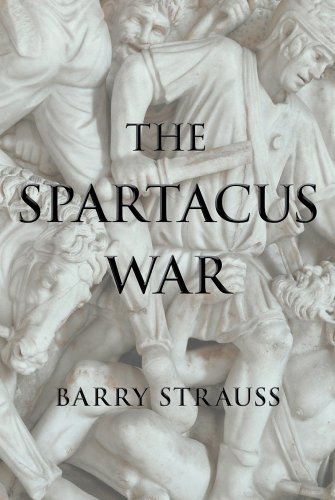
Michigan War Studies Review (Arthur M. Eckstein)Book review – The Spartacus War by Barry Strauss

Looks like The Spartacus War is a good book about one of history’s most famous insurgents. Hat tip to Adam Elkus.

….Spartacus was certainly both a talented tactician and an insightful strategist. His tactical skills showed in the startling victories of his ill-equipped irregulars over the far better equipped and trained Roman troops. All along, the slave leader sought to avoid set-piece battles with the heavy Romans infantry, preferring maneuver and ambush. Spartacus’ strategic skill is evident in his desire to escape Italy, where he knew no rebellion of slaves could long withstand Roman power. He also knew that the discipline and obedience necessary for survival would be difficult to instill in an army of rebels and fugitives. The break with Crixus and the turning back from the Alps are indicative of the army’s indiscipline


The Committee of Public SafetyThis Town Needs An Enemy

Joseph Fouche is informative and amusing, in a post featuring Michael Jordan, Ibn Khaldun and dieting tips from Nassim Taleb.

SEEDWhy We Haven’t Met Any Aliens

This “fits” (pun intended) very well with Joseph Fouche’s post above.

Presentation ZenYou can learn a lot from a child (redux) and The secret to great work is great play

That’s it!

Recommended Reading

Monday, April 26th, 2010

Overdue.

No “top billing” this week.

Thomas P.M. BarnettThe fastest and most likely route to breaking the magic 50 boundary and Feudalism replaced by “Democratic centralism” replaced by feudalism replaced by …?

Medvedev talks of needed modernization, but it is a still-born notion so long as Putin remains co-ruler. Thus the muddle-through option that defines much of Russian history remains operative until word comes definitively from Putin as to his plans in 2012.

Putin prefers a non-competitive environment in which his state-run companies and those piloted in the private sector by his cronies can dominate. So long as that remains the case, Russia’s economy will remain more cannibalistic than innovative.

Chicago Boyz (Lexington Green) –Col. Frederick Gustavus Burnaby 

 Col. Frederick Gustavus Burnaby, late of the Royal Horse Guards (the Blues), author of A Ride to Khiva: Travels and Adventures in Central Asia and On Horseback Through Asia Minor. He was also a pioneering aeronaut, author of A Ride Across the Channel: and Other Adventures in the Air. Col. Burnaby met his death in the hand-to-hand fighting of the Battle of Abu Klea, 1885. Queen Victoria fainted when she heard of his death.

The Duck of Minerva (Bill Petti)Statistics is the New Grammar

….In thinking about this I remembered an argument I had with a number of colleagues while in grad school over why they had to be at least somewhat literate in quantitative analysis and game theory since they never intended to use such methods. Given that we will only see an increase of data and data-based (no pun intended) arguments, policies, and decisions we need to, at a minimum, be able to understand how the results were achieved and whether or not the studies are flawed

Agreed. You don’t need to be a quant or be able to do quant things. You need to be able to recognize when a quant’s work may be incompetent, misleading or is being misrepresented by a third party for nefarious ends.

Wings Over IraqDo Aviators Get COIN–A Resounding “Yes”

I should have brought attention to this post sooner – Starbuck is a victim of my creeping blogging burn-out. 🙂 

  The AH-64 and OH-58 pilots, as a general rule, seemed to understand COIN better than the UH-60 and CH-47 pilots (“skirts”, as we’re known). This is likely because these aviators are employing weapons on the battlefield and have to think about the effects of their weapons systems.

One of the most profound statements came from an Apache pilot, who spent a few weeks in a targeting class. The first few days of the class focused on the principles of Islam and Muslim culture. At first, he found the emphasis a little bizarre; however, upon his deployment to Iraq, he quickly learned the importance of culture. As he looked at the ramshackle buildings and farms below him, he could see a man’s livelihood–his only means of supporting his family. Damaging a farm or killing goats might cause an entire family to go hungry–something we must always consider when employing weapons systems on the battlefield. This shouldn’t be an excuse to never fire–just another factor to take into consideration before firing. Wiping out a farmer’s livelihood might drive him to seek an alternate form of employment: insurgency.

Josh Foust features “Kabul Expat”, who wins points for the following para from How to Write About Afghanistan:

….Never have a picture of a well-adjusted Afghan accompanying your article. (Make an exception for Afghans you want to be president.) A stoned cop, a woman in a burka begging, a scowling man holding a Kalashnikov: use these. If you must include an Afghan who is not miserable or threatening, make sure you get an elderly farmer with very few teeth, or a little girl holding a baby goat.

No teeth….a love of goats….feuding…..Afghanistan is kinda like the Scotland of the Hindu Kush without decent golf or widespread alcoholism.

A weird juxtaposition I’d never expected, Col. Pat Lang blogging on South Park. He also had a pragmatic take on Arizona’s immigration enforcement law.

The Strategist amused many, including me, with the following graphic:

That’s it!

Recommended Reading

Sunday, April 11th, 2010


The Road to Tartary edition…. 

  If I were Lord of Tartary,
Myself, and me alone,
My bed should be of ivory,
Of beaten gold my throne;
And in my court should peacocks flaunt,
And in my forests tigers haunt,
And in my pools great fishes slant
Their fins athwart the sun.

– Walter de la Mare

Top Billing! Michael J. TottenOur Man Inside Iran’s Revolutionary Guards

I have a weakness, acquired from my days of studying the Soviets, for the intriguing and often tormented characters who become double-agents and defectors, as well as for the morally uncompromising, superhumanly heroic, dissidents who elect to confront tyrannical power head-on. We have had very few windows in the last thirty years into the opaque world of the of the Pasdaran-clique that now runs Iran. Michael Totten interviews one of them:

MJT: I’m a bit surprised that over the past year, since uprising after the fake election, that more people haven’t been killed during street demonstrations. I expected thousands to be killed like in China in 1989. If Khamenei were to order something like that, would the Revolutionary Guards carry it out?

Reza Kahlili: That is a very good question.

What happened in Iran totally destroyed the legitimacy they claimed to have, that they represent God and protect the oppressed. So if Khamenei wanted to do what he has seen other dictators do by killing thousands, I am sure it would affect the Revolutionary Guards’ mentality and spirit. They might not participate. That’s a very good question.

They don’t use the Revolutionary Guards to beat people or knife them or spy on them. They have the Basij and the special forces and the plainclothes police for the dirty jobs. The regular forces couldn’t sustain such an act. It would deeply affect them.

MJT: So what do you think they would do if they were given those orders? Would they just refuse to comply, or would they move against the government?

Reza Kahlili: They won’t move against the government. They just wouldn’t carry it out. They wouldn’t show up. Or if they did show up, they wouldn’t do what would be expected of them. It would create doubt in the hearts of the loyal forces who would fight a foreign force to the last drop of blood.

MJT: If you’re right about that, the government is eventually going to lose

Registan.net has excellent analysis of and speculation about events in Kyrgyzstan:

Protests, Clashes, and Arrests in Kyrgyzstan, Rushing for Inaccuracy in Bishkek, Let the Revolution Be Archived, Side elements of Upheaval, The More Things Change…What We Talk about When We Talk about Revolution, Why Kyrgyzstan’s Social Media Matters, A New Republic?

Transitions Online ( Bullough)Why Are Chechens So Angry?

A very pro-Chechen look at the last few centuries of Russian-Chechen conflict and coexistence

New Eurasia.net has an interesting series on Turkmenistan. The blogger, “Annasoltan” has a good eye for the use of striking visuals too:

The signal of freedom, part 3: the 3Golden Age , OtherTube, PseudoBook, and the fate of the world in Turkmenistan,  Turkmen Gods, part 2: “This is for God and this is for our idols” , Turkmen Gods, part 1: divide and convert , “My people have been hypnotized” , Into the iris of insanity: dissent, psychiatry, and the true face of Turkmen totalitarianism,  Berdimuhammedov three years on: metaphysical dentistry or just cosmetic scrubbing?

The Atlantic CouncilKyrgyzstan’s New Chance for Democracy and Watching Karzai, Seeing Diem

Like Diem, Karzai brought some baggage with him. He was not a figure with whom the majority of Pashtuns identified, and his collaboration with the Northern Alliance made him suspicious as well. In the “grand” Afghan tradition, he has proven to be classically corrupt, instituting a kleptocracy in which members of his family have been notable beneficiaries. Corruption has, like land reform in Southeast Asia, been a major theme in Afghan opposition to Karzai, and the United States has publicly and privately implored him to clean up his regime’s act. Like Diem, he has issued pious rhetoric about attacking the problem but basically not done anything about it. As evidence, Americans seeking to liberate Helmand Province regularly report they fear corrupt Afghan officials as much or more than the Taliban.

Foreign Policy –  How Not to Run an Empire (Tom Malinowski)

U.S. policymakers increasingly view Central Asia as a transit point to somewhere else. It is a region through which oil and natural gas flow to Europe, reducing U.S. allies’ dependence on Russian energy supplies. It is a region through which fuel, food, and spare parts flow to surging U.S. and NATO forces in Afghanistan, reducing their dependence on a precarious Pakistani supply route. Officials and policy experts even have a new name for this region that captures its status as a logistical intermediary, rather than a set of distinct countries that matter in their own right: They call it the “Northern Distribution Network.”

Foreign AffairsA Substitute for Victory (Dr. Bernard Finel)

There is now a clear path to ending the war in Afghanistan; the question is whether political leaders can take advantage of McChrystal’s battlefield success. If Washington can turn the changing balance of power on the battlefield into a negotiating strategy that acknowledges the need to offer insurgent leaders more than just the opportunity to lay down their arms, the United States could succeed in Afghanistan in a way that neither proponents nor opponents of the Afghan surge imagined last fall. For the first time since the United States intervened in Afghanistan in 2001, it is possible to outline a coherent political-military plan that would yield, if not a clear-cut victory, at least an outcome that enhances U.S. security.

UNRELATED SUBJECTS:

There’s more than one way to skin a cat. With climate change as damaged goods for justifying social engineering and tax-farming on a global scale by an unaccountable IGO class, the scientist-political activist public intellectuals and their bureaucratic allies will be increasingly putting their efforts here.

Fabius MaximusStarfor looks at Mexico: “The Struggle for Balance” and Freidman of Stratfor writes about “Mexico and the Failed State Revisited”

FM also includes a bibliography of Mexico related links. Comments are shut off, not sure why though if FM’s getting spammed like I have been lately I don’t blame him.

After a period of dormancy, the IO/Black Propaganda boys with an eye for talent at Swedish Meatballs Confidential are back in business!

That’s it!


Switch to our mobile site