zenpundit.com » IC

Archive for the ‘IC’ Category

Graphic matches?

Thursday, September 27th, 2012

[ by Charles Cameron — Netanyahu’s UN speech, Jyllands-Posten cartoon, a nifty film technique, and is there an echo there? ]
.
**

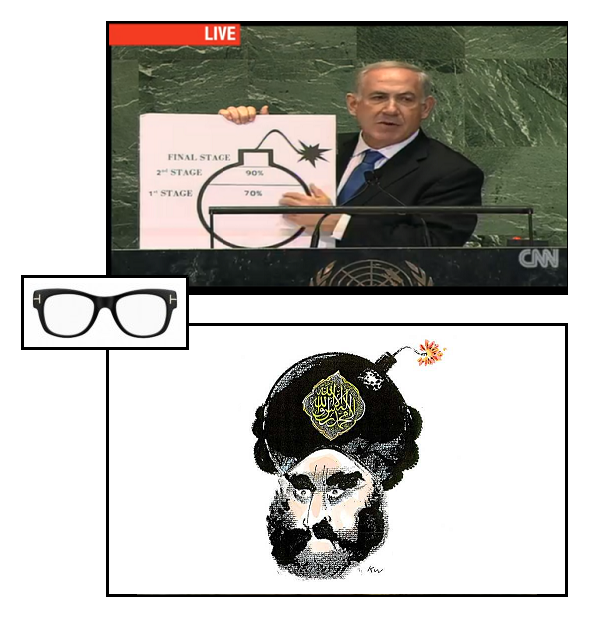
A fair number of people have commented on Israeli PM Netanyahu‘s displaying a cartoonish bomb graphic in the course of his UN address today, and some have complained, fairly IMO, at the choice of photo used to depict Netanyahu during his speech by eg Fox News:

I think it’s important to read graphic messages closely for the cues they contain.

**

Sometimes, as with images of the Virgin Mary seen in grilled cheese sandwiches or oil slicks, the correspondences don’t really mean much more than that the brain is designed for pattern recognition, and a little “imagination” without critical appraisal can get things wrong: the terms commonly used for this are apophenia, patternicity and pareidola.

My own favorite example of this phenomenon is of the wall-stain in a school in the East Bay that was recognized as the Virgin Mary by Catholics and the bodhisattva Kuan-Yin by Buddhists

Nonetheless, I’m reluctant to ridicule such modes of perception without also recognizing the utility of Rorschach blots in psychology and the even more creative uses to which Leonardo put them.

**

Perceived visual similarities, in short, can be the result of creative or merely overheated imagination, but in the visually sophisticated they become much more.

Film-makers, in particular, have several names for the kind of skillful editing by which one scene segues into another via a well-chosen visual similarity: match cut and graphic match.

My personal favorite example is that of Apocalypse Now, where the rotors of the fan in that claustrophobic hotel room in Saigon morph into the rotors of the helicopter coming to take Captain Willard out and away on his mission up river…

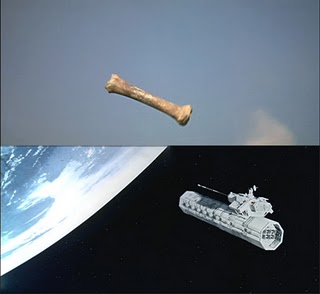
Perhaps even more celebrated, though, is Kubrick’s match between the bone tumbling through the air and the space station tumbling through space, in 2001: A Space Odyssey:
**

To get back to Netanyahu, then — is his hand held out a little above vertical, palm down, really a Hitler salute? I think not.

And does his image of a bomb carry any resonance from the Jyllands-Posten cartoon? I have to admit I’m almost undecided on that one.

And if there’s just a hint of a correspondence, would it be conscious or unconscious?

**

The thing is, politicians have to be extremely careful about tossing graphic matches onto dry kindling.

To my own way of thinking, both Netanyahu’s “cartoonish bomb” graphic and his “mid-heil” salute are potential fodder for incautious speculation — but neither one is even remotely as far-fetched as Jerome Corsi‘s claim in a recent WND that a recent Obama campaign use of the Stars and Stripes (above, upper panel) — in admittedly terrible taste — suggests that Obama in any way favored the decease of Ambassador Christopher Stevens in Benghazi (lower panel).

**

My point here, as so often, lies not in any political content or conclusion, so much as in a general purpose invitation to persons of intelligence (and a fortiori, intel) to watch out for possible graphic matches, to make close and cautious readings of visual as well as textual data — in short, to take a closer look

With blinders

Wednesday, August 22nd, 2012

[ by Charles Cameron — light-hearted, but even so, redacted to avoid needless transparency ]
.

No comment.

It Seems the Oligarchs Distrust their own Creepy-state

Tuesday, July 10th, 2012

I previously made note of the emergence of an authoritarian Creepy-state element in American government, enjoying bipartisan popularity with this era’s predominantly Boomer elite politicians, CEOs and academic activists. Largely because this growing surveillance state is directed at controlling the rest of us and eroding the democratic and legal accountability of a self-imagined superclass.

Here’s a new (but unsurprising) wrinkle. The political-bureaucratic folks quietly building this incipient machinery of coercion already distrust and fear the men and women who are employed to run it. Evidently, the Rise of the Praetorian Class theory has been widely read.

US spy agency accused of illegally collecting personal data

WASHINGTON — One of the nation’s most secretive intelligence agencies is pressuring its polygraphers to obtain intimate details of the private lives of thousands of job applicants and employees, pushing the ethical and legal boundaries of a program that’s designed instead to catch spies and terrorists.

The National Reconnaissance Office is so intent on extracting confessions of personal or illicit behavior that officials have admonished polygraphers who refused to go after them and rewarded those who did, sometimes with cash bonuses, a McClatchy Newspapers investigation found.

The disclosures include a wide range of behavior and private thoughts such as drug use, child abuse, suicide attempts, depression and sexual deviancy. The agency, which oversees the nation’s spy satellites, records the sessions that were required for security clearances and stores them in a database.

Even though it’s aggressively collecting the private disclosures, when people confess to serious crimes such as child molestation they’re not always arrested or prosecuted.

“You’ve got to wonder what the point of all of this is if we’re not even going after child molesters,” said Mark Phillips, a veteran polygrapher who resigned from the agency in late May after, he says, he was retaliated against for resisting abusive techniques. “This is bureaucracy run amok. These practices violate the rights of Americans, and it’s not even for a good reason.”

The agency refused to answer McClatchy’s questions about its practices. However, it’s acknowledged in internal documents that it’s not supposed to directly ask more personal questions but says it legally collects the information when people spontaneously confess, often at the beginning of the polygraph test.

Even though it is against the law as well as internal regulations, the NRO management have given themselves the green light in a self-investigation to keep doing it to their own employees and anybody going through a security clearance background investigation – a vast number of people, many of whom have or will someday have incredibly sensitive positions in the defense, intelligence and national security communities.

After a legal review of Phillips’ assertions, the agency’s assistant general counsel, Mark Land, concluded in April that it did nothing wrong. “My opinion, based on all of the facts, is that management’s action is legally supportable and corrective action is not required,” he wrote.

But McClatchy’s review of hundreds of documents – including internal policy documents, memos and agency emails – indicates that the National Reconnaissance Office is pushing ethical and possibly legal limits by:

-Establishing a system that tracks the number of personal confessions, which then are used in polygraphers’ annual performance reviews.

-Summoning employees and job applicants for multiple polygraph tests to ask about a wide array of personal behavior.

-Altering results of the tests in what some polygraphers say is an effort to justify more probing of employees’ and applicants’ private lives.

Read the rest here.
.
The charitable explanation is that all this is bureaucratic overreach motivated by tiny empire building and budget-padding in the age of  austerity, where cybersecurity is one of the few “growth” areas of discretionary spending for senior bureaucrats to pursue.
.
The cynical explanation is that these are blackmail files being compiled systematically and deliberately; to be used later to compel IC/DoD/DHS/DoJ employees to stick with an agency party line, intimidate and punish whistleblowers or use their official positions to engage in illegal misconduct to benefit politically influential VIPs. Like harassing American citizens or journalists critical of an agency or administration policy or special interests.
.
There’s few good reasons for the government to do this – and those few are all narrowly related to genuine and specific security concerns we have had to live with since WWII – but many bad ones.

Elkus and Zen at Pragati Magazine

Saturday, July 7th, 2012

My amigo Adam Elkus and I each have an article up at the newest issue of Pragati magazine:

Adam Elkus – Confront, Conceal, Leak 

David Sanger’s Confront and Conceal is best used as a Rosetta stone for deciphering DC discourse. Its true utility lies not in its uneven discussion of Barack Obama’s national security decisions, but in the way it reveals both mundane and alarming traits of American foreign policy debate. Sanger’s obsession with a supposed “split” between values and interests, mistaken belief that international security should be conducted according to the Golden Rule, and exposure of sensitive leaks all tell a story about the state of national security debate in 21st century Washington. Although the message is muddied and the narrator unreliable, Confront and Conceal is gripping reading.

Sanger’s self-designated task is to illuminate, through judicious research and both on and off the record interviews, the Obama administration’s struggle to operationalise its new vision of foreign policy. Sanger is at his best when exploring the way high-level officials engage in bureaucratic judo. His Obama is a canny political operator that compensates for relative inexperience with self-awareness and vigor. Even in the face of strategic surprise and bureaucratic infighting, Obama keeps a firm hand on the steering wheel. Sanger aggressively promotes a reading of Obama as driven operator rather than spectator, a portrayal that rings true when compared to other popular accounts of Obama’s foreign policy leadership style…. 

Mark Safranski –Drone invasions and cyber dystopias 

….Of the two, drones have the older history, going back almost a century to the Great War where experiments in auto-piloted planes were financed by the US Navy, but for much of the twentieth century, military applications for drones (or “remotely piloted vehicles”) were sharply limited. The technological capabilities of drones always lagged far behind the advances in manned aircraft and they were extremely vulnerable to modern anti-aircraft systems, or in some cases, small arms fire. While drones had some marginal utility for battlefield surveillance or as decoys, during the Cold War they were never the primary collection tools for sensitive intelligence that the U-2 Blackbird, listening posts and spy satellites were.

Several factors in the twenty-first century have pushed drones to the forefront as a weapon of choice for the Pentagon and the militaries of major powers. First, has been the relative decline of the probability of major interstate war since the collapse of the Soviet Union and the corresponding rise of irregular warfare in the form of insurgency by terrorists, guerrillas and rebellious tribes. Generally, these low-tech combatants reside in poor and remote areas and lack the capacity to detect or defend against drones except by concealment. Secondly, drones offer a tremendous economic advantage and battlefield return on investment (ROI) per enemy killed over advanced fighter aircraft.  A new F-22 costs $150 million to buy and $45,000 an hour just to fly with a pilot whose training costs the USAF $2.6 million; a reusable, propeller-driven Predator only costs slightly over $4 million. About the price of two and half Tomahawk cruise missiles….

The Psychology of Intelligence Analysis

Friday, June 22nd, 2012

Recently, commenter L.C. Rees brought to our attention  Psychology of Intelligence Analysis by Richards J.  Heuer, one of the rare sort of CIA officers who spent decades in both the Directorate of Operations and the Directorate of Intelligence.  I have been thumbing through Heuer’s work and if you have an interest in metacognition, analytical clarity, and cognitive biases, this book is for you.


Switch to our mobile site