zenpundit.com » blogosphere

Archive for the ‘blogosphere’ Category

A Question for Hegghammer & Lacroix

Sunday, April 28th, 2013

[ by Charles Cameron — a single word in a very small book, and the world that hangs in the balance ]
.
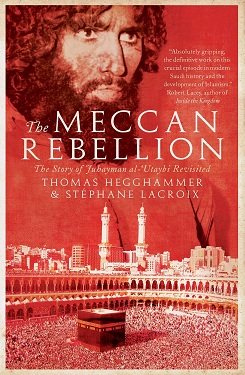
I’ve just read Hegghammer & Lacroix on The Meccan Rebellion. At 78 pages and 5.3 x 8.3 inches, it’s a tiny book in hardback and quite a delight to hold — the electricity in my city block went out for a while the other day, and I took pleasure in reading it out under the sun — and it contains, in essence, the two authors’ paper, Rejectionist Islamism in Saudi Arabia (Int. J. Middle East Stud. 39 (2007), 103–122) and a companion piece by Lacroix titled Between Revolution and Apoliticism: Nasir al-Din al-Albanai and his Impact on the Shaping of Contemporary Salafism.

Blog posts tend to present a point of view – whether to preach to the choir, promote it to unbelievers, stir up trouble, or simply add detail or a fresh angle to an existing narrative. Seldom do they ask questions.

My own instincts — in line with Madhyamaka as I briefly encountered it in the teachings of Elizabeth Mattis-Namgyel — lead me to leave some kinds of questions open: I use my DoubleQuotes format to set the juices flowing, by providing nudges to thought rather than outright statements – but on this occasion I have a question to ask, and as it’s too long for Twitter I’ll post it here.

**

Here’s my question. Juhayman al-Utaybi believed one of his companions, Muhammad al-Qahtani, was the Mahdi, the awaited Coming One of Islam — and that, in our authors’ words, “consecrating him [al-Qahtani] in Mecca on the turn of the hijra century” would ”precipitate the end of the world”.

In my view, a great deal rests on that simple word, “precipitate”. Would “usher in” do as well? Or “mark the beginning of” perhaps? Or is the idea of forcing the hand of God present, as it is in Reuven Paz’ phrase, “hot-wiring the apocalypse”?

There’s a lot riding on that issue: whether or not it is possible to force the hand of God, to accelerate destiny, to hasten apocalypse.

**

Okay, let’s go light-footed into this issue. In The Question in the DC Comics universe, we have a character described thus:

During service in Vietnam Jeremiah Hatch got insane, he began to hear the voice that urged him to do the will of the Lord by serving the Devil. He thought that his mission was “to hasten the corruption, to nurture the foulness until the almighty has no choice but to rain down fire and brimstone and overthrow the cities and the plain and all the inhabitants of cities and all that grows on the ground…”

**

Hastening the apocalypse — it’s an idea you can find in the world of DC Comics, but it was Israeli analyst Dr Reuven Paz who presented it to us in canonical “national security” form in his paper, Hot-wiring the Apocalypse, where his actual words are:

The Jihadi and nationalist insurgency in Iraq, which feeds the motivations and enthusiasm of growing number of Islamist youth to search for Jihad, look for the “culture of death and sacrifice,” and self-radicalize themselves, is another factor in the growing sense of Jihadi pride, which also hotwires the sense of the apocalypse.

That’s a faily imprecise form of words (‘The sense of apocalypse”) from a careful scholar, and Paz applies the concept in a specifically Sunni context. This, however, doesn’t prevent a popular Christian writer such as Joel Rosenberg from applying the same idea to the Shi’ite rulers of Iran:

Only when we understand the eschatology currently driving Iranian foreign policy, can we truly begin to understand how dangerous the regime in Tehran is. Only then can we fully appreciate how events like the revolution underway in Egypt only encourages Twelvers like Khamenei to take still further provocative and perilous actions to hasten the coming of the Twelfth Imam.

So the idea is afloat that both Sunni jihadists in Iraq and the Shi’ite state of Iran ay be about the “hastening” business.

**

Blog-friend Dr. Timothy Furnish, as I’ve noted here before, rebuts the application of Paz’ concept by Rosenberg, Glenn Beck and others to the situation in Iran, saying of it:

It posits that there is a strain of Islamic eschatological thought which hopes to force Allah’s hand in sending the Mahdi, as it were, via sparking a major conflagration (nuclear, or otherwise) with the West (either the U.S. or Israel). This may be true of some of the Sunni jihadits with an apocalyptic bent, but there is very little evidence that such an idea is operative in the upper echelons of the Islamic Republic of Iran. The ayatollahs may be cut-throat, anti-Israeli and anti-American-but they are not stupid. They know full well that any nuclear attack on Israel of the U.S. would be met with a crushing retaliation. (Besides, what good would it do for the Mahdi to come and establish his global caliphate over smoking radioactive ruins?)”

**

And if I might ask a follow-up question — is the first of the Juhayman Letters, which is devoted to the theme of the coming of the Mahdi, available in English?


Two tales from the outsider jihad

Sunday, April 28th, 2013

[ by Charles Cameron — wanna know the very latest on those black banners from Khorasan? ]
.

Here’s the scene that greeted four British recruits to the jihad on their arrival at a training camp in Pakistan in August 2011:

This wasn’t like the training camps of propaganda videos, with the black flag of al-Qaeda flying free in the wind. There were no racks of weapons waiting for recruits. And all the trainers had left for the religious festival of Eid.

They came home to the UK, where their families “berated” them, they were arrested, tried, found guilty and sentenced to 40 month terms in prison.

With jihad, as with so much else, you can’t always count on truth in advertising.

**

And then there’s Omar Hammami.

Even Rusty Shackleford from My Pet Jawa — “a weblog comparing Muslims to Jawas and containing criticism and satire of Islamic traditions and beliefs” — can’t help but like Omar Hammami, aka Abu Mansoor Al-Amriki, the American jihadist from Alabama who, as Wired puts it, “shoots the breeze” on Twitter “with the people whose job it is to study and even hunt people like him.” He does it with verve, even when ridiculing al-Shabab, the group he was put on the the FBI’s Most Wanted Terrorist List with a $5 million bounty for joining:

Shackleford commented, “I’ve actually become kinda fond of the guy — if that’s possible”.

Al-Shabab, however, appears to dislike him enough to have tried to assassinate him a couple of days ago, following up their failure with a major attack, results as yet unknown.

With jihad in foreign lands, apparently, you can’t even trust your fellow mujahidin to treat you better than your avowed enemies.

Man in the moon: armed and dangerous

Sunday, March 31st, 2013

[ by Charles Cameron — just kiddin’ ]
.


.

Chris Anzalone keeps us all up to date on the videos, graphics and anasheed used by various jihadist movements in recruitment and rejoicing/mourning via his various Ibn Siqilli blogs. Yesterday, he featured the graphic above in a post on Jabha al-Nusra, and it caught my eye.

The crescent moon (normally accompanied by a star) is a symbol of Islam. The man, Chris tells me, is “just the silhouette of a photo of a gunman from a photograph, which, if I remember correctly, isn’t from Syria”. The outline map, however, is of Syria. The black banner motif inside the map, reading “No god but God” and showing the Prophet’s seal, is now pretty widespread, but with some AQ and sometimes specifically Khorasan / Mahdist associations.

**

The man in the moon is a jihadist? Does NASA have drone capability? Is this what President Reagan‘s “Star Wars” Strategic Defense Initiative was all about?

Tyrannicide and the Lost Republic

Tuesday, March 19th, 2013

“Beware the Ides of March”

T. Greer gave me a rousing recommendation that I read the following post on the death of Julius Caesar by Burt Likko of The League of Ordinary Gentlemen blog. Greer was correct, it was outstanding. You should read the post in it’s entirety:

Rue the Ides

….One of my big observations about Julius Caesar is that he took great care in his career to do nothing that he could not credibly claim that a political or military leader had not done before him. Scipio Africanus used his huge prestige from winning a massive war for Rome to monopolize all political power within his own family. The Gracchi disregarded informal controls in the cursus honorum in favor of pursuing needed reform. Pompey used extraordinary and open-ended military powers to wage a war of conquest for Rome and got personally rich doing it. Catalina had been a blue-blooded populist who thumbed his nose at the consuls in power. Both Marius and Sulla had marched on Rome; Marius was consul six times in a row and Sulla was a dictator for longer than the traditional six months and used attainders to purge the ranks of the elites of his enemies.

So all along, when people protested to Caesar that he was making himself into a king, he could point to precedent and say he was doing nothing new, and nothing that the republic hadn’t been through before without losing its republican character. This seemed a transparent fiction to his critics. But for a legal culture steeped in and heavily reliant on precedent, it mattered a lot. Not for nothing did Caesar spend the first chapter of both his books chronicling his own military conquests on offering political justifications for what he had done.

After all nearly two centuries of history that preceded Caesar’s rise to power demonstrated that in order for the government of Rome to be effective, it took a blue-blooded strongman brushing aside the niceties of the anti-autocratic but ossified constitution to actually do something. And that same history demonstrated to him that the public admired success much more than it did formal adherence to the law – which had grown too complex, too much a creation of the elite, and too distant from the realities of daily life and popular culture, to matter all that much to the average Roman on the street. The formalities of government were for the elites to worry about, not the common man functionally unaffected by them; justice was obtained through informal means and not through the courts.

By the end of the civil war against Pompey and the remnants of the Scipio Africanus family’s control group, every tribune, every judge, every junior official, and every decision-maker of consequence was a client of Gaius Julius Caesar. Caesar himself held a consulship, a censorship, and a dictatorship and was quite clear that he would never let those things go – he clearly intended to hold on to all of that prestige and power and immunity from criticism until his death, and he would brook no serious opposition. [….]

Read the rest here.

There is much to agree with here.

First, I think Likko understood the limitations, frustrated ambitions and political immaturity of the anti-Caesarian and Optimate conspirators very well. Tyrannicide in classical antiquity was not mere political assassination, but a noble act, usually accompanied by martyrdom, which further sanctified it. This was true of the Athenians who had put up statutes of  Harmodius and Aristogeiton who slew the tryrant Hipparchus and Lucius Junius Brutus, the ancestor of the assassin Brutus, was revered for his leadership in the overthrow of the Roman monarchy of the Tarquins.

That the conspirators expected that the participation of Brutus in the murder of his patron Caesar would resonate symbolically as an intended gesture of patriotism with the Roman people was reasonable; the romantic hope the assassination itself would prove politically transformative was not.  Likko was correct, Rome had changed since the second century BC – and not just from the abusive political intrigues of the Patrician elite but by the Social Wars that brought the bulk of Rome’s Italian allies into their political community as Roman citizens. The “People of Rome” had changed and the mob of landless poor – whom Populares like Caesar wished to aid with reforms over optimate objections – had grown much larger and dangerous.

This goes to Likko’s larger point that, as revered as the Republican traditional virtues and outward forms may have been in terms of lip service, in substantive practice as the first century AD progressed, they were increasingly ignored when convenient to powerbrokers, the wealthier classes or the mob.  Sulla’s attempt to “re-set” the Roman political system along traditionalist lines by blood purge and Cincinnatus-like personal example failed within a generation.  Other than the terrifying example of the proscriptions to inculcate political restraint, which lasted only so long as Sulla lived, nothing else was introduced to tamp down the subversive dynamic of unrestrained and aggressive aristocratic political competition for imperium and glory by the ambitious among Rome’s elite.

Where Likko errs, somewhat, in my opinion, is here:

The liberators did not think about institutions. They did not think about culture. They did not think about logistics. They did not think about government. They did not think about the contradiction inherent in a lawless act done in the name of preserving the law. They did not think about the immediate political aftermath. 

Some of this is right – the conspirators did not think clearly about politics, given the large numbers of patricians and rich “new men” alike who had fallen under Caesar’s spell or grudgingly accomodated themselves to his personal rule after the failure of Pompey and Cato. That they expected the sort of popular sympathy Cato received -really more public respect for his incorruptibility and intrangisent virtue than any widespread desire to emulate Cato’s antiquated Roman mores or reactionary politics – is itself evidence f how out of touch they were. That said, thinking in terms of institutions would have been nigh impossible for them.  As an aristocratic Republic, Rome’s institutions that composed what we might call “the state”  were very few in number and skeletal in form. This was because the expectation was that patrician leadership, informally exercised through their extensive clientelas, their public benefactions and donations, expressions of charismatic auctoritas even when not in power, would always provide the muscle to make things happen. These in turn would be regulated by age-old custom, tribunican vetoes, the signs of the augurs, the weight of Senatorial opinion and what formal laws existed.

When custom began to be lightly disregarded in pursuit of political vendettas and even the legions did not possess an “institutional” existence yet, there was little to stop aristocracy from transmogrifying into oligarchy and autocracy. Conceiving of institutions in the modern sense of an independent, self-regulating,  corporate body in the late 1st century BC would have been a radical innovation to say the least. Even Octavian’s assumption of imperial power was done under the mantle of amalgamating republican offices in his own person that took many lifetimes to crystallize “princeps” into an institutionalized, tyrannical, office of  “emperor” as understood later in the time of the Dominate.  Brutus, the wayward follower of Cato, could no more have conceived of institutionally-based constitutional reform to renovate Roman government than he could have invented an airplane

This however, is a mere quibble about a minor point in an excellent post.

Zenpundit Decennium

Monday, February 25th, 2013

We have reached the tenth year here at zenpundit.com.

This is an uncommon duration in the blogosphere. When I started, blogging was a marginal activity, a “fad”, that I was warned against by a well-meaning academic who thought I would be wasting my time. Today institutions of great importance, politicians, celebrities and, strangely, major media outlets, believe that a blog is a “must have” platform, even when the cutting edge of debate has shifted to social media services like twitter and facebook – everyone’s blog “anchors” their presence and provides a place for arguments more complex than what can be conveyed in 140 characters.

It is appropriate at this time that I make a few brief remarks in honor of the occasion.

First, would be to say thank you to the readership and commenters, past and present. It is you who have made zenpundit.com worth doing by returning time and again, by making contributions of your own here, by email and by circulating posts with which you agree (or dispute) in your own networks. You have given us the ability to punch well above our weight and for that I am grateful.

Secondly, to our “bigger fish” supporters and affiliated sites who have given the bloggers here other forums or added attention. There are many, but especial thanks needs to be given to Dave Dilegge and the crew at Small Wars Journal, to Thomas P.M. Barnett,  to John Robb, to Bruce Kesler, to Dave Schuler and The Watcher’s Council, to Howard Rheingold’s Brainstorms community, to Pragati Magazine, to DoctrineMan!!, to Wikistrat and the gang at Chicago Boyz. Your help has not always been noted but it has always been appreciated.

Lastly, to my co-bloggers Charles Cameron and J. Scott Shipman, whose intellectual range, wise advice and excellent writing have vastly enriched zenpundit.com far beyond what I could have ever accomplished on my own. I am honored that you have chosen to be here.

May the next decade surpass the first!


Switch to our mobile site

