zenpundit.com » africa

Archive for the ‘africa’ Category

On Maundy Thursday

Friday, April 6th, 2012

[ by Charles Cameron — humility, transformation ]
.

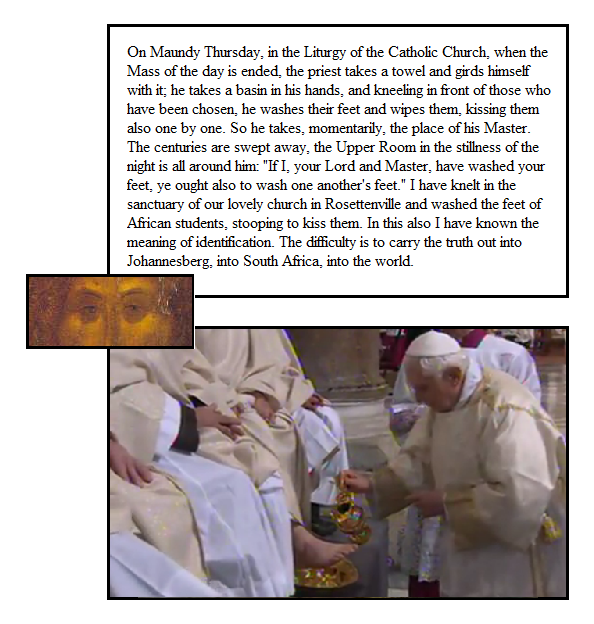
It is the evening of another Maundy Thursday — in the western Christian tradition, the day on which Christ washed the feet of his disciples:

The inherent poetry of the gesture — and no matter your opinion of the edifice that Christianity has become, it is a gesture of simple humility, possessing and transmitting the poetic power that humility alone affords us — that poetry, for me, will always be associated particularly with the paragraph I have dropped into the image above.

It is a paragraph from my mentor Fr. Trevor Huddleston‘s book, Naught for Your Comfort, and I believe it sums up his life’s work.

Today I remember him: monk and teacher.

Tomorrow is Pesach — in the Christian west, Good Friday and the Crucifixion: I shall listen to Bach.

_______________________________

Inset image of the eyes of Christ from an icon by Andrei Rublyev

Two for the Dalai Lama, and one more

Thursday, April 5th, 2012

[ by Charles Cameron – the UN panel of happiness experts, human nature on and off the freeway, and royal rainmaking in Thailand and Tanzania ]
.

Seeings as how the Kingdom of Bhutan just convened a UN forum on the topic of Happiness and Well-being: Defining a New Economic Paradigm, I thought it might be interesting to compare the faces in reports of a recent, controversial congressional panel on contraceptive issues with those of the folks on the happiness panel:

And to be frank, neither panel looked particularly cheerful. I thought it might be nice to get away from all that seriousness, so I featured the Dalai Lama’s often playful eyes as an inset…

Seriously: is happiness something we should figure out in committee?

To be fair, though, they did have some decent guest speakers — Joan Halifax for one. My guess is, some people just bring their happiness with them.

*

And while I have the Dalai Lama in mind and in a conveniently copiable graphic, I thought I’d post a second, quick item — this one also having to do with happiness, I suppose, and raising the question of what human nature is.

When you’re stuck on the San Diego Freeway on the way back from work, you may not feel as “one with nature” as you do when you’re out for an evening walk on the beach in Malibu. But are the ribbons of the Interstate system really that different from the veining of a leaf?

I suspect that question might bring some quiet laughter to the Dalai Lama’s eyes…

Hat-tip: I have Andrea Lobel of Concordia U to thank for this second pair of images, which she very kindly sent me knowing of my delight in such pairings.

*

Time for one more?

Given my strong interest in ritual, you won’t be surprised to learn that royal rainmaking is of interest to me.

The insignia on the left is that of the Thai Bureau of Royal Rainmaking and Agricultural Aviation, founded by Thailand’s King Bhumibol Adulyadej, who holds European patents on several of his methods:

According to the notes attached to this video:

Among the best-known and most successful of His Majesty’s water provision projects has been the Royal Rainmaking programme. He began to study how clouds might be seeded to produce rain. In 1969 he carried out preliminary tests at Khao Yai National Park using a Cessna 180 and dry ice. In August 1969, he moved to Hua Hin and used two aircraft in a variety of weather conditions to determine what worked best. Initially, he financed the research with his own funds but in 1970, he sought temporary funding for a “Rainmaking Project” from the government. With it, he established the Royal Rainmaking Research and Development Institute. Based on it, he has spent succeeding years refining his techniques to accord with varying cloud conditions and to suit differing climatological and geographic areas, enjoying considerable success throughout Thailand.

On the right is the encampment for the mapolyo a mbula or ancestral offerings for rain of the Ihanzu of Tanzania.

Todd Sanders, in his book Beyond Bodies: Rainmaking and Sense Making in Tanzania, writes:

Because the Ihanzu have long depended on the rain for their very existence, it is not surprising that rainmaking is central, both conceptually and practically, to their everyday lives. They have two royal rainmakers – one male, the other female – whose job it is to ensure the rains arrive on time and fall properly each year. … Through varied rain rites carried out each year in the village of Kirumi, royal rainmakers regulate the annual movement from the dry ‘male’ season (kipasu) to the wet ‘female’ one (kitiku) and back again. These rites take various forms, as we shall see…

For a detailed account of the mapolyo a mbula rites and the legend that accompanies and explains the diagram above, see Sanders’ Reflections on Two Sticks: Gender, Sexuality and Rainmaking in Cahiers d’Etudes Africaines:

These rites take place only when the rains have utterly failed and it has been divined that the royal Anyampanda clan spirits have demanded such an offering. Offerings take place over two days, but the entire ritual sequence often lasts a month, sometimes longer. It is only the two Anyampanda royal leaders, and no one else, who can bring such rain offerings to fruition.

*

Enough, I’m done for now — I’m happy.

Of Kony and Constellation

Friday, March 23rd, 2012

[ by Charles Cameron — non-linearity, complexity, “constellational thinking”, a quick spin around the blogosphere, history, Walter Benjamin — following on from Nancy Fouts ]
.


image: Galileo Galilei, Siderius Nuncius (i.e. The Starry Messenger), 1610

.
The novelist Teju Cole has a piece in the Atlantic that’s triggered by the Kony2012 business, and zooms out to touch on much else besides. His piece is titled The White Savior Industrial Complex, and as I was reading it, I came across a phrase that tweaked my keen interest. Cole is talking about Nicholas Kristof, and writes:

His good heart does not always allow him to think constellationally. He does not connect the dots or see the patterns of power behind the isolated “disasters.” All he sees are hungry mouths, and he, in his own advocacy-by-journalism way, is putting food in those mouths as fast as he can. All he sees is need, and he sees no need to reason out the need for the need.

By my lights, “he sees no need to reason out the need for the need” is a powerful tongue-twister, but it’s the phrase “to think constellationally” that interests me here.

Cole returns to a slight variant on the phrase later, this time saying:

Success for Kony 2012 would mean increased militarization of the anti-democratic Yoweri Museveni government, which has been in power in Uganda since 1986 and has played a major role in the world’s deadliest ongoing conflict, the war in the Congo. But those whom privilege allows to deny constellational thinking would enjoy ignoring this fact.

Constellational thinking, then, connects the dots, sees the patterns behind isolated events, sees not just the events themselves but also the circumstances that caused them – and its absence allows us to reduce complexly-interwoven reality to one or more simplistic polarities — better suited to sound bites than to analysis.

*

Cole also points us to Rosebell Kagumire‘s video response to the Kony affair, and she in turn has her own way of addressing the same kind of reduction of complexity to simplicity. She wrote, back on March 8th:

For the last many hours i have followed a campaign by Invisible Children NGO called KONY2012 that has gone viral getting more than 20 million hits on Youtube. I am a story teller and i know the danger of a single story.

So simple, that: I know the danger of a single story.

Remember the Ocean of the Streams of Story diagram in my post almost a week ago, Countering Violent Extremism: variants on a theme? Edward Tufte designed it, to illustrate a paragraph by Salman Rushdie

The truth of a complex situation lives in the interweaving of many stories, not in a single strand, a single view.

*

Constellations — of thoughts, of ideas.


image: Eugen Gomringer, Constellation, ca 1960

I did some digging – I’m not the Oxford English Dictionary, and I can’t say for sure that any particular use of “constellation” marks its first appearance in the sense that interests me here – Eugen Gomringer‘s Constellations (from 1954 onwards, example above) may be relevant in an avant-garde way– but my search brought me to a post by Liz Danzico at Bobulate titled Celestial History, in which Liz wrote:

Teaching constellations is an exercise in storytelling. You see, dots, these anonymous light encrusted patterns, must be memorized and categorized, and it’s only through stories that one can make sense of them. Starting with the north star, and systematically creating relationships in the winter sky among Hercules and Sagittarius, Libra and Polaris, we told tales. We’d trade stories on top of the old stone building in the middle of dark campus until late into the night. Creating these stories, giving Hercules a relationship to Cassiopeia — true or not, good or not, believable or not, it didn’t matter — what mattered were that patterns were found and marked.

Marking patterns and making content accessible through stories is what we do. And often, still, when we begin, we’re in the dark.

*

This post in turn lead Robin Sloan at Snarkmarket to write a quick note of praise, Explosions in the sky, which drew a comment from Tim of Short Schrift that said:

After the Copernican revolution, a constellation isn’t even a constellation. Instead, it’s a two-dimensional flattening of a three-dimensional reality. Actually, we should probably say a FOUR-dimensional reality. The light from stars at varying distances, leaving their sources at various times in the distant past, gets mistaken, from our earthbound point-of-view, as a simultaneous two-dimensional pattern.

BUT! That distortion, that accident, produces something extremely powerful — both imaginatively and practically.

Take “constellational thinking” and apply it to something besides stars in space. Let’s say — history.

Over here, you’ve got the Roman Republic, over there, the French Revolution. Distant in time, distant in geography, no kind of causal proximity let alone a relationship between them.

But bam! Slap them together. View them as a single event, a collapse of time.

Now you begin to see the French Revolution the way part of the Revolution saw itself, as an explosion of the continuum of history.

Now — and sorry if I slow-played this — you’re in Walter Benjamin’s “On the Concept of History.” Now you’re performing a genuinely three-dimensional nonlinear reading of historical time.

Consider that process, spelled out in the phrases “Distant in time, distant in geography, no kind of causal proximity let alone a relationship between them. But bam! Slap them together. View them as a single event, a collapse of time.”

Consider how that “fits” the same Arthur Koestler model of thinking I was on about yesterday in my post Nancy Fouts and the heart of the matter, in which I described:

the “release of cognitive tension” that occurs when some form of analogy, similitude, overlap allows the mind to join conceptual clusters from two fields in a “creative leap”

*

Well, I’m not along in finding this sort of thing useful. Here’s bethr from Mixed Bits writing on tumblr:

Constellational thinking

Omigosh… I’ve been using this phrase in numerous conversations for at least 4 years, usually when attempting to describe how I seem to process information and think, in contrast to the linear thinking which is more prevalent and encouraged in my profession. I’ve never heard anyone else use this phrase…it excites me that others have applied the same phrase and metaphor to the same idea and have articulated it much better than I ever have.

*

And Walter Benjamin:
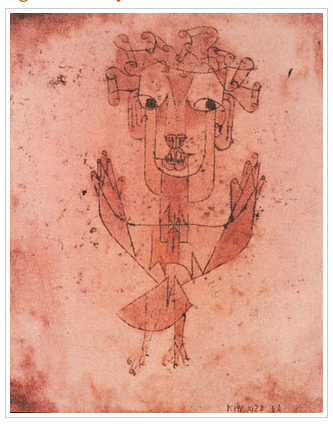

image: Paul Klee, Angelus Novus, 1920

Turning to Walter Benjamin’s On the Concept of History for a moment, we find a remarkable and justly celebrated paragraph about the angel depicted above, a 1920 Paul Klee painted etching which Benjamin himself once owned, now housed in the Israel Museum, Jerusalem:

There is a painting by Klee called Angelus Novus. An angel is depicted there who looks as though he were about to distance himself from something which he is staring at. His eyes are opened wide, his mouth stands open and his wings are outstretched. The Angel of History must look just so. His face is turned towards the past. Where we see the appearance of a chain of events, he sees one single catastrophe, which unceasingly piles rubble on top of rubble and hurls it before his feet. He would like to pause for a moment so fair, to awaken the dead and to piece together what has been smashed. But a storm is blowing from Paradise, it has caught itself up in his wings and is so strong that the Angel can no longer close them. The storm drives him irresistibly into the future, to which his back is turned, while the rubble-heap before him grows sky-high. That which we call progress, is this storm.

*

More prosaically, Benjamin then gives us the twinned realities to which Tim had pointed in his comment at Snarkmarket:

For Robespierre, Roman antiquity was a past charged with the here-and-now, which he exploded out of the continuum of history. The French revolution thought of itself as a latter day Rome. It cited ancient Rome exactly the way fashion cites a past costume. Fashion has an eye for what is up-to-date, wherever it moves in the jungle of what was.

*

Benjamin’s “moment” — his here-and-now — has passed, perhaps. The nuances discoverable through juxtaposition, counterpoint, overlay, constellational thinking, remain.
Quite the contrast

Tuesday, March 13th, 2012

[ by Charles Cameron — the Joseph Kony rumpus, and Robert Fowler on the religious zealotry of AQIM ]
.

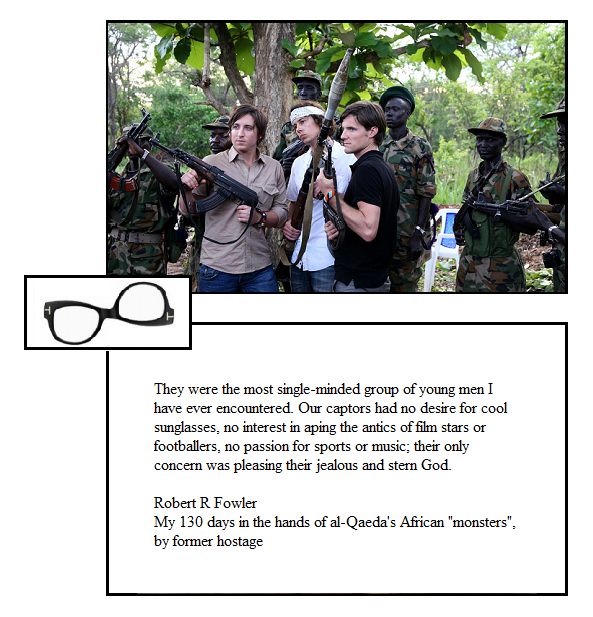
Above:

In the Glenna Gordon photo above the text is Jason Russell, the film-maker who put together the Joseph Kony 2012 campaign, who says of himself:

I am a rebel soul: dream evangelist. I am obsessed with people. I tell stories by making inspiring movies that move people’s emotions, and then I take those emotions and transform them into action. My middle name is Radical. I married my best friend.

— radical, yeah, and looking “tough” — or as one commentator on the Visible Children tumblr said, “posing”:

Here’s a photo of the founders of Invisible Children posing with weapons and personnel of the Sudan People’s Liberation Army. Both the Ugandan army and Sudan People’s Liberation Army are riddled with accusations of rape and looting, but Invisible Children defends them, arguing that the Ugandan army is “better equipped than that of any of the other affected countries”, although Kony is no longer active in Uganda and hasn’t been since 2006 by their own admission. These books each refer to the rape and sexual assault that are perennial issues with the UPDF, the military group Invisible Children is defending.

Below:

By way of contrast: the text below the photo is culled from Robert R Fowler‘s searing account of his al-Qaeda in the Islamic Maghreb (AQIM, but please don’t call it AA-kem) captors. As he also said:

Kidnappings of Westerners have fueled debate among securocrats as to whether our AQIM captors might simply bandits flying an Islamic flag of convenience. I know that to be the wrong answer. Our kidnappers were utterly focused religious zealots who believed absolutely in their cause. They sought to expel Western infidels from Muslim lands and to destroy what they saw as apostate Western-stooge governments who were usurping God’s purposes across the Muslim world. The concepts and ideals we hold most dear were anathema to them: liberty, freedom, justice, democracy, human rights, equality between the sexes — all matters which they considered to be the exclusive province of Allah.

Yes, that contains the popular idea that “they hate us for our freedoms” — but in the context of what I can only call ruthless religious idealism.

Fowler is very clear on that. And no posing.

Sounds like Fowler’s book, A Season in Hell, goes right onto the anti-library lists.

Darfur question… and wider Sufi ripples

Saturday, February 25th, 2012

[ by Charles Cameron — request for info, Darfur, Janjaweed, Sufis, Senegal and more ]

.

.

Dr John Esposito has a post up at HuffPo disputing Ayan Hirsi Ali‘s recent Newsweek piece, and one very small matter of phrasing raised a small cluster of questions for me …

*

My Questions:

Dr Esposito quotes Hirsi Ali as saying “What has often been described as a civil war is in practice the Sudanese government’s sustained persecution of religious minorities” and comments, “to say that Darfur is an example of the Muslim-Christian genocide is flat out wrong”.

My questions are not about Ali’s “Global War on Christians” or “Muslim-Christian genocide” but about the range of Muslim theological interests at play in the Darfur conflict.

Julie Flint, in Sudan, Darfur destroyed: ethnic cleansing by government and militia forces in Western Sudan, writes that “Almost all Darfurians belong to the Tijaniya sect of Sufi Islam that extends from Senegal to Sudan.”

And Robert Spencer writes that “Salafists target Muslims they regard as insufficiently Islamic also in Darfur, where Arab Muslims attack non-Arab Muslims whose Islam is closer to the cultural version that prevailed in Somalia than to Wahhabi austerity.”

So:

Is Spencer right about that? And is it therefore arguable that in additional to nomadic vs sedentary and Arab vs black African issues, there’s a sectarian (intra-Muslim) component to the conflict?

Further, is Darfur (inter alia) a front we should be monitoring in terms of a global Salafi vs Sufi struggle?

Who and what should I be following / reading?

*

All of which brings me to the wider issue of violence against Sufis (and for that matter, violent as well as peaceable Sufi responses) in (eg) Libya (Daveed GR today), the Punjab (Raza Rumi) and of course Senegal (see image of mosque in Touba above)…

All pointers welcome.


Switch to our mobile site