[ by Charles Cameron — on skilled design, and on choosing to purchase influence, elegance or beauty ]
.
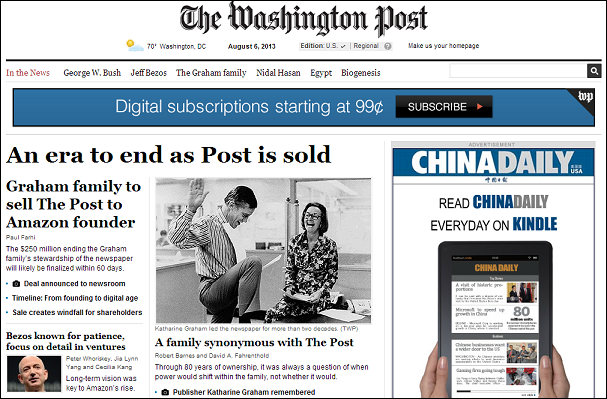
There’s something very neat about this front page:
Okay, okay, Jeff Bezos has bought the Washington Post. But what intrigues me about this front page of today’s digital edition as it appeared on my screen this morning was the way a color photo of Bezos sneaks in (left) below a larger black and while photo of Katharine Graham (center) — while an ad for the China Daily (right) takes up a third of the real estate (right), to be read, mark you, on Bezos’ own Kindle.
So we have today’s future, to coin a phrase, with the “pivot to Asia” and the “pivot to Bezos” right there together — and the “pivot to digital” pretty much a done deal.
**
The price of the Post was $250 million, and plenty of people have talked about what Bezos could have bought instead — and while we’re on the topic of neat design, I couldn’t help but notice that there’s a $250 million penthouse under construction in Monaco, described by HiConsumption as The World’s Most Expensive Penthouse, and that one of the numerous architectural illustrations provided also features a striking lesson on graphics:
What catches my eye here is the parallelism between the window with its center divider and balcony rail (left) with the geometry of the painting on the wall (right) — that’s a brilliant design choice, as the photographer well knows.
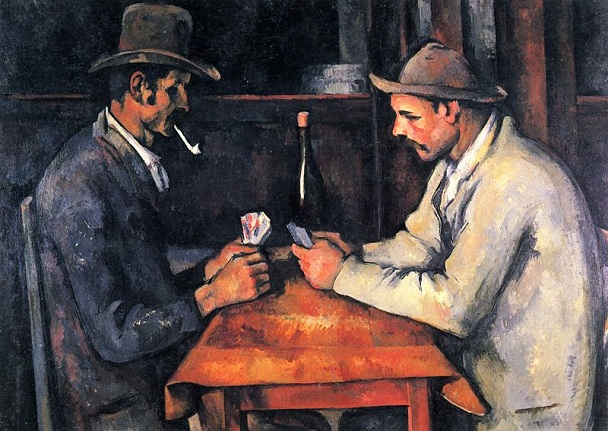
In my dreams I’d prefer my own choice of art-work, frankly — and if I only had $250 million to play with, I’d go for a small craftsman cottage in Pasadena, perhaps — with that luminous $250 million Cezanne to grace one of my walls…
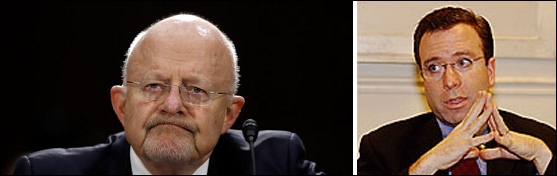
Sen. Ron Wyden (D-Ore.) asked Clapper at a Senate hearing in March, “Does the NSA collect any type of data at all on millions or hundreds of millions of Americans?”
“No, sir,” Clapper testified.
“It does not?” Wyden pressed.
“Not wittingly. There are cases where they could inadvertently, perhaps, collect, but not wittingly.”
We now know that Clapper was not telling the truth. The National Security Agency is quite wittingly collecting phone records of millions of Americans, and much more
Is there a signikficant distinction to be made between collecting data ONmillions of Americans, and collecting phone records OF them?
[ by Charles Cameron — Khorasan, black banners, the Ghazwa-e-Hind — when will the updating ever stop? ]
.
**
It looks as though I first realized that “the black banners of Khorasan” was a meme I should be “eyes out” for was in July 2007, when John Robbpointed us to a piece by Syed Saleem Shahzad on events at the Red Mosque
For the al-Qaeda leadership sitting in the tribal areas, the situation is fast evolving into the promised battle of Khorasan. This includes parts of Iran, Pakistan, Afghanistan and Tajikistan from where the Prophet Mohammed promised the “end of time” battle would start.
That reference to Khorasan in turn led me back to a slightly earlier Washington Post piece where the Khorasan / black banners motif was clearly set forth, along with a pointed comment from Andrew Black, co-founder of Thistle Intelligence Group:
The battles today, like those against the Soviet occupiers, are also fought with religious verve. The Taliban and al-Qaida fight under a black flag connoting the participation of Islam’s prophet in their battle for Khorasan, the ancient name for the region centered around Afghanistan.
Khorasan increasingly features in the militants’ videos and the name was taped to the leg of a suicide bomber who killed 24 people in Pakistan’s Northwest Province this spring.
“One should not underestimate the theological importance of Khorasan to aspiring mujahedeen; particularly those who are only able to initially view the conflict through the Internet,” said Black.
Hamid Gul was in Shahzad’s piece too, talking about the Red Mosque and the Red Fort — and here, too, I likely made my first acquaintance with the motif of the Ghazwa-e-Hind, symbolized by the wish to plant Pakistan’s flag on Delhi’s Red Fort:
It is a pity that our army was preparing youths to seize Lal Qala [the Red Fort of Delhi] and they ended up seizing the Lal Masjid,” Gul said.
Both these memes have been around longer than I have, but back then they didn’t seem to be attracting much attention in the west.
Now they’re cropping up all over — and I’m (to switch metaphors in mid-stream) paddling hard to keep up.
**
The black flags are alive and well this week, as shown in this video of the graduation of a new batch of the Free Army fighters in Syria:
Khorasan too, as seen in the image from the new magazine Azan at the top of this post — but where does Azan itself come from?
B Raman writes:
It is not yet clear who has started “Azan”. One suspect is the Tehrik-e-Taliban Pakistan (TTP), which is the Pakistani Taliban. The other suspect is Al Qaeda headquarters in the South Waziristan area of Pakistan.
I’m interested in this question, because Azan had an overview of the various fronts of contemporary jihad, and an image that invokes both Khorasan and Jerusalem isn’t exactly “local” in focus. And that brings me to that other meme of interest here — the Ghazwa-e-Hind — which as I pointed out recently ius also mentioned in Azan, though not a huge focus there.
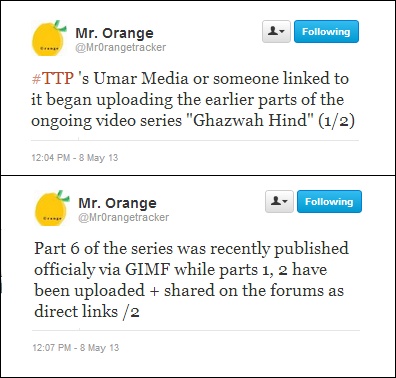
But if Azan is indeed a TTP product, then this info from Mr Orange:
would indicate they find the Ghazwa of more than passing interest…
[ by Charles Cameron — you can safely ignore this if you have zero interest in any or all of Bach, Eliot, Christianity and Sufism ]
.
It’s Sunday evening here, let’s start with Yehudi Menuhin playing Bach — the great Chaconne:
**
This post began to coalesce for me when Dr Alan Godlas, whose web-pages at the University of Georgia offer, among other things, a profound “gateway to Sufism“, gave me his permission to quote a comment he’d made in a private communication:
Sufis and Muslims need to learn how to recite and listen to the Qur’an (and how to do dhikr and practice Islam and Sufism) at the depth at which Bach wrote this Chaconne and at which it was played by Menuhin.
**
That really gets to the heart of the issue of spirituality and beauty — and it brought to mind a comment made by then Cardinal Joseph Ratzinger, now Pope Benedict Emeritus, in his speech at Rimini on The Feeling of Things, the Contemplation of Beauty:
The encounter with the beautiful can become the wound of the arrow that strikes the heart and in this way opens our eyes, so that later, from this experience, we take the criteria for judgement and can correctly evaluate the arguments. For me an unforgettable experience was the Bach concert that Leonard Bernstein conducted in Munich after the sudden death of Karl Richter. I was sitting next to the Lutheran Bishop Hanselmann. When the last note of one of the great Thomas-Kantor-Cantatas triumphantly faded away, we looked at each other spontaneously and right then we said: “Anyone who has heard this, knows that the faith is true”. The music had such an extraordinary force of reality that we realized, no longer by deduction, but by the impact on our hearts, that it could not have originated from nothingness, but could only have come to be through the power of the Truth that became real in the composer’s inspiration. Isn’t the same thing evident when we allow ourselves to be moved by the icon of the Trinity of Rublëv? In the art of the icons, as in the great Western paintings of the Romanesque and Gothic period, the experience described by Cabasilas, starting with interiority, is visibly portrayed and can be shared.
**
John Eliot Gardiner, the great conductor of Bach with whom I apparently spent some of my earlier school-years, offers us an intriguing insight in In Rehearsal with John Eliot Gardiner (Bach Cantata No. 63), immediately after Sara Mingardo‘s deeply devotional rendering of the recitative O selger Tag —
Nota bene: Bei einer andächtigen Musik ist allezeit Gott mit seiner Gnaden Gegenwart. Now I find that very, very significant. That he’s saying wherever there is devotional music, God with his grace is present. Which, from a strict theological point of view is probably heresy, heretical, because it’s saying that music has an equivalent potency to the word of God. And I think that in essence is why Bach is so attractive to us today because he is saying that the very act of music-making and of coming together is, in a sense, an act which invokes the latency, the potency, the potentiality of God’s grace, however you like to define God’s grace; but of a benediction that comes even in a dreadful, overheated studio like Abbey Road where far too many microphones and there’s much too much stuff here in the studio itself, that if one, as a musician, puts oneself in the right frame of mind, then God’s grace can actually come and direct and influence the way we perform his music.
**
But I’ve quoted both Benedict and Gardiner on this very topic before, I know, so I’ll move on to the poet TS Eliot, who in Four Quartets tells us:
For most of us, there is only the unattended
Moment, the moment in and out of time,
The distraction fit, lost in a shaft of sunlight,
The wild thyme unseen, or the winter lightning
Or the waterfall, or music heard so deeply
That it is not heard at all, but you are the music
While the music lasts. These are only hints and guesses,
Hints followed by guesses; and the rest
Is prayer, observance, discipline, thought and action.
**
I would like to offer three more interpretations of the Bach Chaconne, and one anecdote. The first interpretation is of the entire Solo Violin Partita #2, including the Chaconne, by the young and already great Hilary Hahn. Her rendition of the Chaconne alone is available as a separate YouTube video here:
There’s also a Busoni piano arrangement, played here by Helene Grimaud — it was, I think, our own J Scott Shipman who introduced me to this stunning performance:
Finally –since I obviously love the Chaconne — I would like to leave you with the story of a double performance of this same piece by violinist Joshua Bell at L’Enfant Plaza metro in Washington, DC — as told by Washington Post reporter Gene Weingarten — who won a Pulitzer for this article:
HE EMERGED FROM THE METRO AT THE L’ENFANT PLAZA STATION AND POSITIONED HIMSELF AGAINST A WALL BESIDE A TRASH BASKET. By most measures, he was nondescript: a youngish white man in jeans, a long-sleeved T-shirt and a Washington Nationals baseball cap. From a small case, he removed a violin. Placing the open case at his feet, he shrewdly threw in a few dollars and pocket change as seed money, swiveled it to face pedestrian traffic, and began to play …
Go ahead, read it if you haven’t already — it’s quite a story!
Zenpundit is a blog dedicated to exploring the intersections of foreign policy, history, military theory, national security,strategic thinking, futurism, cognition and a number of other esoteric pursuits.