zenpundit.com » turkey

Archive for the ‘turkey’ Category

BRIEFING: some religious aspects of the Armenian Genocide:

Saturday, April 25th, 2015

[ by Charles Cameron — my latest for LapidoMedia ]
.

Here’s my latest for LapidoMedia, a UK organization which supports journalists with resources on the religious background of current events:

**

What’s in a name?

by Charles Cameron – 24th April 2015


Pope Francis with Karekin II, Catholicos of the Armenian Apostolic Church. Photo: Gregorio Borgia/AP via Washington Post

A HUNDRED years ago, an estimated 1 million to 1.5 million Armenians, along with or followed shortly by other minorities including Kurds, were killed or otherwise deprived of their lands and homes by the Ottomans in an event that for sheer horror compares with the genocides of Hitler and Pol Pot. 

Today, 24 April 2015, marks the centenary of start of the Armenian Genocide, known in Armenian – and also in US Presidential English – as Metz Yeghern, literally The Great Evil or Crime.

We are faced, therefore, with the Shakespearean question – does genocide by any other name smell quite so foul?

Both Jewish and Muslim traditions counsel that the needless taking of one human life is equivalent to the extinguishing of a world, as reported in the Talmud and referenced in the Qur’an – how much more so, the attempt to extinguish an entire culture?

For the Armenians, the genocidal nature of the events of 1915 is not in doubt. Turkey, on the other hand, is less willing than Germany was after the WWII Shoah to admit to so horrendous a crime – and President Recep Tayyip Erdo?an thus pressured the White House not to use the English term ‘genocide’.

In deference to Turkish geopolitical pressure, President Obama opted for the equivalent Armenian term, Metz Yeghern, taking considerable heat from those who viewed his choice as a cop-out.

The politics are well known. What is less known is the role religion plays in the event. To understand the religious dimension of the genocide, and by extension of Armenian sentiment condemning President Obama’s decision, we must understand the importance of Christianity to the Armenian people, and the changing relations between Christians and Muslims in Anatolia across the centuries.

Vicken Cheterian, in Open Wounds: Armenians, Turks, and a Century (Hurst, 2015), writes: ‘Religion and language are the two markers of Armenian identity. For many centuries, the identity of the Armenians was closely intertwined with membership of the Armenian Apostolic church, one of the religious communities of the Ottoman Empire.’

**

To read the rest — inclouding some philosophical thoughts on suffering I am glad to see included — go to the LapidoMedia site: BRIEFING: Armenian Genocide: what’s in a name?

TwitterFightClub 2015, the best yet

Tuesday, March 24th, 2015

[ by Charles Cameron — March Madness for those whose sport is what William Blake called “Mental Fight” ]
.

If you’re unsure what TwitterFightClub is, it’s “an annual March Madness style tournament for national security and foreign policy tweeters”, overseen by the remarkable Caitlin Fitz Gerald, creator of Clausewitz for Kids. Hayes Brown has a fuller explanation.

**

Okay, let’s get real. As Kelsey Atherton noted:

That caught my attention, so I went to hannah draper‘s twitter feed and got a rapid education on religious freedom in Turkey, in staccato 140-character bursts:

When it comes to the Orthodox communities of Turkey (as there are a few), religious freedom is the right to train and their own clergy. It’s the right to provide religious education as they see fit for their communities, and it’s the right to equal protections before the law. For the Greek Orthodox community, one of the biggest concerns is Halki Seminary, a theological school in Ist that’s been closed for decades. For the Syriac Orthodox community, it’s finding enough space in Istanbul for their community of tens of thousands to worship. For the Armenian Apostolic community, it’s property restitution to address expropriated properties in decades past. For the Jewish community in Turkey, it’s protecting the safety and history of their centuries-long presence in Anatolia and Istanbul.

Deep breath.

For the Baha’i community, it’s legal recognition of their faith and protection of their holy sites, especially in Edirne. For the Jehovah’s Witnesses, it’s the right to conscientious objection and to perform civil instead of compulsory military service. For Alevis, it’s the right for their houses of worship, cem evleri, to be recognized as such. For Protestants, it’s the right to open and operate houses of worship. And lest you think we only care about minorities, religious freedom for Sunnis in Turkey – by far the largest religious group – matters too. For Sunnis, it’s the right to wear the headscarf or not, as each individual sees fit. It’s the right to worship as they deem appropriate. For atheists, it’s the right NOT to worship and not to face discrimination for that choice.

You can read more about what works and what needs more work in Turkey in the International Religious Freedom report. I wrote two or three of those during my time in Turkey. Writing annual reports like this are the basics of a political officer’s work.

If that wasn’t enough, these two tweets alone would have won my vote:

Ms Draper went on to tweet extensively about Ambassador Chris Stevens and Benghazi — keen insight with the personal touch:

Ambassador Stevens was a legend. Everyone knew him and his big, goofy smile. Everyone called him Chris, or “Krees,” depending on the accent. And damn, was it fun working for him. We may not have had regular cell service or food that passed the bar of tolerable, but he made it fun. The man was a brilliant diplomat – not formal or stodgy, not forceful, but warm, engaging, funny, and knowledgeable. Everyone felt they could be honest with him and that he would be honest in return.

We went to meetings with anyone and everyone. Mahmoud Jibril. Abdulhakim Belhaj. Mohammad Sawan. Ali Tarhouni. Ali Zeidan. Some random religiously conservative guy who sat up until 3 AM with us one night, drinking coffee and talking about E. German philosophy. …in Arabic. With me and the Ambassador translating for our visitors from Washington. Believe me, I was not prepared to discuss Eastern Bloc philosophy in Arabic with a former LIFG member. But hey, that’s how Chris rolled.

— which drew this appreciative comment:

**

But hey, TwitterFightClub is also fun — because not only does it educate you and suggest a bunch of twitter-feeds you should probably follow year-round, it also brings a concentrated and brilliant dose of those irrelevant images which become a glut when unleashed 24/7/365 across all channels of communication.

I get mine for the year here, and allow myself to forego “fun pix” the rest of the time:

and:

And those were just from one of Rebecca Johnson‘s fans…

**

Back to serious. Today’s find and follow for me is Ivan Plis, who also tweets up a storm:

We had a good number of #TFC15 tweets about religion & policy yesterday and today. Allow me to expand on that… USG has several offices on religion. State has a religious freedom office with Ambassador-at-Large, plus “religion & global affairs.” And outside State, there’s a commission — @USCIRF — with its own global religious freedom mandate, management style and tone.

@draperha explained yesterday why religious freedom is a US interest abroad. The fun part’s seeing the different elements interact. I’ve met a lot of foreign affairs folks in DC, and outside the religion silos they tend to be less religious than the general public. When I worked these issues on the Hill, we saw secular Jews, New Religious Movements, every Muslim & Christian flavor, and much more.

I learned 2 key points: 1) religious freedom benefits everyone, and 2) those who ignore religion in their field do so at their peril. As someone whose church is politically nervy (Orthodoxy in Russia) I’ve realized seeking state privilege hurts long-run legitimacy. In other words, big groups (e.g. Orthodox) look bad when they act threatened by smaller ones (Jehovah’s Witnesses, Mormons, etc).

One last thing: the “persecution-industrial complex” is real, and insidious. It feeds cynicism and spoils good will. People can have disagreements about US policy on religious minorities abroad, but don’t manipulate vulnerable groups to your benefit. And there are ways to talk about religion, and religious actors, without violating the 1st Amendment or being played for a fool. Back to my earlier point: NatSec and foreign policy analysts must then do more to hear religious voices. Most agree that religion plays an undervalued role in security and geopolitics. Weighing it has to be part of the solution too.

Amen, brother.

Or in secular, #TFC terms: that gets my vote.

**

You can follow along at #TFC2015 on Twitter, and vote on today’s round — quick — here.

Sunday surprise: Penguins, Turkey

Sunday, February 22nd, 2015

[ by Charles Cameron — a little quiet, serious fun here ]
.

Ken aka @chumulu suggested a DoubleTweet to me, and I’m delighted to post it here, Turkey, penguins and all:

and:

**

Plus I’m a big admirer of Zeynep.

Sisi followup: two publications of significant interest

Friday, January 16th, 2015

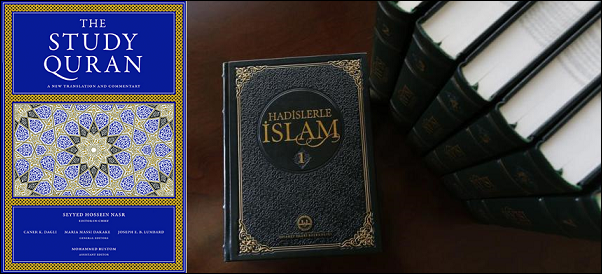
[ by Charles Cameron — SH Nasr’s The Study Quran and the Diyanet collection of ahadith ]
.

Quran & Ahadith

**

In a recent post I quoted President Sisi‘s speech calling for “a revolution” in Islamic thinking about “that corpus of texts and ideas that we have sacralized over the centuries” and which is now “antagonizing the entire world”. I would like to bring your attenbtion here to two publications which may well provide support for such a rethinking: SH Nasr’s The Study Quran and the Diyanet collection of ahadith

**

The Study Quran:

I have seen some of the proofs of this Quran, and it strikes me that once it is published (in Fall this year) it is likely to be the resource of record for anyone lacking in depth Arabic language skills and knowledge of Islamic thought across history. Superb, and very auspiciously timed.

From their prospectus:

In The Study Quran, renowned Islamic scholar Seyyed Hossein Nasr and a team of editors address the deeper spiritual meaning of the Quran, the grammar of difficult passages, legal and ritual teachings, ethics, theology, sacred history, and the place of various passages of the Quran in Muslim life.

For the first time, both Muslims and scholars will have a clear and reliable resource for looking up the history of interpretation for any passage in the Quran—together with a new, accurate English translation.

From the book itself:

The Quran is the constant companion of Muslims in the journey of life. Its verses are the first sounds recited into the ear of the newborn child. It is recited during the marriage ceremony, and its verses are usually the last words that a Muslim hears upon the approach of death. In traditional Islamic society, the sound of the recitation of the Quran was ubiquitous, and it determined the space in which men and women lived their daily lives; this is still true to a large extent in many places even today. As for the Quran as a book, it is found in nearly every Muslim home and is carried or worn in various forms and sizes by men and women for protection as they go about their daily activities. In many parts of the Islamic world it is held up for one to pass under when beginning a journey, and there are still today traditional Islamic cities whose gates contain the Quran, under which everyone entering or exiting the city passes. The Quran is an ever present source of blessing or grace (barakah) deeply experienced by Muslims as permeating all of life.

Inasmuch as the Quran is the central, sacred, revealed reality for Muslims, The Study Quran addresses it as such and does not limit it to a work of merely historical, social, or linguistic interest divorced from its sacred and revealed character. To this end, the focus of The Study Quran is on the Quran’s reception and interpretation within the Muslim intellectual and spiritual tradition, although this does not mean that Muslims are the only intended audience, since the work is meant to be of use to various scholars, teachers, students, and general readers. It is with this Book, whose recitation brings Muslims from Sumatra to Senegal to tears, and not simply with a text important for the study of Semitic philology or the social conditions of first/seventh-century Arabia, that this study deals.

**

The other publishing venture of great interest in this context is Turkey’s Diyanet project for a contemporary selected edition of the Hadith.

Emran El-Badawi, co-director of the newly formed International Qur’anic Studies Association, told the Christian Science Monitor in 2013:

Change is certain to come to the Islamic world, not just to the streets of Cairo or Istanbul but deep within Islam’s religious tradition as well. The Turkish Directorate of Religious Affairs, called the Diyanet, recognizes this with its seven-volume revision of the Hadith – which is the source of Sharia law and second only to the Quran.

Thousands of the prophet’s sayings and traditions were circulated and eventually collected in the centuries after his death in 632. The sheer size of Hadith collections and their archaic 7th century Arabian context have made the texts too intractable for many Muslims today. This is the challenge which the six-year Turkish Hadith project, with its selections and interpretive essays, seeks to overcome.

The central issue surrounding the Hadith, as with other foundational religious works such as the Bible, is whether it should be read literally or in a historical context and for its inspired message. A literal reading, for instance, may seek to justify medieval practices like severing the hands of thieves or allowing underage marriage. An inspired interpretation would see them as historical practices absent the kind of rule of law that democracies like Turkey have today.

The question for Turkey’s new multi-volume set is whether its contemporary interpretations can be widely appreciated by the Islamic community, or whether they will be considered too avant-garde – the fate of previous modern interpretations.

Elie Elhadj, in his post A Turkish Martin Luther: Can Hadith be Revised? on on Joshua Landis‘ Syria Comment blog wrote in 2010:

The Indian Islamic thinker Muhammad Ashraf observed that it is curious that no caliph or companion found the need to collect and write down the Hadith traditions for more than two centuries after the death of the Prophet (Guillaume, Islam, 1990, 165). Ignaz Goldziher concludes “it is not surprising that, among the hotly debated controversial issues of Islam, whether political or doctrinal, there is none in which the champions of the various views are unable to cite a number of traditions, all equipped with imposing Isnads” (Goldziher, Muslim Studies, 1890, Vol. II., 44). John Burton observes, “the ascription of mutually irreconcilable sayings to several contemporaries of the Prophet, or of wholly incompatible declarations to one and the same contemporary, together strain the belief of the modern reader in the authenticity of the reports as a whole” (Burton, An introduction to the Hadith, 1994, xi).

Leaders of Turkey’s Hadith project say successive generations have embellished the text, attributing their political aims to the Prophet Muhammad (BBC, February 26, 2008).

And Tom Heneghan, Religion Editor for Reuters noted in 2013:

The collection is the first by Turkey’s “Ankara School” of theologians who in recent decades have reread Islamic scriptures to extract their timeless religious message from the context of 7th-century Arab culture in which they arose.

Unlike many traditional Muslim scholars, these theologians work in modern university faculties and many have studied abroad to learn how Christians analyse the Bible critically.

They subscribe to what they call “conservative modernity,” a Sunni Islam true to the faith’s core doctrines but without the strictly literal views that ultra-orthodox Muslims have been promoting in other parts of the Islamic world.

As to its likely influence, in Egypt and thus (I infer) on Sisi’s project, Heneghan offers this hint:

“Among intellectuals in Egypt, there is a welcome for this new interpretation which they think is very important for the Arab world to be exposed to,” said Ibrahim Negm, advisor to Egypt’s grand mufti, the highest Islamic legal authority there.

**

I haven’t seen any reference as yet to the preparation of an English translation.

A not-so-brief brief: Adnan Oktar to President Obama

Thursday, December 4th, 2014

[ by Charles Cameron — a highly personalized and peaceable account of the awaited Mahdi, who may according to Oktar himself already be among us ]
.

I thought you might want to know the advice Adnan Oktar, aka Harun Yahya, has for President Obama:
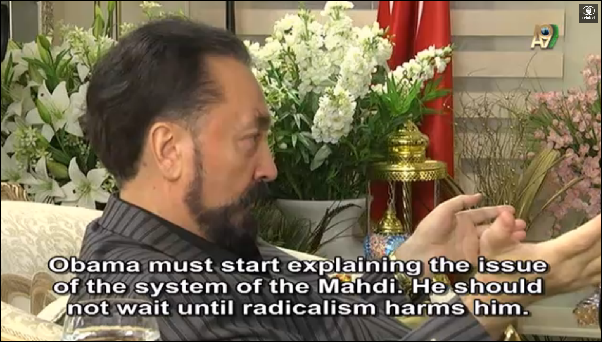
Yahya advises Obama re Mahdi

That’s it. But there’s more to it that that single phrase.

**

So who is the Mahdi, and how would Obama know what the system of the Mahdi was, so that he could do a reasonably good job at explaining it to the rest of us?

Should he, for instance, be reading the Ayatollah Baqir al-Sadr, who is reported to have said:

The Mahdi is not an embodiment of the Islamic belief but he is also the symbol of an aspiration cherished by mankind irrespective of its divergent religious doctrines. He is also the crystallization of an instructive inspiration through which all people, regardless of their religious affiliations, have learnt to await a day when heavenly missions, with all their implications, will achieve their final goal and the tiring march of humanity across history will culminate satisfactory in peace and tranquility. This consciousness of the expected future has not been confined to those who believe in the supernatural phenomenon but has also been reflected in the ideologies and cult which totally deny the existence of what is imperceptible. For example, the dialectical materialism which interprets history on the basis of contradiction believes that a day will come when all contradictions will disappear and complete peace and tranquility will prevail.

Somehow, I don’t think the Turkish Yahya was suggesting the President take his understanding of the Mahdi from an Ayatollah from Najaf..

**

Yahya / Oktar himself has written extensively on the Mahdi, his companion the returning Prophet, Christ, and the end times in general. Anne Ross Solberg, in her thesis The Mahdi Wears Armani: An Analysis of the Harun Yahya Enterprise, writes:

In 1987, Yahya published a brief pamphlet titled Is AIDS the Beast mentioned in the Qur’an? The first book published by Yahya on the subject of the Mahdi and the End Times was Mahdi and the Golden Age: The World Supremacy of Islam.

Solberg then lists other books subsequently published by Yahya on eschatological topics, including (in order of publication — I have omitted the Turkish titles & publication details for brevity) Jesus Will Return; Death, Resurrection, Hell: The Golden Age; The Last Days and the Beast; Signs of the End Times in Surat al-Kahf; The Glad Tidings of the Messiah; Signs of the Last Day; The Signs of Jesus’ Second Coming; The Day of Judgment; The End Times and the Mahdi; Portents and Features of the Mahdi’s Coming; The Prophet Jesus (as) and Hazrat Mahdi (as) Will Come This Century; Hazrat Mahdi (PBUH) Is a Descendant Of The Prophet Abraham (PBUH); How Did the Dajjal Die?; and The Prophet Jesus (as), Hazrat Mahdi (as) and the Islamic Union.

Solberg then writes:

Based on these publications, the Harun Yahya enterprise has made a number of documentaries that are available both as DVDs and online video files for download and streaming, as well as a vast number of websites devoted to the Mahdi and the End Times.

**

So putting it mildly, the arrival and “system” of the Mahdi is a major topic for Harun Yahya – pen-name of the Turkish preacher and writer Adnan Oktar — and as Solberg suggests in the title of her thesis, he may in fact understand himself as acting in that role.

Al Jazeera put the question to Yahya / Oktar directly in an interview:

Sir, from your books and speeches it appears that you believe in the Mahdi. Do you really believe in the Mahdi? And is it certain when he will appear? Around what time will he appear on Earth?

Adnan Oktar: The Mahdi should already have appeared according to the writings of Said Nursi, and according to the accounts in reliable hadith and signs have already taken place. For example, we are told that Afghanistan will be occupied at the time of the appearance of the Mahdi. That has happened. There is also the fact that Iraq will be occupied, which has also taken place. An attack on the Kaaba was predicted, and that has happened as well. The waters of the Euphrates would be cut off. And the dam has done so. We are told that during the month of Ramadhan in the year of his appearance both the Sun and Moon will be eclipsed in a space of 15 days, and that has happened as well. Approximately a hundred portents like this have already taken place. For that reason, I am convinced that the Mahdi has appeared.

Al Jazeera: Could you be the Mahdi?

Adnan Oktar: There is a rumor that has been going round for a long while that I have claimed to be the Mahdi. The reason for that is that I have written a book on that subject. I have cited all the relevant hadith in that book. They said that I had described myself, that the information about the Mahdi in the hadith was the same. As a result, [they said] you are claiming to be the Mahdi. They say that his forehead is broad, and your forehead is broad, too. That his brow is curved, and your brow is also curved. They say that the Mahdi has a small nose, and a big body. He is a Sayyid of medium height, they say. He has a mole on his cheek, and one on his back. Because you have all these characteristics, you are probably claiming to be the Mahdi.

I have borrowed those paragraphs from Tim Furnish, who quoted them in 2008 — the Al Jazeera interview is no longer available on the original website.

**

Oktar / Yahya declines to answer the question with a “yes” or “no” – but the comparisons he makes are nonetheless striking…

In a Reuters interview he makes it clear why he won’t answer that question:

Because of parallels in what I have written and the hadith (sayings) of the Prophet Mohammad, some people have thought I could be him… but in Islam it is forbidden for me to make such a claim.

Furnish has a more detailed quote from Yahya:

No claims can be made regarding the Mahdi. Nobody can claim to be the Mahdi. Nobody can say I am the Mahdi. Identification with the Mahdi can only be measured in terms of success. In other words, a figure will emerge and will be successful. From his success the conclusion may be drawn that he is the Mahdi. Even if the Mahdi were to appear, we could never say for certain that he was the Mahdi. We can only have a good perception of him. We can only say that he is probably the Mahdi. The Mahdi himself will never claim to be the Mahdi. He cannot say that. He will not say that. That is haram [not permissible]. He would be apostatized if he were to say such a thing.

**

So President Obama will necessarily have to guess the Mahdi’s identity, if he is to follow Yahya / Oktar’s advice.

Let us suppose the President comes to the conclusion that Yahya is indeed the Mahdi – what could he then deduce about the “system of the Mahdi”? For an answer, we return to Solberg’s thesis:

Yahya sums up the Mahdi’s crucial and redemptive role as follows:

During the terrible chaos of the final times, Allah will use a servant having superior morality known as the Mahdi (the guide to the truth), to invite humanity back to the right path. The Mahdi’s first task will be to wage a war of ideas within the Islamic world and to turn those Muslims who have moved away from Islam’s true essence back to true belief and morality. At this point, the Mahdi has three basic tasks:

1. Tearing down all philosophical systems that deny Allah’s Existence and support atheism.

2. Fighting superstition by freeing Islam from the yoke of those hypocritical individuals who have corrupted it, and then revealing and implementing true Islamic morality based on the rules of the Qur’an.

3. Strengthening the entire Islamic world, both politically and socially, and then bringing about peace, security and well-being in addition to solving societal problems.

These three tasks are Yahya’s interpretation of the three tasks of the Mahdi as taught by Said Nursi. Nursi’s teachings thus serve as a template for the da‘wa of the Harun Yahya enterprise. Since the late 1990s, the Harun Yahya enterprise has focused on trying to demolish thought systems of materialism, targeting in particular Darwinism, which Yahya regards as the most serious threat to faith.

**

There’s one really interesting reference in Solberg’s text that bears implications in many other realms than that of Islamic apocalyptic:

According to Snow and Benford (1988), the three core framing tasks of a movement are to identify a problem and identify who is to blame (diagnostic framing), articulate solutions (prognostic framing) and urge others to act (motivational framing).

I think those distinctions will likely serve us very well in thinking through the entire complex issue of terrorism and counterterrorism.

And here are two key points, rephrased by Solberg from Yahya’s writings, which give us Yahya’s perspective on both the caliphate and the possibility that the Mahdi will be a warrior in the literal as well as the spiritual or ideological sense:

  • According to the hadiths, claims Yahya, the Mahdi will assume leadership of the Islamic world as a caliph and rule the whole world both politically and religiously.
  • Yahya is careful to emphasize that the struggle is an ideological one, and that the Mahdi will never shed blood.
  • Those are two fascinating points at this juncture in history.

    **

    In closing..

    The Mahdi wears Armani

    Solberg’s book is subtitled An Analysis of the Harun Yahya Enterprise — is the Harun Yahya Enterprise in fact another name for the System of the Mahdi? If so, these words from her closing paragraphs give an idea of the scope of the Mahdi’s intent:

    The magnitude and span of the Harun Yahya enterprise operation suggests that this is an enterprise with very high ambitions in terms of having a major impact both in Turkey and globally. As indicated in the introduction chapter, the Harun Yahya enterprise does appear to have a considerable impact with regards to its promotion of creationism. As I have attempted to show, however, the purpose of the creationist activism of Harun Yahya is not only to convince the audience that the theory of evolution is wrong, but also to promote Adnan Oktar himself. This aspect of the Harun Yahya enterprise has, as we have seen, become more pronounced especially after 2009, with the publication of books that appear to be designed to create the impression that Adnan Oktar might be the Mahdi. One might speculate that the reason for this increasingly insistent and explicit approach is the recognition that Adnan Oktar, contrary to expectations, has not been widely recognized and affirmed as neither a Muslim authority, nor a Mahdi.

    We shall see..


    Switch to our mobile site