zenpundit.com » Mahdist

Archive for the ‘Mahdist’ Category

From Nicholae Carpathia to the Mahdi: a significant shift

Friday, November 9th, 2012

[ by Charles Cameron — a notable shift in the portrayal of Antichrist, from European politician to Islamic savior ]
.

I have written before about the clash of eschatologies, and today I want to note what appears to me to be a significant turning point in popular Christian end-times thinking. Joel Richardson today posted this endorsement:


.

IMO, that’s huge.

[ edited to add: BTW, LaHaye seems to be thinking in terms of the Shia Mahdi, the Twelfth Imam — the Sunni al-Mahdi would not be “the Imam of the Twelfth century”. Richardson’s view encompasses both. ]

**

Nicholae Carpathia is the Antichrist figure in the best-selling 1995-2007 Left Behind series of books, films and games, in which pastor Tim LaHaye presents his vision of the end times in fictional form, with the help of co-writer Jerry Jenkins.

Here’s how Wikipedia sums up Carpathia as he features in the series:

Former president of Romania, former Secretary General of the United Nations, self-appointed Global Community Potentate, assassinated in Jerusalem, resurrected at GC complex and possessed by Satan. Within the series, Carpathia is the Antichrist, and leader of the Global Community, a world government which he ultimately marshals against the followers of Jesus Christ.

LaHaye, in other terms, was working on the European Antichrist model that has been the staple of “soon coming” eschatology for decades. Indeed, in Revelation Unveiled (p 209) he wrote of the Antichrist:

Daniel 9:26 refers to him as the ruler of the people that will come, meaning that he will be of the royal lineage of the race that destroyed Jerusalem. Historically this was the Roman Empire; therefore he will be predominantly Roman.”

From Joel Richardson’s point of view, LaHaye’s endorsement is pretty strong evidence of the tide turning from the European to the Islamic model of the Antichrist. From my point of view, too, it’s a significant marker of that turning of the tide — but I also fear lest the rival messianisms of Christianity and Islam set up a howling feedback loop and polarize a situation where calmer minds…

**

Well, let me just point you — with a hat-tip to my friend Damian Thompson of the Telegraph — to this statement on the possibility of “reconciliation with Islam” by Justin Welby, the newly-announced next Archbishop of Canterbury and head of the world-wide Anglican Communion:

The confrontation between the different traditions of thought and forms of society that are represented by the Christian tradition and the Islamic world is one of the two most important issues of our age. It has the potential for endless conflict, vast loss of life, immeasurable cruelty, and even nuclear war. More than that, in the secularised North, all religious conflict is seen as justifying attacks on religion, including Christianity.

In addition, there is a growing tendency in political thought to see confrontation with Islam as inevitable, not as facing a religious system, but as facing a perceived mediaeval religious ideology. The Church can too easily be drawn into this, as a sort of partner, unwilling or even critical, but not providing an alternative to the tendency to say: “The great questions of the day will not be settled by resolutions or the votes of majorities in assemblies… but by Blood & Iron.” The costs of that error and sin are borne afresh every day by another soldier’s family in this country.

The formative influence in this pattern of thought in the last 20 years, and especially since 2001, has been Samuel Huntington’s Clash of Civilisations in which he argues that wars between civilisation groups rather than nation states are inevitable. This approach, which is followed by many other political scientists, has been taken up especially with regard to Islam, based on the long history of conflict between Christendom and Islam, going back to the 7th century.

Many Christian groups have almost welcomed this analysis, and seen in it the justification required to excuse many of the actions of “Christian” countries towards the world of Islam. Other have welcomed it as explaining the perceived and experienced threat. Within Protestant circles, revisionist theology has called for a syncretistic approach, in which the common values of the faiths are emphasised to the point where no distinctions can be recognised. This is also true amongst Anglo Saxon secular thinking, where it is not overtly atheist.

And yet, as I want to suggest, the Church has both the understanding and the means to face this great issue with tools and opportunities that can offer a genuine solution.

The understanding comes first. Christians understand the importance of the spiritual life, and thus should be able to relate to Islam in a way that the secular may find more difficult…
Details, nuances and blind-spots…

Sunday, November 4th, 2012

[ by Charles Cameron — Zen, Mahdism, and the importance of details ]
.

If you hear the phrase, “Details, details” from time to time, you may have noticed it is often accompanied by a sigh.


.

I’m never quite clear on which came first, the saying “God is in the details” or the saying “the Devil is in the details” — but whichever it is, the details are where you’ll find it.

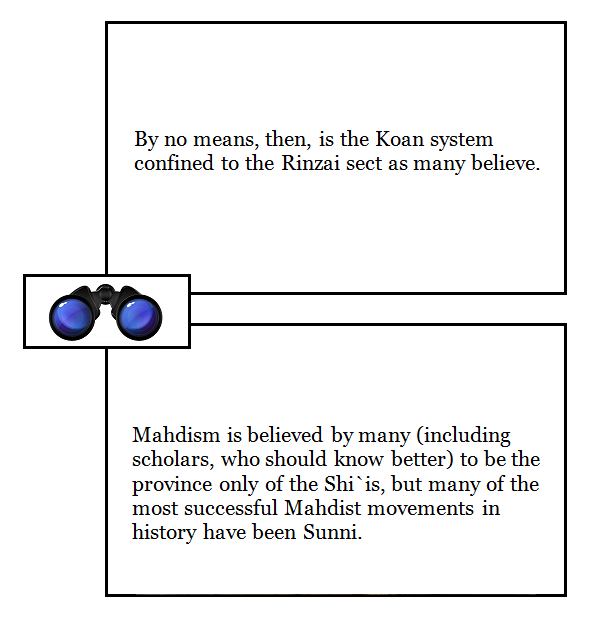
I ran across Philip Kapleau Roshi’s comment on koans (above) in his classic book, The Three Pillars of Zen, the other morning, and it sent me from Zen by rapid mental transit to Mahdism — one of the other termini in my mental system — and to the quote fro m Tim Furnish, one of many to the same effect, which I’ve juxtaposed to it.

If you still think Ahmadinejad (Shiite), and only Ahmadinejad, in terms of Mahdism, then you’ve missed the general point that Furnish is rightly making — and the specific point that Al-Qaeda (Sunni), and not only Al-Qaeda but many Sunnis are also liable to hold strong Mahdist expectations — Abu Musab al-Suri among them.

Because the Whichever-it-is is in the details, the details are the nuances and — when we make decisions without knowing the details, we’re liable to sail right into our blind-spots.

**

Now if you go to a zen master for instruction, you may or may not bee taught shikantaza (“just sitting”) or given a koan (“meditation paradox”) — both descriptions are simplistic; Kapleau Roshi’s book will take you deeper — but one way or another you’ll soon find out, and hopefully you and the master in question can figure things out.

If, on the other hand, you don’t know that Mahdism may be a Sunni as well as a Shiite phenomenon, watch out!

Amplified Mahdist expectation transforms the mental “set” of a jihadist from someone “fighting the good fight” in a generalized way into someone who believes the fight they are fighting is the Culminating War of Good against Evil.

Which, as Furnish’s article’s title, What’s Worse than Violent Jihadists? suggests, is a whole lot more intense.

**

I argued for taking “wide-angle view” at the end of my recent post, Sensitive dependence on initial conditions — here. I’m at the other end of a mental zoom, arguing for precise and nuanced focus on distinctions.

As with Hayakawa‘s Ladder of Abstraction, it pays to be able to work both ends of the spectrum — from the detailed specifics of “my cow Bessie” abstract statistical generalities of “livestock in Colorado” — and beyond.

Ladders will feature one of these days in a “form is insight” post of their own — Hayakawa’s Ladder, and William Blake‘s, and Herman Kahn‘s.

**

Details have their own details, and details are essentially differences — so there’s a lot of zooming in and out to do before you gain clarity. In Gregory Bateson‘s terms, you want to be clear on the differences that make a difference.

An army in Sham, an army in Yemen, and an army in Iraq

Thursday, November 1st, 2012

[ by Charles Cameron — uh-oh, it’s Mahdi time again.. giving a little wide-angle context, then passing along a hadith of possible current interest — also an aside about an end-times Shiite trinity ]
.

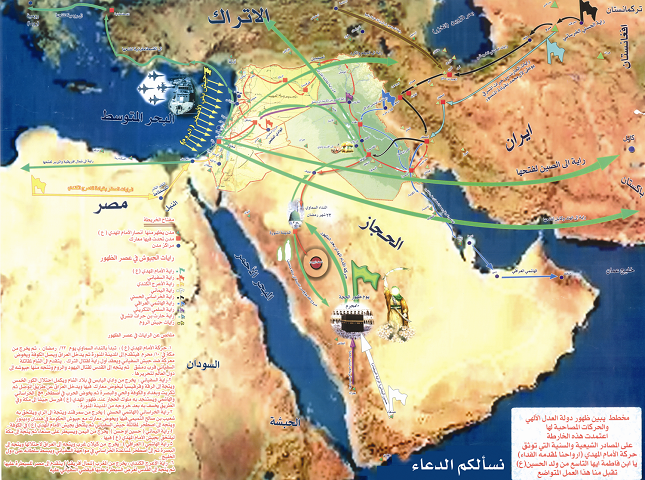
a ShiaChat map of one end times scenario: the Sufyani will attack Iran, black banners come from Khorasan

.

We live, as everyone pretty much agrees, in some place called “here” (although that shifts) at a particular moment called “now” (although that shifts too) in a medium often called “spacetime” in honor of Albert Einstein.

The Game-changing Coming Ones of many religions and sects – and even their secular variants, the Game-changing Coming Ideologies and Leaders) – are situated in another area of the same “spacetime” continuum for their respective believers: next up after “wars and rumors of wars” or “come the revolution” or “when the Mayan Calendar runs out” or “next year in Jerusalem”…
.

When:

My old friend Stephen O’Leary suggests there’s a shifting “window of opportunity” for people who preach “soon comings” – if you warn people that the world will end in a couple of thousand years, or with the heat death of the sun, or even that sea levels are liable to rise precipitously over the next few decades unless remedial action is taken, the view is long-range enough to seriously diminish your impact. Conversely, if you announce the end of the world will occur three minutes from now, nobody has time to get scared or prepared – or to propagate your message.

So “soon coming expectations” generally predict the coming is a little ways around the corner, close enough to matter but no close enough to sell all that you possess and climb Mt Ararat this week.
.

Where:

The “where” is interesting, though. We have news cameras focused 24/7 on the Mount of Olives to catch the Second Coming of Christ, although most observant Jews won’t be expecting that Christianity will be finally vindicated as the true inheritor of Judaism’s mantle there any time soon, and many Muslims expect he’ll descend at one of the minarets of the Umayyad Mosque in Damascus.

And the Mahdi? Two popular points of anticipated arrival are beside the Kaaba in Mecca, or out of the well behind the Jamkaran mosque, not too many miles from Qom.

But Islamic apocalyptic geography doesn’t end with either place – it extends, minimally, from Khorasan (Iran or Afghanistan) to Jerusalem, with a possible side-expedition to India (the Ghazwa-eh-Hind) and with possible tributaries from Africa and who knows where else… and in at least some Shia strands of apocalyptic thinking, the city of Kufa in Iraq will be the Mahdi’s seat of government.
.

And now, the hadith:

All this is simply to provide some context for a specific hadith that my friend Aaron Zelin pointed to me today, as recorded yesterday on the Kavkaz Center webpage:

Hadith about Syria, Iraq and Yemen

Publication time:
30 October 2012, 14:58

Sham – the territory of Syria, Palestine, Jordan and Lebanon

Abdullah ibn Hawalah [Allah's blessings be on him] narrated from the Messenger of Allah (pbuh) that he said:

"Matters will run their course until you become three armies: an army in Sham, an army in Yemen, and an army in Iraq".

Ibn Hawalah said:

"Choose for me, O Messenger of Allah! in case I live to see that day".

The Messenger of Allah (pbuh) said:

"You should go to Sham, for it is the best of Allah's lands, and the best of His slaves will be drawn there!

And if you refuse, then you should go to the Yemen and drink from its wells. For Allah has guaranteed me that He will look after Sham and its people!"

(Imam Ahmad 4/110, Abu Dawud 2483. Authenticated by Imam Abu Hatim, Imam ad-Diya al-Maqdisi, Sheikh al-Albani and Sheikh Shu'aib Al-Arnaut).

Department of Monitoring
Kavkaz Center

.
Further reading:

For more on this, see especially J-P Filiu‘s Apocalypse in Islam, noting in particular his account of “the revelation of Abu Musab al-Suri” (pp. 186-193), including specifically his discussion of “Sham” in a paragraph on p. 189.

*****

And an intriguing aside:

And since were talking Yemen and the greater Sham here, it may be worth noting as an aside, the presence in Islamic apocalyptic traditions of a figure known as the Yemeni — sometimes identified in Iranian Shia apocalyptic as Hezbollah’s Hasan Nasrallah. Filiu writes (p.156) of:

Shaykh Nazrallah’s transformation into the apocalyptic figure of the Yemeni, completing a very political trinity in which Ayatollah Khamenei served as the standard bearer of the Mahdi and Ahmadinejad as the commander of his armies.

Filiu’s book was published in France in 2008, but the same trinity can also be found in the fairly recent video The Coming is Upon Us attributed by Reza Kahlili to circles around Ahmadinejad. I’ve taken this account of the video and the trinity as it reports it from the Counter Jihad Report, because their version succinctly draws together the strands that most concern me here:

A little-noticed documentary titled “The Coming is Upon Us” was produced by Ahmadinejad’s office last year and it lays out the regime’s beliefs and planned path forward, much like Mein Kampf did. And it debunks the notion that the U.S.S.R. and the Iranian regime are equivalent. The film makes the case that the regime’s leaders are the incarnations of specific End Times figures foretold in Islamic eschatology.

Iran is the “nation from the East” that paves the way for the Mahdi’s appearance. Supreme Leader Khamenei is Seyed Khorasani, “the preparer” who comes from Khorasan Province with a black flag and a distinct feature in his right hand. Khamenei’s right hand is paralyzed from an assassination attempt. Khorasani’s commander-in-chief is Shoeib-Ebne Saleh, who the film says is President Ahmadinejad. Hezbollah chief Hassan Nasrallah is the incarnation of Yamani, a commander with a Yemeni ancestry who leads the Mahdi’s army into Mecca.

These three “preparers” wage war against the Antichrist and “the Imposters”-the U.S., Israel and the West’s Arab allies. The film also mentions that a figure named Sofiani will side with Islam’s enemies. Former Iranian Revolutionary Guards officer Reza Kahlili, who leaked the film, told me that the full-length version identifies him as Jordanian King Abdullah II.

The film lists various End Times prophecies that have been fulfilled to argue that the Mahdi’s appearance is near. The 1979 Islamic Revolution in Iran; the invasion of Iraq from the south and subsequent sectarian violence and death of Saddam Hussein; the Houthi rebellion in Yemen; the fall of Egyptian President Hosni Mubarak and the increasing amount of open homosexuality, cross-dressing, adultery and women taking off the hijab are correlated to specific Islamic prophecies.

As to the video’s authenticity and provenance, I can only express my ignorance and keen interest — but whatever the case, it seems likely that the split between Khamenei and Ahmadinejad, together with the latter’s “soon going” from office, renders that particular strain of prophecy moot.

Particular prophetic timelines may fail, and indeed do so repeatedly — the apparatus of apocalyptic hope simply incorporates new figures and events into its calculations, and moves its sense of urgency a little further up along the timeline…

The Messianic Mahdist Moebius strip — or maybe Maze?

Monday, October 29th, 2012

[ by Charles Cameron — a quick look at some confusing clashes between messianisms, with specific reference to the MUJAO — also the late Ayatollah Baqir al-Sadr sounding an ecumenical note ]
.

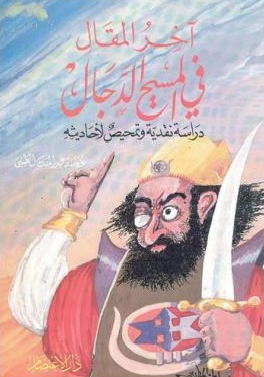
image: Dajjal, from Okasha Abdelmannan al-Tibi's The Whole Truth about the Antichrist

.

Tim Furnish opens his book Holiest Wars: Islamic Mahdis, their Jihads and Osama bin Laden, with the words:

One man’s messiah is another man’s heretic.

What he doesn’t state outright, which is also true, is that all too often that heretic is the anti-Messiah.

**

I use that term “anti-Messiah” deliberately, because in discussing Islamic end times beliefs, the term “Antichrist” is frequently used by both Christians and Muslims to refer to the Muslim “equivalent” of the Christian Antichrist — ie the “deceiving messiah” or Masih al-Dajjal, whose coming at the end of days is predicted in Islamic apocalyptic narratives in negative counterpoint to the coming of the Mahdi, in much the same way that some Christian apocalyptic narratives predict the coming of the Antichrist in negative counterpoint to the return of the Christ.

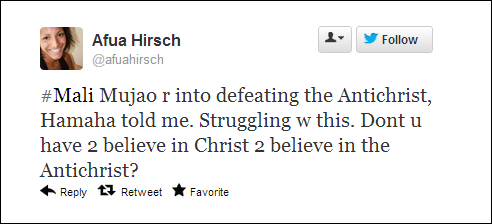
This issue was brought home to me once again today when Aaron Zelin pointed me to this tweet from Afua Hirsch [ @afuahirsch ], West Africa Correspondent for the Guardian:

Frankly, I think that’s a very natural question to raise, and one that has an even more intriguing answer.

**

One other note, which I’ve separated out between asterisks here because I think it’s a crucial one at that:

by Afua Hirsch’s account, Mali’s Movement for Unity and Jihad in West Africa (MUJAO) has the apocalyptic fever…

**

Strange things happen when different views of the end times, as prophesied one way or another in various branches of all three Abrahamic religions, clash.

Here’s where I see the moebius strip effect, whereby apocalyptic figures are turned into their opposites by rival sets of beliefs:

Some Muslims call the Dajjal (literally, “the deceiver”) the Antichrist — here, for instance, is a video clip of Sheikh Imran Hosein, whom I have discussed on Zenpundit before, quoting a hadith or tradition of the Prophet from the Sahih Muslim collection, and using the term “Antichrist” without further comment in his translation of the term Dajjal —

While some Christians call the Mahdi the Antichrist — as does Joel Richardson in his book currently issued under the title The Islamic Antichrist: The Shocking Truth about the Real Nature of the Beast. Reviewing the book in its first edition under its earlier title, Dr David R. Reagan sums Joel’s basic points succinctly:

Joel Richardson in his book Antichrist: Islam’s Awaited Messiah argues that the Mahdi will be the Antichrist of the Bible and that the Muslim Jesus will be be the False Prophet of the Bible who serves the Antichrist and his purposes. Both will be destroyed when the true Jesus returns at the end of the Tribulation.

We were talking about the Sufyani just the other day, right? Here’s a stunner to spin your head a further 180 degrees — the Sufyani as a second (and more dangerous) Dajjal than the Dajjal:

While the great Dajjal focuses on atheism and fights Christianity, the Islam Dajjal, Sufyan, fights Islam, which is the only true religion before Allah, openly. Therefore he is regarded as more frightening.

There’s also a question of one and / or many Antichrists in Christianity, of course — see 1 John 2:18:

Little children, it is the last time: and as ye have heard that antichrist shall come, even now are there many antichrists; whereby we know that it is the last time.

And hey, bear with me, I’m not done yet: members of the Ahmadi school quote a hadith from the Sunan Ibn Majah collection which says:

There is no Mahdi but Jesus son of Mary.

Ibn Majah, however, also has a hadith in which it is stated that at the time of the Mahdi’s advent he will invite the returning Jesus to lead the evening dawn prayer [as quoted here]:

…while their Imaam will have advanced to pray the Fajr prayer with them, Eesa, the son of Mary will descend [at the time of the Fajr prayer]. The Imaam will draw backward so that ‘Eesa would go forward and lead the people in prayer. However, ‘Eesa would put his hand between his shoulders and say to him: “Go forward and pray, as it is for you that the call for the prayer was called, so their Imaam would lead them in prayer.”

**

Confusing?

I think so, unless you are paying close attention.

My own recommendation would be that the phrase “the Islamic Antichrist” should be replaced by “the Islamic equivalent of an Antichrist” when referring to the Dajjal, and “the Mahdi viewed as Antichrist” when referring to the Mahdi.

I know, I know — the chances of changing people’s verbal habits across the board are pretty slender.

But have I made things seem complicated enough?

**

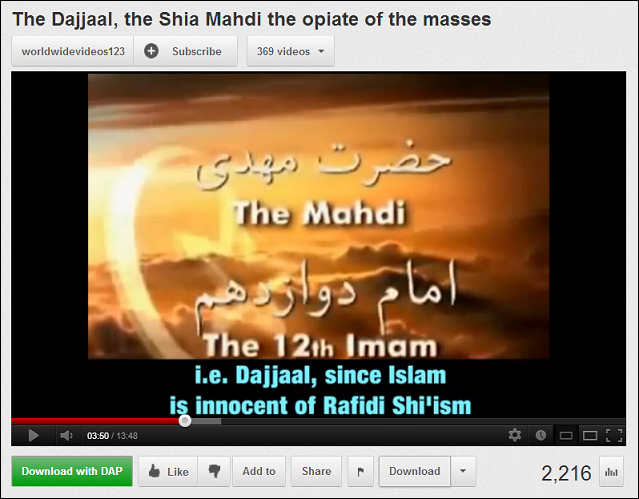
This whose business naturally gets just a tad more complicated once one adds in the Sunni concept — I am not sure how widespread it is, but it would make a fascinating topic for research for someone with the requisite language skills — that the Mahdi of the Shiites will be the Dajjal of the Sunni… as shown in this screen cap of a YouTube video.

[Rafidi means one who has deserted the truth, and is a derogatory term, in this case used by Sunnis to disparage the Shiites.]

Or this one — with its equation of the Shiites with the Jews:

Of course, Christianity too has its share of internecine apocalyptic mud-slinging: Rev. Ian Paisley (long-time leader of the Ulster Unionists and Moderator of the Free Presbyterian Church of Ulster) interrupted Pope John Paul II‘s speech at the European Parliament to denounce him as the Antichrist — while Rev. JD Manning gives Oprah Winfrey that title

**

Everything I have described above is dualistic in nature and sectarian in its specifics. It comes as something of a surprise, then, to find the late Ayatollah Muhammad Baqir al-Sadr quoted as writing:

The Mahdi is not an embodiment of the Islamic belief but he is also the symbol of an aspiration cherished by mankind irrespective of its divergent religious doctrines. He is also the crystallization of an instructive inspiration through which all people, regardless of their religious affiliations, have learnt to await a day when heavenly missions, with all their implications, will achieve their final goal and the tiring march of humanity across history will culminate satisfactory in peace and tranquility. This consciousness of the expected future has not been confined to those who believe in the supernatural phenomenon but has also been reflected in the ideologies and cult which totally deny the existence of what is imperceptible. For example, the dialectical materialism which interprets history on the basis of contradiction believes that a day will come when all contradictions will disappear and complete peace and tranquility will prevail.

The point is made even more clearly in a speech given by the Iranian scholar Muhammad Ali Shumali:

So, our own camp comprises of people who have this understanding: First of all, they are the people who believe in the Ahl al-Bayt. Yet, in our camp it is possible for there to be people who work for the Ahl al-Bayt without knowing the Ahl al-Bayt. This is also something very important. You may have a non-Shia who works for the Ahl al-Bayt better than many Shias. Indeed, you have some Shias that work against the Ahl al-Bayt. You may even have non-Muslims who are working for Imam Mahdi—for the cause of Imam Mahdi, for justice, for many things—and they may not even know who Imam Mahdi is. So it is not that whoever is not a Shia is not in our camp.

and:

I believe that the majority of the people of the world are not against us; it is just our failure to present our ideas and to convince them that what we have is for all mankind. I think in particular, in the case of Imam Mahdi, we must do the same thing: we must not present Imam Mahdi as a saviour for the Shias. Imam Mahdi is not a saviour for [just] the Shias. Imam Mahdi is a saviour for all mankind…

**

And then you see what you yourself see, and believe what you yourself believe.

Of quantity and intensity: the case of the Sufiyan

Sunday, October 28th, 2012

[ by Charles Cameron — catching the apocalyptic mention in a broad sectarian overview ]
.


.

I’d like to discuss the last four paragraphs of a recent NYT piece on the influx of Iraqi Shiites to Syria:

Iraqi Shiites did not initially take sides in Syria. Many Shiites here despise Mr. Assad for his affiliation with the Baath Party, the party of Saddam Hussein, and the support he gave foreign Sunni fighters during the Iraq war.

But as the uprising became an armed rebellion that began to attract Sunni extremists, many Shiites came to see the war in existential terms. Devout Shiites in Iraq often describe the Syrian conflict as the beginning of the fulfillment of a Shiite prophecy that presages the end of time by predicting that an army, headed by a devil-like figure named Sufyani, will rise in Syria and then conquer Iraq’s Shiites.

It was the bombing of an important shrine in Samarra in 2006 that escalated Iraq’s sectarian civil war, and many Iraqis see the events in Syria as replicating their own recent bloody history, but with even greater potential consequences.

Hassan al-Rubaie, a Shiite cleric from Baquba, the capital of Diyala Province, said, “The destruction of the shrine of Sayyida Zeinab in Syria will mean the start of sectarian civil war in Iraq, Syria, Lebanon, Bahrain and Saudi Arabia.”

**

There’s a lot going on there, and I just want to point you to the little diagram I posted above, which features what I consider one very significant point that jumped out at me on this occasion from the “larger picture”.

It’s my impression that the name Sufiyan will be far less familiar to most readers than the names Iraq, Syria, Lebanon, Bahrain and Saudi Arabia. Furthermore, Iraq, Syria and so on are nations — real geopolitical entities with territories, wealth, militaries, populations, factions, fighting and so forth. The Sufyani, by contrast, is a single person, perhaps a figure of legend.

For the contemporary western mind, therefore, it is easy to read those last four paragraphs and be struck by the breadth, the sheer physical extent of the potential conflict described there – and after noting the basic concept of sectarian rivalry between Sunnis and Shiites, that may in fact be the major “takeaway” from the article: this thing could be huge.

I want to suggest there’s a more significant, and less studied takeaway – that Sufyani is the key word here, because Sufyani is a figure in a specifically end-times narrative, a precursor to and noted adversary of the Mahdi.

**

That’s my bottom line here – that this individual the Sufyan may be less known and less impressive-sounding than a swathe of nations between the Mediterranean, the Red Sea and the Persian Gulf – but he represents the power of end-times belief, and the intensity that inevitably accompanies the final showdown between good and evil, with heaven and hell the only possible outcomes of one’s chance and choice to participate.

**

There is not a whole lot of documentation in English regarding the Sufyani, especially as viewed in Shiite eschatology, but this quick excerpt archived from an Iranian state media site will give us a basic overview:

According to narrations Sofyani, a descendant of the Prophet’s archenemy Abu Sofyan will seize Syria and attack Iraq and the Hejaz with the ferocity of a beast. The Sofyani will commit great crimes against humanity in Iraq slaughtering people bearing the names of the infallible Imams, and his army will lay siege to the city of Kufa and to Holy Najaf. Of course, many incidents take place in this line and finally Imam Mahdi sends troops who kill the Sofyani in Beit ol-Moqaddas, the Islamic holy city in Palestine that is currently under occupation of the Zionists. Soon a pious person from the progeny of Imam Hasan Mojtaba (AS) meets with the Imam. He is a venerable God-fearing individual from Iran. Before the Imam’s appearance he fights oppression and corruption and enters Iraq to lift the siege of Kufa and holy Najaf and to defeat the forces of Sofyani in Iraq. He then pledges allegiance to Imam Mahdi.

The Rice University scholar David Cook gives a worthwhile account of the Sufiyani in Shiite perspective, in his Hudson Institute paper Messianism in the Shiite Crescent [CC note: this paragraph added about an hour after first posting]:

First among the major omens connected with the belief in the Mahdi’s imminent return is the appearance of his apocalyptic opponent, the Sufyani. Mainstream tradition tells that the Sufyani will be a tyrannical Arab Muslim ruler who will hail from the region of Syria and who will brutally oppress the Shiite peoples. Before the 2003 collapse of the Saddam Hussein regime in Iraq, many messianic writers in both the Sunni and Shiite traditions identified Saddam Hussein as the Sufyani. Since 2004, however, there has been a tendency to gloss over the classical belief in the Sufyani’s Syrian-Muslim identity and to identify him instead with the United States (as many Iraqis hold the U.S. responsible for the slaughters in their country.) Another recent trend within Shiite messianism has been to identify the Sufyani with prominent Sunni radicals such as Abu Musab al-Zarqawi (killed June 2006), who was virulently anti-Shiite. From the perspective of the classical sources, Zarqawi would have indeed been an excellent candidate, because his hometown in Jordan is extremely close to where the Sufyani is supposed to come from.

It’s worth noting, perhaps, that the Sufyani also features in the (Sunni AQ strategist) Abu Musab al-Suri‘s work, the Call to Global Islamic Resistance. As Jean-Paul Filiu reports:

Abu Musab al-Suri looks with favor upon a hadith that speaks of the restoration of Islam by an armed force “coming from the east.” This will be the vanguard of the Mahdi, known by its black banners and led by Shuaib ibn Saleh, whom every believer will join “even [if it means] marching in the snow.” The Sufyani, whose face is scarred by smallpox, will rise up against it in Damascus and ravage Palestine, Egypt, and Hijaz, proceeding as far as Mecca, where he will kill the “Pure Soul.” Yet it is also at Mecca that the Mahdi will appear, and he will reconquer Damascus after eighteen years…

Meanwhile, out there on the wild profusion of the net, there’s naturally controversy as to who the Sufyani might be – suggestions I’ve seen include Bashar al-Assad of Syria and Abdullah II of Jordan – in much the same way that the identity of the Antichrist is debated in Christian eschatological circles, with candidates ranging from the Emperor Nero to Ronald Reagan and more recently Oprah Winfrey [link is to an amazing video clip which also features President Obama and Louis Farrakhan].

**

So?

So. Rather than – or in addition to – considering the sheer extent of geopolitical space referenced in the NYT piece, I’d suggest we should pay attention to the intensity factor signaled by the mention of the Sufyani. Following that tack, after all, we will also be considering a wide swathe of territory —

in Abu Musab al Suri’s terms, from Syria via Palestine, Egypt, and the Hijaz, to Mecca – but with the added intensity that apocalyptic war brings with it.


Switch to our mobile site