zenpundit.com » Mahdist

Archive for the ‘Mahdist’ Category

A little diligence makes for a long post, 1: Kahlili

Wednesday, October 24th, 2012

[ by Charles Cameron — first part of a post on misreading Mahdism in Iran ]
.

book credit: amazon -- Mahdist graphic credit: Tim Furnish / MahdiWatch

.

Our blog friend Pundita has been relying on Reza Kahlili, the pseudonymous Iranian author of A Time to Betray: The Astonishing Double Life of a CIA Agent Inside the Revolutionary Guards of Iran, quite a bit recently, pointing to his recent discussion with John Batchelor and some reports of his on World Net Daily.

There are a number of people whose views on the religious issues surrounding an Iranian nuclear weapons program interest me — I leave other aspects of the problem to others better informed than I — some because they have insight, some because they have megaphones, and so on.

I’m not the person you’d want to ask whether Reza Kahlili was a CIA source, whether he was trusted, and if so, on what issues – issues which might range from troop movements to popular opinion of the IRG rank and file to theology and apocalyptic, a range that no single source is likely to be omnicompetent in – but WND is a media source I’ve followed off and on for a dozen years, it’s strongly associated with one of the strands of recent Christian apocalyptic with its own messianic take on Islam and Mahdism, and it isn’t necessarily a source I’d trust without verification…

**

So I did some checking of my own on Reza Kahlili, and found that he, or more likely some ghost writer employed to write his book for him (along with his publisher’s copy editor), simply doesn’t know what a hadith is. A hadith is a statement attributed to the Prophet (or in the Shi’a case, one of the infallible Imams who succeeded him) and passed down through an authoritative train of transmission (isnad). For a practicing Muslim, the corpus of hadith is second only to the Qur’an, and knowing what a hadith is is like knowing what the Epistles are for a practicing Christian: basic. For a theologically nuanced scholar from Qom or Najaf, it’s kindergarten.

Kahlili gets the use of the word “hadith” right early on in his book, but when he starts talking about the return of the Twelfth Imam or Mahdi he writes (p. 334.):

Like others who think as he does, Ahmadinejad believes that many of the signs of Mahdi’s return have emerged. Known as hadiths, these signs include the invasion of Afghanistan, the bloodshed in Iraq, and the global economic meltdown. According to prophecy, the hadiths will grow increasingly furious as Mahdi’s return comes closer, including “persecution and injustice” engulfing the earth, “chaos and famine,” and “many wars.” The hadiths predict that “many will be killed and the rest will suffer hunger and lawlessness.” People like Ahmadinejad so completely believed that these conditions would hasten the return of the twelfth Imam that they were willing to foment universal war, chaos, and famine to bring it about.

That’s at best very sloppy writing — the signs are known as ayat (as are the verses of the Quran), and the Quran states (28.59):

Nor was thy Lord the one to destroy a population until He had sent to its centre a messenger, rehearsing to them Our Signs; nor are We going to destroy a population except when its members practise iniquity.

Some translators actually render what this translation calls “signs” as “verses”.

Giving this passage from Kahlili a charitable reading, it could be understood to mean that signs as described in reliable hadith “include the invasion of Afghanistan, the bloodshed in Iraq, and the global economic meltdown” – though there’s a lot of interpretive scope in there, as there is in locating Gog and Magog (are both place names, or is one a prince of the other?) in comparable Christian eschatological circles.

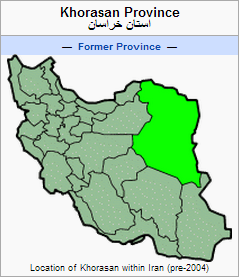
Taliban recruiters (Sunni) certainly take “Khorasan” as mentioned in some Mahdist hadith as referring to “Afghanistan” – see Ali Soufan‘s book, The Black Banners – but an Iranian would read “Khorasan” as referencing the region of that name in Iran, or perhaps a wider zone that includes it, but also encompasses portions of Afghanistan and other neighboring states – it was, after all, the name of Iran’s largest province until divided in three parts, North, South and Razavi Khorasan in 2004:
Interestingly too, the hadith traditions in question are considered likely to have been written by and for the Abbasids. David Cook, for instance, in his magisterial Contemporary Islamic Apocalyptic Literature writes of Khorasan (p. 173.):

The ‘Abbasids sought to present their movement as the fulfillment of messianic expectations, and so they produced a great quantity of materials given in the form of hadith traditions to indicate that the Mahdi would come from this region.

— not that scholarship of this kind is liable to influence popular apocalyptic sentiment…

**

Okay, so with a little creative forgiveness, we can read that first passage of Kahlili’s as saying that within the hadith can be found signs such mentions of Afghanistan / Khorasan, bloodshed in Iraq, and economic woes. But then we read this (p. 337.):

With the eyes of the world on them, the mullahs and the thugs who took orders from them fought mercilessly to hold on to the power that had never been their right, using extreme force to deny that their time was over. In their minds, Mahdi was coming and the blood they shed now was yet another hadith.

C’mon, now, has Kahlili even read his own book? Blood shed equals hadith?

The most charitable thing I can find to say is that Reza Kahlili may or may not have been some level of CIA source, but his credibility in matters involving any aspect of Iranian theology is utterly unconvincing.

**

Jeff Stern, in a WaPo piece from 2010, doesn’t sound any too convinced that Kahlili is worth our trust in other matters either, writing:

Reza Kahlili, a self-proclaimed former CIA “double agent” inside Iran’s Revolutionary Guards, appeared in disguise at a Washington think tank Friday claiming that Iran has developed weapons-grade uranium and missiles ready to carry nuclear warheads.

The pseudonymous Kahlili, whose previous accounts have been greeted with widespread skepticism, also said Iran was planning nuclear suicide bombings with “a thousand suitcase bombs spread around Europe and the U.S..

and:

Several current and former U.S. intelligence officials in the audience “rolled their eyes” at Kahlili’s claims, said one observer who was present.

Some in attendance compared Kahlili with Ahmed Chalabi, the former Iraqi exile who helped convince the George W. Bush administration that Iraqi leader Saddam Hussein had weapons of mass destruction. After the U.S.-led invasion of Iraq, the claims were proved false.

My personal knowledge-map features huge areas of ignorance where many others have strong opinions. On matters religious, Kahlili is not to be believed. On the siting of nuclear labs, or weapons development and deployment, we’re in areas that bear the legend “Here there be Smoke and Mirrors” on my map.

Thus endeth my blog-epistle to Pundita, whose knowledge of many of the other moving parts in the wider geopolitical situation far exceeds my own.

**

I’ll follow up with part II of this essay, in which I’ll talk a bit about Glenn Beck and Joel Rosenberg, and some other significant ways in which Shi’ite eschatology is being misrepresented via popular media in the west.

For those following the development of my book / media project, I am hoping the project will include a section of longer essays such as this one, in which I pull apart some of the myths currently surrounding western understanding of Islam, while pulling together major strands of a more nuanced view.

Some interesting pre-debate readings, left and right

Monday, October 22nd, 2012

[ by Charles Cameron — first, the humor, then the serious stuff — including insider and outsider claims as to who belongs with what religious grouping ]
.

Two items from my inbox on this day of the Presidential Foreign Policy debate play humorously with the, for want of a better term, issue of Muslims and Mormons:

On the top, Tim Furnish, author of the book Holiest Wars and an expert on Mahdism, heads up a brief post on his MadhiWatch blog with an image out of South Park and the caption: The quintessential Mormon v. the original Mahdi! It’s ON! That’s from the right.

From the left, Frank Schaeffer, who “left” the movement his influential “right” father, the evangelical theologian Francis Schaeffer, helped found, and is now an Orthodox Christian of a more sacramental and liberal stripe, plays a rather different game in his Huffington Post piece, posted under their Comedy header, and purportedly describing an “alternative USA somewhere on a planet far away and not so long ago…”

Okay, that’s the fun. The serious part, for me, boils down to these two things:

**

Schaeffer has a point, I think, in mocking the Billy Graham organization’s sudden and opportunistic dropping of Mormonism from the list of cults on their My Answer page.

I support the right of Latter-day Saints to call themselves Christians, since they follow the teachings of Jesus Christ as they understand them.

I support the right of other Christians to view them as non-Christian, should they feel obliged in good conscience to do so, since Mormons consider the revelations of Joseph Smith on a par with the canonical gospels, much as Moslems consider the revelation to Muhammad as a completion of the Towrat and Injil (Jewish and Christian revelations).

And I don’t much like the term “cult” as applied to people whose beliefs differ from one’s own in any case, since it tends to dehumanize those to whom it is applied, as witness the tragedy of the Branch Davidians in Waco not too many years ago.

I am not entirely opposed to the idea of adjusting religion to suit a changing world, but I have to say this move on the part of the Graham organization appears to be a totally inauthentic PR move, made for political and not theological reasons, and wide open to the appearance of hypocrisy. If, on the other hand, it leaves all concerned more willing to respect each other as individuals across theological borders, that’s something I can readily applaud.

As usual, there are nuances within nuances to be considered.

**

And Tim Furnish’s use of an image from South Park (I imagine it’s from their Super Best Friends episode) is pure eye-candy. It’s an attention grabber, all right, and it’s function is to point you to Furnish’s recent piece on History News Network, titled What Would a Mitt Romney Foreign Policy Look Like? We’ll learn more about that tonight, I imagine, but Furnish’s column makes interesting preparatory reading:

Ironically, rather like Obama, Romney sees the events of the “Arab Spring” and the abortive “Green Revolution” in Iran through neo-Wilsonian lenses, as evidence of Middle Eastern masses yearning to breathe free — a “struggle between liberty and tyranny, justice and oppression, hope and despair.”

Interestingly enough, the question of who can or should not be tagged with a particular label is central to Furnish’s post. Discussing Romney’s use of the term “extremism” seven times in his Virginia Military Institute [VMI] addresss, he writes:

Only once, note, did he preface the term with the adjective “Islamic.” However, by that one example of intellectual honesty, Romney locates himself light-years ahead of the Obama administration, which actively discourages honest discussion of the fact that 61 percent — 31 of 51 — of the foreign terrorist organizations on the State Depatment’s list thereof are Islamic and which, further, sanctions counter-terrorist trainers who dare to utter words such as “jihad.” One wishes he would simply call an Islamic extremist spade a spade — but Romney is allowing himself to be constrained by his stable of advisors, as well as, perhaps, the pro-Islamic tendencies inherent in the Church of Jesus Christ of Latter Day Saints. Someone needs to tell the Governor that naming Islamic extremism in the defense of Western civilization is no vice.

FWIW, I am in favor of recognizing that jihadists are influenced by their own versions of Islamic doctrine, within widely varying degrees of flexibility, so the phrase “Islamist extremists” makes some sense to me. And I am equally in favor of allowing those Muslims who see the jihadist’s theology as alien and contrary to their own Muslim tradition to make it clear that in their understanding of Islam, the “jihadists” represent an aberration from the faith. Nuance again, nuance.

Okay, that reference above to the “pro-Islamic tendencies inherent in the Church of Jesus Christ of Latter Day Saints” is linked to another of Furnish’s pieces for HNN, in which he asks Has Mitt Romney’s Mormonism Influenced His Views on Islam? — in which Furnish quotes Romney thus:

I spoke about three major threats America faces on a long term basis. Jihadism is one of them, and that is not Islam. If you want my views on Islam, it’s quite straightforward. Islam is one of the world’s great religions and the great majority of people in Islam want peace for themselves and peace with their maker. They want to raise families and have a bright future. There is, however, a movement in the world known as jihadism. They call themselves jihadists and I use the same term. And this jihadist movement is intent on causing the collapse of moderate Muslim states and the assassination of moderate Muslim leaders. It is also intent on causing collapse of other nations in the world. It’s by no means a branch of Islam. It is instead an entirely different entity. In no way do I suggest it is a part of Islam [emphasis added].

Here’s where the delicate balance is required.

On the one hand, we need to be clear — especially on the analytic and policy-making levels — on the ways in which Islam can be and is being interpreted as providing divine sanction for sustained campaigns of terroristic violence.

And on the other, we should in no way encourage — particularly at the level of popular public opinion — the idea that we are “at war with Islam”, an idea which leads to such things as the dehumanizing and killing of American (not necessarily even Muslims) citizens within our own shores, and an increasing sense that America is in fact at war with Islam in the minds of some few Muslims here and many more abroad — who then become prey for further radicalization, as rage on each extreme fuels the other in the multiple echo-chambers and feedback loops of YouTube and the net.

**

And for what it’s worth, Tim F and Frank S — you should both talk to your editors about proof-reading. Tim, the Mormon church is the Church of Jesus Christ of Latter-day Saints if I’m not mistaken, with a hyphen and lower-case “d” in “Latter-day” — strictly FTR. And Frank — you get Dinesh D’Souza‘s first name right on two occasions — why spell it Dnish and Dinish on two others?

Oh well, we all make mistakes. I tried to type the word “to” the other day. You might think that’s simple enough, but I spelled it “typo”. Oops!

Feel free, y’all, to let me know what I’ve mis-spelled, misunderstood, or just plain missed, okay?

Mahdism in Iraq, redux

Thursday, August 30th, 2012

[ by Charles Cameron — news bulletin on Mahdist messianism, with a muddling mixing of metpahors ]
.

prominent ISCI leader Jalal al-din Ali al-Sagheer, via Rudaw


Dated yesterday, Hevidar Ahmed‘s piece on the Kurdish news site Rudaw, Shia Leader: The Awaited Imam Mahdi Will Fight the Kurds, confirms that Iraq’s Mahdist undercurrent has at least one well-placed adherent while also denying the specific applicability of one particular sermon — except in case of earthquake:

Jalal al-din Ali al-Sagheer, a prominent leader of the Islamic Supreme Council of Iraq (ISCI), denies saying that the awaited Imam al-Mahdi will fight the Kurds when he emerges.

Sagheer also sent a letter to the president of Iraq Jalal Talabani and Kurdistan Region President Massoud Barzani explaining his intentions behind a lecture he delivered on Aug. 10.

The lecture, delivered in Baghdad’s Buratha Mosque, was about recent political activities of Kurds in Iraq and Syria and the relation of these activities to the appearance of the awaited Shia imam.

Sagheer cited some texts about the subject and concluded that “these could be some of the signs of the appearance of the awaited imam, but in order for these expectations to come true, a strong earthquake needs to hit Syria and Turkish soldiers must land in Cizre region.”

A tip of the hat to Timothy Furnish, whose MahdiWatch blog has a longer and more detailed version of story. Among Dr. Furnish’s points:

Modern Iraqi Mahdism has, heretofore, been largely a phenemenon manifesting among outre groups there: Ahmad al-Hasan’s Ansar al-Mahdi, the late Abd al-Zahra al-Qar`awi’s Jund al-Sama’, or Mahmud al-Hasani al-Sarkhi’s Jaysh Husayn, as well as (albeit probably more politically and less seriously) Muqtada al-Sadr’s Jaysh al-Mahdi. Now, however, a mainstream Iraqi politician is espousing Mahdist views–and not just pious ones reflecting some far-off, future hope but beliefs working eschatology into the modern political scene in the Middle East.

Ali A Allawi said Iraqi Mahdism was flying “under the radar” of western analysts when he spoke at the Jamestown Foundation on October 9, 2007. The video of that meeting is no longer publicly available, and as far as I know, no transcription exists online.

Are we paying attention to Mahdism as a significant current in the Middle East yet? If not — and switching my metaphors in midstream — it’s probably “up periscope” time again.

Pew on the prevalence of Mahdism — take heed!

Sunday, August 12th, 2012

[ by Charles “told you so” Cameron — Pew figures for Mahdist expectation, also the Second Coming, Israel, and the potential influence of apocalyptic ideation on foreign policy ]
.

The World’s Muslims: Unity and Diversity, p. 65

.

I am Qualit, not Quant by nature, really much more interested in the workings of the imagination that in the aggregates of poll responses, so it’s a bit like pulling teeth for me to report on a Pew report — but in this case I can legitimately say “I told you so”, which massively outweighs the reluctance I might otherwise feel…

**

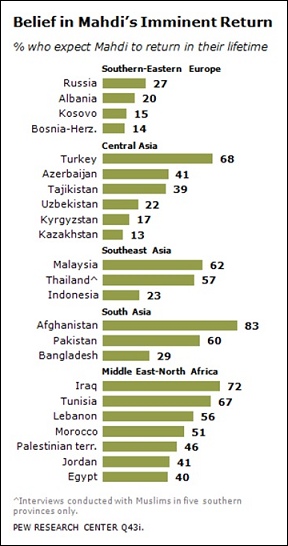
Recently, Pew has been including questions about the expectation of the Mahdi in some of its reports, and even Tim Furnish — who wrote the book on Mahdist movements and has long been saying we neglect them at our peril — even Tim was surprised at how widespread Mahdist expectation is, as reported in their just released The World’s Muslims: Unity and Diversity. In a post aptly titled Don’t Leave a Live (or Occulted) Mahdi Out of Your Calculations, Tim says the report contains “The most notable — indeed, strikingly important — news” in the form of “fascinating — and disturbing — data on belief in the Mahdi’s imminent (in one’s lifetime) return.”

See graphic above.

I recommend you read Tim’s analysis for the full range of his points — I won’t, for instance, be touching on what he says about Turkey — here I am going to select a couple of his key issues, and make just a point or two of my own.

**

Furnish:

Of the 23 countries whose Muslim citizens were polled, nine have majorities which expect the Mahdi in their lifetimes, with the overall average percentage at 41.8% … it is safe to extrapolate this percentage to Islam as a whole; ergo, 42% of 1.6 billion = 672 million Muslims who believe in the Mahdi’s imminent return! This is FAR greater than I had supposed.

Furnish also notes that Iran, the world’s most intensely Shi’ite nation and the one whose President has been speaking openly of Mahdist expectation, is not even included among the 23 countries Pew sampled.

Simply put, we have been blind to a very real phenomenon, and now we have a statistical alarm call to wake us up.

More subtly: there’s a difference between answering yes to the question “do you expect the Coming of X in your lifetime” and being on the edge of your seat, viewing every week as threshhold. Damian Thompson is very good on this in his book, Waiting for the Antichrist, and Stephen O’Leary in Arguing the Apocalypse suggests there’s an optimal “arousal” period — if you believe the Coming is too far away, you won’t be motivated to prepare for it quite yet, and if it’s too close it may be too late for you to do much to spread the word…

So, Pew — next time, ask a question with the opinions “in the next five to ten years” and “in my lifetime” — okay? The distinction is important, and a shift towards the shorter time-span would be highly significant.

**

Furnish again:

Despite the conventional wisdom (repeated even by Pew, in the face of their own data) that Mahdism is primarily the province of Shi`is, note that three of the four countries with the highest percentage expecting the Mahdi are majority-Sunni ones: Afghanistan (83%), Turkey (68%) and Tunisia (67%). This has ramifications, respectively, for: US policy in a country we are currently occupying; the only NATO Muslim-majority nation; and the vanguard state of the “Arab Spring.”

In his Conclusions, Furnish says:

The usual State/Defense departments’ “rational actor” approach to international relations might be quite simply irrelevant, if almost half the world’s Muslims expect the imminent return of their eschatological deliverer.

So there you have it. I discussed the “rational actor” versus Scott Atran‘s “devoted actor” in a recent post. And yes indeed, there are “ramifications for U.S. policy”…

Notably with regard to Afghanistan …

**

Here’s Furnish again:

Afghanistan is so rife with Islamic messianism because the 80% of the population that is Sunni and the 20% that is Shi`i (albeit Sevener/Isma’ili, as well as Twelver) both are in the middle of a war and occupation by a “Christian” power — which tends to ratchet up such expectations …

And again, in his Conclusions:

Afghanistan is a lost cause: over eight in ten of its people expect the Mahdi in their lifetime, and no amount of roads and clinics and girls’ schools built by the infidels will change that.

I don’t want to argue that second point in detail, although I think there’s a great deal more to life that Mahdist expectation for many who would answer “yes” to Pew’s question about expecting the Mahdi in one’s lifetime — see my comment on Damian’s book above. But how can I put it? A background Mahdist expectation can become a passionate involvement in a Mahdist movement if the right trigger comes along.

But what I find most striking here is that Afghanistan should be the country with the strongest Mahdist current out of all those Pew selected. And I’m struck not because Afghanistan has been a battlefield for so much of recent history — indeed, for so much of its history, period. I am struck because, in Al-Qaida’s recruitment narrative, supported by a number of ahadith, Afghanistan as Khorasan is the very locus from which the Mahdi’s victorious army will sweep out to conquer (finally) Jerusalem. And this too I have been posting about, eg in my discussions of Ali Soufan‘s The Black Banners and Syed Saleem Shahzad‘s Inside Al-Qaeda and the Taliban.

So the highest level of Mahdist expectation also happens to be found in an area with a potentially major role to play in an end times scenario…

**

There’s at least one earlier report in which Pew raised the question of Mahdist expectation — this time tied in with both the expectation of the Caliphate, and Christian hope of the Second Coming — their 2010 report Tolerance and Tension: Islam and Christianity in Sub-Saharan Africa.

Here, for instance, we learn:

Both Christians and Muslims believe they are living in a time that will undergo momentous religious events. For example, at least half of Christians in every country with large enough samples of Christians to analyze believe that Jesus will return to earth during their lifetime, including nearly seven-in-ten Christians in the Democratic Republic of the Congo (69%).

And at least half of Muslims in 10 of the 15 countries with large enough Muslim populations to analyze say they believe that the caliphate, the golden era of Islamic rule, will be re-established in their lifetime; this belief is most common among respondents in Mozambique (69%). And in 12 of these 15 countries, roughly six-in-ten or more Muslims believe in the return of the Mahdi, the guided one who will initiate the final period before the day of resurrection and judgment, though the survey did not ask respondents whether they expect this to occur during their lifetime.

And here is the relevant data on sub-Saharan Mahdist belief. In Q51 of this poll, Muslims were asked whether they believe “in the return of the Mahdi, the guided one who will initiate the final period before the Day of Resurrection and Judgment? Here’s the table of responses:

Given the “religious fault line” of mixed conflict and amicable coexistence between Christians and Muslims running across Africa from (so to speak) Nigeria to Somalia, with Boko Haram and Al-Shabaab among the less delightful participants, keeping an eye out for signs of Mahdist “semiotic arousal” would be important here, too.

**

And “semiotic arousal” — that reminds me. Richard Landes, who coined the term, has the definitive, encyclopedic book out about all the many forms of apocalyptic, and why they’re important: Heaven on Earth: The Varieties of the Millennial Experience Essential reading, if you ask me, on a hugely neglected and no less critically important subject.

**

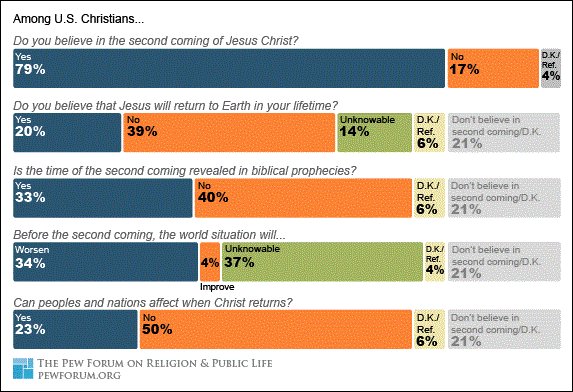
Finally, here’s yet another Pew graphic

— to be viewed in conjunction with this one, illustrating the ways in which belief in the Second Coming of Christ correlate with opinions about scriptures and the State of Israel:

**

Prophecy has impact, both on public opinion and on believing leaders. Jews with an expectation of the Messianic era, Christians expecting the soon Coming of Christ, and Muslims with Mahdist expectations each have their own apocalyptic scenarios, and in each case those scenarios exert some influence on policies relating to the Middle East and the Israeli-Palestinian situation in particular.

The bottom line?

Scriptural interpretation — and prophetic eschatology in particular — can no longer be assumed to be a quiet backwater topic for rabbinic students, seminarians and future mullahs to study, each in terms of their own tradition. It is now a series of conflicting drivers of current affairs — of war and peace.

Who among us can comprehend religion? — Mahdi & Second Coming

Wednesday, August 8th, 2012

[ by Charles Cameron — the Second Coming in Mahdist eschatology, Abu Musab al-Suri: a first addendum to my post responding to Scott Atran ]
.

I quietly asked “who among us can comprehend religion?” in the header to my most recent post responding to Atran on FP, and here and in the post that follows this one, I want to stir some thoughts on the topic.

**

First, here’s a snippet of today’s twitterfeed that caught my attention:

Bright folks, each one of them — and Vatyma is right, Lebovich nails it tecommending Filiu‘s book.

**

Okay, larger than life with my in-house advantage, here’s my response:

**

And here’s Jean-Pierre Filiu, talking specifically about Abu Musab al-Suri‘s attention to the Second Coming — understood as an accompaniment to the coming of the Mahdi and defeat of the Antichrist / Dajjal — in his Apocalypse in Islam, p. 191:

Abu Musab al-Suri endorses all the accepted traditions concerning Jesus and the Antichrist, notably among them the homicidal hadith about the stones and trees that denounce the Jews hiding behind them. But he innovates in supplementing it with a related saying, according to which the concealed presence of “impure Christians” will also be betrayed in the same fashion.

BTW, that’s the gharqad tree hadith, on which see (a) the Charter of Hamas, article 7, and (b) Anne Marie Oliver & Paul Steinberg, The Road to Martyr’s Square, pp 19-24.

Here’s Filiu again, a little later on the same page, still expounding Abu Musab:

The Antichrist, harassed by two angels who denounce his lies, will attempt to follow [the Muslims into Jerusalem], but at this juncture Jesus will return from heaven and strike him down.

**

Abu Musab dedicates the last hundred pages of his 1,600-page Call for Global Islamic Resistance to his eschatological views — and as Filiu notes, and as I have quoted before:

There is nothing in the least theoretical about this exercise in apocalyptic exegesis. It is meant instead as a guide for action. …

So there you have it: in the view of the man Brynjar Lia calls the Architect of Global Jihad, popular Sunni eschatology — including the return of Jesus — has detailed implications for prophetically informed strategic jihadist planning.

Religion: why it is indeed imperative, as Scott Atran suggests, for us to understand it.


Switch to our mobile site