zenpundit.com » Israel

Archive for the ‘Israel’ Category

The symmetry: Charlie Hebdo

Saturday, September 22nd, 2012

[ by Charles Cameron — my apologies for an earlier incomplete draft, quickly withdrawn — first of two, on loose cannonry and mirror imagery — second will deal with recent events in Benghazi ]
.

.

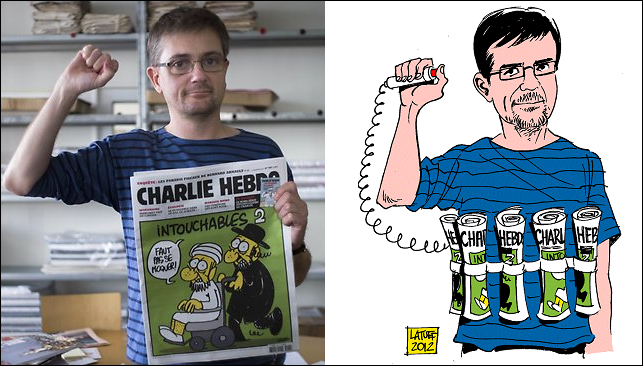
Charlie Hebdo recently published some cartoons featuring the prophet…

Okay, I’m always on about symmetry.

I posted a piece titled Messianic symmetries on ZP a while back, noting that both Ahmadinejad and Netanyahu can be viewed as exercising “leadership that makes decisions out of messianic feelings” — the quote comes from an unimpressed ex-Shin Beth director describing Bibi; Ahmadinejad makes the case for his own Mahdist leabings quite well himself.

Symmetry seems like an important analytic category to me, either because it’s there in the build of the world, or because it’s there in the build of the mind. Either way, I think we should take careful notice of symmetries.

Asymmetries I’ll talk about in my next post.

**

What about the cartoon above, right? It’s clearly based on the photo above, left, which shows Stéphane Charbonnier, the editor of Charlie Hebdo, holding his magazine with its offensive cartoons / vindication of free speech. And the suggestion is clear that he’s some kind of suicide bomber.

But who is he blowing up, exactly? Himself, and perhaps his staff and anyone else who happens to be within a few yards of his office at the time? France, Europe, the western world — the world itself? And how much irony should we read into the cartoon portrait?

They may have learned the technique from the Tamil Tigers, but these days, in the immediate wake of widespread rioting over the video clip and in the context of someone publishing cartoons that satirize the prophet, it’s clearly Islamist suicide bombers who provide the model for the cartoon of the cartoonist above.

Tit for tat? An eye for an eye? You’re just setting yourself up for a fatwa like Salman Rushdie?

**

Incendiary rhetoric on one side leads to incendiary behavior on the other, validating the incendiary rhetoric and making the escalation to incendiary behavior all the more probable.

Some of the incendiary rhetoric has its origin in holy books, which also preach peace.

There are Coptic Christians utterly blindsided by the virulence of the video, attributed to one of their number. There are Libyan Muslims utterly blindsided by the virulence of the attack on the US Embassy, attributed to some of their own.

**

I want to focus not on the specifics of the topic, but on the symmetry.

One writer, observing the partition of India and Pakistan, wrote:

The rioters brought the train to a stop. Those who belonged to the other religion were methodically picked out and slaughtered. After it was all over, those who remained were treated to a feast of milk, custard pies and fresh fruit.

Before the train moved off, the leader of the assassins made a small farewell speech: “Dear brothers and sisters, since we were not sure about the time of your train’s arrival, regretfully we were not able to offer you anything better than this most modest hospitality. We would have liked to have done more.”

Commenting on this paragraph, Ali Sethi wrote recently in the New Yorker:

That is all there is: murder—methodical and quick—followed by a feast and an ingratiating speech. Note the withholding of tags: we don’t know the location of the massacre or the religion of the killers. All we have is a spurt of base instincts.

The point here is that whenever you see a symmetry of opposites, it’s worth considering that symmetry in the abstract, as well as weighing the particular issues that drive your own side or the other.

That, I’d suggest, is one of the implications of that Paul van Riper remark I’m fond of quoting:

What we tend to do is look toward the enemy. We’re only looking one way: from us to them. But the good commanders take two other views. They mentally move forward and look back to themselves. They look from the enemy back to the friendly, and they try to imagine how the enemy might attack them. The third is to get a bird’s-eye view, a top-down view, where you take the whole scene in. The amateur looks one way; the professional looks at least three different ways.

**

I am concerned about hatred, simmering here, boiling over there. I am concerned about what sparks hatred, and what fans it. What I want to draw your attention to here, though, is the process by which one hatred fuels abother, the process of mirror imaging.

Mark Juergensmeyer, a terrific scholar of religion who has published on topics ranging from Gandhi‘s nonviolence to the violence of religionists who consider themselves sanctioned by the scriptures of various religions, makes the point in a recent Religion Dispatches post thus:

The US-based Islamophobes behind the insulting and amateurish video “The Innocence of Muslims,” and those behind the violent protests it allegedly caused around the Muslim world, are kindred hatemongers. Both are extremists with a political agenda, and both want to use this incident to discredit the legitimacy of the moderate governments in power in their respective countries. There is a symbiotic relationship between the strident protesters and the bigoted filmmakers; each needs the other.

We are in a hall of incendiary mirrors, with plenty of kindling: in my view, we should avoid playing with matches.

**

Thank God, there are also asymmetries.

In a companion post, I’ll take a look at recent, very promising events in Benghazi (h/t to Pundita for a pointer to this particular article), the not particularly unsurprising but unwelcome attitude of a Pakistani minister, and the imbalances that go along with the dangerous balances I’ve discussed in this post.

**

Oh, and let me digress…

I won the Divinity essay prize back in my schooldays at Wellington College, and received my chosen prize book, the Liber Usualis with its glorious collection of Gregorian Chants, from the then Minister of Defence, John Profumo, MP. Not long thereafter, it was discovered that he pillow talked with one Christine Keeler, a night lady of class, who also pillow talked with the Russian defence attaché. And the story was broken, week by glorious week, by the British satirical magazine, Private Eye.

Which I consequently have an affection for, after all these years. And I tell you this, because Charlie Hebdo, or Weekly Chuck as we might call it over here is, I’d suggest, a plausible latter-day French rough equivalent of Private Eye.

I don’t really like our guys posting inflammatory materials, you see, but I also have an affection for freedom of speech — and for magazines with a satirical bite, too…

So sue me, I contain multitudes.
Biblical prophecy and foreign policy: a caution

Thursday, September 6th, 2012

[ by Charles Cameron — on prophetic stances towards Israel: both blessings and rebukes ]
.

It seems to be fairly common in some Christian circles to view the Israeli Prime Minister’s position on war with Iran as somehow sacrosanct.

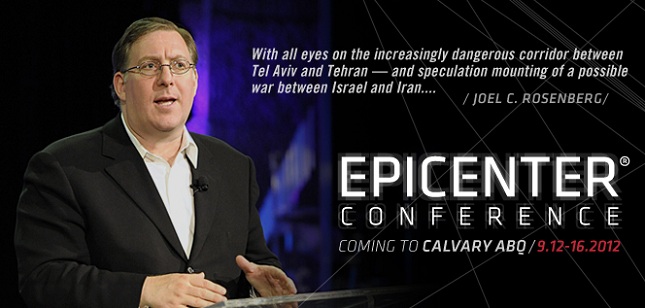
Thus the end times fiction and non-fiction author Joel Rosenberg, for instance, recently blogged a “sermon” in two posts [Rediscovering the power and purpose of Bible Prophecy: 1 and 2] about the importance of prophecy to an understanding of Middle Eastern affairs, noting:

Israel is the epicenter of God’s plan and purpose in the last days. Other countries mentioned in Bible prophecy are Russia, Iran, Syria, Lebanon, Turkey, Libya, Sudan, the revived Roman empire, and several others. The United States, however, is never mentioned directly or specifically in the Bible. In my recent book, Implosion, I go into this in greater detail. But the bottom line is that even though America is the wealthiest and most powerful nation on the face of the earth in the history of mankind, the Bible does not describe a specific role for us in the last days. Something, therefore, apparently happens to neutralize us or paralyze from played a key role in the events that lead to the return of Christ.

Despite this lack of emphasis on the Unites States, he followed these two posts up with a post titled Troubling development: rift between White House & Israel growing as threat of war rises:

In recent days, anyone watching U.S.-Israel relations has seen a very troubling development: the already serious rift between the current White House and Israel is growing. The relationship between President Obama and Prime Minister Netanyahu has been strained for nearly four years. But as the threat of war between Israel and Iran this fall continues to rise, the Obama administration seems to be intentionally signaling a growing distance from the Netanyahu government.

He doesn’t draw a direct link to prophecy in this particular post, but he does close with this prayer:

Please pray for the Lord to change the heart of President Obama and his advisors, and that they would change course and truly and publicly stand firmly with Israel, our most faithful ally in all of the epicenter. As we read in Genesis 12:1-3, God promises to bless those who bless Israel, and curse those who curse Israel. With America facing a growing risk of economic and moral implosion, now is certainly not the time to turn our backs on Israel.

**

As usual, my interest is in nuance — so I’d just like to say that from a purely Biblical point of view, it is by no means out of the question for believers to disagree with the kings and rulers of Israel. Indeed, Rav Moshe Taragin, writing in the Virtual Beit Midrash of Yeshivat Har Etzion, hardly a bastion of anti-Israeli sentiment, goes so far as to say:

In general, the function of the prophet is to rebuke the nation, to expose its negative traits and to help the people improve their behavior. As the Rambam teaches (Hilkhot Teshuva 4:2): “Thus, all the prophets rebuked Israel so that they would repent.”

Just because someone rebukes Israel doesn’t mean they don’t bless her…

**

I addressed a question to my Christian friends on Twitter the other day, using the Iraq war as my example — but it applies to the current face-off between Israel and Iran, too:

If you and I disagree on, say, the Iraq war now, will one of us have to change his or her mind in heaven?

I added that my question was not about the Iraq war as such, but about our certainties when so many of our certainties differ.

My friend Mike Sellers responded with this admirable quote — which as he pointed out is often attributed to St Augustine (for more on its origins, try Wikipedia):

In things necessary, unity, in things doubtful, liberty, in all things, charity.

Rhetoric, intent — logistics — and who went first?

Monday, August 27th, 2012

[ by Charles Cameron — when religious leaders talk of wiping nations off the map ]
.

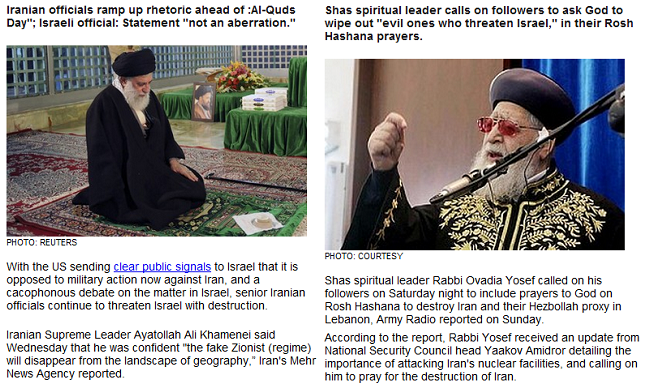
-Two bearded religious figures face of with what seems like parallel but opposite rhetoric:

______________________________________________________________________________________________

______________________________________________________________________________________________

The Ayatollah Khamenei, left, is the Supreme Jurisprudent of Iran — not merely a senior cleric but Iran’s final authority. Rabbi Ovaida Yosef, right, is the leader of the Shas movement in Israel and a cleric who swings enough power that Prime Ninister Netanyahu consults him and Foreign Minister Avigdor Lieberman, briefs him — an influence, then, something akin to an eminence grise perhaps, but by no means the final authority.

You may, loathe one of them you may loathe both of them: I doubt there are many people who admire both. But I’m not here to stir your animosities, I’m here to see what we can learn from comparing and contrasting them by catching them in similar circumstances. Perhaps it will make their differences stand out in high relief — perhaps it will reinforce their similarities.

The two men are both religious clerics, both political players, both getting on in years, both grey-bearded — and both seem to be comfortable using the same rhetoric at this point.

My aim here is to learn from this juxtaposition.

*

So I have two sorts of questions that I’d like to explore here, calmly and with appropriate documentation if you please…

One sort of question probes the differences in position and pouvoir of the two men:

Who has the higher position? Whose side has the most potent weapons? Whose side started this — or is that a moot question?

The second sort is subtler, since it has to do with motives hidden in the hearts and minds of men — and with the differences that sometimes exist between between rhetoric and intent.

Is is an entire people, or simply a regime that they would like to see an end to?

Is either one of them bluffing?

And of course my own favorite: is either one of them, the rabbi or the ayatollah, saying what he’s saying because of an “end times” (Messianic or Mahdist) expectation?

**

Hitler‘s rhetoric in Mein Kampf was pretty clear, and the actions of his Dritte Reich did not belie his rhetoric. Considerable planning was involved, there was documentation.

What, beyond rhetoric, do we know about Israeli planning to take down the Iranian nuclear program? What, beyond rhetoric, do we know about Iranian planing to respond to an Israeli strike — or to defeat and destroy Israel more generally?

Do the logistics back the rhetoric up?

What happens when the word “fire” is itself a match? What happens in an echo chamber, in a hall of mirrors?

The Shariah twins and other ads

Sunday, August 26th, 2012

[ by Charles Cameron — attempting the unbiased exploration of nuance in often low-nuance discourses ]
.

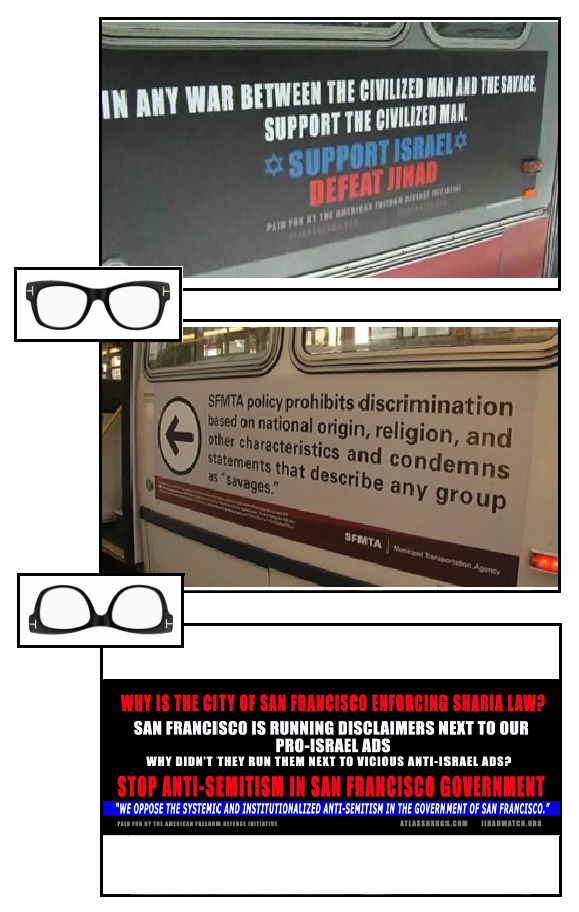
As usual, billboards, pamplets and ads on the sides of buses are worth watching. Let’s start with the Shariah twins:

The similarities are pretty obvious — what are the differences?

Well, the upper one was put up first, while the lower one was a response to it — that’s one difference, and it accounts for the similarities. Another difference has to do with the URLs each of them provides for further inquiry:

http://www.defendingreligiousfreedom.org
http://www.defendingreligiousfreedom.us

Again, the second is a response to the first and mimics its URL, although it switches automagically to http://freedomdefense.typepad.com/leave-islam/ when you click through. And “defending religious freedom” is clearly a double-sided coin…

The actual situation is neither that “Islam is a religion of Peace” nor that “Islam is a religion of War” — I would suggest it is that Islam is a religion that believes in opposing injustice in the name of peace, for the sake of eventual peace. In this regard, Islam is not unique.

Islam also has adherents who would like to see the entire world under Islam’s banner. In this again, Islam is not unique. Islam has given the world great poetry, history, architecture, philosophy, music, mathematics, science. Again, Islam is not unique in this. In one of my own fields of special interest, social entrepreneurship, Islam has given use Muhammad Yunnus and the Grameen Bank… The Islamic world also includes many religious leaders who espouse virulent anti-Semitism. In short…

Islam as expressed for better or worse in a vast diversity of human lives and situations neither renders each and every adherent an angel nor a beast. God may be perfect, but Muslims are only human. In this again, Muslims are not unique.

**

Let’s turn from religion to patriotism:

According to the lower image, the Tea Party is not the enemy. That’s fine by me — I have friends who are Tea Party stalwarts. According to the upper image, which was put up by a local Tea Party related organization using the Tea Party name, the sitting President of the US is the equivalent of Hitler and Stalin. And if they weren’t seen as enemies by the US, I don’t know what the Second World War and Cold War were all about…

So let’s just say that when Obama‘s death camps pass the five million mark in Jews, gypsies, homosexuals, poets, Christians or whoever killed, I will no longer think the comparison a trifle overheated. To put it mildly.

But hey, I have a question for the Oath Keepers among our readership.

If you are supposed to fire on the enemy, and the illustration in your ad specifically features British red-coats, but you’re not allowed to fire on American citizens, and Col. Kevin Benson, who wrote the disputed article in Small Wars Journal, is an American citizen whom you consider a “red-coat” — are you supposed to shoot him? Please note, I also have friends who are SWJ stalwarts.

What about droning Anwar al-Awlaki? I suppose these paradoxes of double identity all belong in the same category as Bertrand Russell‘s celebrated paradox of the Spanish barber:

There was once a barber. Some say that he lived in Seville. Wherever he lived, all of the men in this town either shaved themselves or were shaved by the barber. And the barber only shaved the men who did not shave themselves.

All of which is fine, until you begin to wonder, as Russell did, whether the barber shaves himself?

**

Back to religion (jihad) — or are we still on politics (Israel)? — for a quick look at the San Francisco Muni advertising discourse, which has now reached the point where I need to amend my usual two panel format:

Pamela Geller paid for the first ad, which encourages US support for Israel, okay, but also seems to call some group or other “savages” — we’re not quite sure who that group consists of since she doesn’t specify it — but she could plausibly be meaning all Palestinian suicide bombers, all Palestinians, all Arabs, all Muslims, even perhaps all those who support Israel… we just don’t know.

Given the amount of hatred floating around on the Israeli-Palestinian issue, I’d suggest the ad is indeed inflammatory, and that the Muni — who didn’t think they could refuse it under applicable US law — was acting appropriately if somewhat surprisingly in posting its own ad in response, seen here in the middle panel.

Now Geller has announced her intention to respond to the Muni’s ad with one of her own, seen here in the third panel — and all eyes will be on Muni if and when she does — to see if they will continue the back and forth.

**

The world is the cinema. There actually are people setting fires in several parts of the cinema, and others whose words could be the sparks that ignite yet more fires. Some of the fire-setters have names like Ajmal Kasab and Osama bin Laden, some like Timothy McVeigh or Anders Breivik, some like Vellupillai Prabhakaran. The theater is crowded, and some people are yelling “fire”…

Furthermore, there’s a difference between panic and precaution.

Yiddish humor, US Presidential Election

Friday, August 24th, 2012

[ by Charles Cameron — Jewish Democrats suggest humorous barbs for Jewish Republicans to digest ]
.

As those who follow my strand of posts her on Zenpundit know by now, I’m not a great one for taking sides: I imagine very few bridge builders are, and my real interest is in building bridges.

I am also, in general, interested in the ephemeral signals that go on between and within opposing camps — because they’ll often portray a different side of things from what’s in the official pronouncements.

What I’m offering here, then, is a fleeting glimpse into some Jewish humor from the Democratic side of things:


.
— two “curses” from the from the Yiddish Curses for Republican Jews website.

As wry humor, I’m okay with these. As embittered humor, not so much.

And I don’t know the people who posted these “curses” — though I’m reasonably sure they didn’t intend them as actual, may G*d do this to you and I mean it, curses.

Frankly, I’m interested in the religious content.

**

I’m interested in the jokes.

I’m interested in the leaflets, the comments in the comment sections of websites — and in the winks, the nudges and the nods.

I’m interested in the differences between “in-house” and “external” explanations of things, what the differences may actually mean, and what they may get interpreted to mean. I’m interested in the asides, the sneers and smears, the jokes, the ambiguous threats, the real hatreds, the moments of reflection, the metanoias, changes of heart, repentances.

At times, the materials I run across are threatening, at times witty or droll, at times insightful, and at times completely unhinged from reality, but they usually have something to teach us about undercurrents — about the variousness of human thoughts and feelings.

We humans are a strange lot, each one of us so singular that we have a hard time getting our heads around the differences between us — differences that can make all the difference between peace and war, life and death.

**

I’m not going to explain the jokes, but I am going to take just a quick look at their religious content.

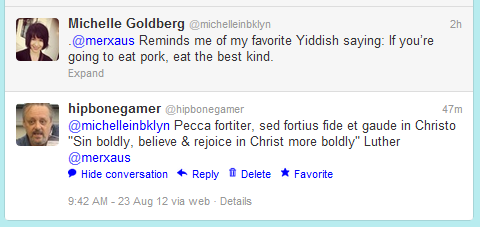
One of the qualities that is, IMO, most likeable about Jewish culture is that it delights in self-mockery. The New York Times journalist Michelle Goldberg tweeted a Jewish joke yesterday, to which I responded with a quote from Martin Luther:

Now I don’t know about Michelle, but I didn’t intend my quote from Luther — “sin boldly” — as representing either my personal advice to the world at large, or Luther’s, except perhaps in a very limited sense such as the one Dietrich Bonhoeffer offered as his explanation of Luther’s meaning.

Bonhoeffer’s question is the obvious one:

Is this the proclamation of cheap grace, naked and unashamed, the carte blanche for sin, the end of all discipleship? Is this a blasphemous encouragement to sin boldly and rely on grace? Is there a more diabolical abuse of grace than to sin and rely on the grace which God has given?

And his response?

Take courage and confess your sin, says Luther, do no try to run away from it, but believe more boldly still. You are a sinner, so be a sinner, and don’t try to become what you are not. Yes, and become a sinner again and again every day, and be bold about it. But to whom can such words be addressed, except to those who from the bottom of their hearts make a daily renunciation of sin and of every barrier which hinders them from following Christ, but who nevertheless are troubled by their daily faithlessness of sin? Who can hear these words without endangering his faith but he who hears their consolation as a renewed summons to follow Christ? Interpreted in this way, these words of Luther become a testimony to the costliness of grace, the only genuine kind of grace there is.

**

So no, I don’t think all religiously-themed tweeting and web-based cursing is to be taken literally.

But I do find it interesting that Michelle jokes about kosher, and I joke about sinning boldly — and that the Yiddish humor displayed on the “curses” website includes references to the LDS practice of proxy baptism for the dead and an indication that it might be uncomfortable for those with strong anti-Muslim feelings to meet the generous hospitality that so often characterizes Muslim cultures.

So let’s dig into those two themes in a little more depth.

**

Official Latter-day Saints doctrine teaches:

Jesus Christ taught that baptism is essential to the salvation of all who have lived on earth (see John 3:5). Many people, however, have died without being baptized. Others were baptized without proper authority. Because God is merciful, He has prepared a way for all people to receive the blessings of baptism. By performing proxy baptisms in behalf of those who have died, Church members offer these blessings to deceased ancestors. Individuals can then choose to accept or reject what has been done in their behalf.

And while the practice of baptizing the dead by proxy may seem strange to most Christians, the Latter-day Saints can point to I Corinthians 15.29:

Else what shall they do which are baptized for the dead, if the dead rise not at all? why are they then baptized for the dead?

and I Peter 4.6 for precedent:

For for this cause was the gospel preached also to them that are dead, that they might be judged according to men in the flesh, but live according to God in the spirit.

Maybe so — but Saints Peter and Paul, though Jewish by birth, are now generally reckoned Christians, having accepted the belief that Jesus was the awaited Jewish Messiah, the Christ — so their epistles are not canonical texts for mainstream Judaism.

**

Feelings in the Jewish community can run pretty strongly on the issue of Mormon believers’ baptisms of Jewish believing dead:

The wrongful baptism of Jewish dead, which disparages the memory of a deceased person is a brazen act which will obscure the historical record for future generations. It has been bitterly opposed by many Jews for a number of years. Others say they will never stop being Jews, simply because there is a paper saying they had been baptized, that the act of posthumous baptism is unimportant and should be ignored. We think this to be a narrow, parochial, and shallow view. We will continue opposing this wrongful act which assimilates our dead to the point where it will not be possible to know who was Jewish in their lifetimes.

[ … ]

A protest drive initiated by Jewish genealogists escalated it to a nationally publicized issue that was followed by public outcry. American Jewish leaders considered it an insult and a major setback for interfaith relations. They initiated discussions with the Mormon Church that culminated in a voluntary 1995 agreement by the Church to remove the inappropriate names. Activists continue to monitor Mormon baptismal lists, seeking removal of inappropriate entries.

Indeed, in February of this year it was discovered that the Holocaust victim Anne Frank had been baptized by proxy — for what one researcher said was the ninth time.

The Nobel laureate Elie Wiesel responded with passionate anger, and the Mormon Church with an apolpogy and a firm statement that the practice was prohibited.

LDS spokesman Michael Purdy made it clear that the Church “is absolutely firm in its commitment to not accept the names of Holocaust victims for proxy baptism.”

There are serious issues here: as humans, we can listen to one another with respect, and work them out.

**

Palestinian Muslim hospitality towards Jews?

Miftah is an Ethiopian who visited some Palestinian shepherds in company with people sympathetic to the Palestinian cause:T

he group I went with was a mostly Israeli – international activists’ group that accompanies shepherds in the village as they graze their herds. Since these shepherds face attacks from settlers and soldiers frequently, the purpose of the trip was to document and confront the settlers or soldiers if they try to harass the shepherds.

These were people the Palestinians had reason to respect, Israelis and foreign activists sympathetic to their cause — but the degree of hospitality they were shown nicely illustrates the innate courtesy of so many pastoral peoples…

As we were heading back from the hills to where our mini-van was, these shepherds we had met offered to take us home for some tea and coffee. Mind you, it’s the Ramadan fasting season and all of them were fasting. They would offer us water, coffee and bread even though the last meal they had was at dawn that morning and would not have any food or water until dusk that evening. In Ramadan, even people who don’t fast don’t eat in public or in front of people who fast. But out of true hospitality, they extended their “‘Mitzvah’ – their act of kindness” to us, as one of the Israeli activists put it

**

The story is an old one: the person of few possessions who will kill one of their handful of sheep to feed the passing stranger…

In this second “curse” we glimpse the long tradition of hospitality to strangers without which the great trade routes of the ancient would would not have permitted China to supply Europe with silks, nor Roman jewelry to have found its way into Japanese tombs


Switch to our mobile site