Formats for civil online debate I – inspired by the Talmud
Monday, August 15th, 2011[ by Charles Cameron — hypertext, rhetoric, Talmud, civility ]
.
I have been thinking quite a bit recently about formats for online debate, and posted a comment on Jean Goodwin‘s blog yesterday, in which I commented on the Talmudic page (see R Eliezar Segal‘s excellent hypertext version for an explanation of how it works). It’s a topic that has interested me since before the turn of the millennium, and one I’ve discussed and prototyped a bit in some of Howard Rheingold‘s class forums.
Yesterday in my comment on JG’s blog, I said:
My guiding principle here is that devising suitable forms may well elevate the content poured into them…
I said this because, in my view, constraint facilitates excellence.
*
Part of the key here is captured very nicely in this quote from Jean Toomer:
In this multiple simultaneous world words only dole out one thing at a time.
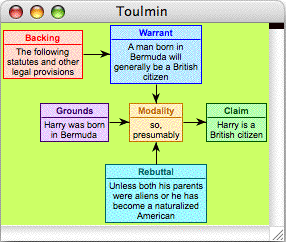
So we need polyphony, we need forms that capture many voices, many points of view, the perspectives of many stakeholders, simultaneously — not a linear progression from premise to conclusion. And since we’re talking argumentation here, this simultaneity can be captured in a graphical form, as in this diagram based on Toulmin:
*
In that spirit, I thought I’d post a couple of my own experimental formats. The first is based fairly closely on the Talmudic page — and I put it together in March of this year, so things in Libya have moved along a bit since then, though not quite enough as yet:
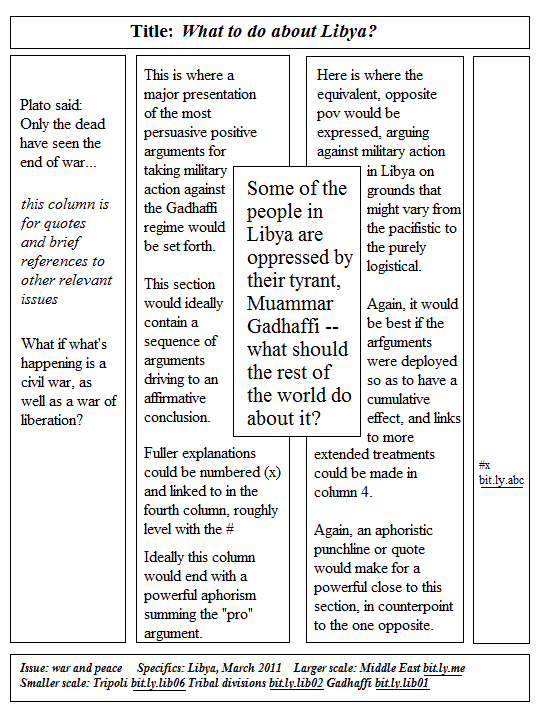
My second format is a variant on the “Dart Board” sometimes used for playing my HipBone Games (see, for instance, my solo game War is Sexy, says Dawn).
I shall present it in a follow up post of its own.
*
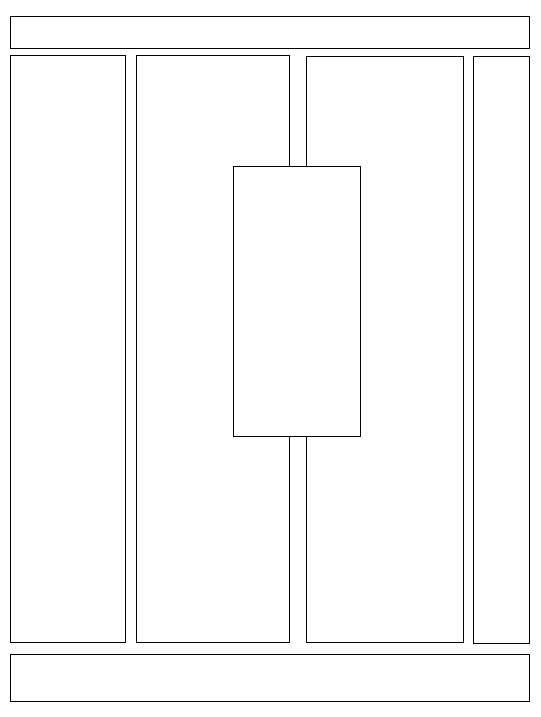
For your convenience, here’s a blank template for the kind of Talmudic debate-page I used above, available for download. It can be filled with any graphical software that allows text and a choice of fonts & sizes. I recommend using larger type for the main text, medium for the commentary, and small print for annotations and footnotes: