zenpundit.com » scriptures

Archive for the ‘scriptures’ Category

The symmetry: Charlie Hebdo

Saturday, September 22nd, 2012

[ by Charles Cameron — my apologies for an earlier incomplete draft, quickly withdrawn — first of two, on loose cannonry and mirror imagery — second will deal with recent events in Benghazi ]
.

.

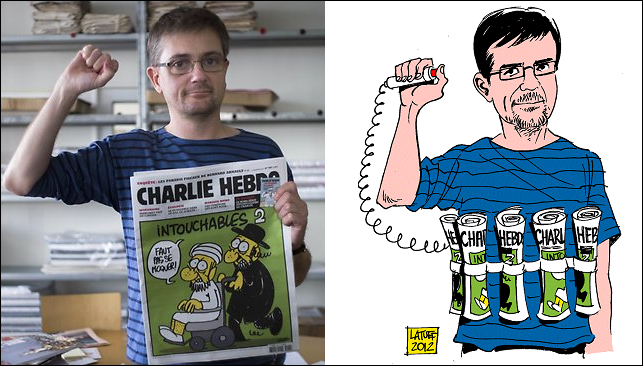
Charlie Hebdo recently published some cartoons featuring the prophet…

Okay, I’m always on about symmetry.

I posted a piece titled Messianic symmetries on ZP a while back, noting that both Ahmadinejad and Netanyahu can be viewed as exercising “leadership that makes decisions out of messianic feelings” — the quote comes from an unimpressed ex-Shin Beth director describing Bibi; Ahmadinejad makes the case for his own Mahdist leabings quite well himself.

Symmetry seems like an important analytic category to me, either because it’s there in the build of the world, or because it’s there in the build of the mind. Either way, I think we should take careful notice of symmetries.

Asymmetries I’ll talk about in my next post.

**

What about the cartoon above, right? It’s clearly based on the photo above, left, which shows Stéphane Charbonnier, the editor of Charlie Hebdo, holding his magazine with its offensive cartoons / vindication of free speech. And the suggestion is clear that he’s some kind of suicide bomber.

But who is he blowing up, exactly? Himself, and perhaps his staff and anyone else who happens to be within a few yards of his office at the time? France, Europe, the western world — the world itself? And how much irony should we read into the cartoon portrait?

They may have learned the technique from the Tamil Tigers, but these days, in the immediate wake of widespread rioting over the video clip and in the context of someone publishing cartoons that satirize the prophet, it’s clearly Islamist suicide bombers who provide the model for the cartoon of the cartoonist above.

Tit for tat? An eye for an eye? You’re just setting yourself up for a fatwa like Salman Rushdie?

**

Incendiary rhetoric on one side leads to incendiary behavior on the other, validating the incendiary rhetoric and making the escalation to incendiary behavior all the more probable.

Some of the incendiary rhetoric has its origin in holy books, which also preach peace.

There are Coptic Christians utterly blindsided by the virulence of the video, attributed to one of their number. There are Libyan Muslims utterly blindsided by the virulence of the attack on the US Embassy, attributed to some of their own.

**

I want to focus not on the specifics of the topic, but on the symmetry.

One writer, observing the partition of India and Pakistan, wrote:

The rioters brought the train to a stop. Those who belonged to the other religion were methodically picked out and slaughtered. After it was all over, those who remained were treated to a feast of milk, custard pies and fresh fruit.

Before the train moved off, the leader of the assassins made a small farewell speech: “Dear brothers and sisters, since we were not sure about the time of your train’s arrival, regretfully we were not able to offer you anything better than this most modest hospitality. We would have liked to have done more.”

Commenting on this paragraph, Ali Sethi wrote recently in the New Yorker:

That is all there is: murder—methodical and quick—followed by a feast and an ingratiating speech. Note the withholding of tags: we don’t know the location of the massacre or the religion of the killers. All we have is a spurt of base instincts.

The point here is that whenever you see a symmetry of opposites, it’s worth considering that symmetry in the abstract, as well as weighing the particular issues that drive your own side or the other.

That, I’d suggest, is one of the implications of that Paul van Riper remark I’m fond of quoting:

What we tend to do is look toward the enemy. We’re only looking one way: from us to them. But the good commanders take two other views. They mentally move forward and look back to themselves. They look from the enemy back to the friendly, and they try to imagine how the enemy might attack them. The third is to get a bird’s-eye view, a top-down view, where you take the whole scene in. The amateur looks one way; the professional looks at least three different ways.

**

I am concerned about hatred, simmering here, boiling over there. I am concerned about what sparks hatred, and what fans it. What I want to draw your attention to here, though, is the process by which one hatred fuels abother, the process of mirror imaging.

Mark Juergensmeyer, a terrific scholar of religion who has published on topics ranging from Gandhi‘s nonviolence to the violence of religionists who consider themselves sanctioned by the scriptures of various religions, makes the point in a recent Religion Dispatches post thus:

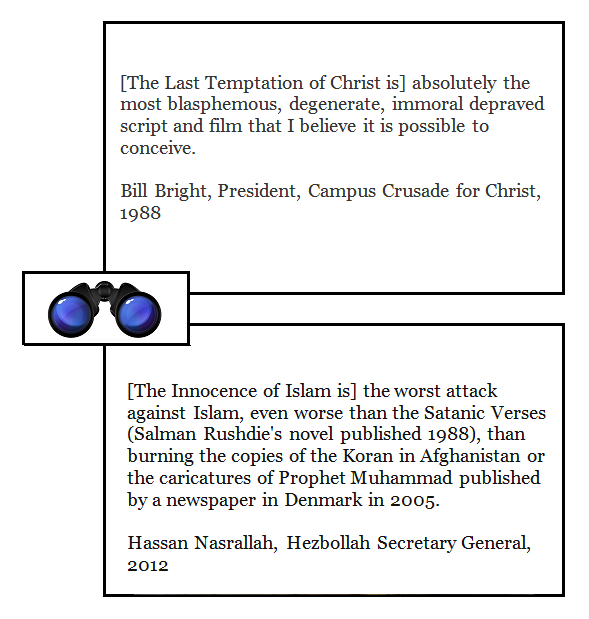
The US-based Islamophobes behind the insulting and amateurish video “The Innocence of Muslims,” and those behind the violent protests it allegedly caused around the Muslim world, are kindred hatemongers. Both are extremists with a political agenda, and both want to use this incident to discredit the legitimacy of the moderate governments in power in their respective countries. There is a symbiotic relationship between the strident protesters and the bigoted filmmakers; each needs the other.

We are in a hall of incendiary mirrors, with plenty of kindling: in my view, we should avoid playing with matches.

**

Thank God, there are also asymmetries.

In a companion post, I’ll take a look at recent, very promising events in Benghazi (h/t to Pundita for a pointer to this particular article), the not particularly unsurprising but unwelcome attitude of a Pakistani minister, and the imbalances that go along with the dangerous balances I’ve discussed in this post.

**

Oh, and let me digress…

I won the Divinity essay prize back in my schooldays at Wellington College, and received my chosen prize book, the Liber Usualis with its glorious collection of Gregorian Chants, from the then Minister of Defence, John Profumo, MP. Not long thereafter, it was discovered that he pillow talked with one Christine Keeler, a night lady of class, who also pillow talked with the Russian defence attaché. And the story was broken, week by glorious week, by the British satirical magazine, Private Eye.

Which I consequently have an affection for, after all these years. And I tell you this, because Charlie Hebdo, or Weekly Chuck as we might call it over here is, I’d suggest, a plausible latter-day French rough equivalent of Private Eye.

I don’t really like our guys posting inflammatory materials, you see, but I also have an affection for freedom of speech — and for magazines with a satirical bite, too…

So sue me, I contain multitudes.

Of films, riots and hatred III: Scorsese and Verhoeven

Monday, September 17th, 2012

[ by Charles Cameron — The Last Temptation of Christ troubles, an early warning re the upcoming Jesus of Nazareth movie — the blood libel and more ]
.

American and European Christians, too, can react violently to films they perceive as blasphemous, and this too we should remember as we weigh our own responses to the rioting in Cairo and elsewhere.

Martin Scorsese‘s Last Temptation of Christ gives us a sense of how modern American and European Christians can react to perceived blasphemy, while the forthcoming Paul Verhoeven movie of his own book Jesus of Nazareth will test the degree to which we’ve learned the lessons of a quarter century ago — and of this last week.


.

**

Martin Scorsese’s The Last Temptation of Christ: stirred strong feelings when it opened. I was in LA at the time, and was following the controversy fairly closely having attended an early screening, and having both literary and theological interests.

The short video clip below is a little choppy, it doesn’t make it particularly clear that the clips you see are from the film Martin Scorsese made of a novel — written by the Nobel laureate Nikos Kazantzakis — which makes no attempt nor pretense to be a historical or religiously orthodox portrayal of Christ. IMO, it is worth watching for the glimpse it gives of just how strong the undercurrents of emotion aroused by Scorsese’s film were at the time:

**

I’m bringing this subject up and attending to it in some detail because NBC World News mentioned Martin Scorsese’s movie on the 13th of this month, in an explanation as to Why films and cartoons of Muhammad spark violence, but without gwetting the picture quite right:

Director Martin Scorsese’s adaptation of a book by the same name showed Jesus struggling with lust, depression and doubt, and engaging in sex — in his imaginings — before snapping back to reality and dying on the cross. That movie was seen as blasphemy by some Christians, who — though not violent — were vocal enough to prevent the film from being shown in many parts of the United States.

There may have been no violence done to humans in the US — but there as certainly damage to property, and some vicious threats made, as The Encyclopedia of Religion and Film records:

At the Cineplex Odeon Showcase Theater in New York City, vandals slashed seats and spray-painted threats aimed at the chairman of MCA: “Lew Wasserman: If you release ‘The Last Temptation of Christ,’ we will wait years and decimate all Universal property. This message is for your insurance company.”

In parts of Europe, the violence was more intense:

Overseas, at the September 28 opening in Paris, demonstrators who had gathered for a prayer vigil threw tear gas canisters at the theater’s entrance. Catholic clergy led rock-throwing and fire-bombing assaults on theaters in many French municipalities. A thousand rioters in Athens trashed the Opera cinema, ripping apart the screen and destroying the projection equipment.

In Paris, specifically, the violence severely injured some human targets. From Wikipedia (with their footnotes removed — you can track the various quotes from the original page):

On October 22, 1988, a French Christian fundamentalist group launched Molotov cocktails inside the Parisian Saint Michel movie theater while it was showing the film. This attack injured thirteen people, four of whom were severely burned. The Saint Michel theater was heavily damaged, and reopened 3 years later after restoration. Following the attack, a representative of the film’s distributor, United International Pictures, said, “The opponents of the film have largely won. They have massacred the film’s success, and they have scared the public.” Jack Lang, France’s Minister of Culture, went to the St.-Michel theater after the fire, and said, “Freedom of speech is threatened, and we must not be intimidated by such acts.”

The Catholic response — from the Cardinal Archbishop of Paris among others — reproved both the blasphemy and the rioting:

The Archbishop of Paris, Jean-Marie Cardinal Lustiger, said “One doesn’t have the right to shock the sensibilities of millions of people for whom Jesus is more important than their father or mother.” After the fire he condemned the attack, saying, “You don’t behave as Christians but as enemies of Christ. From the Christian point of view, one doesn’t defend Christ with arms. Christ himself forbade it.” The leader of Christian Solidarity, a Roman Catholic group that had promised to stop the film from being shown, said, “We will not hesitate to go to prison if it is necessary.”

There was apparently a connection with French far-right politics, too:

The attack was subsequently blamed on a Christian fundamentalist group linked to Bernard Antony, a representative of the far-right National Front to the European Parliament in Strasbourg, and the excommunicated followers of Archbishop Marcel Lefebvre. Lefebvre had been excommunicated from the Catholic Church on July 2, 1988. Similar attacks against theatres included graffiti, setting off tear-gas canisters and stink bombs, and assaulting filmgoers.

There were legal proceedings following the Saint Michel incident, and it’s notable that Fr. Gérard Calvet OSB, founder and Prior of the Benedictine Abbaye Sainte-Madeleine du Barroux, testified at the tribunal on behalf of the convicted youths, describing their motives if not their mode of expression as “noble”. Would that term be equally applicable to protesters of blasphemies against other faiths? We now live in a dense-packed world where such comparisons are easily made.

Let’s pause for a minute over the twinned remarks of the late (and widely respected) Cardinal Lustiger concerning Last Temptation

Jean-Marie Cardinal Lustiger, said “One doesn’t have the right to shock the sensibilities of millions of people for whom Jesus is more important than their father or mother.” After the fire he condemned the attack, saying, “You don’t behave as Christians but as enemies of Christ. From the Christian point of view, one doesn’t defend Christ with arms. Christ himself forbade it.”

and compare the remarks of a similarly authoritative religious figure in Libya to the Innocence of Muslims video:

Libya’s Grand Mufti, Sheikh Sadeq Al-Ghariani, has issued a fatwa condemning Tuesday’s killing of US Ambassador Chris Stevens along with three other American diplomatic staff and a number of Libya security guards. He said those involved were criminals who were damned by their action.

He also condemned the production of any film, picture or article insulting the Prophet Mohammad or any of the prophets by “extreme fanatics” in the US or elsewhere. The Prophet Muhammad, Ghariani said, had specifically forbidden the killing of ambassadors and envoys.

**

Almost a quarter century has passed since Scorsese’s movie opened, but as I said above, we will soon have an opportunity to show what we have learned from those lamentable events in Paris and the more recent tragedies in Benghazi, Cairo and elsewhere.

Paul Verhoeven — the director of such blockbusters as RoboCop, the original Total Recall, and Basic Instinct — has raised the financing for his upcoming movie Jesus of Nazareth, based on his book of the same name, and scripted by Roger Avary, who shared an Oscar with Quentin Tarrentino for their Pulp Fiction screenplay.

Verhoeven, be it noted, is not only a writer and movie director, but also a member of the Jesus Seminar — a group of scholars which, as Wikipedia nicely puts it, “treats the canonical gospels as historical sources that represent Jesus’ actual words and deeds as well as elaborations of the early Christian community and of the gospel authors” and prepares color-coded editions of the gospels suggesting which sayings of Jesus should be considered original, and which are better understood as later additions.

Here, to give you an idea of what may be on the horizon, is an excerpt from a quick and informal take on the upcoming movie by an admirer of Verhoeven:

Deadline reports that the legendary Paul Verhoeven — a guy who, amazingly, only directed three movies in the past fifteen years — has received financing to adapt his own book, Jesus of Nazareth, which discounts every mythical story surrounding Christ and, instead, opts to present him as a simple human figure with a message powerful enough to radiate throughout time. Roger Avary (Tarantino‘s story partner on Pulp Fiction) will write the film, while Muse Productions are doing the proper backing.

Almost any work going against the long-held Biblical grain will get groups up in arms — no, I don’t even need to provide examples — but the claims of Nazareth are, even in this context, still mighty contentious. Most notable is the idea that Jesus is not the son of God, but was actually the product of Mary being raped by a Roman soldier; so, right off the bat, you’re discounting the entire foundation of his story.

I am pointing this out because right now would be a good time for the various churches to begin a general conversation about the film-maker’s right to hold an opinion, write a book and make a movie, the hurt that may be felt by believers, and the importance of responding without hatred or violence when offended.

**

In our concern with matters of Christian and Muslim issues, let us not lose sight of the fact that Jews too have movies made about them that may not only hurt feelings but also represent real threats against them, reminiscent of Nazi and earlier Russian antisemitic propaganda fabrications.

From the copious “blood libel” entry in Wikipedia:

In 2003 a private Syrian film company created a 29-part television series Ash-Shatat (“The Diaspora”). This series originally aired in Lebanon in late 2003 and was broadcast by Al-Manar, a satellite television network owned by Hezbollah. This TV series, based on the antisemitic forgery The Protocols of the Learned Elders of Zion, shows the Jewish people as engaging in a conspiracy to rule the world, and presents Jews as people who murder Christian children, drain their blood and use this blood to bake matzah.

MEMRI has a report with further details, and a MEMRI clip of the scene in which a Christian child is killed by Jews has been posted on YouTube, with the comment:

Al-Shatat: Jews Murder A Christian Child and Use His Blood for Passover Matzos. anti Semite Arab propaganda against Jews, Judaism and Israel.

The following is a scene from the Syrian-produced TV series Al-Shatat. Al-Shatat was first aired on Hizbullah’s Al-Manar TV during the month of Ramadan 2003, and then on two Iranian channels during Ramadan 2004. Al-Mamnou’ TV, a new Jordanian channel, is airing Al-Shatat during Ramadan 2005.

It is worth recalling, too, that Mel Gibson‘s film, The Passion of the Christ, was perceived by many Jews, Christians and others as anti-Semitic — and that nonetheless the Orthodox Jew and conservative movie critic Michael Medved wrote:

The possibility of anti-Jewish violence in response to the film has been irresponsibly emphasized and has become, self-fulfilling prophecy. In parts of Europe and the Islamic world, anti-Semitic vandalism and violence occur daily, and hardly need a film by a Hollywood superstar to encourage them. In this context, Jewish denunciations of the movie only increase the likelihood that those who hate us will seize on the movie as an excuse for more of hatred.

**

I trust it is not too late to wish our Jewish readers l’shana tova: may your apples be dipped in honey and all our days bathed in peace.

Of films, riots and hatred I: Benedict XVI in Lebanon

Sunday, September 16th, 2012

[ by Charles Cameron — where to begin? let’s start with peace ]
.

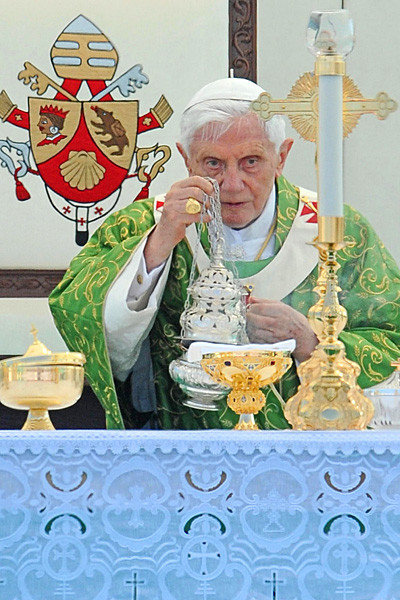
Photo credit: Ciro Fusco, EPA

.

Pope Benedict XVI has been in the Lebanon these last three days, and after an extremely turbulent week in which many discordant religious and / or “religious” notes have been sounded, I thought I’d begin what I imagine will be a series of posts from my POV on the mayhem with some words of peace (Heb: Shalom; Ar: Salaam) from the Pontiff, seen above celebrating an open air mass on the Beirut beachfront.

**

The Pope was in the Lebanon to sign a Catholic document of some significance, the Apostolic Exhortation Ecclesia in Medio Oriente, and it is from that document that I would like to extract some specific paragraphs:

Here’s the kernel of the situation as the Pope sees it, going into it —

How many deaths have there been, how many lives ravaged by human blindness, how many occasions of fear and humiliation! … How sad it is to see this blessed land suffer in its children who relentlessly tear one another to pieces and die!

— grief at human folly.

**

Benedict then begins to address the situation, offering us his definition of peace:

For the sacred Scriptures, peace is not simply a pact or a treaty which ensures a tranquil life, nor can its definition be reduced to the mere absence of war. According to its Hebrew etymology, peace means being complete and intact, restored to wholeness. It is the state of those who live in harmony with God and with themselves, with others and with nature.

Since we are not yet in harmony with each other…

Authentic witness calls for acknowledgment and respect for others, a willingness to dialogue in truth, patience as an expression of love, the simplicity and humility proper to those who realize that they are sinners in the sight of God and their neighbour, a capacity for forgiveness, reconciliation and purification of memory, at both the personal and communal levels.

He observes that such a dialogue should be theologically oriented rather than politically driven:

The Church’s universal nature and vocation require that she engage in dialogue with the members of other religions. In the Middle East this dialogue is based on the spiritual and historical bonds uniting Christians to Jews and Muslims. It is a dialogue which is not primarily dictated by pragmatic political or social considerations, but by underlying theological concerns which have to do with faith.

This dialogue can be grounded in in the one God common to the Abrahamic faiths:

Jews, Christians and Muslims alike believe in one God, the Creator of all men and women. May Jews, Christians and Muslims rediscover one of God’s desires, that of the unity and harmony of the human family. May Jews, Christians and Muslims find in other believers brothers and sisters to be respected and loved, and in this way, beginning in their own lands, give the beautiful witness of serenity and concord between the children of Abraham.

It will demand humility rather than triumphalism:

The truth cannot unfold except in an otherness open to God, who wishes to reveal his own otherness in and through my human brothers and sisters. Hence it is not fitting to state in an exclusive way: “I possess the truth”. The truth is not possessed by anyone; it is always a gift which calls us to undertake a journey of ever closer assimilation to truth. Truth can only be known and experienced in freedom; for this reason we cannot impose truth on others; truth is disclosed only in an encounter of love.

I imagine that some will find here an echo of the Qur’an:

Let there be no compulsion in religion.

— Quran 2. 256

Thus far the pope has expressed his grief at the circumstances, and outlined the basic issues between religions. He now turns his analysis to the situation within the religions:

Like the rest of the world, the Middle East is experiencing two opposing trends: secularization, with its occasionally extreme consequences, and a violent fundamentalism claiming to be based on religion.

Benedict is well know for his opposition to the “occasionally extreme consequences” of secularism: here he speaks in favor of what he terms “healthy secularity”.

Some Middle Eastern political and religious leaders, whatever their community, tend to look with suspicion upon secularity (laïcité) as something intrinsically atheistic or immoral. It is true that secularity sometimes reduces religion to a purely private concern, seeing personal or family worship as unrelated to daily life, ethics or one’s relationships with others. In its extreme and ideological form, secularity becomes a secularism which denies citizens the right openly to express their religion and claims that only the State can legislate on the public form which religion may take. [ … ]

A healthy secularity, on the other hand, frees religion from the encumbrance of politics, and allows politics to be enriched by the contribution of religion, while maintaining the necessary distance, clear distinction and indispensable collaboration between the two spheres.

Religious fundamentalism is the second challenge the Pope addresses:

Economic and political instability, a readiness on the part of some to manipulate others, and a defective understanding of religion help open the door to religious fundamentalism. This phenomenon afflicts all religious communities, and denies their long-standing tradition of coexistence. It wants to gain power, at times violently, over individual consciences, and over religion itself, for political reasons.

Here he addresses his colleagues in religious leadership:

I appeal urgently to all Jewish, Christian and Muslim religious leaders in the region to seek, by their example and by their teaching, to do everything in their power to eliminate this menace which indiscriminately and fatally affects believers of all religions.

He then drives the point home by quoting his own words on an earlier occasion:

“To use the revealed word, the Sacred Scriptures or the name of God to justify our interests, our easy and convenient policies or our violence, is a very grave fault.”

**

That’s the substance of the Pope’s message in the context of recent disturbances in the region. There were a couple of notes he touched on, however, that interested me not for any connection with recent events, but for specific theological connotations:

Growth by individuals in the life of faith and spiritual renewal within the Catholic Church will lead to the fullness of the life of grace and theosis (divinization).

Theosis is a term more commonly found among Eastern Christians, and I wouldn’t want to define the doctrine in words, though I’ll suggest that its spirit is captured in the English mystic Thomas Traherne‘s magnificent meditation [Century I. 29]:

You never enjoy the world aright, till the Sea itself floweth in your veins, till you are clothed with the heavens, and crowned with the stars: and perceive yourself to be the sole heir of the whole world, and more than so, because men are in it who are every one sole heirs as well as you. Till you can sing and rejoice and delight in God, as misers do in gold, and Kings in sceptres, you never enjoy the world.

One of Benedict’s comments specifically addresses an issue of importance as Christianity and Islam find common ground in the Middle East:

In those unfortunate instances where litigation takes place between men and women, especially regarding marital questions, the woman’s voice must also be heard and taken into account with a respect equal to that shown towards the man, in order to put an end to certain injustices.

He gives an account of the Catholic doctrine of scriptural interpretation, which will be of interest to those concerned with such things in specifically Catholic, more generally Christian or comparative contexts:

The representatives of the various schools of textual interpretation were agreed on the traditional principles of exegesis accepted by the Churches of both East and West. The most important of these principles is the conviction that Jesus Christ incarnates the intrinsic unity of the two Testaments and consequently the unity of God’s saving plan in history (cf. Mt 5:17). The disciples would only come to understand this unity after the resurrection, once Jesus had been glorified (cf. Jn 12:16). A second principle is fidelity to a typological reading of the Bible, whereby certain Old Testament events are seen as a prefiguration (a type and figure) of realities in the new Covenant in Jesus Christ, who is thus the hermeneutical key to the entire Bible (cf. 1 Cor 15:22, 45-47; Heb 8:6-7). The Church’s liturgical and spiritual writings bear witness to the continued validity of these two principles of interpretation, which shape the ecclesial celebration of the word of God and inspire Christian witness. The Second Vatican Council went on to explain that the correct meaning of the sacred texts is found by considering the content and unity of the whole of Scripture, in the light of the living Tradition of the whole Church and the analogy of faith.

He also addressed the question of liturgical renewal, in a similar spirit, both orthodox (little o) and catholic (little c):

Such a renewal must of course be undertaken, to the extent possible, in cooperation with those Churches which are not in full communion, yet are also heirs to the same liturgical traditions. The desired liturgical renewal must be based on the word of God, on the proper tradition of each Church, and upon the new insights of Christian theology and anthropology.

As an aside — anthropology is an interesting word to have made its way into that statement. I must admit I am not sure whether he’s in any way suggesting something along the lines of “cultural anthropology” — which has a fair amount to say about ritual and how it functions — but I’m pretty sure his main meaning here is something closer to the original meaning of the word — along the lines of the “sound understanding of man” that he’d mentioned in an earlier passage in the Exhortation.

One passage suggested to me that Benedict might be alluding to the Muslim terminology of the Companions of the Prophet, and suggesting some measure of similarity with the disciples of Christ:

By rediscovering its original inspiration and following in the footsteps of those first disciples whom Jesus chose to be his companions and whom he sent out to preach (cf. Mk 3:14), the Christian presence will take on new vitality.

I’m hoping that will prove to be a deft touch, a tiny but significant gesture of friendship.

**

Finally, Pope Benedict makes another reference which must have resonated with his Eastern Catholic and Orthodox co-religionists, returning to the grief with which he began his orations, appealing to Mary as Theotókos, “the one who gives birth to the one who is God”:

The heart of Mary, Theotókos and Mother of the Church, was pierced (cf. Lk 2:34-35) on account of the “contradiction” brought by her divine Son, that is to say, because of the opposition and hostility to his mission of light which Christ himself had to face, and which the Church, his mystical Body, continues to experience. May Mary, whom the whole Church, in East and West alike, venerates with affection, grant us her maternal assistance. Mary All-Holy, who walked in our midst, will once again present our needs to her divine Son. She offers us her Son. Let us listen to her, for she opens our hearts to hope: “Do whatever he tells you” (Jn 2:5).

In so doing, he remembers also, and reminds us all, of those who are martyred for their Christianity in a world where religion can so often be your excuse to kill, or another’s excuse to kill you.

When the rivers run red

Sunday, September 9th, 2012

[ by Charles Cameron — science and / or apocalypse, quirky, not analytic ]
.

The upper image of this par shows the Yangtze River recently, as reported by the Daily Telegraph under the delightful header, Red China:

I got it from Scence, Space & Robots, which commented:

NDTV reports that Chongqing’s Environmental Protect Bureau is blaming sand for the color change in the river. They claim flooding upstream washed sand downstream which turned the river red.

Okay, so as anyone who has stirred watercolors with their fingers knows, water can be all kinds of colors…

But what it it’s the apocalypse?

That was one possible conclusion Live Science found whehn they asked people about the red color of a lake in Texas (lower image):

The color has some apocalypse believers suggesting that OC Fisher is an early sign of the end of the world, but Texas Parks and Wildlife Inland Fisheries officials say the bloody look is the result of Chromatiaceae bacteria, which thrive in oxygen-deprived water.

So — when you see red water, do you think “aha! daub time” or “ooh, chromatiaceae” — or “OMG, it’s the end, it must be”?

**

Do you prefer to get your explanations for curious events from science, or from religion?

As Caitlin Fitz Gerald — who has an impressive acquaintance with watercolors as the artist behind the Clausewitz for Kids project — kindly tweeted:

John the Revelator puts it this way, in Revelation 16.4:

And the third angel poured out his vial upon the rivers and fountains of waters; and they became blood.

Even the Onion mentions the streets running red, though out of concern for good taste, I won’t quote…

Elvis, Bach, and their respective Bibles

Monday, September 3rd, 2012

[ by Charles Cameron — two books their owners have underlined and scribbled in, a practice I generally detest, and the issue of what music is suitable for worship ]
.

From the Omega Auctions catalogue of the Presley Collection:

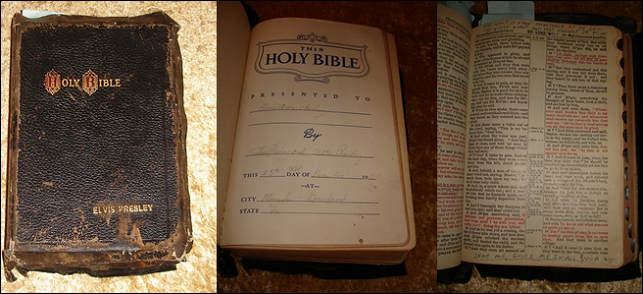
Elvis Owned Holy Bible given to him in 1957 on his first Christmas at Graceland (estimate £20,000 – £25,000).

Elvis Presley’s personally owned and used Holy Bible 1957-1977 with Elvis’ handwriting, annotations and underlining throughout. This was Elvis Presley’s most precious book throughout his life from Christmas 1957 to that final day on 16th August 1977 and he read and wrote in this Holy Bible over many years. This sixteen hundred page bible with Elvis Presley and Holy Bible, embossed in gold on a leather cover was given to Elvis by his uncle Vester and Aunt Clettes Presley as a Christmas gift on December 25th, 1957 at Graceland. The bible contains Elvis’ personal annotations throughout its fragile pages. This bible was published by. The John A. Hertel Co., Chicago, IL ©1941.

I’d say that would be a steal at the price!

The auction starts at 3pm GMT on Saturday 8th September 2012 at Meadow Mill, Water St, Stockport, SK1 2BX, UK, but there are viewings on Friday 7th September from 11.00am – 6.00pm and on Saturday 8th September from 8.30am – 10.30am.

**

Tell you what I’d prefer myself, though — and I would’t even want to own it — just to know it’s there in the Concordia Seminary Library:

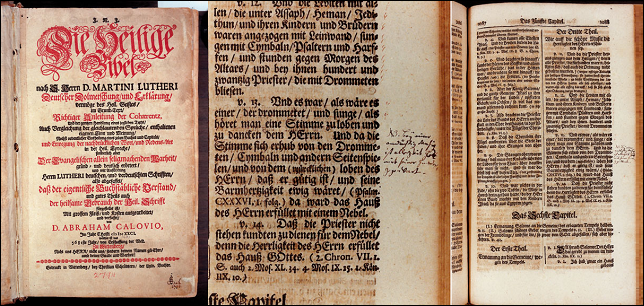
Images of Bach's Calov Bible Commentary courtesy of the Library at Concordia Seminary, St. Louis.

The 3-volume Bible commentary compiled by 17th-century Lutheran theologian, Abraham Calov, and once in the library of Johann Sebastian Bach has been in the Seminary Library collection since it was given to the Seminary by the Reichle family of Frankenmuth, MI, in the 1930s. The volumes are the only known, i.e., identified, books from the library of J. S. Bach. Calov is both editor and author of the commentary, using as he does both Martin Luther’s translation of the Bible and primarily Luther’s comments on the text, adding his own commentary when no material was available in Luther’s works. The work was printed in 1681-82. Some 25 marginal annotations of Bach, along with underlining and other marginal markings, are evidence of the composer’s use of the volumes. Careful analysis of the handwriting, as well as technical analysis of the ink done in the 1980s, established the authenticity of Bach’s ownership.

**

Is that your final choice?

That is my final choice.

**

Really what I’m getting at, though, is something that those two books can stand for: the debate now proceeding in the Catholic Church — and in Evangelical and Pentecostal Churches too — as to what kind of music is to be performed in the course of worship. The “battle lines” tend to be drawn between music that is intended to draw in the young, and music that is felt to be well-suited to the sacred.

Pope Benedict XVI is a strong proponent of the Western musical tradition:

An authentic updating of sacred music can take place only in the lineage of the great tradition of the past, of Gregorian Chant and Sacred Polyphony.

More personally, Benedict is an admirer of Mozart, whose music he plays daily on the piano — and of JS Bach, about whom he once said:

The encounter with the beautiful can become the wound of the arrow that strikes the heart and in this way opens our eyes, so that later, from this experience, we take the criteria for judgment and can correctly evaluate the arguments.

For me an unforgettable experience was the Bach concert that Leonard Bernstein conducted in Munich after the sudden death of Karl Richter. I was sitting next to the Lutheran Bishop Hanselmann. When the last note of one of the great Thomas-Kantor-Cantatas triumphantly faded away, we looked at each other spontaneously and right then we said: “Anyone who has heard this, knows that the faith is true.”

The music had such an extraordinary force of reality that we realized, no longer by deduction, but by the impact on our hearts, that it could not have originated from nothingness, but could only have come to be through the power of the Truth that became real in the composer’s inspiration.

Blogs like the Chant Cafe and colloquia like those of the Church Music Association of America are introducing a new generation of worshipers to this tradition.

**

Interestingly, though, something of the same sort is also discernible in the writings of the Australian Pentecostal preacher and author named (perhaps coincidentally, maybe by grace) Barry Chant.

Here in the early 21st century, Chant wrote in “Retuning the Church”:

an unhealthy number of new songs focus more on rhythm and harmony than melody … Whereas a half century ago, Christians sang songs in which there were disciplined rhythms and rhymes, and both melody and lyrics followed an obvious orderly pattern, today’s rhythms are more likely to be disruptive and disjointed… ‘feeling’ is what matters. So the pulsating rhythms throb through our beings, the compelling beat makes our bodies respond and the intellectual or biblical content only needs to be sufficient to justify calling what we are singing ‘Christian’

But hey, this discussion goes back a while… Back in the mid fourth century CE, St Basil the Great wrote:

The passions born of illiberality and baseness of spirit are naturally occasioned by this sort of music. But we must pursue that other kind, which is better and leads to the better, and which, as they say, was used by David that author of sacred songs, to soothe the king in his madness. And it is said that Pythagoras, upon encountering some drunken revelers, commanded the aulete who was leading their song to change the mode and to play the Dorian for them. They were so sobered by this music that tearing off their garlands they returned home ashamed. Others dance to the aulos in the manner of the Corybantes and Baccantes. Such is the difference in filling one’s ears with wholesome or wicked tunes! And since the latter type now prevails, you must have less to do with it than any utterly depraved thing.

And yet hey, hey — L’homme armé was a pop song in France around the time of the Renaissance — yet composers from Josquin to Benedict’s beloved Palestrina based settings to the Mass on its tune…

**

The single piece of recorded music that I play most often for myself is Sara Mingardo‘s rendering of the recitative O selger Tag in rehearsal with John Eliot Gardiner, which is mercifully available on DVD.

On that same DVD, just after Mingardo has concluded her luminous performance, Gardiner quotes Bach as saying “Nota Bene: Bey einer andächtigen Musique ist allezeit Gott mit seiner Gnadengegenwart” — and then comments:

Now I find that very, very significant. That he’s saying wherever there is devotional music, God with his grace is present. Which, from a strict theological point of view is probably heresy, heretical, because it’s saying that music has an equivalent potency to the word of God. And I think that in essence is why Bach is so attractive to us today because he is saying that the very act of music-making and of coming together is, in a sense, an act which invokes the latency, the potency, the potentiality of God’s grace, however you like to define God’s grace; but of a benediction that comes even in a dreadful, overheated studio like Abbey Road where far too many microphones and much too much stuff here in the studio itself, but if one, as a musician, puts oneself in the right frame of mind, then God’s grace can actually come and direct and influence the way we perform his music.

Aaaaaaah….


Switch to our mobile site