zenpundit.com » sufi

Archive for the ‘sufi’ Category

The Sufism of Zen

Tuesday, November 20th, 2012

[ by Charles Cameron — double-quoting a remark taken from Zen’s most recent post with a Sufi teaching tale out of Idries Shah ]
.


.

Zen Zenpundit, Mark Safranski (above) that is — had a powerful comment about “the emaciated Somali followers of a two-bit warlord, Mohammed Farah Aidid, gleefully swarming over and looting our military’s former…. garbage dump” tucked away in his recent post on Strategy, Power and Diffusion:

When the enemy has a land so poor that he treasures and makes use of the crap you throw away, the economic spillover of your logistical supply lines will fund his war against you.

That’s a pretty profound statement about different levels of disparity, if you ponder it a bit. And worth pondering.

*

And it reminds me of Idries Shah‘s lovely story The Food of Paradise, in which a fellow named Yunus, son of Adam sets out to find the source, the original source, of food.

Sitting by a riverbank to consider the matter, he spies a package floating downstream, rescues it, and find that it contains a delicious halwa “composed of almond paste, rosewater, honey and nuts and other precious elements” – surely a gift of providence — which he then eats. The next day, at the same time, a second package appears – and each day thereafter he wades further upstream, in search of the miraculous giver, each day receiving and appreciating the gift.

In time he comes to an island with a high tower, from a high window of which a maiden is casting out, each day, the packaged halwa which is to him the food of paradise. After considerable efforts involving a mirror stone and an army of jinn, he manages to present himself to this princess, and asks her:

How, and by what order, is the Food of Paradise, the wonderful halwa which you throw down every day for me, ordained to be deposited thus?

to which she replies:

Yunus, son of Adam, the halwa, as you call it, I throw down each day because it is in fact the residue of the cosmetic materials with which I rub myself every day after my bath of asses’ milk.

**

You can read the whole tale with many others in Idries Shah’s Tales of the Dervishes, or here on the alhaddad blog.
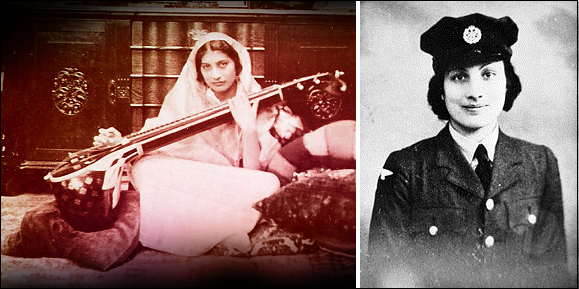

Noor Inayat Khan, GC

Saturday, November 10th, 2012

[ by Charles Cameron — east, west, music, espionage, pacifism, war, the Resistance, the Nazis, Dachau, and exceptional gallantry ]
.

A Muslim woman — born in Moscow of princely Indian paternal descent, her mother an American from Albuquerque, her father a great North Indian classical musician and Sufi master of pacifist leanings…
.


.

Noor Inayat Khan was a student of Western classical music in pre-War Paris under the great Nadia Boulanger, escaped the oncoming Nazis and made it across the channel to England, where she told a British officer during a recruitment interview that she would indeed support Indian independence from Britain after the war — but that defeating Hitler took precedence and she would gladly fight for the British…

She thus became the first female radio operator sent by the British Special Operations Executive into Nazi-occupied France, where she worked courageously as a vital link between the French Resistance and Churchill‘s London until she was finally betrayed, imprisoned, and finally executed by firing squad in Dachau.

After the war, the British awarded her the highest civilian award for bravery, the George Cross, and France the Croix de Guerre.

**

Yesterday’s Guardian reports:

On Thursday afternoon, in a corner of Bloomsbury, Princess Anne unveiled Britain’s first memorial to an Asian woman. The bust is of Noor Inayat Khan, a woman who was a pioneer in so many things: an Indian princess who was also a gifted harpist; a Sufi who wrote Buddhist fables for children; an anti-imperialist who spied for the British empire – and the first female radio operator sent into Nazi-occupied France.

Her Twenty Jataka Tales is available here.
Shrabani Basu‘s biography of Noor Inayat Khan is here.

I raise a virtual toast to Noor Inayat Khan.

**

h/t David Foster at Chicago Boyz.

Every Day is the Day of Something

Wednesday, August 29th, 2012

[ by Charles Cameron — days, months, years, Saints, Josaphat, Buddha, problems, issues, solutions — I think that about captures it all ]
.

Josaphat, the Bodhisattva Saint

.

Today is the International Day against Nuclear Tests — and since I don’t much like tearing open the fabric of the world I’m living in to witness and geiger-count the radiance it usually hides, I favor the idea. But the Day was already a Festival as far as I’m concerned: I woke up.

**

Look, there are International and National Days, Weeks, Months and Years — this month, for instance, in addition to Spinal Muscular Atrophy Awareness Month was also National Catfish Month. It was Don’t be a Bully Month and National Dirty Harry Month, quite a pair! It was also Never Leave a Child Unattended in a Car Purple Ribbon Month, National Water Quality Month – which needs to be Internationalized – and Win with Civility Month. And there are many more

See — we have enough issues to go around twenty-four slash seven slash three-sixty-five plus one on leap years…

That remarkable fellow Anthony Judge is largely responsible for the Union of international Association’s Encyclopedia of World Problems and Human Potential, which includes:

a World Problems database with 56,000+ entries and 276,000+ links
a Global Strategies and Solutions database with 32,000+ entries and 284,000 links
a Human Values database with 3,200+ entries and 119,000+ links
a Human Development database with 4,800+ entries and 19,000+ links, and
a Patterns and Metaphors database with 1,200+ entries and 4,500+ links.

**

So that’s how many problems we have, and how many solutions, and naturally we can offer prayers about the problems, and perhaps the prayers will be answered by the solutions, or with new ideas…

So it’s also not surprising that there are a vast number of saints who can intercede for us…

And since my birthday happens to fall on November 27, I have a special affection for St Josaphat, whose Feast Day that is.

He’s the fellow preaching in the panel at the top of this post, from a 12th Century Greek manuscript…

**

Josaphat’s story is recounted in Wikipedia:

According to the legend, King Abenner or Avenier in India persecuted the Christian Church in his realm, founded by the Apostle Thomas. When astrologers predicted that his own son would some day become a Christian, Abenner had the young prince Josaphat isolated from external contact. Despite the imprisonment, Josaphat met the hermit Saint Barlaam and converted to Christianity. Josaphat kept his faith even in the face of his father’s anger and persuasion. Eventually Abenner converted, turned over his throne to Josaphat, and retired to the desert to become a hermit. Josaphat himself later abdicated and went into seclusion with his old teacher Barlaam.

A fine tale it is, and curiously reminiscent of that of the young bodhisattva Siddhartha, who was to become known as the Buddha:

Siddhartha Gautama was also a prince whose birth was accompanied with a prophecy that he would become a great holy man but not a king. He was also protected from the outside world by his father but on leaving the palace he also recognised that the world was full of suffering. He sought to pursue an ascetic life and to reach enlightenment but during this process he was subjected to many attempts to deflect him from this path. He was tempted by the demon Mara who sent his three beautiful daughters, Tanha (desire), Raga (lust), and Arati (aversion) to try to seduce him while he sat meditating under a banyan tree. After resisting these temptations, the prince attained Buddhahood at the age of thirty five.

And yes, that would make an excellent DoubleQuote!

**

In fact, stories travel — and the Buddha we know became Josaphat as his story traveled from India via St John Damascene to the farthest west:

Bodhisattva in Sanskrit became rendered as Bodhisav in Persian, then as Budhasaf in Arabic, Iodasaph in Georgian, Ioasaph in Greek and then finally Josaphat in Western Europe

I used to collect books about the kindly teacher Barlaam and his student Saint Josaphat the Boddhisattva: most of them are now in storage, alas.

And you can now see how the Catholic in me feels warmly-disposed towards the Buddhist, while the Buddhist in me is on amicable terms with the Catholic.

**

And i haven’t even begun to talk about the Sufis yet…

On the martyrdom of al-Hallaj & the modeling of pocket universes

Monday, March 26th, 2012

[ by Charles Cameron — commemoration of al-Hallaj, sufi and martyr, the nature of circumambulation, matrioshka, modeling and mandalas ]
.

According to a report by Fahad Faruqui in today’s Huff Post, Mansur al-Hallaj was martyred on this day, March 26, 922 CE.

His offence is often said to have been that he declared “An al-Haqq” — I am the Truth — although many sufis would say that his egoic nafs had been erased in fana, and that it was al-Haqq that spoke through him, not a claim that he made of himself.

So today would be the day to leave a marker here on Zenpundit, saying that I hope to return in the not too distant with a post that ties al-Hallaj as described in Faruqui’s post with the circumambulation of Banaras, the circumambulation of an avatar of Vishnu Shiva and Parvati by Ganesh, and the modeling of what I sometimes refer to as “pocket universes”…

*

The particular aspect of Faruqui’s post that caught my attention was this:

Hallaj was not sentenced to death for uttering “ana’l-haqq.” After his arrest, he was accused of various things, but, according to Professor Ernst, he was pinned down after his prosecutors discovered a document in the handwriting of Hallaj that recommended that those who were unable to afford Hajj pilgrimage could construct a model of Kaaba at home and perform circumambulation (tawaf) and give alms to poor and feed some orphans and they would have completed the Hajj.

“At that point one of the judges turned to Hallaj and said in Arabic ‘damuka halal,’ that is, your blood may legally be shed. In other words, now we have you,” said Professor Ernst, a specialist in Islamic Studies. “But then Hallaj said that I found this in the writings of Hasan al-Basri, so that was a kind of technicality, but he was given no opportunity to explain or repent.”

*

I gratefully offer a hat-tip @ Sarah Schlesinger.

Darfur question… and wider Sufi ripples

Saturday, February 25th, 2012

[ by Charles Cameron — request for info, Darfur, Janjaweed, Sufis, Senegal and more ]

.

.

Dr John Esposito has a post up at HuffPo disputing Ayan Hirsi Ali‘s recent Newsweek piece, and one very small matter of phrasing raised a small cluster of questions for me …

*

My Questions:

Dr Esposito quotes Hirsi Ali as saying “What has often been described as a civil war is in practice the Sudanese government’s sustained persecution of religious minorities” and comments, “to say that Darfur is an example of the Muslim-Christian genocide is flat out wrong”.

My questions are not about Ali’s “Global War on Christians” or “Muslim-Christian genocide” but about the range of Muslim theological interests at play in the Darfur conflict.

Julie Flint, in Sudan, Darfur destroyed: ethnic cleansing by government and militia forces in Western Sudan, writes that “Almost all Darfurians belong to the Tijaniya sect of Sufi Islam that extends from Senegal to Sudan.”

And Robert Spencer writes that “Salafists target Muslims they regard as insufficiently Islamic also in Darfur, where Arab Muslims attack non-Arab Muslims whose Islam is closer to the cultural version that prevailed in Somalia than to Wahhabi austerity.”

So:

Is Spencer right about that? And is it therefore arguable that in additional to nomadic vs sedentary and Arab vs black African issues, there’s a sectarian (intra-Muslim) component to the conflict?

Further, is Darfur (inter alia) a front we should be monitoring in terms of a global Salafi vs Sufi struggle?

Who and what should I be following / reading?

*

All of which brings me to the wider issue of violence against Sufis (and for that matter, violent as well as peaceable Sufi responses) in (eg) Libya (Daveed GR today), the Punjab (Raza Rumi) and of course Senegal (see image of mosque in Touba above)…

All pointers welcome.


Switch to our mobile site