zenpundit.com » judaism

Archive for the ‘judaism’ Category

Joseph Smith and Kabbalah: Neibaur, Owens, Hamblin, Haaretz, Idel

Friday, October 5th, 2012

[ by Charles Cameron — controversy and scholarship re Joseph Smith’s King Follett Discourse and Kabbalah of considerable interest to students of comparative religion ]
.

A scholarly Jospeh Smith translating the Bible, and the title page of Portae Lucis, Augsburg, 1516

.

With Latter-day Saints more than a little in the news, Ha’aretz yesterday posted an article titled How kabbala shaped Mormon faith which you can also read here, and as it’s a topic I’ve been interested in for a while, I thought I’d point you to the article Lance Owens, a friend of a friend, wrote some years back, in which he describes the library of Alexander Neibaur, a Jewish convert to Mormonism and friend and Hebrew teacher to the Prophet, along with quite a bit of context.

There are two forms of Owens’ article on line, the original, quite long one [parts 1, 2, 3] and a shorter version [4] for those who’d like the details but not the details of the details.

I have to say that I find Owens’ work on Neibaur’s library, and the conclusion he draws about Joseph’s King Follett Discourse – one of the Prophet’s last sermons, and a fascinating work in its own right – pretty compelling.

**

The great magister of studies in Kabbalah Moshe Idel probably catches the situation well when he writes in his as yet untranslated book, The Angelic World: Apotheosis and Theophany (Olam Ha’malakhim):

See for now the controversial article by Owens, Joseph Smith and Kabbalah, pg. 117-194, which also contains a list of Kabbalistic sources which supposedly were in the library of Joseph Smith’s teacher. The connection between Enoch-Metatron in Jewish tradition and Mormonism was first noted by Harold Bloom, in his book The American Religion, pg. 99, 105. I can’t go into the details of the controversies created by Owens’ article and the doubts about Smith’s relationship to the Kabbalah. It seems that the matter of kabbalistic connections is more complicated and interesting than what can be learned from the currently published documents. (Pg. 156)

**

For a Mormon response to Owens’ article, and pending the comments our Mormon and other interested readers will hopefully provide, might I suggest William Hamblin‘s review of Owens’ piece, which indicates how seriously Hamblin takes the issues involved when it opens with these two sentences:

The Mormon History Association recently awarded Lance S. Owens’s “Joseph Smith and Kabbalah: The Occult Connection” its Best Article Award for 1995. With such an imprimatur the article deserves a closer critical evaluation than it has apparently heretofore received.

Hamblin’s review runs to 74 pages and 186 footnotes – together with Owens’ original 77 pages and 161 footnotes, that would make a book-sized volume of interesting reading. And as Moshe Idel notes, what we don’t know may be “more complicated and interesting” yet…

The cloak, mantle and authority of the Prophet

Sunday, September 30th, 2012

[ by Charles Cameron — the symbolic importance of Mullah Omar with the cloak of the Prophet, comparative, frankly long, and IMO worth it ]
.
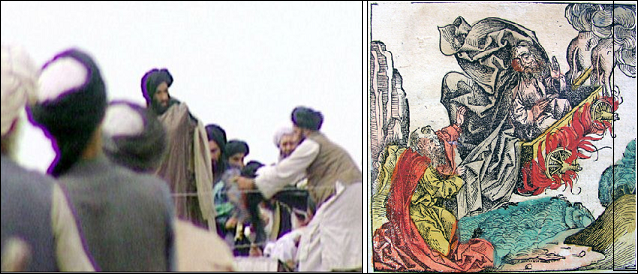
Mullah Omar in Kandahar; Elijah & Elisha from the Nuremberg Chronicle

.
I would like to give you a sense of the significance of an apparently insignificant detail, which I was reminded of today while skimming Charles Kurzman‘s The Missing Martyrs: Why There Are So Few Muslim Terrorists, page 74:

To gain legitimacy as he was taking over Afghanistan,Taliban leader Mulla Muhammad Umar literally wrapped himself in the cloak of the Prophet Muhammad, a cherished relic stored for two centuries at a shrine in Qandahar. He ordered the custodians to unlock the sanctuary, then stood on the roof of a nearby mosque and placed his hands in the cloth as a crowd of supporters chanted “Commander of the Faithful,” a title associated with the first caliphs to succeed the Prophet Muhammad.

To better grasp the significance of the situation, I will first quote from the Jewish and Buddhist scriptures to illuminate the symbolic power that can be vested — interesting word — in a cloak or robe.

**

John Daido Loori is a zen master in whose teishos or teachings I often find insight and delight. Here’s his description of the original transmission of “bowl and robe” in Buddhism, from the Buddha to his disciple Mahakashyapa:

After Buddha died, Ananda became the attendant of Mahakashyapa. One day he asked, “That time on Mount Gudhakutra, when the World-Honored One gave you the bowl and robe, and transmitted the Dharma to you, what else did he give you?” Mahakashyapa called out, “Ananda.” Ananda responded, “Yes, Master?” Mahakashyapa said, “Take down the flagpole.” At that point, Ananda finally had a realization. He realized what Mahakashyapa had realized. So it has been, down through successive generations, mind-to-mind for 2,500 years.

The Buddha’s teaching later passes from India into China, where the transmission continues. Here’s how Hui Neng, in the Platform Sutra, describes his own enlightenment and reception of the teachings:

At midnight the Fifth Patriarch called me into the hall and expounded the Diamond Sutra to me. Hearing it but once, I was immediately awakened, and that night I received the Dharma. None of the others knew anything about it. Then he transmitted to me the Dharma of Sudden Enlightenment and the robe, saying: ‘I make you the Sixth Patriarch. The robe is the proof and is to be handed down from generation to generation. My Dharma must be transmitted from mind to mind. You must make people awaken to themselves.’

**

There’s a remarkable story told in 2 Kings 2.8-15 that concerns the transmission of prophetic gifts by similar means, when the prophet Elijah is carried up into heaven:

And Elijah took his mantle, and wrapped it together, and smote the waters, and they were divided hither and thither, so that they two went over on dry ground. And it came to pass, when they were gone over, that Elijah said unto Elisha, Ask what I shall do for thee, before I be taken away from thee. And Elisha said, I pray thee, let a double portion of thy spirit be upon me. And he said, Thou hast asked a hard thing: nevertheless, if thou see me when I am taken from thee, it shall be so unto thee; but if not, it shall not be so.

And it came to pass, as they still went on, and talked, that, behold, there appeared a chariot of fire, and horses of fire, and parted them both asunder; and Elijah went up by a whirlwind into heaven. And Elisha saw it, and he cried, My father, my father, the chariot of Israel, and the horsemen thereof. And he saw him no more: and he took hold of his own clothes, and rent them in two pieces.

He took up also the mantle of Elijah that fell from him, and went back, and stood by the bank of Jordan; And he took the mantle of Elijah that fell from him, and smote the waters, and said, Where is the Lord God of Elijah? and when he also had smitten the waters, they parted hither and thither: and Elisha went over. And when the sons of the prophets which were to view at Jericho saw him, they said, The spirit of Elijah doth rest on Elisha. And they came to meet him, and bowed themselves to the ground before him.

The beauty, the power in this telling comes from the cloak’s ability to part the waters, as on an earlier occasion Moses‘ staff had done, not merely in the hands on Elijah, but also, once the transmission has been made, in the hands of Elisha. It is that double motif of the parting of the waters that demonstrates the efficacy of the prophetic transmission.

Coming fresh from the Buddha, Mahakashyapa, Hui Neng, Elijah and Elisha, we should be ready to appreciate that the mantle, cloak or robe of a sacred person is imbued with that person’s power — Matthew 14.36 describes crowds bringing the sick to Jesus:

that they might only touch the hem of his garment: and as many as touched were made perfectly whole.

**

In light of these examples, let us consider the reports of the day when Mullah Omar was proclaimed Amir of the Faithful:

There was a tremendous stir in Kandahar: we followed the crowds to a mosque in the city center. The Taliban had been holding an assembly of mullahs from all over Afghanistan. Now the results were about to be made public. Holy war was announced against the government of President Rabbani in Kabul. The head of the Taliban, Mullah Omar, was declared to be the Amir or leader of all Muslims everywhere. Because this was regarded as a key moment for the Afghan nation, Mullah Omar displayed the holy cloak of the Prophet Muhammad to the crowd. It’s kept in Kandahar and shown only in times of crisis. The last time was sixty years ago. Neither the cloak nor the ceremony has ever been filmed before, not has Mullah Omar. People in the crowd threw up their turbans to touch the cloak and be blessed by it. It was like being at some great religious ceremony in the Middle Ages.

That’s from the soundtrack of a video I sadly can’t post here, but which you can see for yourself on a BBC site under the title Mullah Omar reveals the Prophet’s cloak.

Adam Curtis, who posted the clip, describes it thus:

In the early 90s the students returned to Afghanistan and set up the Taliban – to cleanse the country of a revolution that had gone wrong, compromised by the futile idea of modernising Islam. And in April 1996 Mullah Omar went to the Shrine of the Holy Cloak. He took out the cloak for the first time in 60 years and waved it from the roof – just as Amanullah had in 1929 – and announced a jihad against the Islamist factions in Kabul.

The BBC producer Tom Giles and John Simpson were in Kandahar that day – and they captured this extraordinary moment on video.

When King Amanullah had held the cloak above his head in 1929 it symbolised the end of his dreams of creating a modern world in Afghanistan. Now – in 1996 – Omar was saying the same thing – forget the future, listen to the ghosts of your past – and follow their rules.

Let’s note in passing that Omar holds the cloak up — neither in the video clip nor in the two accounts is it suggested that he wore it — and that it had previously been held up by Amanullah Shah in 1929.

**

For the symbolic impact as reported in the West, let’s turn to Tim Weiner‘s piece, Seizing the Prophet’s Mantle: Muhammad Omar, in the NYT of December 7, 2001:

And as the country was falling to the Taliban five and a half years ago, Mullah Omar literally cloaked himself in the trappings of the Prophet Muhammad.

On April 4, 1996, as the Taliban neared total control, he was moved by zeal to unseal a shrine in Kandahar that held a cloak believed to have belonged to the prophet, the founder of Islam. The cloak had not been touched since some time in the 1930’s. He lifted it in the air as he stood on a rooftop, displaying it to a crowd of followers. The event was caught on videotape, one of the very few times that he was ever photographed. He placed the cloak, which only the Prophet was said to have worn, upon his own shoulders.

And at that moment, he declared himself the commander of the faithful, the leader of all Islam. No one had claimed that title since the Fourth Caliph, more than 1,000 years ago.

That’s impressive stuff, and “Seizing the Prophet’s Mantle” and “Omar literally cloaked himself in the trappings of the Prophet” do a decent job of capturing the marriage of literal and symbolic that’s at work here.

But “he placed the cloak … upon his own shoulders”? I’m not so sure.

**

It was a tremulous moment, evidently, even for Omar, as Norimitsu Onishi reported in the NYT a couple of weeks later on December 19, 2001, in A Tale of the Mullah and Muhammad’s Amazing Cloak:

The first time Mullah Muhammad Omar was allowed to enter the Shrine of the Cloak of the Prophet Muhammad here in Kandahar, and cast his gaze on the sacred ancient robe, he trembled. So disoriented was Mullah Omar that as he prepared to pray, he mistook the way toward Mecca.

“He turned to face toward the south,” recalled Qari Shawali, 48, the keeper of the prophet’s cloak. “So I made him change his position to turn toward Mecca.”

I suspect that here we have an indication that Omar was surprised by the event, that he was in fact acclaimed by the assembly of mullahs rather than claiming the robe and title for himself.

However, as the saying goes: Allah is the best of knowers.

**

Mujib Mashal‘s piece, The myth of Mullah Omar on al-Jazeera, 6 June 2012, gives us a few clues as to informed Afghan responses to the event, throwing in the detail that bin Laden was there at the time -– but also informing us that Omar “donned the cloak” and claiming this was the first time in 250 years that this had happened:

To formally announce his leadership in 1996, Mullah Omar, then 36 years old, brought forth the purported cloak of the Prophet Mohammed, one of Afghanistan’s most cherished Islamic relics. For the first time since the reign of Ahmad Shah Abdali more than 250 years before, Omar donned the cloak in the presence of about 1,500 religious leaders, including the late Osama bin Laden.

“Wearing the cloak was a masterstroke,” Sharifi said, adding that it linked the ex-guerrilla fighter to both Abdali and the Prophet. But Wahid Muzhda, an Afghan analyst and one-time high-ranking official in the Taliban foreign ministry, disputes that narrative. “From what I know, from sources close to Omar, and from a chat with the keeper of the shrine [where the cloak is kept], Omar did not wear the cloak.” “With great respect, he held the cloak in front of the religious leaders gathered for allegiance.”

This gesture, more than any other, was the impetus that allowed Mullah Omar, without any deep political or tribal base, to become the iron-fisted ruler of about 90 per cent of Afghanistan until the US invasion in 2001.

**

I know, you’re fatigued and I’m excited: bear with me, let’s hear the story of Ahmad Shah as told by Steve Inskeep on NPR in The Cloak of the Prophet some time in 2002:

According to the version of the legend that I heard, Ahmad Shah traveled to Bokhara — once one of the major centers of Islamic scholarship and culture, now a modern city in the former Soviet state of Uzbekistan . There he saw the sacred Cloak of the Prophet Mohammed, and decided to bring it home. He wanted Kandahar to have the artifact, so he asked to “borrow” the cloak from its keepers.

The keepers knew he might steal it, and told him he must not take the cloak from Bokhara. So Ahmad Shah pointed to a stone in the ground and made a promise. He said, “I will never take the cloak far away from this stone.”

Relieved, the keepers let him take the cloak. Ahmed Shah kept his word, in a sense. He had the stone taken up out of the ground, and had it carried back to Kandahar, along with the cloak, which he never returned. Today, the stone stands on a pedestal near the shrine.

The Cloak of the Prophet is normally hidden from public view. It is taken out only for special occasions. The last such occasion came in 1996, as the Taliban seized control of the country.

The Taliban leader, Mullah Omar, made what was considered a brilliant propaganda move. He took Mohammed’s shroud out of storage and wore it in a public rally, as a way to identify himself with the Prophet, and give himself legitimacy.

That’s an interesting tale in its own right, and reminds me of another Abrahamic treasure, the Stone of Scone, throned above which Scottish and British Kings and Queens are crowned. For your viewing delight: Stone of Destiny.

**

Fast forward to July 1928, a more recent moment when Afghanistan was in crisis.
Adam Curtis reports in The Weird World of Waziristan, 5 April 2010:

Amanullah fled to Kandahar. He knew that his attempt at modernization had failed and to save himself he tried to prove that in reality he was a traditional Islamic monarch. He did it in a final dramatic gesture.

Amanullah went to the Shrine of the Holy Cloak in the centre of Kandahar. He opened up the brass bound chest where the cloak which was reputed to have been the Prophet’s had lain for over a 100 years. Amanullah lifted it above his head and demanded of the mullahs in front of him whether Allah would allow a heretic or an apostate to perform such a sacred act.

**

And so to our most serious analytic effort on the topic, and a couple of indicators of the point I’m so often trying to make, here and in other posts on ZP. Here are Thomas H. Johnson and M. Chris Mason, writing in Terrorism, Insurgency, and Afghanistan as published by the Naval Postgraduate School, where both of them work in the Program for Culture & Conflict Studies:

Omar joined this rogues gallery of politicized insurgent Mullahs by means of a politico-religious stunt that is of enormous importance to the Taliban movement but that is considered insignificant by most Western analysts, if they are aware of it at all. In doing so, he became the epitome of the charismatic leader as described by Max Weber, who he defined as having:

… a certain quality of an individual personality, by virtue of which he is set apart from ordinary men and treated as endowed with supernatural, superhuman, or at least specifically exceptional powers or qualities. These are such as are not accessible to the ordinary person, but are regarded as of divine origin or as exemplary, and on the basis of them the individual concerned is treated as a leader.

The event in question was Omar’s removal in 1994 of a sacred garment -— believed by many Afghans to be the original cloak worn by the Prophet Mohammed -– from its sanctuary in Kandahar, and actually wearing it while standing atop a mosque in the city. Whereas Omar had been a nonentity before this piece of religious theatre, the audacious stunt catapulted him to a level of mystical power (at least among the 90 percent of Pahstuns who are illiterate) in a manner that is almost impossible for Westerners to understand, and it resulted in his being proclaimed locally the Amir-ul Momineen, the Leader of the Faithful — not just of the Afghans but of all Muslims.

I would draw your particular attention to this phrase:

a politico-religious stunt that is of enormous importance to the Taliban movement but that is considered insignificant by most Western analysts, if they are aware of it at all.

Why? Why do we continually overlook such indications of the depth of feeling that animates the Taliban? Perhaps another analogy, from closer to home, will help us here.

I’m not sure that I’d call the exposition of the Shroud of Turin a “piece of religious theatre” or an “audacious stunt” — even if Pope Benedict, famously concerned at the secularization of Europe, visited it and remarked both on the Shroud as an icon of the death and burial of Christ, and of our era’s participation in the “death of God” “after the two World Wars, the lagers and the gulags, Hiroshima and Nagasaki”:

Jesus remained in the tomb until dawn of the day after the Sabbath and the Turin Shroud presents to us an image of how his body lay in the tomb during that period which was chronologically brief (about a day and a half), but immense, infinite in its value and in its significance.

You may regard the Son of God and the Prophet of Allah as similar figures or utterly different: but to understand the emotions roused by Mullah Omar’s gesture, these correspondences drawn from other religious traditions may provide a useful place to start.

**

As for myself, I have a poet’s reverence for symbols, but I recognize that it is what they symbolize that is important — and so I’ll close as I began, with the Buddhist robe and bowl and another delighful teisho from Abbot Loori:

Ming was chasing after Hui-neng, determined to retrieve the bowl and robe of Bodhidharma from him. Finally, when he caught up to Hui-neng, the Sixth Ancestor put down the robe and bowl and said, “This robe was given to me on faith. How can it be fought for by force? I leave it for you to take it.” Ming tried to pick up the robe and bowl but couldn’t—they were as heavy as a mountain. He fell to his knees, trembling, and said, “I come for the teachings, not the robe. Please teach me, oh lay brother.” Completely open, completely receptive, completely ready, he was a man teetering on the brink of realization. Immediately, the Sixth Ancestor struck. “Think neither good nor evil,” he said. “At that very moment, what is the true self of monastic Ming?”

Of films, riots and hatred III: Scorsese and Verhoeven

Monday, September 17th, 2012

[ by Charles Cameron — The Last Temptation of Christ troubles, an early warning re the upcoming Jesus of Nazareth movie — the blood libel and more ]
.

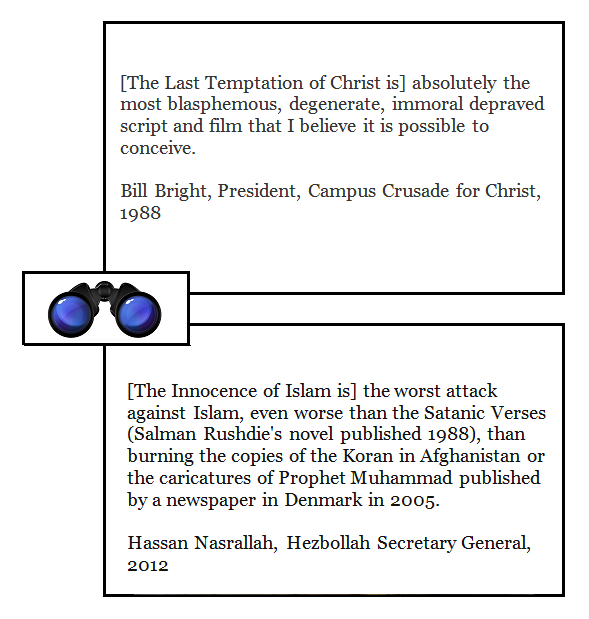
American and European Christians, too, can react violently to films they perceive as blasphemous, and this too we should remember as we weigh our own responses to the rioting in Cairo and elsewhere.

Martin Scorsese‘s Last Temptation of Christ gives us a sense of how modern American and European Christians can react to perceived blasphemy, while the forthcoming Paul Verhoeven movie of his own book Jesus of Nazareth will test the degree to which we’ve learned the lessons of a quarter century ago — and of this last week.


.

**

Martin Scorsese’s The Last Temptation of Christ: stirred strong feelings when it opened. I was in LA at the time, and was following the controversy fairly closely having attended an early screening, and having both literary and theological interests.

The short video clip below is a little choppy, it doesn’t make it particularly clear that the clips you see are from the film Martin Scorsese made of a novel — written by the Nobel laureate Nikos Kazantzakis — which makes no attempt nor pretense to be a historical or religiously orthodox portrayal of Christ. IMO, it is worth watching for the glimpse it gives of just how strong the undercurrents of emotion aroused by Scorsese’s film were at the time:

**

I’m bringing this subject up and attending to it in some detail because NBC World News mentioned Martin Scorsese’s movie on the 13th of this month, in an explanation as to Why films and cartoons of Muhammad spark violence, but without gwetting the picture quite right:

Director Martin Scorsese’s adaptation of a book by the same name showed Jesus struggling with lust, depression and doubt, and engaging in sex — in his imaginings — before snapping back to reality and dying on the cross. That movie was seen as blasphemy by some Christians, who — though not violent — were vocal enough to prevent the film from being shown in many parts of the United States.

There may have been no violence done to humans in the US — but there as certainly damage to property, and some vicious threats made, as The Encyclopedia of Religion and Film records:

At the Cineplex Odeon Showcase Theater in New York City, vandals slashed seats and spray-painted threats aimed at the chairman of MCA: “Lew Wasserman: If you release ‘The Last Temptation of Christ,’ we will wait years and decimate all Universal property. This message is for your insurance company.”

In parts of Europe, the violence was more intense:

Overseas, at the September 28 opening in Paris, demonstrators who had gathered for a prayer vigil threw tear gas canisters at the theater’s entrance. Catholic clergy led rock-throwing and fire-bombing assaults on theaters in many French municipalities. A thousand rioters in Athens trashed the Opera cinema, ripping apart the screen and destroying the projection equipment.

In Paris, specifically, the violence severely injured some human targets. From Wikipedia (with their footnotes removed — you can track the various quotes from the original page):

On October 22, 1988, a French Christian fundamentalist group launched Molotov cocktails inside the Parisian Saint Michel movie theater while it was showing the film. This attack injured thirteen people, four of whom were severely burned. The Saint Michel theater was heavily damaged, and reopened 3 years later after restoration. Following the attack, a representative of the film’s distributor, United International Pictures, said, “The opponents of the film have largely won. They have massacred the film’s success, and they have scared the public.” Jack Lang, France’s Minister of Culture, went to the St.-Michel theater after the fire, and said, “Freedom of speech is threatened, and we must not be intimidated by such acts.”

The Catholic response — from the Cardinal Archbishop of Paris among others — reproved both the blasphemy and the rioting:

The Archbishop of Paris, Jean-Marie Cardinal Lustiger, said “One doesn’t have the right to shock the sensibilities of millions of people for whom Jesus is more important than their father or mother.” After the fire he condemned the attack, saying, “You don’t behave as Christians but as enemies of Christ. From the Christian point of view, one doesn’t defend Christ with arms. Christ himself forbade it.” The leader of Christian Solidarity, a Roman Catholic group that had promised to stop the film from being shown, said, “We will not hesitate to go to prison if it is necessary.”

There was apparently a connection with French far-right politics, too:

The attack was subsequently blamed on a Christian fundamentalist group linked to Bernard Antony, a representative of the far-right National Front to the European Parliament in Strasbourg, and the excommunicated followers of Archbishop Marcel Lefebvre. Lefebvre had been excommunicated from the Catholic Church on July 2, 1988. Similar attacks against theatres included graffiti, setting off tear-gas canisters and stink bombs, and assaulting filmgoers.

There were legal proceedings following the Saint Michel incident, and it’s notable that Fr. Gérard Calvet OSB, founder and Prior of the Benedictine Abbaye Sainte-Madeleine du Barroux, testified at the tribunal on behalf of the convicted youths, describing their motives if not their mode of expression as “noble”. Would that term be equally applicable to protesters of blasphemies against other faiths? We now live in a dense-packed world where such comparisons are easily made.

Let’s pause for a minute over the twinned remarks of the late (and widely respected) Cardinal Lustiger concerning Last Temptation

Jean-Marie Cardinal Lustiger, said “One doesn’t have the right to shock the sensibilities of millions of people for whom Jesus is more important than their father or mother.” After the fire he condemned the attack, saying, “You don’t behave as Christians but as enemies of Christ. From the Christian point of view, one doesn’t defend Christ with arms. Christ himself forbade it.”

and compare the remarks of a similarly authoritative religious figure in Libya to the Innocence of Muslims video:

Libya’s Grand Mufti, Sheikh Sadeq Al-Ghariani, has issued a fatwa condemning Tuesday’s killing of US Ambassador Chris Stevens along with three other American diplomatic staff and a number of Libya security guards. He said those involved were criminals who were damned by their action.

He also condemned the production of any film, picture or article insulting the Prophet Mohammad or any of the prophets by “extreme fanatics” in the US or elsewhere. The Prophet Muhammad, Ghariani said, had specifically forbidden the killing of ambassadors and envoys.

**

Almost a quarter century has passed since Scorsese’s movie opened, but as I said above, we will soon have an opportunity to show what we have learned from those lamentable events in Paris and the more recent tragedies in Benghazi, Cairo and elsewhere.

Paul Verhoeven — the director of such blockbusters as RoboCop, the original Total Recall, and Basic Instinct — has raised the financing for his upcoming movie Jesus of Nazareth, based on his book of the same name, and scripted by Roger Avary, who shared an Oscar with Quentin Tarrentino for their Pulp Fiction screenplay.

Verhoeven, be it noted, is not only a writer and movie director, but also a member of the Jesus Seminar — a group of scholars which, as Wikipedia nicely puts it, “treats the canonical gospels as historical sources that represent Jesus’ actual words and deeds as well as elaborations of the early Christian community and of the gospel authors” and prepares color-coded editions of the gospels suggesting which sayings of Jesus should be considered original, and which are better understood as later additions.

Here, to give you an idea of what may be on the horizon, is an excerpt from a quick and informal take on the upcoming movie by an admirer of Verhoeven:

Deadline reports that the legendary Paul Verhoeven — a guy who, amazingly, only directed three movies in the past fifteen years — has received financing to adapt his own book, Jesus of Nazareth, which discounts every mythical story surrounding Christ and, instead, opts to present him as a simple human figure with a message powerful enough to radiate throughout time. Roger Avary (Tarantino‘s story partner on Pulp Fiction) will write the film, while Muse Productions are doing the proper backing.

Almost any work going against the long-held Biblical grain will get groups up in arms — no, I don’t even need to provide examples — but the claims of Nazareth are, even in this context, still mighty contentious. Most notable is the idea that Jesus is not the son of God, but was actually the product of Mary being raped by a Roman soldier; so, right off the bat, you’re discounting the entire foundation of his story.

I am pointing this out because right now would be a good time for the various churches to begin a general conversation about the film-maker’s right to hold an opinion, write a book and make a movie, the hurt that may be felt by believers, and the importance of responding without hatred or violence when offended.

**

In our concern with matters of Christian and Muslim issues, let us not lose sight of the fact that Jews too have movies made about them that may not only hurt feelings but also represent real threats against them, reminiscent of Nazi and earlier Russian antisemitic propaganda fabrications.

From the copious “blood libel” entry in Wikipedia:

In 2003 a private Syrian film company created a 29-part television series Ash-Shatat (“The Diaspora”). This series originally aired in Lebanon in late 2003 and was broadcast by Al-Manar, a satellite television network owned by Hezbollah. This TV series, based on the antisemitic forgery The Protocols of the Learned Elders of Zion, shows the Jewish people as engaging in a conspiracy to rule the world, and presents Jews as people who murder Christian children, drain their blood and use this blood to bake matzah.

MEMRI has a report with further details, and a MEMRI clip of the scene in which a Christian child is killed by Jews has been posted on YouTube, with the comment:

Al-Shatat: Jews Murder A Christian Child and Use His Blood for Passover Matzos. anti Semite Arab propaganda against Jews, Judaism and Israel.

The following is a scene from the Syrian-produced TV series Al-Shatat. Al-Shatat was first aired on Hizbullah’s Al-Manar TV during the month of Ramadan 2003, and then on two Iranian channels during Ramadan 2004. Al-Mamnou’ TV, a new Jordanian channel, is airing Al-Shatat during Ramadan 2005.

It is worth recalling, too, that Mel Gibson‘s film, The Passion of the Christ, was perceived by many Jews, Christians and others as anti-Semitic — and that nonetheless the Orthodox Jew and conservative movie critic Michael Medved wrote:

The possibility of anti-Jewish violence in response to the film has been irresponsibly emphasized and has become, self-fulfilling prophecy. In parts of Europe and the Islamic world, anti-Semitic vandalism and violence occur daily, and hardly need a film by a Hollywood superstar to encourage them. In this context, Jewish denunciations of the movie only increase the likelihood that those who hate us will seize on the movie as an excuse for more of hatred.

**

I trust it is not too late to wish our Jewish readers l’shana tova: may your apples be dipped in honey and all our days bathed in peace.

Of films, riots and hatred I: Benedict XVI in Lebanon

Sunday, September 16th, 2012

[ by Charles Cameron — where to begin? let’s start with peace ]
.

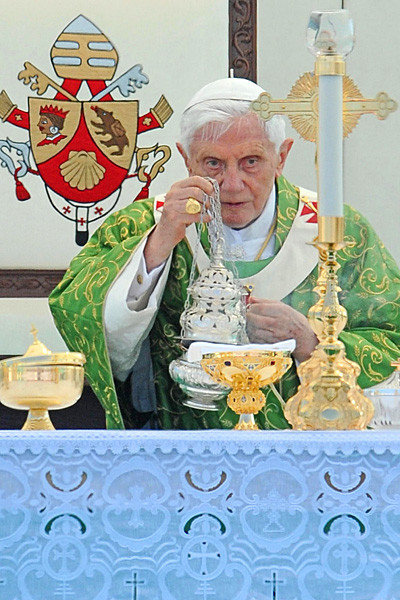
Photo credit: Ciro Fusco, EPA

.

Pope Benedict XVI has been in the Lebanon these last three days, and after an extremely turbulent week in which many discordant religious and / or “religious” notes have been sounded, I thought I’d begin what I imagine will be a series of posts from my POV on the mayhem with some words of peace (Heb: Shalom; Ar: Salaam) from the Pontiff, seen above celebrating an open air mass on the Beirut beachfront.

**

The Pope was in the Lebanon to sign a Catholic document of some significance, the Apostolic Exhortation Ecclesia in Medio Oriente, and it is from that document that I would like to extract some specific paragraphs:

Here’s the kernel of the situation as the Pope sees it, going into it —

How many deaths have there been, how many lives ravaged by human blindness, how many occasions of fear and humiliation! … How sad it is to see this blessed land suffer in its children who relentlessly tear one another to pieces and die!

— grief at human folly.

**

Benedict then begins to address the situation, offering us his definition of peace:

For the sacred Scriptures, peace is not simply a pact or a treaty which ensures a tranquil life, nor can its definition be reduced to the mere absence of war. According to its Hebrew etymology, peace means being complete and intact, restored to wholeness. It is the state of those who live in harmony with God and with themselves, with others and with nature.

Since we are not yet in harmony with each other…

Authentic witness calls for acknowledgment and respect for others, a willingness to dialogue in truth, patience as an expression of love, the simplicity and humility proper to those who realize that they are sinners in the sight of God and their neighbour, a capacity for forgiveness, reconciliation and purification of memory, at both the personal and communal levels.

He observes that such a dialogue should be theologically oriented rather than politically driven:

The Church’s universal nature and vocation require that she engage in dialogue with the members of other religions. In the Middle East this dialogue is based on the spiritual and historical bonds uniting Christians to Jews and Muslims. It is a dialogue which is not primarily dictated by pragmatic political or social considerations, but by underlying theological concerns which have to do with faith.

This dialogue can be grounded in in the one God common to the Abrahamic faiths:

Jews, Christians and Muslims alike believe in one God, the Creator of all men and women. May Jews, Christians and Muslims rediscover one of God’s desires, that of the unity and harmony of the human family. May Jews, Christians and Muslims find in other believers brothers and sisters to be respected and loved, and in this way, beginning in their own lands, give the beautiful witness of serenity and concord between the children of Abraham.

It will demand humility rather than triumphalism:

The truth cannot unfold except in an otherness open to God, who wishes to reveal his own otherness in and through my human brothers and sisters. Hence it is not fitting to state in an exclusive way: “I possess the truth”. The truth is not possessed by anyone; it is always a gift which calls us to undertake a journey of ever closer assimilation to truth. Truth can only be known and experienced in freedom; for this reason we cannot impose truth on others; truth is disclosed only in an encounter of love.

I imagine that some will find here an echo of the Qur’an:

Let there be no compulsion in religion.

— Quran 2. 256

Thus far the pope has expressed his grief at the circumstances, and outlined the basic issues between religions. He now turns his analysis to the situation within the religions:

Like the rest of the world, the Middle East is experiencing two opposing trends: secularization, with its occasionally extreme consequences, and a violent fundamentalism claiming to be based on religion.

Benedict is well know for his opposition to the “occasionally extreme consequences” of secularism: here he speaks in favor of what he terms “healthy secularity”.

Some Middle Eastern political and religious leaders, whatever their community, tend to look with suspicion upon secularity (laïcité) as something intrinsically atheistic or immoral. It is true that secularity sometimes reduces religion to a purely private concern, seeing personal or family worship as unrelated to daily life, ethics or one’s relationships with others. In its extreme and ideological form, secularity becomes a secularism which denies citizens the right openly to express their religion and claims that only the State can legislate on the public form which religion may take. [ … ]

A healthy secularity, on the other hand, frees religion from the encumbrance of politics, and allows politics to be enriched by the contribution of religion, while maintaining the necessary distance, clear distinction and indispensable collaboration between the two spheres.

Religious fundamentalism is the second challenge the Pope addresses:

Economic and political instability, a readiness on the part of some to manipulate others, and a defective understanding of religion help open the door to religious fundamentalism. This phenomenon afflicts all religious communities, and denies their long-standing tradition of coexistence. It wants to gain power, at times violently, over individual consciences, and over religion itself, for political reasons.

Here he addresses his colleagues in religious leadership:

I appeal urgently to all Jewish, Christian and Muslim religious leaders in the region to seek, by their example and by their teaching, to do everything in their power to eliminate this menace which indiscriminately and fatally affects believers of all religions.

He then drives the point home by quoting his own words on an earlier occasion:

“To use the revealed word, the Sacred Scriptures or the name of God to justify our interests, our easy and convenient policies or our violence, is a very grave fault.”

**

That’s the substance of the Pope’s message in the context of recent disturbances in the region. There were a couple of notes he touched on, however, that interested me not for any connection with recent events, but for specific theological connotations:

Growth by individuals in the life of faith and spiritual renewal within the Catholic Church will lead to the fullness of the life of grace and theosis (divinization).

Theosis is a term more commonly found among Eastern Christians, and I wouldn’t want to define the doctrine in words, though I’ll suggest that its spirit is captured in the English mystic Thomas Traherne‘s magnificent meditation [Century I. 29]:

You never enjoy the world aright, till the Sea itself floweth in your veins, till you are clothed with the heavens, and crowned with the stars: and perceive yourself to be the sole heir of the whole world, and more than so, because men are in it who are every one sole heirs as well as you. Till you can sing and rejoice and delight in God, as misers do in gold, and Kings in sceptres, you never enjoy the world.

One of Benedict’s comments specifically addresses an issue of importance as Christianity and Islam find common ground in the Middle East:

In those unfortunate instances where litigation takes place between men and women, especially regarding marital questions, the woman’s voice must also be heard and taken into account with a respect equal to that shown towards the man, in order to put an end to certain injustices.

He gives an account of the Catholic doctrine of scriptural interpretation, which will be of interest to those concerned with such things in specifically Catholic, more generally Christian or comparative contexts:

The representatives of the various schools of textual interpretation were agreed on the traditional principles of exegesis accepted by the Churches of both East and West. The most important of these principles is the conviction that Jesus Christ incarnates the intrinsic unity of the two Testaments and consequently the unity of God’s saving plan in history (cf. Mt 5:17). The disciples would only come to understand this unity after the resurrection, once Jesus had been glorified (cf. Jn 12:16). A second principle is fidelity to a typological reading of the Bible, whereby certain Old Testament events are seen as a prefiguration (a type and figure) of realities in the new Covenant in Jesus Christ, who is thus the hermeneutical key to the entire Bible (cf. 1 Cor 15:22, 45-47; Heb 8:6-7). The Church’s liturgical and spiritual writings bear witness to the continued validity of these two principles of interpretation, which shape the ecclesial celebration of the word of God and inspire Christian witness. The Second Vatican Council went on to explain that the correct meaning of the sacred texts is found by considering the content and unity of the whole of Scripture, in the light of the living Tradition of the whole Church and the analogy of faith.

He also addressed the question of liturgical renewal, in a similar spirit, both orthodox (little o) and catholic (little c):

Such a renewal must of course be undertaken, to the extent possible, in cooperation with those Churches which are not in full communion, yet are also heirs to the same liturgical traditions. The desired liturgical renewal must be based on the word of God, on the proper tradition of each Church, and upon the new insights of Christian theology and anthropology.

As an aside — anthropology is an interesting word to have made its way into that statement. I must admit I am not sure whether he’s in any way suggesting something along the lines of “cultural anthropology” — which has a fair amount to say about ritual and how it functions — but I’m pretty sure his main meaning here is something closer to the original meaning of the word — along the lines of the “sound understanding of man” that he’d mentioned in an earlier passage in the Exhortation.

One passage suggested to me that Benedict might be alluding to the Muslim terminology of the Companions of the Prophet, and suggesting some measure of similarity with the disciples of Christ:

By rediscovering its original inspiration and following in the footsteps of those first disciples whom Jesus chose to be his companions and whom he sent out to preach (cf. Mk 3:14), the Christian presence will take on new vitality.

I’m hoping that will prove to be a deft touch, a tiny but significant gesture of friendship.

**

Finally, Pope Benedict makes another reference which must have resonated with his Eastern Catholic and Orthodox co-religionists, returning to the grief with which he began his orations, appealing to Mary as Theotókos, “the one who gives birth to the one who is God”:

The heart of Mary, Theotókos and Mother of the Church, was pierced (cf. Lk 2:34-35) on account of the “contradiction” brought by her divine Son, that is to say, because of the opposition and hostility to his mission of light which Christ himself had to face, and which the Church, his mystical Body, continues to experience. May Mary, whom the whole Church, in East and West alike, venerates with affection, grant us her maternal assistance. Mary All-Holy, who walked in our midst, will once again present our needs to her divine Son. She offers us her Son. Let us listen to her, for she opens our hearts to hope: “Do whatever he tells you” (Jn 2:5).

In so doing, he remembers also, and reminds us all, of those who are martyred for their Christianity in a world where religion can so often be your excuse to kill, or another’s excuse to kill you.

Biblical prophecy and foreign policy: a caution

Thursday, September 6th, 2012

[ by Charles Cameron — on prophetic stances towards Israel: both blessings and rebukes ]
.

It seems to be fairly common in some Christian circles to view the Israeli Prime Minister’s position on war with Iran as somehow sacrosanct.

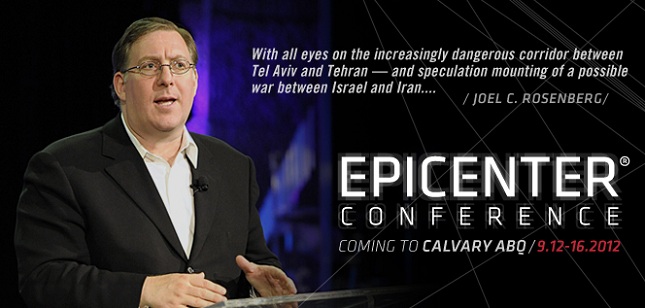
Thus the end times fiction and non-fiction author Joel Rosenberg, for instance, recently blogged a “sermon” in two posts [Rediscovering the power and purpose of Bible Prophecy: 1 and 2] about the importance of prophecy to an understanding of Middle Eastern affairs, noting:

Israel is the epicenter of God’s plan and purpose in the last days. Other countries mentioned in Bible prophecy are Russia, Iran, Syria, Lebanon, Turkey, Libya, Sudan, the revived Roman empire, and several others. The United States, however, is never mentioned directly or specifically in the Bible. In my recent book, Implosion, I go into this in greater detail. But the bottom line is that even though America is the wealthiest and most powerful nation on the face of the earth in the history of mankind, the Bible does not describe a specific role for us in the last days. Something, therefore, apparently happens to neutralize us or paralyze from played a key role in the events that lead to the return of Christ.

Despite this lack of emphasis on the Unites States, he followed these two posts up with a post titled Troubling development: rift between White House & Israel growing as threat of war rises:

In recent days, anyone watching U.S.-Israel relations has seen a very troubling development: the already serious rift between the current White House and Israel is growing. The relationship between President Obama and Prime Minister Netanyahu has been strained for nearly four years. But as the threat of war between Israel and Iran this fall continues to rise, the Obama administration seems to be intentionally signaling a growing distance from the Netanyahu government.

He doesn’t draw a direct link to prophecy in this particular post, but he does close with this prayer:

Please pray for the Lord to change the heart of President Obama and his advisors, and that they would change course and truly and publicly stand firmly with Israel, our most faithful ally in all of the epicenter. As we read in Genesis 12:1-3, God promises to bless those who bless Israel, and curse those who curse Israel. With America facing a growing risk of economic and moral implosion, now is certainly not the time to turn our backs on Israel.

**

As usual, my interest is in nuance — so I’d just like to say that from a purely Biblical point of view, it is by no means out of the question for believers to disagree with the kings and rulers of Israel. Indeed, Rav Moshe Taragin, writing in the Virtual Beit Midrash of Yeshivat Har Etzion, hardly a bastion of anti-Israeli sentiment, goes so far as to say:

In general, the function of the prophet is to rebuke the nation, to expose its negative traits and to help the people improve their behavior. As the Rambam teaches (Hilkhot Teshuva 4:2): “Thus, all the prophets rebuked Israel so that they would repent.”

Just because someone rebukes Israel doesn’t mean they don’t bless her…

**

I addressed a question to my Christian friends on Twitter the other day, using the Iraq war as my example — but it applies to the current face-off between Israel and Iran, too:

If you and I disagree on, say, the Iraq war now, will one of us have to change his or her mind in heaven?

I added that my question was not about the Iraq war as such, but about our certainties when so many of our certainties differ.

My friend Mike Sellers responded with this admirable quote — which as he pointed out is often attributed to St Augustine (for more on its origins, try Wikipedia):

In things necessary, unity, in things doubtful, liberty, in all things, charity.


Switch to our mobile site