zenpundit.com » tao

Archive for the ‘tao’ Category

Xi Jinping

Monday, November 26th, 2012

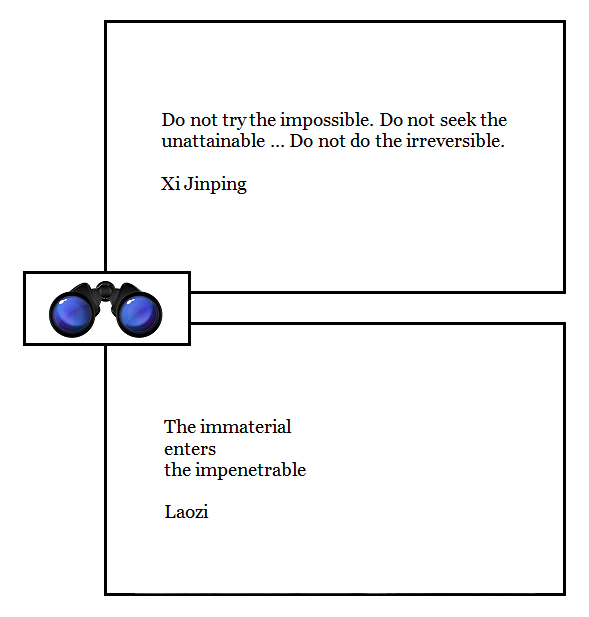
[ by Charles Cameron — Xi Jinping quotes an unnamed “ancient Chinese military strategist” and I respond with Laozi — this one’s for Raff Pantucci ]
.


.

According to Reuters today, Xi used his quote (above, top) in a speech in 2000, while governor of Fujian province. If anyone can identify the “ancient Chinese military strategist” and reference the original source of Xi‘s quote, I’d appreciate a heads up. My version of the Laozi is from Ursula le Guin‘s translation, chapter 43.

The Church of England stress-tested

Sunday, November 25th, 2012

[ by Charles Cameron — of integrity and flexibility in that most curious chameleon of a religious institution, the Church of England, of which I am still fond at a distance ]
.

.

The Church of England is run, if that’s the word, by the three houses of its General Synod, and just this week the the House of Bishops and the House of Clergy voted to approve the ordination of women bishops, while the House of Laity voted against the idea — and since all three houses have a veto, carried the day.

Be it noted that there are in fact women priests in the Church of England, and women bishops in other parts of the Anglican Communion of which the Church of England is the mother province.

In the Church of England, however, a woman is still barred from being ordained a bishop.

**

There’s a Church of England blogger I follow to catch the more conservative slant on things — he calls himself Archbishop Cranmer after a celebrated Anglican divine — and in a recent post titled Church of England remains a bit more Catholic, His Grace remarked:

The Church of England is historical and so mortal. It is a creature of continual creation; of adaptability in religio-political fluidity. It opposes immutability in theological expression, recognising that mobility is intrinsic to mortality: as believers are continually converted to God, there must be continual conversion to the nature of the Church, and those confessional bodies must be mutable, for none possesses exclusive ownership of the identity of Christ.

The Church of England was never designed to be Protestant, though it has elements of that movement within it. And it was certainly not Roman Catholic, though it drew on the strengths of that denomination to manifest the Church in a visible society. Its struggle has ever been how to permit freedom of the Spirit within ancient structures: how to put new wine into old wineskins.

This is why the Archbishop of York is right when he says there will be women bishops, because Anglicanism is a communion, and in that koinonia is toleration of mutual exclusives.

That’s an interesting formulation: toleration of mutual exclusives.

Cranmer winds up that particular post with the words:

You may hear talk of splits and schisms, but these are nothing more than the spats of human mortality. For as long as we can examine what sort of church we are and question our core principles and values, there will be discussion, debate, tears and joy. The moment we cease to disagree and hurt each other is the moment the church ceases to be church.

And that too is interesting — especially in view of St Paul‘s exhortation in Philippians 2:2:

Fulfil ye my joy, that ye be likeminded, having the same love, being of one accord, of one mind.

**

I believe Cranmer is right, and that the Church of England was indeed intended to house a variety of views, some of them tending Catholic, some tending Protestant.

But what I find most interesting here is his sense that the church quite properly opposes immutability in theological expression, recognising that mobility is intrinsic to mortality — because here we are coming very close to Christ‘s identification —

I am the way, the truth, and the life…

read in the light of Lao Tse‘s dictum —

The way that can be put into words isn’t the true Way.

**

And remembering always that CS Lewis once asked:

Is not the Tao the Word Himself, considered from a particular point of view?

and that Fr. Thomas Merton quotes with approval Dr Wu‘s “well-known Chinese translation of the New Testament” in which the Prologue to St John’s Gospel begins:

In the beginning was the Tao.

**

One other point.

A day or two after the vote in General Synod, His Grace posted an extensive excerpt from the parliamentary questions raised for Sir Tony Baldry MP to respond to, as Second Church Estates Commissioner. One such question was raised by Mrs Eleanor Laing (Epping Forest) (Con): ‘

Does he agree that when the decision-making body of the established Church deliberately sets itself against the general principles of the society that it represents, its position as the established Church must be called into question?

To my minds, that’s an extraordinary question, and in the comments section of His Grace’s blog, one D. Singh said:

Your Grace

It is written: ‘Do not be conformed to this world, but be transformed by the renewal of your mind, that by testing you may discern what is the will of God, what is good and acceptable and perfect.’

Romans 12:2

One would have thought that after the death of Dietrich Bonhoeffer at the hands of the Nazis for his unwillingness to go along with “decision-making body of the established Church” — in his case, the Lutheran Church in Germany at the time — a little more thought might need to be given before such a question was raised…

**

Oh, and somewhat amusingly, if you are inclined to be amused at such things — when Sir Tony Baldry addressed the House of Commons on the topic of women bishops — an idea whose time he clearly believed was long overdue — he was wearing the tie of London’s distinguished Garrick Club.

A private club close to London’s theatrical district, where:

‘actors and men of refinement and education might meet on equal terms’, where ‘patrons of the drama and its professors were to be brought together’, and where ‘easy intercourse was to be promoted between artists and patrons’…

Oh, and which to this day does not admit women as members.
Applied Pontecorvo: Gaza

Thursday, November 22nd, 2012

[ by Charles Cameron — lessons from Pontecorvo’s Battle of Algiers for the medium-term Israeli-Palestinian conflict — and other instances of asymmetry ]
.


.

Pontecorvo‘s film, The Battle for Algiers, really seared itself into me when I watched it again recently — and so it has been a bit of a template for other thoughts, and notably influenced some of my thinking as I was watching events unfolding in Gaza, now thankfully in cease-fire mode.

Pontecorvo, as I noted in my previous post, takes the side of the Algerians in their conflict with the French, and I suppose it’s only natural that a “reading” of the Gaza situation in light of Pontecorvo’s masterpiece will tend to support the Palestinian “cause” against the Israelis.

After all, Yitzhak Epstein, addressing the Seventh Zionist Congress in Basel in 1905, had a point when he said:

We devote attention to everything related to our homeland, we discuss and debate everything, we praise and criticise in every way, but one trivial thing we have overlooked so long in our lovely country: there exists an entire people who have held it for centuries and to whom it would never occur to leave.

On Thanksgiving Day I am reminded that my Lakota friends also have a point — but there’s what’s memorable, which can remain in very long-term memory indeed, and there’s what’s practicable, which may in practical terms be changing by the day or decade…

**

Let me put that another way.

I don’t need the words of a Zionist Jew from a century ago to give me that insight into the Palestinian side of things, but Epstein’s words remind me that there are facts in the heart on the Palestinian side, just as the Israelis are building facts on the ground in the occupied territories. What of the Israeli side, are there not facts in the heart there too? And on the Palestinian side, what of the ghastly hadith of the Gharqad tree? Must apocalyptic hate last till the end of time?

Of all the reporting I have read, this, from Dahlia Litwick in Jerusalem, struck the deepest chord:

I don’t know how to talk about what is happening here but it’s probably less about writers’ block than readers’ block. It says so much about the state of our discourse that the surest way to enrage everyone is to tweet about peace in the Middle East. We should be doing better because, much as I hate to say it, the harrowing accounts of burnt-out basements and baby shoes on each side of this conflict don’t constitute a conversation. Counting and photographing and tweeting injured children on each side isn’t dialogue. Scoring your own side’s suffering is a powerful way to avoid fixing the real problems, and trust me when I tell you that everyone — absolutely everyone — is suffering and sad and yet being sad is not fixing the problems either.

**

Here, then, are the parallelisms and oppositions that struck me, as I was reading about the Gaza conflict — may today’s cease-fire endure and a peaceful resolution emerge — in light of Pontecorvo’s film:

Gilad Sharon‘s words echo those of Col. Mathieu in the film: they think alike, and indeed their perspective is a not-uncommon one. But while I might otherwise have overlooked Sharon’s voice as but one among many in Israel, having just seen Pontecorvo’s film I take more note of it, and my mind seeks its rebuttal.

I find that rebuttal in the words of Thomas More, in a speech from Robert Bolt’s play that has stuck with me since I first saw Paul Scofield in the role in London at the age of sixteen:

I am, I suppose something of a Taoist by inclination. I think, with Lao Tse, that the way that can be phrased in words isn’t the authentic way — or as Count Alfred Korzybsky might put it, the map does not adequately describe the terrain — and so my feeling is that the letter of the law should be tempered by its spirit, and that justice should be tempered with mercy — a point I hope to return to.

**

There is one other moment in Pontecorvo’s film that struck me as prescient — the one when Larbi Ben M’hidi comments on asymmetry:

I’ve heard remarks of that kind (upper panel) repeated many times in the context of the Palestinian-Israeli situation, but the graphic impact of the image (lower panel) outweighs a thousand explanations.

**

Perhaps we can leave Pontecorvo for a moment, and consider the asymmetry further, and the symmetry:

The lower panel, by a Swiss cartoonist of Lebanese extraction, is titled An Eye for an Eye (Oeil pour Oeil) — a symmetry that is taken to its logical conclusion in a quote often attributed to Gandhi:

An eye for an eye leaves the whole world blind.

**

My apologia:

I am distant, and I am a writer: distant enough to take all humanity for my own side, and writer enough to wish to contribute what I can of concern and insight.


Switch to our mobile site

