zenpundit.com » 2005

Archive for 2005

Thursday, September 8th, 2005

ONLY THE STRO…RESILIENT….SURVIVE !

Resilience, the mental grit and will to endure and overcome tragedy and trauma to come back and fight another day is a biological trait. Resilient people have better brains ( or practicing “Resilience” may make your brain better….chicken-egg, egg-chicken… ).

The always superb Eide Neurolearning Blog has the details on brain function and resilience.

Wednesday, September 7th, 2005

DREAMING OF A JAPAN THAT CAN SAY ” BANZAI”: THE COMING OF THE SHINTARO SHOGUNATE

One of the more interesting periodicals on international relations is Foreign Policy magazine, noted for out of the box thinking and an ability to attract heavy-hitters as writers. The current issue is no exception which features a number of big names in the “Here today, gone tomorrow” feature, including the current governor of Tokyo and one of Japan’s most popular political figures, Shintaro Ishihara, who fiercely decries ” Japanese Passivity”:

“…The Japanese used to have the spirit and backbone of the samurai, the same warriors who were applauded by Walt Whitman when they visited the United States in the 1860’s. When will we recover our national virtue, described so well by Ruth Benedict in The Chrysanthemum and the Sword?”

This is a fairly shocking reference. It is true that foreigners can sometimes capture the essence of another nation’s character and Benedict, who labored under considerable wartime constraints in writing her classic treatise, deserves to be alongside Alexis de Tocqueville and the Marquis de Custine in that regard. That being said, we need to note that Benedict’s critique was not exactly a laudatory one as well as being tilted toward describing what even then would have been an interpretation of Japanese social mores favored by State Shinto reactionaries. This is not the equivalent to Senator Clinton or Speaker Hastert favorably alluding favorably to Democracy in America; it is more on par with a Southern politician praising the values extolled in Birth of a Nation.

Kokutai reactionary romanticism is not the real problem. Shintaro Ishihara, who has his eye on the Prime Ministership of Japan, clearly has ambitions to overturn Japan’s postwar consensus and security relationship with the United States, whom he does not trust, to rearm against a resurgent China whom he fears yet frequently seeks to provoke. This is no small task, given the make-up of the Diet, the strength of the consensus viewpoint even among Japanese conservatives and the fear among the Japanese elite of allowing another “shadow shogun”like Kakuei Tanaka to amass personal control over the levers of government. Something Ishihara would absolutely need to have in order to effect Japan’s rebirth as an independent power on foreign policy and defense issues.

While this would seem to be an unlikely outcome we need to remember that in historical terms Japan’s relationship with the United States is highly abnormal and continues to exist despite the fact that economic and strategic circumstances have shifted radically since the 1950’s. The current consensus of Japanese military dependency on America may be more fragile than Western or even Korean and Chinese observers realize. Japan’s ” natural” position would be the world’s number two military power, which it could assume easily and probably would benefit from economically in the short run due the Keyenesian effects of a robust defense build-up.

This would of course be dangerous for Eastern Asia which would see a resumption of the arms race as Japan nervously eyed China and the two Koreas, inevitably inducing India to try to keep pace with China and Pakistan with India. The United States would then have the thankless task of trying to manage this unruly herd of rising yet insecure powers. This is not any kind of future worth creating in my book.

Let’s be glad Ishihara isn’t getting any younger.

Monday, September 5th, 2005

ZENPUNDIT GRUNTING AT COMING ANARCHY

To my great surprise, I find myself noting that The Atlantic is running an excerpt on Robert Kaplan’s Imperial Grunts before Curzon at Coming Anarchy could get around to doing it.

Must be the time zone difference :o)

Heh.

Monday, September 5th, 2005

YOUR SYSTEM ADMINISTRATION FORCE CANNOT HAVE FEET OF CLAY


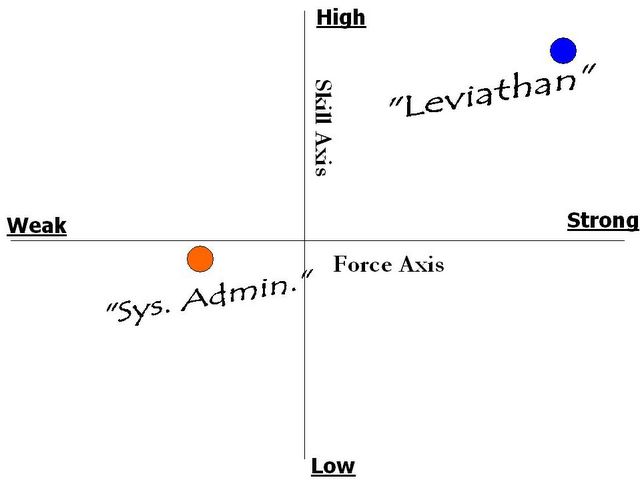
Posted by Picasa

Much has been written about the immense difficulties experienced by the U.S military in occupying Iraq and defeating the multifaceted Iraqi insurgency. While tactics, politics and civilian leadership have all come under fire, most critics have zeroed in on having insufficient numbers of troops, blaming in particular Secretary of Defense Donald Rumsfeld and then Deputy Secretary Paul Wolfowitz for overruling Army Chief of Staff General Eric Shinseki’s recommendation for a much larger invasion force. As it turned out, Saddam’s much-feared but ramshackle regime probably could have been toppled by a lower numbers of troops closer to what had been advocated by Wolfowitz but the occupation of Iraq would have been better served by the larger force recommended by Shinseki. Better served but I would argue not well-served. Numbers alone are not the whole story – something critics and supporters of the war alike have missed entirely.

Dr. Barnett in The Pentagon’s New Map illustrated the “Leviathan” – ” System Administration” division of task and structure that the U.S. military is going to need to adapt to in the 21st century. In Blueprint for Action, Barnett expounds on the lessons Iraq has had for that conceptual division. They are numerous and I will leave them for my future review of BFA . I will however, add my two cents to the discussion. The overlooked aspect of this debate has been the critical misallocation of skills in Iraq – something that will continue even if the military is re-orged into Sys Admin and Leviathan forces unless the problem is recognized and taken into account.

Both Sys Admin and Leviathan forces – or any effective military for that matter – require a continuum of skills to function in the field for any extended period of time. Leviathan would have an overall systemic bias toward very high-end and specialized skill-sets but even so it would still need its share of clerks, cooks and humble enlistees to do mundane tasks like delivering the mail, emptying the trash, pulling guard duty and K.P. System Administration, being very human intensive in terms of security and interactivity with locals, requires a far larger number of personnel to perform low-end skill tasks that while not very glamorous, in the aggregate, if left undone, will create mission failure, low morale and numerous situational hazards. Sys Admin has its high-end skill slots to be sure, particularly in engineering and logistics, but the ratios are skewed differently than with Leviathan.

In Iraq the United States has a high-end skill-set military force configured structurally to destroy other great power conventional militaries attempting to do Sys Admin work while simultaneously waging a counterinsurgency war. We are not simply short ” X” number of boots – though more boots would help – we have local commanders cannibalizing their highly skilled experts in a seat-of-the pants manner to do the mundane tasks needed to simply keep the unit functioning as a military force. We are short on the low-end skills and this is creating massive systemic ineffiencies, essentially diseconomies of scale. One contact of mine who served in Iraq doing some rather dangerous field work during the CPA period first as a USG official then as a private contractor, put it this way:

“…The US Army is horrible understaffed,there are 33% of the interrogators in the military as there were 10 years ago and there weren’t enough then. The army is short in nearly every manning position so if a commander happens to have an interrogator there is not guarantee that they will be working in that capacity, they may well be a mail clerk because the unit doesn’t have enough of them either.”

The absence of a robust amount of low end but vital support personnel are part of the problem and one not solved by getting more of the same. Or by hiring a legion of private contractors to to freelance problems as best they can. You don’t use Navy SEALS to do bodyguard duty, you don’t want psychological warfare experts supervising the motor pool. Any economist looking at what the military is doing or is forced to do with it’s people would predict a series of negative outcomes as the effects of inefficiency begin to accumulate.

High-end skill-set personnel will do low-end jobs for a time, to pitch-in and help as it were, but in the end they get sick of being misused and leave the service, taking their valuable skills elsewhere.

Monday, September 5th, 2005

LARRY JOHNSON ON KATRINA AS A FAILURE MODEL FOR TERROR RESPONSE

Mr. Larry Johnson is a former CIA analyst and Deputy Director for the State Department’s Office of Counterterrorism and is currently the CEO of BERG associates. He blogs at No Quarter:

KATRINA AS A TERRORIST RESPONSE

“The unfolding disaster along the Gulf Coast is only going to get worse, unfortunately. I spoke today to a friend in Louisiana who has two sons that serve in the Louisiana State Police. There are still stories not fully covered by the media. My friend’s boys, for example, were in a shootout last night with a rampaging gang in New Orleans. When the sun goes down the jackals come out. We will see more images of Americans shooting Americans in the coming days.

Another big surprise is the virtual surrender and retreat by the New Orleans Police Department. One State trooper, for example, caught and disarmed a New Orleans police woman who was trying to break into a jewelry store. This has been a failure of leadership across the board, starting with the Mayor then the Governor and finally President Bush.

The body count is going to go thru the roof. Only now are mortuary teams preparing to enter New Orleans. The obvious failure to cope with the aftermath of the hurricane is the fault of Federal, State, and local officials. Consider the levee breach. A friend of mine experienced with crisis response was completely puzzled why Federal and State authorities did not seize and sink barges in the openings. That is an expedient solution to a levee collapse.

The inept response to this disaster is an ominous harbinger of things to come if terrorists hit us with the big one. Ignore for a moment that fact that this scenario in New Orleans had been identified as a potential threat we should prepare for. We should recognize that a terrorist armed with a nuclear weapon could not inflict the physical damage that the hurricane caused. Although a surprise terrorist strike could cause more casualties, only a sustained aerial bombardment could match the force and fury of Mother Nature.

The crisis response to a hurricane is the same as a response to a terrorist attack. Restoration or services, remediation, and humanitarian help are the same regardless of whether it is man made or nature made. The biggest problems in any response are always the same–chain of command (i.e., figuring out who is in charge) and communication. It is inexcusable for the Bush Administration officials to claim they had no way of anticipating this disaster or planning for it. At least they’ve been consistent. We now know that the failure to plan for the aftermath in Iraq was but a precursor of things to come at home.

Hopefully this debacle will inspire the Republican controlled House and Senate to get off their ass and demand the Bush Administration explain how it will respond if terrorists detonate a nuclear device in the harbor of New York City or Los Angeles. We don’t know if or when such a tragedy will happen, but we do know it is something that could happen and that we should be prepared to handle. That is the purpose of holding crisis management exercises. You work on problems and potential solutions before you are in the midst of an actual crisis.

Given the scale of the disaster along the Gulf Coast it is essential that the response be Federalized and that NORTHCOM be put fully in charge of coordinating and directing the humanitarian and crisis response operation. Unlike the current head of FEMA, the Commander of NORTHCOM is an experienced officer who knows how to command large scale operations”


Switch to our mobile site
