zenpundit.com » 2005

Archive for 2005

Monday, August 15th, 2005

POSTING STATUS

I should have a heterogeneous mix of subjects up today, plus a continuation of the ” reforming State” discussion going on below (Dave, Collounsbury and Jeff have made a few remarks already this morning but I will address them fully later ). The children need to be hustled out the door to their activities as I have a workman coming this afternoon.

Saturday, August 13th, 2005

A STATE DEPARTMENT WORTH CREATING: GETTING INSTITUTIONAL CLARITY AT FOGGY BOTTOM


Posted by Picasa

The Bush administration announced today an intention to perform a major overhaul of the State Department ( hat tip Combat Boots). This move ( assuming it results in real reforms) will not be welcomed by many members of the Foreign Service who are already balking at the strategic objective/mission/task orientation demands of the Bush White House. Nor will it be welcomed by many liberals or Democrats who will no doubt suspect a purge is in the offing, motivated by Republican partisanship against a bureaucracy widely ( and correctly) perceived as leaning liberal and dovish.

Both groups may be correct to worry but it is also true the State Department is in dire need of reforms as its antiquated regional desk structure, byzantine personnel assignment policies and insular culture are inadequate to meet the challenges of a radically different world from the Cold War era. I would also add that State and its Foreign Service officers need not just a new culture but more resources in order to do their jobs – sometimes dangerous jobs I might add- effectively. The historic pennypinching of Congress, to nickel and dime common sense requests from State, line by budget line, while at the same time appropriating megabillions of pork for the district back home has to end. It impacts our national interests and even our national security.

In what way should the State Department be changed ? A few suggestions:

Outreach: The Department needs to be deeply engaged in public diplomacy and connecting with the American public about the importance of foreign affairs. It’s great to build embassies that cannot be easily blown up by terrorists, not so great if diplomats do not leave their desk located in what amounts to a nuclear war bunker built to look like a suburban community college campus. Might as well stay in Georgetown. If we aren’t mingling with ordinary locals as well as host government officials we can hardly be aware of what is really going on ” in -country”.

Strategic Thinking: George Kennan and Paul Nitze attempted in the 1950’s to reverse State’s intrinsic love affair with crisis management, muddling through and a day to day time horizon in favor of long-term strategic planning. While they instituted strategic policies they never managed to inculcate strategic thinking.

While you might disagree with the Bush administrations ” transformationalist” priorities, getting State Department personnel habituated to think and act in terms of a set of strategic priorities is a good thing. The age of ad hoc, seat of the pants, diplomacy has to go and the State needs to reorg an internal structure that perpetuates empire-building and encourages end-runs around the president’s stated policy or the Secretary of State’s instructions.

Depth: FSO’s should not rotate everywhere without rhyme or reason. Their regional area/major nation should be their career so true depth can be cultivated. Yes, I realize ” clientism” would be a problem. My answer to that is it is a problem now except, on average, it’s a less-informed clientism than if someone spent say, thirty years as a Sinologist.

Secondary areas of expertise for FSO’s should be non-regional – economics, business and international finance, IT, counter-terrorism, intelligence, military affairs, public health, management, law and so on. Real expertise here as well should be the goal.

Jointness: State, the IC and the Pentagon need to learn operational ” jointness” in foreign affairs the way the Army, Navy, Air Force and Marines had to adapt to planning, buying and executing missions in the field in unison ( actually the military is still learning…but they’re better at it than they used to be).

This is going to take some time and new blood to achieve but America needs more of a team and fewer prima donnas in foreign policy.

Friday, August 12th, 2005

THE FIRST WAR ON TERROR


Posted by Picasa

I’ve been reading Tom Holland’s well-received Rubicon – best described as a ” retro history” with modern America as the model for understanding the late Roman Republic. This technique violates major precepts of the historical profession but it also makes Rubicon a very refreshing read. The stuffiness and pomposity that are germance to classical history as a field are absent from Holland’s prose.

Holland took special delight in drawing the following parallel with the Pirate chiefdoms of the Mediterranean sea:

“THE WAR AGAINST TERROR

…Calculated acts of intimidation ensured that they could extort and rob almost at will. The scale of their plundering was matched by their pretensions. Their chiefs claimed for themselves the status of kings and tyrants, and for their men, that of soldiers, believing that if they pooled their resources they would be invincible.

…The shadowiness of the pirate’s organization, and their diffuse operations, made them a foe unlike any other.’ The Pirate is not bound by the rules of war, but is the common nemy of everyone” Cicero complained. ‘ There can be no trusting him, no attempt to bind with him with mutually agreed treaties’. How was such an adversary ever to be pinned down, let alone eradicated? To make the attempt would be to fight against phantoms.’ It would be an unprecedented war, fought without rules, in a fog’: a war that appeared without promise of an end”.

What happened ? Much dithering and desultory, half-hearted campaigns, turning a blind eye to increasing pirate outrages by the Roman elite, until the populace made its will felt.

“…it was a Tribune, in 67 BC who proposed that the people’s hero [ Pompey] be given a sweeping license to deal with the pirates. Despite an impassioned appeal from Catalus not to appoint a ” virtual monarch over the empire’ these citizens rapturously ratified the bill. Pompey was granted the unprecedented force of 500 ships and 120,000 men, together with the right to levy more, should he decide that they were needed. his command embraced the entire mediterranean, covered all its islands, and extended fifty miles inland.”

The result ?

“As it proved, to sweep the seas clear of pirates, storm their last stronghold, and end a menace that had been tormenting the Republic for decades took the new proconsul a mere three months…Even the Romans themselves appeared to have been a little stunned.”

A lesson for today ? Maybe. But the ancient world also offers the lesson of the expedition to Syracuse, an undertaking of similar magnitude in which the Athenians fared not quite so well as did Rome.

Friday, August 12th, 2005

ON LANGUAGE

Some paleoanthropologists and evolutionary biologists once speculated that Homo Sapiens won the genetic arms race with their Neanderthal cousins because of the development of language by the former facilitated an enormous non-zero sum cultural revolution that the latter could not match. A one-sided linguistic advantage for Homo Sapiens may not have been true but language certainly represented the greatest innovation in human history and even today, often structures the core of our personal and collective identities.

I make mention of this because there were two very interesting posts today relating to language and its uses by Younghusband of Coming Anarchy, who is himself a linguist and also at NuSapiens ( hat tip to Dave ).

Younghusband lambastes the theories of George Lakoff, the Democratic Party’s ” framing” guru who I have blogged on previously. An excerpt from YH’s post “Highjacking the American Language“:

[On Lakoff’s ” Framing”] “Unfortunately this is pseudo-science at best, and is based on the Sapir-Whorf Hypothesis which was effectively disproven by the cognitive revolutionaries of the 60’s, and absolutely demolished by my linguistic hero Steven Pinker. The point is, people don’t think in words, thus you cannot control their thoughts by controlling their language. Sorry Mr. Orwell! Ever knew what you wanted to say but couldn’t put it into words? Ever have an idea that you couldn’t explain? As much as the military says “collateral damage” everybody really knows what it means. A “Personal Hydration Engineer” is really just a “waterboy.””

Over at NuSapiens, we have some speculation on the mechanics by which Indo-European languages replaced their indigenous predecessors in “Some Thoughts on Language Replacement“:

In a nutshell: I wonder whether Indo-European can be seen as an ideology associated with a technology, rather than a language associated with an ethnicity or culture. Many people associate the spread of IE languages with the spread of agriculture in Europe following the last Ice Age. But how did Indo-European replace indigenous European languages? Maybe old languages don’t die, they just fade away. Reductionistic linguistic models might miss this by looking for the wrong things: maybe change happened gradually without anyone realizing they were “adopting a new language.

…Our model biases our view: we look at European languages, and see them as Indo-European. We look for common grammatical structure, common words, etc. But what about other variable elements, such as tonality or “accent”? A Spaniard once described Spanish to me as “Latin with a Basque accent.” Well, what is this “accent,” something linguistics might consider random or trivial? Remember, modern linguistics is part of the Indo-European linguistic-thinking system, so how can it objectively view itself? The parts considered trivial or invisible are most likely to maintain survivals of pre-IE influences. “

There’s some logic here but being a certified outsider to the field of linguistics, I’m wondering how this hypothesis stacks up by looking for Indo-European’s ” invisible” connections with Uralic languages and Basque ? Any ideas out there from my learned and multilingual commenters ?

Thursday, August 11th, 2005

THE FIRST ON MY BLOCK !


Posted by Picasa

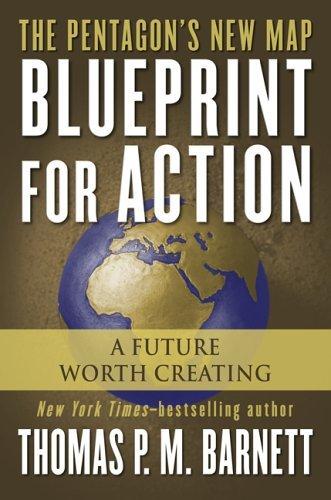
Dr. Barnett was kind enough to have his publisher send me a copy of the uncorrected proof limited edition of his Blueprint For Action for me to review for another venue ( which I will cross-post here at Zenpundit) allowing me to get the jump on the rest of the blogosphere – and not a few old media reviewers.

If you have been following Tom’s blogging this past year you already have some idea of the shape of BFA but as I scan quickly, there are some twists and surprises in the text even for those familiar with PNM. I’m going to start digging in this weekend but my tentative impression – coupled with a close reading of Dr. Barnett’s interview with Secretary of Defense Donald Rumsfeld for Esquire magazine – is that BFA may be a far more influential book in terms of public policy than The Pentagon’s New Map.

The first book was the vision. The second looks to be the structure.


Switch to our mobile site