zenpundit.com » 2006

Archive for 2006

Thursday, August 24th, 2006

ON A (MUCH) LIGHTER NOTE…

I’m working on another decent sized post that I’m simply not going to finish this evening. Too much research involved. But as I was taking periodic breaks by surfing my blogroll, I came across the following at Purpleslog that gave me a good laugh.

Elmo and the Decline of the American Nation

Wednesday, August 23rd, 2006

COMPLEXITY AND CONNECTIVITY:BAR-YAM AGAIN
Preface:

I’ve been pondering the relationship between complexity and connectivity ever since I was prompted by a post and an email from Dave at Thoughts Illustrated. Due to time constraints, I was not able to give the insights Dave offered in his email the proper attention they deserved then but I’m returning to the subject today.

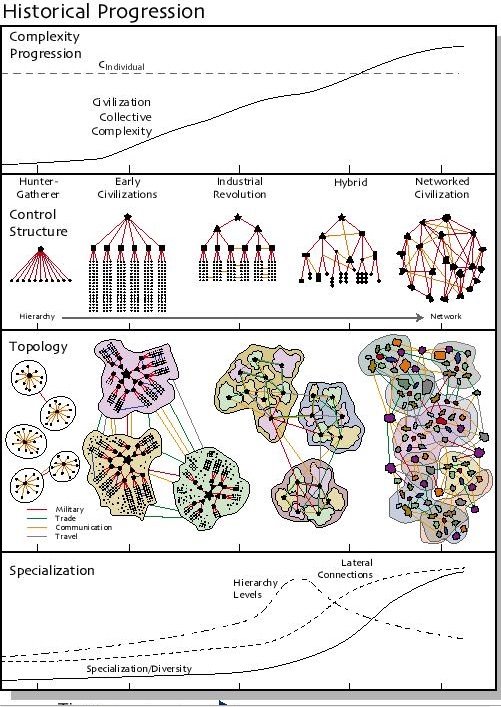
The background here is a short paper on civilizational complexity, ” Complexity Rising:From Human Beings to Human Civilization, A Complexity Profile” by Dr. Yaneer Bar-Yam that I forwarded to a number of thoughtful people, some of whom also were bloggers. My take on Bar-Yam’s paper at the time had to do with ” The Resilience of Civilizations“; Steve DeAngelis at ERMB responded with “Networked Civilization Revisited“; Curtis Gale Weeks at Phatic Communion put these ideas in the context of the theories of John Boyd with “Rule Sets and the Revised OODA” and Dan of tdaxp followed Curtis with “Comments on Verticalization and Progress“. Dr. Von, who introduced me to the ideas of Dr. Bar-Yam in the first place, offered some verbal commentary in person but helpfully pointed to an older post of his, “Our Universe:Continual Emergence“as well.

The Relationship of Complexity and Connectivity in Civilization:

Civilizations are long enduring, complex adaptive social systems that remain distinctive from their neighbors. Differences between civilizatons are visible even to casual observers in the form of culture, language, religious belief, social customs and economic productivity. The origin or causation of civilizational differences have been hotly debated for dozens of centuries and at various times, climate, geography, divine favor, chance or superiority in terms of culture, genetics, martial prowess, political, economic or moral systems have all been offered up as explanations and all have met with fierce criticism.

However, my purpose here is not to weigh in on the merits of Baron de Montesquieu, Jared Diamond, Karl Marx, Victor Davis Hanson or Robert Wright but to point out, first, that the superficial manifestations of civilizations, that make them unlike others, all represent underlying patterns of complexity and of connectivity. Secondly, that while complexity and connectivity in a “superorganism” sized social system have a high degree of interaction and are often mutually reinforcing, they are not one and the same. On some levels, complexity can increase or sharply limit connectivity. Connectivity in turn, may simplify or complicate the workings of a system, increasing or decreasing ” friction” as well as numerous other effects.

Take for example, late medieval to early modern central Europe. The Holy Roman Empire, at one point, had something on the order of 300 independent, overlapping, interdependent polities. That’s more sovereigns than exist today on the entire planet, some ruling nothing bigger than a knightly estate, crammed into an area slightly larger than Germany.

Obviously, in the case of the Holy Roman Empire, the degree of political and social complexity were very high relative to the population of the time or to monarchical states like England . This complexity came at the expense of connectivity, particularly economic connectivity given the number of sovereign and semi-sovereign entities ( most with their hand out) that could and did interfere with trade in a myriad of irrational ways. Unsurprisingly, even after Napoleon consolidated this Germanic crazyquilt into a more manageable 35 state Confederation of the Rhine, the first serious exploration of German unification involved a proposal for a customs union, the Zollervein, that would have simplified, and rationalized trade, increasing the level of connectivity.

Dr. Barnett has made a similar argument regarding the connectivity effect of the Federal union of the United States in Blueprint for Action as well as elsewhere. If you look at the lowest panel of the Bar-Yam Historical Complexity diagram above, you will note the “hierarchy” line levelling off and falling while the “specialization/diversity” and “lateral connection” lines rising in parallel along a timeline. This is a nice visualization of changing the political or legal complexity of rule-sets ( reducing the number of competing rule-sets) intersecting with improvements in technology to permit higher levels of emergent connectivity.

Granted, the higher levels (and faster velocity of transaction) of connectivity are also, in themselves a form of complexity that will generate unanticipated spillover effects that will give rise to demands for regulation or control in the form of new rule-sets. As will the resistance of vested interests to emerging forms of connectivity or technology that endanger rentier arrangements, oligopolistic markets or the authority of corrupt tyrannies. As the relationship between complexity and connectivity is dynamic, these reactionary political responses to creative destruction are unavoidable.

Their success though, is far from inevitable. We have choices if we care to exercise them.

Tuesday, August 22nd, 2006

RECOMMENDED READING

Fast and furious.

Eddie from Live from the FDNF gets top billing for ” Tom Odom’s “Journey Into Darkness“, a review of Journey into Darkness: Genocide in Rwanda by Small Wars Council member Dr. Thomas Odom.

Shannon Love at Chicago Boyz – “The Collapse of Liberal Orders

Edge Perspectives with John Hagel – “Langlois and the Vanishing Hand

Paul B. Hartzog – “ The Age of Distraction

Dan of tdaxp – “Purposeful Practice and Expertise

Marc Schulman at American Future – ” The Iranian Missile Threat

Howard Rheingold at The Cooperation Blog – ” Jamie Boyle on the cognitive bias against open systems

Bruce Kesler at Democracy Project – “Prescience, Conspiracy, and Intelligence

Sonny at FX-Based – “In Defense of EBO – Part 4

Curtis at Phatic Communion – ” Godwinism?

Nusapiens – “ Climate hange and History

That’s it.

Tuesday, August 22nd, 2006

RECOMMENDED DRINKING

Mmmmmm… good !

Sunday, August 20th, 2006

H20 GLOBAL !

A great example of attempting to make a systemic imapact by strategically targeting one variable in a complex system that will have very broad, very positive, downstream effects:

Guest posted at Critt’s Conversation Base Blog by Dr. Timothy Foresman:

Watering Hope with Action and Technology (W.H.A.T)

” A Proposal

Challenges facing the poorest and most disenfranchised peoples of the planet may seem insurmountable as scarcities of food and income are compounded by disease, ignorance, conflicts, and losses of ecological goods and services to support their survival. These conditions become further compounded as negative impacts from land cover change and climate variability reverberate and exacerbate local conditions. These serious conditions facing humanity will require unprecedented cooperation among all nations and businesses to affect shifts in the current trajectories. Provision of safe drinking water is the one arena for immediate action, above all others that will provide critical relief and ameliorate some of the compounding impacts of poverty and poor sanitation for billions of people. Safe drinking water can mean the difference between life or death, between health and sickness, and between hope and hopelessness.

The United Nations community, and recently the United States of America, have raised the banner of water needs, but underemphasized the catalytic effect that water brings to individuals, families, villages, and regions. With water comes hope. With hope comes focus on the proper direction to follow to seek improvement in ones’ own conditions. When seeking further actions for improvement, behavior changes may be necessary in taking the proper steps towards self improvement and sustainability. And people do need to create the conditions for health, education, employment, and the betterment of the environs within their villages and regions as a necessary prerequisite to sustain their existence. This proposal defines the concept of watering hope for people around the globe by applying a recipe containing the best of design experiences, the best in applied technologies, and the best in community-based financing models but with a significant difference. This proposal puts the call for action into the hands of those in need by empowering villages to broadcast their requests for assistance directly to those that can provide philanthropic, financial, and technical support. All of these are prescribed as scalable ingredients for a global paradigm shift away from our current set of unsustainable practices and programs. Watering Hope with Action and Technology (W.H.A.T.) is the first step for empowerment and uplift of people and villages located around the world in order to equip them with coping mechanisms in preparation for the coming decades of major climatic changes.

In the aggregate, the dimensions of the challenge are impressive if not daunting. Best estimates indicate the requirement for 5 to 10 billion dollars (US) per year to address the provision of safe water and sanitation to approximately two-billion people in most need (ref). A total of 50 to 100 billion dollars (US) will probably be required each decade in the near future to initially guarantee that a human safety net can be established and then maintained during the coming turbulent decades. While this may seem a vast amount of money, perspective can be gained by viewing what the US currently provides at this level of funding to supply military weapons to countries around the world during each decade, using American tax dollars, more often with counter intuitive results when temporary allies transform into enemies. It has been well documented that the civil discontent from the poorest segments of society is breeding ground for conflicts and wars (reference Thomas P.M. Barnett’s Non-Integrating Gap). Therefore, with international cooperation, these financial requirements are not viewed as insurmountable and indeed, economically sound according to leading economists, from a cost-benefit perspective. The peace dividend from these investments represents a fertile area for thoughtful analysis. What has been missing are the political will and a proven blueprint or pathway for success. Watering Hope with Action and Technology provides just such a blueprint.

Dr. Timothy W. Foresman is President of Global Water, a 501(c)(3) Corporation. He has a distinguished career leading technology advances (remote sensing, geographic information systems, water, energy) for international environmental protection and management and has been a pioneer for the global expansion of the Digital Earth vision. “


Switch to our mobile site

