zenpundit.com » 2006

Archive for 2006

Monday, February 27th, 2006

KHRUSHCHEV’S SECRET SPEECH

As with a stone tumbling down a hill that inexorably sets off an avalanche, there are some words that once spoken cannot be recalled and lead to the most profound of changes. Oftentimes beyond what the speaker had intended.

Fifty years ago, First Secretary Nikita Sergeievitch Khrushchev strode to the podium of the 20th Party Congress of the Communist Party of the mighty Soviet Union. Gathered there were the elite of the great Communist empire, now a nuclear superpower like capitalist America. Khrushchev had established his primacy in the Politburo’s “collective leadership” after Stalin’s death by de-fanging the dead dictator’s dreaded security appratus, the NKVD, executing its master Lavrenty Beria and demoting it from a ministry to a mere ” state committee”, tightly supervised by the CPSU Central Committee. He was not without rivals either at home or abroad where Mao ZeDong felt little need to defer to Khrushchev as he once had to his ” elder brother” in revolution, Joseph Stalin.

Let us not romanticize Nikita Khrushchev. He was an extremely brutal man who needed an exceptional ruthlessness and cunning to have reached and survived at the pinnacle of the Stalinist system for as long as he did. Moreover, all of his Politburo rivals were, like himself, hardened Stalinists and seasoned mass-murderers who signed the same grim death-lists and arrest warrants that the dictator had put before them time and again, containing even their own colleagues, friends, relatives and even their wives and children. The stakes in Soviet politics at that time resembled nothing so much as the Roman empire in the days of Caligula or Domitian.

Yet Khrushchev made a speech – ” the secret speech” – that shattered the ideological foundations of the Soviet system but briefly reconnected the regime on a moral level with the Russian people. The audience in the hall was in shock – it was as if the new Communist Pope had just condemned his predecessor as the Antichrist before the College of Cardinals:

“The vicious practice was condoned of having the NKVD prepare lists of persons whose cases were under the jurisdiction of the Military Collegium and whose sentences were prepared in advance. Yezhov would send these [execution] lists to Stalin personally for his approval of the proposed punishment. In 1937-1938, 383 such lists containing the names of many thousands of Party, Soviet, Komsomol, Army, and economic workers were sent to Stalin. He approved these lists.

A large part of these cases are being reviewed now. A great many are being voided because they were baseless and falsified. Suffice it to say that from 1954 to the present time the Military Collegium of the Supreme Court has rehabilitated 7,679 persons, many of whom have been rehabilitated posthumously.

Mass arrests of Party, Soviet, economic and military workers caused tremendous harm to our country and to the cause of socialist advancement.

Mass repressions had a negative influence on the moral-political condition of the Party, created a situation of uncertainty, contributed to the spreading of unhealthy suspicion, and sowed distrust among Communists. All sorts of slanderers and careerists were active. “

Khrushchev did not list all of Stalin’s crimes, not by half. Nor did he dwell on his own crimes or those of the delegates in the hall who loyally and probably enthusiastically helped carry out their share of the Great Terror the way Nazi functionaries carried out the Holocaust. But he did empty the slave labor camps and restrict the machinery of terror. He even allowed some criticism to see the light of day, permitting Novy Mir to publish Solzhenitsyn’s One Day in the Life of Ivan Denisovich. Khrushchev paid for that and for other things at the hands of Brezhnev, Kosygin and Suslov, the last being Stalin’s only remaining Politburo member to cling to power into the 1980’s and who was one of the authors of the calamitous invasion of Afghanistan.

Such frank words though did not come again until thirty years later, at the tail end of Mikhail Gorbachev’s perestroika campaign, when the truth in them unravelled the fabric of the Soviet Union itself.

SECRET SPEECH ANNIVERSARY LINKS:

Orange Revolution

NYT Taubman Op-Ed

ShrinkWrapped

BBC

Sunday, February 26th, 2006

SUNDAY RECOMMENDED READING

Edge Perspectives with John Hagel – “The Real Significance of the Dubai Ports Controversy

Top billing post. I have to say that despite my hardline views on the War on Terror, the recent furor over our ports management and Dubai Ports World has left me totally unimpressed and Mr. Hagel here explains why. I’m also intrigued by his reference to “…We suggested that public policy in many different domains should be reassessed in terms of implications for accelerating talent development “ as a general operating concept. This pursuit of niche dominance would be the natural national strategy for a market-state world, especially for smaller powers like Singapore which is currently devoting itself to becoming a world leader in biotech research.

The Eide Neurolearning Blog – “King of Charts: Visual Thinking with Diagrams

From the post title I almost expected that the Drs. Eide might have discovered tdaxp ;o)

I liked this post not merely for the substantive links, of which there were many, but the quote here that drives home the proper use of diagrams in teaching or communication – which if more people were consciously aware of we’d have shorter, better designed, more effective lectures, business presentations and policy briefs:

“The authors add, “diagrams reduce memory load and cognitive effort by computational offloading. Self-explaining is a challenging activity that many learners do not engage in spontaneously. Diagrams free the limited resources of learners to engage in meaning-making activities. Diagrams limit abstraction and aid processibility by restricting the learners’ interpretation of the situation”

Bingo. The diagram isn’t just an illustration or a transmitter of concepts but it sets the parameters for your thought process and reduces tangential errors.

Curtis Gale Weeks at Phatic Communion -” Murder I Wrote

Curtis likes long, comprehensive, posts that consider a wide range of variables and perspectives but his musings here on comparative ideological paradigms, he arrived at a profound observation:

“One last note: I do not know that we should be more afraid of the totalitarian, linear, static system than the complex, chaotic, dynamic system — or, the other way around. BYF’s implication, and one notion circling all of the above ideas, is that ideologies because they are straight lines are far more dangerous, potentially, that pluralistic or diffuse and complex systems. The Jihadists follow the straight-and-narrow (we think) in their advocacy of death, but in America, murder “just happens” or emerges from the general chaos. Which is more frightening? Which is more predictable? “

That was good. Additional questions would be ” Which model is more psychologically attractive ?” and ” Which better reflects reality ? “

That’s it.

Saturday, February 25th, 2006

A CRITICAL LOOK AT 4GW

Matt at Mountainrunner has dug deeply into 4GW theory and found it to be wanting:

Fourth Generation War theory relies on the readers to assume the state is the political actor. This stems from Martin van Creveld and Lind’s erroneous assumption of Clausewitz.

Let’s look for a moment at the “not merely how war is fought, but who fights and what they fight for” statement. Consider Martin van Creveld’s “Through a Glass Darkly”:

To sum up, the roughly three-hundred-year period in which war was associated primarily with the type of political organization known as the state — first in Europe, and then, with its expansion, in other parts of the globe as well — seems to be coming to an end. If the last fifty years or so provide any guide, future wars will be overwhelmingly of the type known, however inaccurately, as “low intensity”. Both organizationally and in terms of the equipment at their disposal, the armed forces of the world will have to adjust themselves to this situation by changing their doctrine, doing away with much of their heavy equipment and becoming more like the police. In many places that process is already well under way.

That, as Hammes wrote and Lind reinforces, the “last fifty years have led to a fundamental erosion of the state’s monopoly on the use of force” relies on the state actually possessing a monopoly on the use of force. First, it wasn’t a three hundred period, but more like one hundred and fifty odd years that the present state has existed. The notion of a monopoly of force entered the vernacular of international relations only in the late 19th early 20th Centuries when Max Weber wrote it. In the 19th Century, states did act to “de-legitimized, de-democratized, and territorialized” non-state forces as Janice Thomson wrote in 1994, but this did not limit the use of force as an exclusive right of to the state. Politics “owned” the use of force and the state was just one incarnation of the political actor with license to use force. 4GW’ers fail to contextualize history in the appropriate moment, instead imposing modernity on all instances of the “State”.

Matt has taken Martin van Creveld’s and William Lind’s theoretical assumption’s about the universality of the decline of the state head-on. The evidence that the state is failing and in varying degrees of dysfunction in some regions is fairly obvious. That the decline follows from the reasons cited by the 4GW school is not.

As my own writing of a review of 4GW has stalled temporarily, I appreciate reading Matt’s tightly-argued piece. A great contribution to the debate !

Friday, February 24th, 2006

THE MEDIA AND INFOWAR STRATEGIES

The Small Wars Council, a gem of a discussion board if there ever was one, has not disappointed with this posting on Secretary of Defense Donald Rumsfeld’s take on the media and the war on terror. An excerpt from the posted quotation:

“Our nation is engaged in what promises to be a long struggle in the global war on terror. In this war, some of the most critical battles may not be in the mountains of Afghanistan or the streets of Iraq but in newsrooms in New York, London, Cairo and elsewhere.

Our enemies have skillfully adapted to fighting wars in today’s media age, but for the most part we — our government, the media or our society in general — have not.

Consider that violent extremists have established “media relations committees” and have proved to be highly successful at manipulating opinion elites. They plan and design their headline-grabbing attacks using every means of communication to break the collective will of free people.

Our government is only beginning to adapt its operations for the 21st century. For the most part, it still functions as a five-and-dime store in an EBay world.

have just returned from Tunisia, Algeria and Morocco. In Tunis, the largest newspaper has a circulation of roughly 50,000 — in a country of about 10 million people. But even in the poorest neighborhoods you can see satellite dishes on nearly every balcony or rooftop.

Regrettably, many of the TV news channels being watched using these dishes are extremely hostile to the West. The growing number of media outlets in many parts of the world still have relatively immature standards and practices that too often serve to inflame and distort rather than to explain and inform. Al Qaeda and other extremist movements have utilized these forums for many years, successfully adding more poison to the Muslim public’s view of the West, but we have barely even begun to compete in reaching their audiences.

The standard U.S. government public affairs operation was designed primarily to respond to individual requests for information. It tends to be reactive, rather than proactive, and it operates for the most part on an eighthour, five-days-a-week basis, while world events — and our enemies — are operating 24/7 across every time zone. That is an unacceptably dangerous deficiency…”

Rumsfeld’s perception of the nature of Arab media and various regimes was much criticized at ‘Aqoul by Collounsbury but the SecDef is more than correct regarding the amateurish, uncoordinated, reactionary, culturally tone deaf and non-strategic nature of American information policy.

As I see it, we have two unrelated problems here:

1. The MSM is intellectually homogenized with a distinctive ” herd mentality” of people of a certain parochial outlook and big journalism school background that produces largely superficial reporting that jams all events into the 100 year old Pulitzerian news frame. For more on this, see Paul H. Weaver’s _News and the Culture of Lying_.

2. That being said, the USG has no Strategic Influence policy worthy of the name. To call our efforts in the war of ideas incompetent would be to cast a slur on incompetent people everywhere. The merely incompetent simply shoot themselves in the foot – of late, we lobb grenades at the enemy and manage to blow off our own genitals on live global television. Repeatedly.

A short list of concerns that come to mind just off of the top of my head:

No setting of strategic information objectives by the POTUS through the NSC.

No coordination of military and civilian agencies in terms of message discipline. Or within either the military OR the civilian agencies. In short, no information policy ” jointness”. Four plus years into a war, no less.

No process by which to methodically identify the multiple audiences that each message is going to reach or analytically gaming how they will perceive it.

Little effort to differentiate intellectually between public diplomacy, covert influence and pure disinformation operations. For that matter, no consideration of how our own disinformation is blowing back at us via the MSM !

An inability to craft messages with an a priori comprehension of the target audience worldview so that our message is culturally relevant and persuasive.

Insufficient linguistic capacity to interpret the OODA loop for information warfare.

Investment in media that is not perceived by the target audience as credible or independent (i.e. al-Hurra comes across as a transparent shill unlike the VOA and Radio Free Europe during the Cold War).

I could go on.

Our opponents are guys who glory in ghoulishly beheading people. The fact that we are having trouble pulling even with them is an indictment of our efforts. Yes, the liberal MSM is unhelpful in terms of furthering national security or foreign policy objectives but we do not have our act together.

Wednesday, February 22nd, 2006

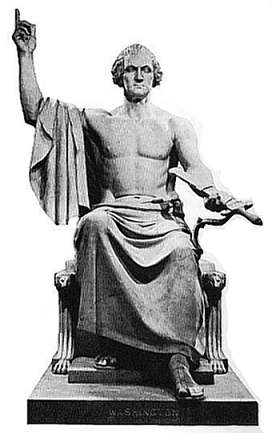
THE MARBLE DEITY ?

Dave Schuler has an excellent post up commemorating the birthday of George Washington, our first President and the only founding father that the other founding fathers, generally a squabbling bunch, regarded with a degree of awe. Dave writes:

“Such was Washington’s popularity that, had he desired to remain in office, he would have been overwhelmingly re-elected. They’d have made him king if he’d wanted it. This is why he was called “the American Cincinnatus”: the voluntary leaving of power.”

When I was in grad school, a student asked the professor in a colonial era history seminar what was Washington’s importance in the larger scheme of American history? The professor, whose research interests went more toward documenting the small doings of the unwashed and dispossessed, replied ” He retired.”

This received a quiet general laugh for cutting to the heart of the matter of Washington helping ensure that our Revolution, unlike almost all others that followed, was civilized and humane. Washington was not without ambition; aside from the Kings of Spain and Portugal, he became one of the largest private landowners in the Americas but the yardstick Washington measured himself by was that of Anglo-Virginian gentry respectability, not the glory of Roman Caesars. The desire to order the lives of other men was far less strong in Washington than his desire to be left alone.

Washington’s preeminence and political charisma came from a reputation of spotless integrity, reticence, perseverence and personal dignity that was reinforced by a record of bravery and physical stature that left him the most impressive figure in any hall or drawing room. Made the president of the Constitutional Convention, one brief reproach from Washington was enough to keep the delegates sworn to secrecy; one simple gesture conceding human weakness, quelled an incipient rebellion of Continental Army officers. Washington’s presence was usually a more eloquent argument than his words.

This aloofness that Washington cultivated out of insecurity and natural inclinaton has left him remote from modern Americans in a way that the irascible John Adams or the intellectual Thomas Jefferson are not. Our view of the Father of Our Country is still that seen in The Apotheosis of Washington that graces the Capitol Building or in The American Zeus – both of which, incidentally, would have horrified Washington. This is unfortunate because while George Washington was not as lettered or learned as Adams or Madison nor as brilliant as Jefferson or Hamilton the man was no idealized marble statue. He was a very shrewd judge of men and possessed keen insight into the limitations of power and the suprising reach of the power of example.

Washington was not merely the best of men by the standards of his day but the best man for the times.


Switch to our mobile site