zenpundit.com » 2011 » October

Archive for October, 2011

Arab Spring and apocalyptic dawn

Sunday, October 2nd, 2011

[ by Charles Cameron — Mahdism and the Arab Spring, depth of apocalyptic expectation not limited to militant circles ]

.

recent-events.jpg

screen-cap from a Feb 2011 video associated with Harun Yahya, see below
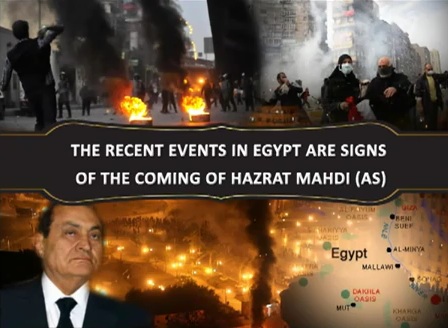
I’ve been holding back on posts about Shi’ite apocalypticism, because it seems to me that President Ahmadinejad‘s influence is on the wane for reasons not entirely disconnected from his keen and oft-expressed expectation of the soon coming of the Hidden Imam.

I have posted a couple of times recently on Sunni apocalyptic — but there my focus has been on AQ, Taliban and the black banners of Khorasan, as illuminated recently by the books of Syed Saleem Shahzad and Ali Soufan. My next forays will hopefully concern another strand of militant Sunni apocalyptic– the traditions of jihad against India (Ghazwa-ul-Hind) — and I’d also very much like to turn my attention some more to some of the eschatological issues in current Christian circles in the US.

But first: a quick glimpse of apocalyptic expectation in the Arab Spring.

1.

Under the title Mubarak’s fall spawns End of Times prophecies, Yasmine Fathi recently reported in Egypt’s Al Ahram online:

The idea of Mubarak as Anti-Christ has caught fire on social networking sites, with many users presenting Muslim Hadiths, sayings of the Prophet, in support of the theory. While others dispute the notion, they nevertheless posit Mubarak’s very existence as a sign that the end is indeed nigh.

One website noted that, according to certain Islamic beliefs, doomsday will come after Egypt is ruled by a leader whose first name is “Mohamed” and second name is “Hussein,” of which “Hosni” – Mubarak’s middle name – is a variation. This, say doomsday-watchers, constitutes further proof that his existence – and recent fall – represented a sign that the end of time can be expected any day now.

One theory currently making the rounds on the web suggests that the world will end on 26 September – this Monday – due to massive earthquakes caused by a rare planetary alignment. The quakes, believers say, will make Japan’s recent disaster look like a walk in the park.

Even Egypt’s Coptic Patriarch, Pope Shenouda III, referred to the prediction, joking at the end of his last weekly sermon, “We’ll meet again next Wednesday after the earthquake, God willing.”

After the theory was savaged by local and international scientists, however, the public’s attention has shifted again to the year 2012 – only three months away – which many fatalists fear will be our last year on earth, since the Mayan calendar ends on 21 December of next year.

The first point to note here is that apocalyptic sentiment is alive and thriving in the Arab world — and not just in the militant jihadist circles of AQ and the like — or Hamas — either.

That’s a significant datum — and our cue for another reading of JP Filiu‘s Apocalypse in Islam.

2.

The number and variety of strands converging in these few brief paragraphs is impressive:

social networking
apocalyptic expectation catching fire
Mubarak’s name as a sign
a date certain — a week from now
cross-religious banter from Pope Shenouda

— and there’s even a reference to the “Mayan” chronology with its 2012 end-date — which (though Fathi doesn’t mention it) just happens to coincide with the Saudi dissident Sheikh Safar al-Hawali‘s ETA for the return of Jerusalem to Islam on the final page of his pamphlet, The Day of Wrath.

3.

Let’s go back to Fathi for a more nuanced — and theologically informed — view:

But according to Amena Nosseir, professor of Islamic theology and philosophy at Cairo’s Al-Azhar University, the true date of the “final hour” will never be revealed to mankind.

“God has not bestowed knowledge of the final hour to any of his prophets or worshippers, and there’s a holy wisdom behind his decision to withhold this information,” she said. “God created humans to create life on this planet, so it doesn’t make sense that he would give them the knowledge of when the end of time will be.”

Even al-Hawali qualifies his suggested date thus:

Therefore, the end -or the beginning of the end- will be 1967 + 45 = 2012, or in lunar years 1387 + 45 = 1433.

This is what we hope will happen, but we do not declare it to be absolutely certain, but if the fundamentalists would like to bet with us, as Quraysh did with Abu Bakr concerning the Qur’anic prophecy concerning the Romans, then without doubt they will lose, although we cannot guarantee that it will be that exact year!

Setting a date for time to end may be the most reliable method yet devised for proving oneself unreliable.

4.

There are other stirrings.

Harun Yahya, an influential Turkish figure, reports that a green horse and rider can be discerned in a recent Cairo video, and proposes that the rider is Khidr — the teacher of Moses in Sura 18 of the Qur’an (which the great scholar Louis Massignon terms “the apocalypse of Islam”) and a mysterious figure of inspiration in Islamic lore…
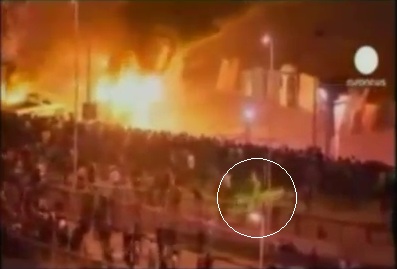
khidr-in-egyptian-video.jpg

He also “reads” Mubarak as an eschatological figure — the Rook — and indeed, this entire video — only five minutes long and readily available on YouTube — is worth watching, to get a visceral sense of how strong this narrative current is:

BTW: see Halverson, Goodall and Corman‘s Master Narratives of Islamist Extremism for a sense of how significant “narrative” is… and then, yes, reread Filiu!

*

Hat-tip for a hot tip to Bryan Alexander.

Recommended Reading

Sunday, October 2nd, 2011

Top Billing! Bruno Behrend –So This Is How Democracy Dies

How is this for a headline?

“Key Democrats call for Ending Democracy”

Some people subscribe to the idea that politicians are stupid. They shoot from the hip until reined in by their consultants during election season. There is probably a great deal of truth to that. On the other hand, the use of the “trial balloon” is a well-tested technique for gauging public reaction to an idea.

With that in mind, I submit today’s WSJ’s “Notable and Quotable” into evidence to let the jury decide.

“Most Americans complain that government is unresponsive to their wishes. But not everyone feels that way. In the space of two days, two prominent Democrats have called for less responsive government that ignores public input.

One of them, former White House Budget Director Peter Orszag, penned a piece this week in the New Republic arguing, as the title says, “Why we need less democracy.” Orszag wrote that “the country’s political polarization was growing worse-harming Washington’s ability to do the basic, necessary work of governing.” His solution? “[W]e need to minimize the harm from legislative inertia by relying more on automatic policies and depoliticized commissions for certain policy decisions. In other words, radical as it sounds, we need to counter the gridlock of our political institutions by making them a bit less democratic.” . . .

[S]imilar comments by Gov. Bev Perdue, D-N.C., are far more troubling. “I think we ought to suspend, perhaps, elections for Congress for two years and just tell them we won’t hold it against them, whatever decisions they make, to just let them help this country recover,” Perdue told a Rotary Club gathering in suburban Raleigh this week. “I really hope that someone can agree with me on that.”

Gaffe or Trial Balloon?

I’m in the trial balloon camp. I think the “Ruling Elite” (aptly described by Codevilla) wants to literally cut governance from “the consent of the governed.”

Democrat or Republican, inside government or outside, these rulers are in the process of turning most important decisions over to “depoliticized commissions,” and they simply don’t want any pesky citizens or constitutional barriers in their way. This class of people has a simple goal – to turn America’s “government of laws, not men,” on its head. They want to govern by edicts issued by commissions. I may be wrong, and I don’t want to appear overwrought, but I think this is (or should be) a big deal.

I am with Bruno. This generation of elite, which have shown themselves to be remarkably less competent and far more corrupt than their Cold War or WWII predecessors, are wistful for a velvet-gloved authoritarianism to help insulate themselves from democratic or legal accountability or even from hearing contrary opinions and criticism. It is amazing how our very best universities – Harvard, Yale and Princeton – produced so many alumni, in so short a period of time, who are disdainful of democracy and hold their fellow citizens in contempt.  Do the spirits of Carl Schmitt and Antonio Gramsci hold sway over undergrad education there or what?

Rethinking Security –Spectrum of Intervention and the Indirect Approach

In each step of the ratchet, actions proposed as cheap and risk-free end up pulling—through dynamics of public pressure and commitment—the political leader deeper and deeper into a military operation her or she did not originally intend to carry out. The process is similar to the famous microeconomic concept of the “dollar auction“—in which players bidding cents to get a dollar end up overbidding because they refuse to see the total sum of their sequential investments (which are deceptively cheap) as a sunk cost. The danger of the R2P spectrum, thus, is that even small investments in prevention can morph into commitment.

Why does prevention often fail? Clausewitz’s injunction about the necessity of defeating the enemy’s main army often applies here. CvC was perfectly fine with using influence to defeat an enemy without fighting—however, his reading of military history suggested that this was very rare and required an exceptional ability to know and manipulate opponents (and an unhealthy amount of luck). Strategic bombing and the idea of systems targeting is an attempt to bypass the enemy’s main army and target a state’s parts in detail, hoping to cause a cascading collapse. I have already dealt with indirect approaches and strategic paralysis here.

I welcome Adam’s keen intellect to the R2P arena.

Joseph Fouche-Attrition on the Cheap

In a recent post, I speculated that zombie military doctrines like the “revolution in military affairs”, “effects based operations”, or “network centric warfare” could bloom afresh in the debris left by the ravages of policy doctrines like “responsibility to protect”. I deliberately refrained from framing the negative consequences of such resurrections as solely a bad retread of past schools of military thought that advocated what author James Kiras called “strategic paralysis”.Military doctrines in the strategic paralysis tradition advocate winning quick, cheap, and easy victories by targeting the enemies critical centers of gravity. Fellow FHI blogger Adam Elkus pointed out in his recent Small Wars Journal article on The Rise and Decline of Strategic Paralysis that the embryonic 20th century version this military doctrine first formulated by the occultist J.F.C. Fuller in his Plan 1919 were based on a crude analogy to the human body. No wonder they required a special type of magick.


If indirect approaches are strategic magick then R2P is akin to the atavistic ritual of a witch doctor.

That’s it.


Switch to our mobile site
