Countering Violent Extremism: variants on a theme
Saturday, March 17th, 2012[ by Charles Cameron — modeling / scoring CVE as a flow of ideas, with related matter from Hesse, Melville, Tufte, Rushdie and John Seely Brown ]
.
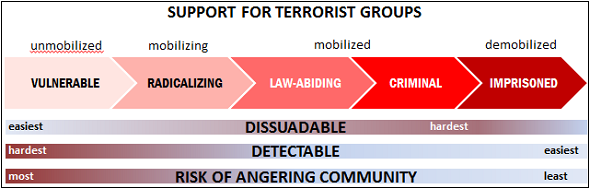
[ graphic: McCants / Berger, see below ]
.
I am interested in thoughts: in the way thoughts connect to one another, differ from one another, lead to one another, parallel or echo one another, and oppose one another…
That’s my interest, that’s me.
1.
So when Will McCants of Jihadica posts the first two parts of his three-part series on Countering Violent Extremism (CVE), two points in particular strike me:
McCants proposes his own definition for CVE – “Reducing the number of terrorist group supporters through non-coercive means” – in part 1 of his presentation, indicating what in his view it should and shouldn’t involve, and in supporting this definition, he notes (recommendation #3):
The focus is not on reducing support for ideas, which is difficult to judge, but rather support for specific organizations that embody those ideas and seek their realization, which is easier to document and more closely related to criminal behavior.
In part 2, he mentions “thought police” twice, the second time saying:
But if counter terrorism is to involve more than just locking people up, it should not stray too far from stopping bomb throwers into social engineering and thought policing.
I’m definitely not into thought police either — but while I’d agree that ideas are by nature difficult to track or assess, that’s nonetheless where my own curiosity and creativity finds its level.
2.
Just how CVE should operate in general is outside my scope — but since I do tend to focus in on ideas, I have the sense that paralleling McCant’s diagram of the approximate stages of support for terrorist groups:

or the version JM Berger reworked with McCants and posted on Intelwire, which I’ve placed at the top of this post — there could in theory be a diagram of the evolution of thought that accompanies those stages, and that such a diagram, intricate though it would undoubtedly be, might still be of some use.
3.
It seems to me that two main streams off thought – some might say “narrative” — would tend to flow together towards the eventual outcome of full radicalization and active jihad.
- One stream would begin with dissatisfaction and wend its way through a general sense of injustice in the world to the idea that Islamic nations and groups in particular are being targeted for military interventions by America and its allies, perhaps with a detour though the issues associated with “underdog” Palestinians, and thence towards a sympathy for jihadists, some level of identification with the Ummah, formal acceptance at some point of Islam (ie the taking of the Shahada), to an acceptance that jihad is an individual obligation for able Muslims under present circumstances…
- The other stream would arise from religious seeking and theological speculation, finding in Islam a simple and clear-cut answer to the seeker’s questions, via further discussion and the taking of Shahada — and then move along roughly the same trajectory that Daveed Gartenstein-Ross meticulously chronicled in his first, less widely known book, My Year Inside Radical Islam: A Memoir, with an emphasis on an increasingly “puritanical” salafi / wahhabi / deobandi interpretation of the religion, which can then lead in turn to a sense of potential political ramifications, again that the West is involved not merely in wars that happen to be in Muslim countries but in wars against the Ummah, and thence again to the acceptance of jihad as individual obligation.
That individual obligation (fard ‘ayn) being, I suspect, the likely “bottleneck” where any and all such streams would converge.
4.
For those interested in how this ties in with wider currents in contemporary thought, and with the bead game in particular:
I said above that I am interested in thoughts. I mean by this that my natural focus is more on thoughts than on people. Not that this is better or worse than some other focus…
In Hermann Hesse terms, I’m more interested in the great game of juxtaposed cultural contents played by the Castalians in his book Magister Ludi:
All the insights, noble thoughts, and works of art that the human race has produced in its creative eras, all that subsequent periods of scholarly study have reduced to concepts and converted into intellectual values the Glass Bead Game player plays like the organist on an organ. And this organ has attained an almost unimaginable perfection; its manuals and pedals range over the entire intellectual cosmos; its stops are almost beyond number.
than I am in the game that Hesse tells us he played in reverie while raking and burning leaves in his garden — visualizing the great men of all times walking and talking together across the centuries – a game which quite a few great minds seem to have stumbled upon, and which Hermann Melville describes in his novel, Mardi:
In me, many worthies recline, and converse. I list to St. Paul who argues the doubts of Montaigne; Julian the Apostate cross- questions Augustine: and Thomas-a-Kempis unrolls his old black letters for all to decipher. Zeno murmurs maxims beneath the hoarse shout of Democritus; and though Democritus laugh loud and long, and the sneer of Pyrrho be seen; yet, divine Plato, and Proclus, and Verulam are of my counsel; and Zoroaster whispered me before I was born… My memory is a life beyond birth; my memory, my library of the Vatican, its alcoves all endless perspectives, eve-tinted by cross-lights from Middle-Age oriels…
Both modes are valuable, I’d suggest, both are worth pursuing.
5.

Edward Tufte has the above diagram in Visual Explanations, one of his several beautiful and profound books. That diagram in turn is based on Salman Rushdie‘s description of the Indian epid Kathasaritsagara or Ocean of the Streams of Story in his book Haroun and the Sea of Stories:
…the Water Genie told Haroun about the Ocean of the Streams of Story, and even though he was full of a sense of hopelessness and failure the magic of the Ocean began to have an effect on Haroun. He looked into the water and saw that it was made up of a thousand thousand thousand and one different currents, each one a different color, weaving in and out of one another like a liquid tapestry of breathtaking complexity; and [the Water Genie] explained that these were the Streams of Story, that each colored strand represented and contained a single tale. Different parts of the Ocean contained different sorts of stories, and as all stories that had ever been told and many that were still in the process of being invented could be found here, the Ocean of the Streams of Story was in fact the biggest library in the universe. And because the stories were held here in fluid form, they retained the ability to change, to become new versions of themselves, to join up with other stories and so become yet other stories…
That diagram offers a quick approximation to the idea that I’d like to be able to model / diagram / score the ideas in play in CVE.
6.
If an idea is timely, it will find its kin — that’s one way to check that you’re not hopelessly out to lunch — and I certainly feel kinship with Tufte, Rushdie and Hesse here.
This, from John Seely Brown‘s opening keynote [video] at the 2012 Digital Media and Learning Conference, also strikes a kindred note for me:
How do you participate on the ever-moving flows of activities, knowledge and so on and so forth; how do you move from being like a steamship that sets course and keeps going for a long time to what you might call whitewater-kayaking, that you have to be in the flow, and you have to be able to pick things up on the moment, you gotta feel it with your body, you gotta be a part of that, you’ve gotta be in it, not just above it and learning about it. … In this new world of flows, participating in these knowledge flows is an active sport. And the whole catch is, how do you participate in these flows…?
7.
Ideas as flows, radicalization processes as flows — it’s mapping, modeling, and scoring them that really catches my own interest. It is still early days as yet…